Why Budget Wireless Earbuds Battery Claims Often Mislead: The mAh vs Wh Reality

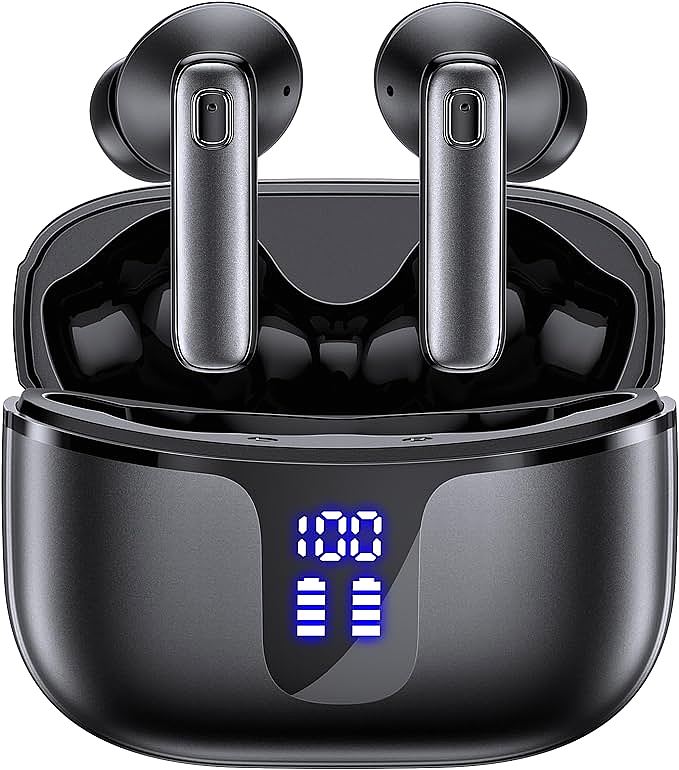
Jzones U7 Wireless Earbuds
Your wireless earbuds die mid-song. Again. The box promised forty hours. You got six. This gap between marketing numbers and actual performance plagues budget audio gear more than any other category. The disconnect isn't random luck or poor QC. It stems from a fundamental measurement problem hiding in plain sight: the industry advertises milliamp-hours when it should be talking about watt-hours.
The mAh Deception
Manufacturers list battery capacity in mAh because larger numbers look more impressive. A 500mAh cell sounds modest. A 2500mAh power bank sounds powerful. But milliamp-hours only tell half the story. The actual energy stored depends equally on voltage, and different battery chemistries operate at different nominal voltages.
Watt-hours represent true energy capacity. The formula is straightforward: watt-hours equal milliamp-hours multiplied by nominal voltage, then divided by 1000. A lithium-ion cell rated at 3.7V nominal stores 37 watt-hours per 1000mAh. A 3.85V cell from the same manufacturer stores slightly more energy even at identical mAh ratings. Most consumers never see this calculation because watt-hour ratings rarely appear on consumer packaging.
IEEE Standard 1725 addresses rechargeable lithium-ion batteries for portable computing devices, establishing testing protocols that reveal why the mAh-only approach creates confusion. The standard requires cycle life testing at specific discharge depths and temperatures. It mandates voltage thresholds that manufacturers must disclose. Yet budget earbud brands operate outside these testing requirements, free to claim any mAh figure they can print on a box.
The Aerospace Parallel
Aviation engineers learned this lesson decades before consumer electronics existed. Aircraft battery systems report capacity in amp-hours for starting power and watt-hours for energy storage. The distinction matters when calculating flight range and reserve power requirements. A helicopter's flight computer doesn't care how many amp-hours the battery holds. It cares about how many watt-hours it can actually deliver at operational altitudes and temperatures.
The parallel extends further. Helicopter rotor systems experience blade flapping and pitch oscillations that drain battery reserves unevenly. Engineers discovered that burst current demands often depleted batteries faster than steady-state calculations predicted. Sound familiar? Wireless earbuds experience similar pulse-loading patterns when Bluetooth transceivers negotiate connections, process audio codecs, and drive microtransducers simultaneously.
TheHelmholtz resonance connection
Acoustic physics offers another perspective on why battery claims mislead. Sound waves in enclosed spaces follow Helmholtz resonance patterns. The air volume inside an earbud case behaves like a resonant cavity. Driver displacement creates pressure variations that interact with the enclosure's internal geometry. This resonance affects power consumption: drivers operating near cabinet resonance boundaries draw more current than drivers working in linear compliance zones.
Cheap earbuds often feature driver housings with poor acoustic design. Uncontrolled resonance forces the amplifier to work harder, draining the battery faster than a well-damped design would require. The mAh rating on the battery tells you nothing about this parasitic power loss. A 2500mAh cell feeding an inefficient driver system delivers fewer usable hours than a 1800mAh cell powering an optimized acoustic package.
Manufacturing Tolerances in Practice
Battery cells exhibit capacity variations across production batches. Industry standards allow plus or minus ten percent tolerance on rated capacity for consumer-grade cells. A battery marketed as 2500mAh might actually contain cells ranging from 2250mAh to 2750mAh. Testing every single battery would eliminate this variance but would increase per-unit costs beyond budget price points.
The bathtub curve describes product failure patterns across operational lifetimes. Early failure instances cluster in the first weeks of use, often from manufacturing defects escaping quality screening. Random failures occur throughout operational life, typically from component stress exceeding design margins. Wearout failures dominate the end of service life, when cells no longer hold charge effectively.
Budget earbuds face elevated early failure rates because manufacturing tolerances stack. A cell at the low end of the acceptable range, combined with a slightly inefficient driver and a Bluetooth module drawing above typical current, creates a compound deficiency that no single component would reveal alone. The 2500mAh label hides these realities behind a single optimistic number.
The IEC 60529 Complication
Waterproof testing adds another layer where specifications diverge from reality. IEC 60529 establishes IP ratings through laboratory conditions that rarely match actual use scenarios. IPX7 certification requires submersion in one meter of water for thirty minutes under static conditions. No movement. No temperature differentials. No pressure variations from user motion.
Real-world waterproofing faces continuous degradation. Seal materials compress and relax with temperature cycling. Sweat contains salts and acids that degrade rubber gaskets over time. Physical handling introduces micro-fractures in adhesive bonds. A budget earbud achieving IPX7 certification in a Shenzhen testing facility might lose that protection after three months of gym workouts and daily commutes through varying climates.
The aviation industry learned similar lessons with aircraft electronics. Military specifications require environmental testing across temperature ranges, humidity cycles, and vibration profiles. Consumer electronics testing often skips these accelerated life simulations, accepting certification based on pristine laboratory conditions rather than field-representative stress profiles.
What Actually Matters
Understanding the mAh versus Wh distinction helps consumers evaluate battery claims more critically. A 3000mAh rating at 3.7V nominal equals 11.1Wh. A 2800mAh rating at 3.85V equals 10.78Wh. The nominally smaller battery stores nearly as much energy. Neither number reveals the cell quality, internal resistance, or cycle life expectations.
Real usable battery life depends on discharge rates, temperature conditions, and aging factors that no single specification captures. A quality cell discharged at 1C (full output in one hour) delivers close to rated capacity. The same cell discharged at 2C (half-hour output) loses 10-15 percent effective capacity from voltage sag. Budget earbuds rarely disclose discharge rate assumptions behind their runtime claims.
The information gap creates opportunity for informed consumers. Reading technical documentation, when available, reveals nominal voltage and rated capacity. Calculating watt-hours provides a normalized comparison across different battery chemistries and voltage platforms. Checking cycle life specifications, even loose ones, indicates whether the manufacturer considered long-term durability or focused only on initial performance.
Engineering Philosophy in Minimal Design
The best audio engineers work by subtraction. Every component removed reduces failure points and power consumption. Every millimeter of enclosure space saved decreases material costs and shipping weights. Every milliwatt of efficiency gained extends battery life without increasing cell size. Budget manufacturers face opposite incentives: adding features justifies higher prices, while larger batteries enable longer marketing numbers.
This tension produces the familiar gap between specifications and experience. The manufacturer optimizing for a spec sheet faces no penalty for using a slightly larger cell that delivers slightly less actual energy per dollar spent. The consumer reading only the mAh number cannot detect this optimization tradeoff without understanding the underlying electrical principles.
The next time a battery claim seems too optimistic, remember the helicopter pilot calculating flight range, the acoustic engineer tuning resonance, and the aerospace engineer documenting tolerance stacks. Battery capacity is never a single number. It is a distribution of possibilities shaped by chemistry, voltage, temperature, and time. The boxes promise certainty. Physics delivers probability.
Quiet manufacturers build trust through disclosure. They publish cycle life test results. They specify nominal voltage alongside mAh ratings. They provide real-world runtime estimates at multiple usage patterns. These practices cost nothing to implement yet remain rare in budget segments. The absence of transparent documentation reveals more about product quality than any specification ever could.
True engineering excellence reveals itself in what manufacturers choose not to claim.
Jzones U7 Wireless Earbuds
Related Essays
FOYCOY A11 68 Hour Battery: How It Works | 2026

SoundPEATS TrueFree2 Wireless Earbuds: The Budget Kings of True Wireless

Silencing the Copper Wire: The Invisible Architecture of Modern Audio

The Physics of Silence: How Active Noise Cancellation Works
The Four Pillars of Unbreakable Sport Audio

A Guide to Modern Earbud Tech: Understanding Bluetooth 5.3,...

How Hollywood, Radio Physics, and Neural Networks Built the...

How True Wireless Stereo Technology Rewired the Way We...

The Science Behind Wireless Audio: From Bluetooth Origins...
