How True Wireless Stereo Technology Rewired the Way We...

Wireless Earbuds
A decade ago, untangling headphone cords was a daily ritual — yanking knots from pockets, replacing frayed cables every few months, and accepting that wired audio was just the price of private listening. Nobody questioned it. The 3.5mm jack had been universal since the 1960s, and the copper wire running from your pocket to your ears felt as permanent as the headphone jack itself.
Then, in a span of roughly five years, the wire vanished.
Not gradually. Not politely. It was yanked from the conversation entirely, replaced by a technology most consumers had never heard of: True Wireless Stereo, or TWS. What started as a clunky experiment by a crowdfunded startup became the dominant form factor for personal audio worldwide, shipping over 300 million units annually by 2023 according to Counterpoint Research.
The story of how we got from tangled cables to invisible earbuds is not a product timeline. It is a behavioral revolution — one that changed how we move through public space, how we signal social availability, and how we experience sound itself.
The Cord Chaos Era
Before wireless meant anything, there was the wire. And the wire was always failing.
The average headphone cable lasted between six and twelve months before internal copper strands fractured from repeated bending near the jack. This was not user error — it was physics. The strain relief near the 3.5mm connector bore the brunt of every pocket stuff, every tug, every time the cable caught on a door handle. The copper inside the insulation is malleable and work-hardens with repeated flexing, eventually cracking. Manufacturers knew this. The replacement cable market was estimated at over $1 billion annually in the early 2010s.
But the cord was more than a maintenance problem. It was a constraint on movement. Gym-goers threaded cables under shirts. Commuters draped wires over coat collars. Office workers swiveled in chairs and caught the cable on armrests. Runners secured cables with clips that never quite held. The cord tethered you to your device — literally. Leaving your phone on a desk meant your head was on a three-foot leash.
The cord was also a social signal. Visible headphones meant "do not disturb." A dangling cable meant you were between songs, between moods, available. The wire was a communication medium before you ever spoke a word, and everyone understood its vocabulary.
All of this — the failures, the constraints, the signals — would vanish within half a decade. Not because someone invented a better wire, but because someone eliminated the wire entirely.
Radio Waves Replace Copper Wires
The foundational technology behind TWS is Bluetooth, a short-range radio communication standard operating in the 2.4 GHz ISM band. Understanding why Bluetooth works — and where it struggles — requires understanding the physics of electromagnetic wave propagation.
Radio waves are electromagnetic radiation, the same phenomenon as visible light but at much lower frequencies. At 2.4 GHz, the wavelength is approximately 12.5 centimeters. This wavelength is large enough to diffract (bend) around many everyday objects but small enough to be absorbed by water-rich materials — including the human body, which is roughly 60% water.
Bluetooth uses frequency-hopping spread spectrum (FHSS) to survive in the crowded 2.4 GHz band, where Wi-Fi routers, microwaves, and billions of other Bluetooth devices compete for the same spectrum. The transmitter and receiver hop between 79 discrete channels approximately 1,600 times per second, following a synchronized pseudo-random sequence. This technique — originally developed for military torpedo guidance by Hedy Lamarr and George Antheil in 1942 — makes the signal extremely resistant to interference.
The audio journey in TWS follows a precise technical path. The source device encodes digital audio into a Bluetooth-compatible format using codecs like SBC, AAC, aptX, or the newer LC3. This encoded signal transmits wirelessly to the earbuds, where a digital-to-analog converter improves it back into analog electrical signals that drive tiny speaker drivers to produce sound waves. The entire encoding-transmission-decoding process occurs in milliseconds.
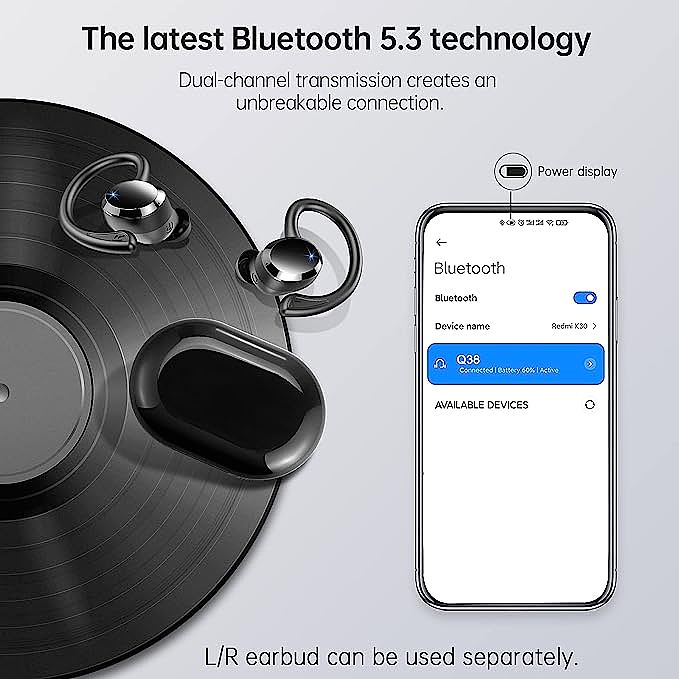
Early TWS earbuds used a master-slave architecture where one earbud connected to the phone and relayed audio to the second earbud across the head. This relay was problematic because the human head absorbs 2.4 GHz signals very effectively — a fact many companies discovered during outdoor testing, where wall reflections did not mask the problem. Modern TWS devices increasingly use dual independent connections where both earbuds connect directly to the source device, delivering superior stability and lower latency.
From Luxury to Commodity
The price-performance curve of TWS technology is one of the steepest democratization stories in consumer electronics.
In 2016, when Jabra launched the Elite Sport — among the first mainstream TWS earbuds — they cost $200 to $250 and lasted approximately three hours per charge. The Bragi Dash, announced in 2014 as the first true wireless earbud, cost $300 and struggled with reliability. These were luxury items, purchased by early adopters willing to tolerate significant compromises for the novelty of wireless freedom.
Apple's AirPods, launched in late 2016, changed the trajectory. Priced at $159, they were not cheap, but they worked reliably and paired seamlessly with iPhones. The AirPods Pro, released in 2019, addressed complaints about fit and sound quality, adding noise cancellation and a proper in-ear seal. Reviewer Christian Thomas of SoundGuys, who has covered headphones since 2011, noted that the TWS segment "absolutely dumpstered conventional wisdom in a few short years — something unheard of in personal audio."
The compression was staggering. By 2024, competent TWS earbuds with Bluetooth 5.2, touch controls, IPX waterproofing, and six-plus hours of battery life were available for $20 to $30. This represents a 90% price reduction in under a decade while simultaneously improving on every performance metric.
The driver is component commoditization. Bluetooth SoC modules from Qualcomm and MediaTek, MEMS microphones from Knowles and Goertek, miniature dynamic drivers, and lithium-polymer batteries are all produced in hundreds of millions of units. Per-unit costs have dropped to the point where the bill of materials for functional TWS earbuds can be under $15. Products like the Volkano Buds X exemplify this democratization — delivering the core TWS experience at a fraction of what early adopters paid.
Over 4.5 billion Bluetooth chips shipped in 2020 alone, demonstrating the massive scale driving innovation and cost reduction.
The Earbud as Extension of Self
The most profound change brought by TWS is not technical. It is behavioral.
When headphones required a wire, wearing them was a conscious decision with physical consequences. You had to untangle the cable, plug it in, manage the cord, and accept the physical tether. Removing the earbuds meant dealing with the cable again. There was friction in both directions.
TWS eliminated that friction. Putting earbuds in became a single motion. Taking them out and dropping them in their case became another. The cognitive cost of engaging with personal audio dropped to nearly zero.
This reduction in friction changed behavior in measurable ways. Average listening time increased. People who previously wore headphones only during commutes began wearing them in offices, while walking, while cooking, while doing virtually everything. The earbud became less like a tool you pick up and put down and more like a garment you put on in the morning and take off at night.
Psychologists call this habit automation — when a behavior becomes so effortless that it requires no conscious decision. The wire required a decision. The absence of wire made the decision automatic. When every interaction is frictionless, the default state shifts from silence to sound.
The social signal changed too. Visible AirPods became a cultural signifier — a meme, a status marker, a way of broadcasting that you were connected but not available. The white stems protruding from ears became as recognizable as the white earbud cables they replaced, but the meaning inverted. The cable meant you were listening to something. The absence of cable — replaced by a barely visible plastic bud — meant you might be listening, or you might be in transparency mode, or you might just be wearing them because taking them out was more effort than leaving them in. The ambiguity was the signal.
Engineering the Invisible
Making a device disappear into the ear requires solving a set of interconnected engineering trade-offs that would have seemed impossible a decade earlier.
Battery life versus size is the most fundamental. A lithium-polymer cell storing enough energy for six hours of audio playback occupies significant volume inside an earbud. Increasing battery capacity means increasing the earbud's size, which degrades fit and comfort. Manufacturers navigate this by optimizing every component for power efficiency — the Bluetooth chip, the DSP, the amplifier, even the codec.
The LC3 codec, released by Bluetooth SIG in 2020 and developed by Fraunhofer IIS (the same institution that created MP3 in 1993), represents a generational leap in this efficiency. LC3 achieves better audio quality than the older SBC codec at half the bitrate. In subjective listening tests using ITU-R BS.1116-3 methodology, LC3 at 345 kbps scored approximately 4.5 in quality perception — exceeding what SBC achieves even at its maximum bitrate. Because LC3 is royalty-free and mandatory for all LE Audio profiles, it eliminates both cost barriers and codec negotiation problems.
Sound quality versus driver size is another trade-off. Bass reproduction requires moving large volumes of air, which favors larger drivers. But larger drivers mean larger earbuds. The 14mm driver has emerged as a sweet spot — large enough for credible bass, small enough for comfort. Engineering the acoustic chamber, driver materials, and tuning together extends the perceived bass response beyond what the driver specifications alone would suggest.
Connectivity stability versus power consumption is the third axis. Maintaining a reliable Bluetooth connection requires frequent signal exchanges between the earbuds and the source device. More frequent exchanges mean greater stability but higher power consumption. Modern TWS earbuds synchronize timing signals over 100 times per second, ensuring both earbuds play audio simultaneously within approximately 40 milliseconds of tolerance. This constant communication is one of the largest power draws in the system.
The Listening Habits Revolution
The aggregate effect of TWS adoption has been a fundamental restructuring of when, where, and how people consume audio.
Podcast listening exploded in the TWS era. The convenience of seamless audio — no cable management, no pairing friction, just open the case and press play — lowered the barrier to audio consumption during activities that previously required full attention to the physical environment. Walking, cleaning, waiting in line — all became podcast-listening opportunities.
Music listening patterns shifted from album-oriented to playlist-oriented. When putting on headphones required no more effort than glancing at your phone, the commitment threshold for starting a listening session dropped dramatically. People began listening to music in shorter, more frequent bursts — between meetings, during a quick walk, while waiting for coffee.
The workplace changed. Open offices, once characterized by ambient noise that made concentration difficult, became seas of white earbud stems. The personal audio bubble — previously limited to private offices with closed doors — became available to anyone with a pair of earbuds and a tolerance for appearing socially unavailable.
Exercise habits changed. Running with wired earbuds required cable management solutions — armbands, routing cables through clothing, accepting that the cable would slap against your chest with every stride. TWS eliminated all of this. product-4992 became the default for every physical activity, and the fitness-oriented TWS market exploded.
The most subtle change was the privatization of public space. A person wearing TWS earbuds in transparency mode can hear their environment perfectly well. But they have established a psychological boundary — a perimeter of intentional solitude. The earbuds signal "I am in my own space" even when that space is physically shared. This reconfiguration of social norms in shared environments is perhaps the most lasting behavioral impact of the TWS revolution.
Democratized Audio Freedom
The TWS revolution did not stop at the premium tier. It cascaded through every price point until functional product-4992 were available to virtually anyone who wanted them.
Products like the Volkano Buds X represent the endpoint of this cascade. They deliver the core TWS experience — wireless Bluetooth connectivity, touch controls, a charging case, and portable audio freedom — at a price that would have been unimaginable when Jabra launched the Elite Sport for $250 in 2016.
This is not because the engineering inside budget TWS products is fundamentally different from premium ones. The Bluetooth radio, the digital-to-analog conversion, the driver transduction, the lithium-polymer electrochemistry — these are the same physical principles, implemented with varying levels of component quality and manufacturing precision. The LC3 codec, the Bluetooth 5.2 standard, the MEMS microphone technology — these are shared infrastructure that lifts all products.
The democratization equation is straightforward: massive scale production of standardized components plus mature wireless protocols plus competitive market dynamics equals functional wireless audio at commodity prices. The physics did not change. The economics did.
What remains constant across the price spectrum is the fundamental behavioral shift. Whether you spent $250 or $25, the wire is gone. The morning untangling ritual is over. The cognitive friction of engaging with personal audio has dropped to near zero. And the way we move through the world — with invisible soundtracks playing in our ears — has been permanently altered.
The next chapter is already being written. LE Audio with its Auracast broadcast technology promises shared audio experiences in public spaces. UWB (Ultra-Wideband) positioning could enable earbuds that know exactly where you are in a room and adjust spatial audio accordingly. MEMS driver technology promises even smaller, more precise sound reproduction.
But the revolution — the moment when billions of humans stopped untangling wires and started opening cases — has already happened. It was not a single product or a single company. It was the convergence of radio physics, acoustic engineering, battery chemistry, and manufacturing economics at a point where the cumulative cost of wireless freedom dropped below the cumulative cost of the wire.
The wire lost. Physics won. And we all stopped untangling.
Wireless Earbuds
Related Essays

Silencing the Copper Wire: The Invisible Architecture of Modern Audio
The Four Pillars of Unbreakable Sport Audio

The Science Behind Wireless Audio: From Bluetooth Origins...

Why Your Wireless Earbuds Last 48 Hours: The Physics Behind Battery and Sound

Senso PODS Plus Wireless Earbuds - True Wireless Earbuds for Everyday Use

The Physics of Silence: How Active Noise Cancellation Works
How Hollywood, Radio Physics, and Neural Networks Built the...

Sport Earbuds Technology Explained: The Physics of Fit, Waterproofing, and Sound

Bluetooth 5.3: How Radio Physics Solves Your Wireless Audio Problems
