How RIZIZI Built 40-Hour Wireless Earbuds for Under 20 Dollars

RIZIZI A12 Wireless Earbuds
Your earbuds fall out, not once but repeatedly during every single run, every sprint interval, and every time you hit the ground with enough force to jar your jaw; you push them back in, only to watch them fall out again, so that by the third mile you have stopped caring about the music and started caring about the physics.
The problem is older than wireless technology itself, since keeping an object attached to a bouncing, sweating, twisting human head is an engineering challenge that connects biomechanics, materials science, electrochemistry, and acoustics, and a pair of wireless earbuds like the the earbuds sits at the intersection of all four disciplines, which means understanding why they stay in or do not stay in requires understanding principles that have won Nobel Prizes and shaped industries far beyond consumer audio.
The Lever You Never Think About
Your outer ear, the pinna, is not merely a flat surface but rather a complex structure composed of ridges, folds, and hollows that evolved to funnel sound toward the eardrum. But for earbud designers, the pinna serves a second purpose: it is a fulcrum.
An earhook works as a class-one lever. The hook curves over the top of the pinna, distributing force across a wider area than a bare ear tip could manage. The physics here is straightforward. Pressure equals force divided by area. Spread the same retention force over a larger contact patch, and the perceived pressure drops. The earhook stays put without pinching.
This is the same principle that makes a crowbar effective. A small input force, applied over a long lever arm, generates enough clamping force at the short end to hold an object in place. In the case of over-ear hooks, gravity and the recoil of each footstrike try to pull the earbud downward. The hook converts that downward force into lateral compression against the pinna. The harder you run, the harder the earbud grips.
The forces involved are not trivial. During running, the head experiences deceleration forces up to three times gravity with each footstrike, which means a 5.6-ounce earbud set suddenly feels like it weighs nearly a pound at impact. Without a retention mechanism, inertia alone would dislodge most in-ear designs within the first few strides, since the earhook counters this by redirecting those forces along a path the ear anatomy can resist.
Anthropometric data drives the curve, because human ears vary in size and shape, but the distance from the concha bowl to the top of the helix falls within a predictable range for most adults. Designers use population-scale measurements to set the hook radius, then provide multiple ear tip sizes to accommodate the remaining variation. The three tip sizes included with most sport earbuds address this last mile of fit, where the hook handles macro-retention while the tip handles micro-seal.
The micro-seal matters for more than comfort. A proper tip seal creates an acoustic closure in the ear canal, which directly affects bass response. Without it, low-frequency sound escapes through gaps between the tip and the canal wall, and the listener perceives thin, tinny audio. Fit and acoustics are not separate design problems. They are the same problem viewed from two angles.
Lithium Ions and the Chemistry of Endurance
A six-hour run demands more from a battery than six hours of sitting still, because Bluetooth transmission, driver amplification, and noise reduction processing all draw current continuously. The chemistry that makes this possible earned John Goodenough, M. Stanley Whittingham, and Akira Yoshino the 2019 Nobel Prize in Chemistry.
Lithium-ion batteries work by shuttling lithium ions between two electrodes. During discharge, lithium ions migrate from the anode through an electrolyte to the cathode, releasing electrons that flow through an external circuit. That electron flow is the current powering the driver, the Bluetooth chip, and the microphone. During charging, an external voltage pushes the ions back to the anode, storing energy for the next use.
The key insight is that lithium ions are intercalated, meaning they slot into the crystal structure of the electrode material without destroying it. This intercalation is what makes the battery rechargeable, since previous battery chemistries relied on chemical reactions that permanently altered the electrode materials. Once the reaction ran its course, the battery was dead; but lithium-ion intercalation, by contrast, is reversible, and the ions move back and forth hundreds of times before the electrode structure degrades enough to matter.
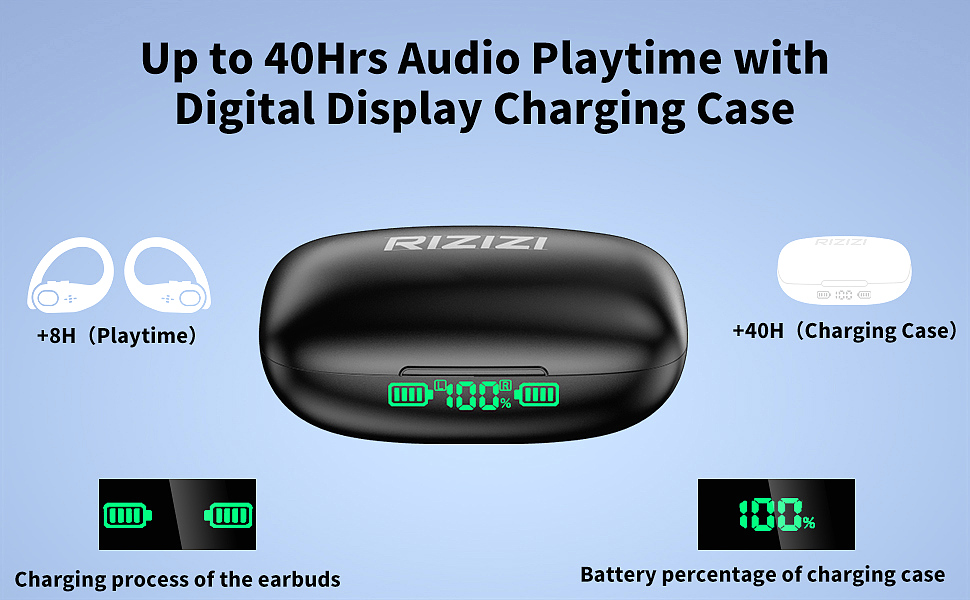
Energy density is the critical metric. Lithium-ion cells store roughly 250-270 watt-hours per kilogram, a figure that has roughly doubled since commercialization in 1991. This density is what allows a charging case the size of a matchbox to hold enough energy for three or four additional full recharges, pushing total playtime past the 40-hour mark.
But battery chemistry has limits. Capacity fades with charge cycles because the electrode structure degrades over time. Extreme temperatures accelerate this degradation. A battery that delivers six hours at room temperature might deliver only four in freezing conditions, because the electrochemical reactions slow down. This is not a defect. It is thermodynamics.
The charging protocol matters too. Modern lithium-ion cells use a constant-current, constant-voltage method. The charger feeds a steady current until the cell reaches a voltage threshold, then holds that voltage while the current tapers off. This two-phase approach balances speed against longevity. Fast charging pushes more current during the constant-current phase, but generates more heat, which accelerates capacity fade over hundreds of cycles.
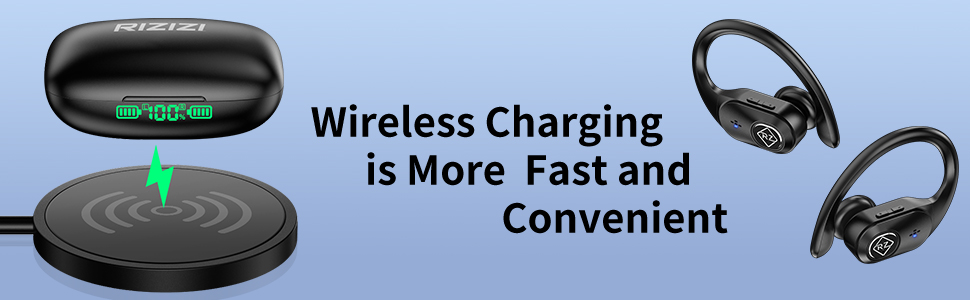
A charging case that supports both USB-C and Qi wireless charging gives the user a choice between speed and convenience. USB-C delivers power through a direct electrical connection with minimal loss. Qi charging trades some efficiency for the ability to drop the case on a pad without fumbling with a cable. Both methods feed the same constant-current, constant-voltage protocol to the cell. The battery does not care how the energy arrives. It only cares that the voltage and current stay within safe limits.
Invisible Power: Electromagnetic Induction
Nikola Tesla proposed wireless power transfer over a century ago. The principle is simple, even if the implementation took decades to standardize.
A wireless charging pad contains a coil of wire connected to an alternating current. That current generates a fluctuating magnetic field. Place a second coil, inside the earbud case, within that field, and the changing magnetic flux induces a voltage across the second coil. That induced voltage drives a current that charges the battery. This is Faraday's law of induction, demonstrated by Michael Faraday in 1831.
The math is elegant. The induced electromotive force equals the negative rate of change of magnetic flux through the coil. Increase the frequency of the alternating current, and the flux changes faster, inducing more voltage. Increase the number of turns in the receiver coil, and each turn contributes additional voltage. These are the two levers engineers can pull to improve wireless charging efficiency.
The Qi standard, maintained by the Wireless Power Consortium, defines the frequency (typically 110-205 kHz), the power levels (up to 15 watts), and the communication protocol between the charger and the device. When you set a charging case on a Qi pad, the two devices negotiate. The charger checks that a compatible receiver is present, confirms the power level, and begins transfer. If the alignment is off or a foreign object is detected, the charger shuts down to prevent damage.
The efficiency of wireless charging hovers around 70-80 percent. Some energy is lost as heat in both coils and in the air gap between them. This is why wireless charging is slower than USB-C, which delivers power through a direct electrical connection with minimal loss. The tradeoff is convenience. Drop the case on a pad instead of finding a cable and orienting a connector. For a device you charge daily, that convenience accumulates.
From Code to Sound: The Electromagnetic Driver
Every sound you hear from a wireless earbud starts as a number. A digital audio file encodes pressure variations as a sequence of numerical values, typically 44,100 values per second for CD-quality audio. A digital-to-analog converter inside the earbud translates those numbers into a varying electrical current. That current flows through a coil of wire attached to a thin membrane, the diaphragm.
The coil sits inside the field of a permanent magnet. When current flows through the coil, it generates its own magnetic field, which either attracts or repels the permanent magnet depending on the current direction. This force moves the diaphragm back and forth, pushing air and creating pressure waves. Those pressure waves reach your eardrum, which vibrates in sympathy, and your brain interprets the result as sound.
This is the moving-coil driver, and it has been the dominant transducer design since the early twentieth century. The principle is identical to what you find in concert venue speakers, scaled down by a factor of several hundred. A 12mm driver in a wireless earbud faces the same design tradeoffs as a 12-inch woofer: bass response requires a diaphragm with enough surface area to move significant volumes of air at low frequencies, while treble response demands a diaphragm light enough to vibrate at 20,000 cycles per second.
Material choice is the compromise. A stiff diaphragm moves as a coherent surface at high frequencies but adds mass, which reduces sensitivity. A light diaphragm responds quickly to high-frequency signals but flexes unevenly at low frequencies, producing distortion. Driver designers select materials and geometries that balance these competing demands for the target price point and acoustic signature.
The frequency range of human hearing, roughly 20 Hz to 20,000 Hz, sets the design target. Most consumer earbuds aim to reproduce this full range, though actual response varies based on driver design, enclosure acoustics, and ear tip seal. The ear tip seal, in particular, affects bass response dramatically. A poor seal allows air to escape around the tip, reducing the low-frequency pressure that reaches your eardrum. This is why getting the right tip size matters beyond comfort. It is an acoustic requirement.
Deep bass presents a special challenge for small drivers. Low frequencies require large air displacements, but a 12mm diaphragm can only move a small volume of air per cycle. To compensate, designers tune the enclosure to create a Helmholtz resonance, a phenomenon where air oscillating through a port or vent amplifies specific low frequencies. The vent acts like the neck of a bottle when you blow across it. The resonance boosts the bass output without requiring a larger driver. It is an acoustic trick that turns a physical limitation into a design feature.

The Democratization of Precision
In 1991, a lithium-ion battery cost over $3,000 per kilowatt-hour. Today, the price is below $150. In 1999, a Bluetooth development kit cost thousands of dollars and required specialized engineering knowledge to implement. Today, a Bluetooth 5.1 system-on-chip costs less than two dollars in quantity.
This cost trajectory is not unique to audio. It is the same pattern that put GPS receivers in every smartphone and accelerometers in every fitness tracker. Basic research, funded by governments and conducted at universities, produces fundamental innovatives. Engineering teams at semiconductor companies turn those innovatives into integrated circuits. Consumer electronics manufacturers buy those circuits, design products around them, and compete on price until the technology becomes cheap enough to appear in a twenty-dollar product.
The the earbuds wireless earbuds are a case study in this cascade. The Bluetooth 5.1 radio uses frequency-hopping spread spectrum, originally developed for military communications in the 1940s, to maintain a stable connection across 79 channels in the 2.4 GHz band. The IPX5 water resistance relies on polymer coatings and gasket designs refined over decades of industrial sealing. The LED battery display uses organic semiconductors, a field that earned its own Nobel Prize in Chemistry in 2000.
None of these technologies were invented for a budget earbud. They were invented to solve problems in defense, aerospace, telecommunications, and energy storage. The fact that they now appear in a product that costs less than a dinner for two is not an accident. It is the predictable result of decades of incremental improvement and cost reduction.
Physical buttons on sport earbuds illustrate another kind of democratization. Touch controls dominate premium earbuds because they look cleaner and support gestures like swipe-to-adjust-volume. But during exercise, sweat and accidental touches make touch controls unreliable. Physical buttons provide tactile feedback. You know you have pressed one without looking. The engineering decision to use buttons instead of touch surfaces is not a cost-cutting shortcut. It is a design choice that prioritizes function over form for a specific use case.
IPX5 water resistance tells a similar story. The rating means the device can withstand low-pressure water jets from any direction. For runners, this translates to sweat protection and rain resistance. Achieving IPX5 requires sealing the enclosure with gaskets and applying hydrophobic coatings to exposed circuit boards. The silicone polymer used in ear tips, with its Si-O-Si backbone, is itself water-resistant, which helps. But the real protection comes from engineered seals at every seam and port. This is industrial sealing technology, originally developed for automotive and marine applications, miniaturized to fit inside an earbud shell.
The Invisible Engineering
The next time you put on a pair of wireless earbuds and they stay put through a run, consider what had to go right. The lever mechanics of the earhook had to match the geometry of your ear. The lithium-ion cell had to store enough chemical energy to last the duration of your activity. The Bluetooth radio had to hop between frequencies faster than interference could disrupt it. The moving-coil driver had to convert electrical signals into acoustic waves that your brain recognizes as music.
Each of these subsystems draws on decades of research, standards development, and manufacturing refinement. Each represents a solved problem that was once considered difficult. The fact that a consumer can now purchase this convergence of disciplines for roughly twenty dollars says less about the product and more about the cumulative weight of scientific progress.
Good engineering does not call attention to itself. It disappears into the experience. You do not think about Faraday's law when you set a charging case on a pad. You do not calculate lever arms when you adjust an earhook. The technology works, and you move on. That invisibility is the real achievement.
RIZIZI A12 Wireless Earbuds
Related Essays

The Physics Behind Why Your $25 Earbuds Die in Six Months

Yeteky A16 Wireless Earbuds: Experience the Freedom of Sound, Intelligently Designed

Sony WI-C310 Wireless In-Ear Headset: The Science Behind All-Day Wireless Audio Freedom

Mosonnytee Sleep Headphones – Comfortable and Long-lasting Sleep Earbuds

Mosonnytee Sleep Headphones – Comfortable and Long-lasting Sleep Earbuds

MOYAGOA MFi Certified AirPods Pro Wireless Earbuds – Top-notch Features and Performance

How to Use anker noise cancelling earbuds properly

How to Use wireless earbuds bluetooth noise cancelling

XZC Bull Demon King Design in-Ear HiFi Stereo Wireless Ear Buds – A Stylish and Functional Choice
