How Hollywood, Radio Physics, and Neural Networks Built the...
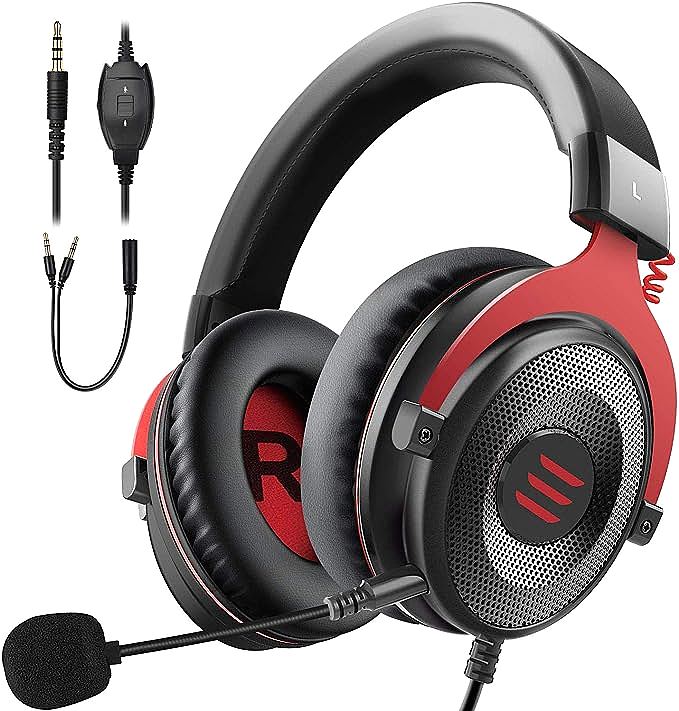
EKSA H16 Bluetooth Headset
In 1942, a Hollywood actress and an avant-garde composer patented a frequency-hopping radio system designed to prevent enemy forces from jamming Allied torpedoes. Hedy Lamarr and George Antheil's invention — which used a player-piano mechanism to synchronize rapid frequency changes across 88 channels — was decades ahead of its time. The Navy shelved it. Twenty years passed before the concept resurfaced in military communications. Forty years later, it became the invisible backbone of every wireless headset on the market.
The device sitting on your desk is not simply a pair of speakers strapped to a headband. It is a negotiated truce between radio frequency engineering and artificial intelligence — two disciplines that evolved independently for most of a century before being crammed into the same piece of plastic. One manages the invisible highway of radio waves that carries your voice through the air. The other filters the chaos of the physical world so that only your voice arrives at the other end. Understanding how these two systems learned to share the same battery, the same silicon, and the same millisecond budget is to understand something fundamental about how modern technology converges.

The Torpedo That Taught Headsets to Dance
Lamarr and Antheil's frequency-hopping spread spectrum, or FHSS, solved a specific military problem: if a radio signal stays on one frequency, an adversary can easily jam it by broadcasting noise on the same frequency. The solution was elegant — never stay in one place. By rapidly switching between frequencies according to a shared pattern known only to the transmitter and receiver, the signal becomes nearly impossible to block.
This principle translates directly to the 2.4 GHz ISM band — the unlicensed slice of radio spectrum between 2400 and 2483.5 MHz that serves as the shared playground for Bluetooth, Wi-Fi, microwave ovens, baby monitors, and countless other devices. A Bluetooth headset doesn't face enemy jammers, but it faces something almost as hostile: your neighbor's Wi-Fi router, your microwave at lunchtime, and the two dozen other Bluetooth devices within arm's reach.
Bluetooth's answer is the same as Lamarr's: keep moving. A Bluetooth radio hops across 79 channels spaced 1 MHz apart, switching 1,600 times every second. In 2003, Bluetooth 1.2 introduced Adaptive Frequency Hopping, or AFH, which monitors which channels are clogged with interference and simply avoids them — like a driver who knows which lanes are blocked during rush hour. The result is a signal that weaves through invisible traffic with a kind of choreographed grace.
A Crowded Invisible Highway
The 2.4 GHz band is the most congested stretch of radio spectrum in your home. Understanding why requires a brief detour into the physics of bandwidth.
Wi-Fi, the bandwidth hog of the household, occupies enormous swaths of spectrum — 22 MHz channels for 802.11b/g, and 20 to 40 MHz for 802.11n. A single Wi-Fi router effectively blocks roughly a third of the entire usable 2.4 GHz band. Bluetooth, by comparison, is a whisper: each channel is only 1 MHz wide. Texas Instruments' PurePath Wireless protocol, used in some proprietary audio systems, occupies 3.8 MHz with a shaped 8-FSK modulation scheme that achieves 5 Mbps of RF capacity in that narrow window.
The physics here is unforgiving. Every device sharing this band is governed by Shannon's channel capacity theorem — the maximum data rate is constrained by bandwidth and signal-to-noise ratio. When Wi-Fi floods a channel with data, the noise floor rises for everyone else. Bluetooth's response is to scatter. When that isn't enough, proprietary protocols take a different approach: they claim a dedicated lane.
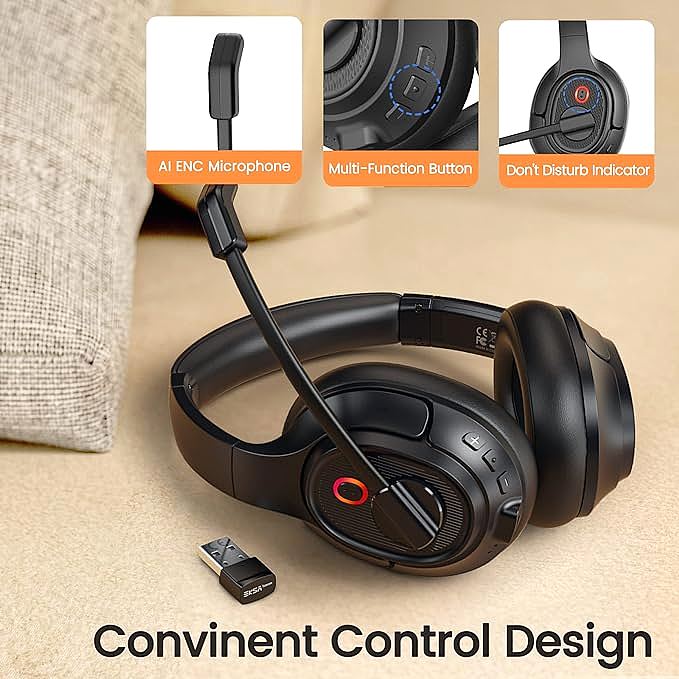
This is why many business headsets, including the dual-mode EKSA H16, ship with both Bluetooth and a USB dongle. The dongle creates a direct, closed-loop connection that doesn't have to negotiate with the broader Bluetooth ecosystem. It doesn't need to discover devices, manage pairing, or respect the full protocol stack. It simply transmits audio as fast as physics allows.
Two Roads Through the Same Air
The difference between Bluetooth and a proprietary 2.4 GHz link is a study in engineering trade-offs.
Bluetooth is designed for universal compatibility. Your headset must handshake with your phone, your laptop, your car's infotainment system — each running different operating systems with different Bluetooth stacks. This negotiation takes time. The device receives audio data, stores it in a buffer to ensure smooth playback, then decodes and plays it. That buffer is the primary source of latency, which typically ranges from 100 to 200 milliseconds with standard Bluetooth. For music, this is imperceptible. For a live conversation or a competitive game, it creates a perceptible disconnect between cause and effect.
A proprietary 2.4 GHz USB dongle bypasses this entire negotiation. The transmitter and receiver are paired in a closed loop at the factory. The packet structure can be optimized strictly for speed, without the overhead of device discovery, codec negotiation, or backward compatibility. This architecture routinely achieves end-to-end latency below 30 milliseconds, with some systems reaching 1 to 4 milliseconds for the RF transmission alone.
The trade-off is simple: Bluetooth gives you freedom to connect to anything. A dongle gives you speed at the cost of flexibility. Dual-mode headsets offer both, letting the user choose which road to take depending on the situation.
The Leap That Cut Latency by 80 Percent
In 2020, Bluetooth 5.2 introduced LE Audio, the most significant advancement in wireless audio since the original specification. LE Audio's Low Complexity Communication Codec, or LC3, achieves something that previous generations could not: higher audio quality at lower bitrates with dramatically reduced latency.
The numbers tell the story. Classic Bluetooth audio, using the SBC codec, typically achieves single-link latency around 100 milliseconds. LE Audio with LC3 reduces this to between 20 and 30 milliseconds on an optimized link — an 80 percent reduction. For context, the Audio Engineering Society has published research showing that drummers can detect latency above 10 milliseconds, guitarists above 12 milliseconds, and keyboardists above 20 milliseconds. LE Audio doesn't reach the sub-10-millisecond territory required by professional musicians, but it crosses the threshold where most people in a video call or a casual gaming session can no longer perceive a delay.
LE Audio also solves the earbud relay problem. In older designs, the phone connects to the primary earbud, which then relays the signal to the secondary earbud. This relay adds buffering delay. LE Audio introduces isochronous channels — time-synchronized data streams that allow a phone to maintain independent connections to both the left and right earbuds simultaneously. No relay, no extra buffering, no asymmetrical battery drain.
The technology was a long time coming. Bluetooth SIG's official publication on LE Audio traces its lineage back to hearing aid technology, where constraints around battery life, miniaturization, and audio quality have always been more severe than in consumer electronics. The 4.5 billion Bluetooth chips shipped in 2023 attest to the scale of this convergence.
When Machines Learned to Listen
While radio engineers were solving the problem of moving audio through the air, a completely different group of researchers was solving a different problem: separating a voice from the chaos around it.
Traditional noise suppression relied on digital signal processing algorithms — mathematical filters that estimate the noise floor and subtract it from the audio signal. These work reasonably well for steady background noise: the hum of an air conditioner, the drone of an airplane engine. They fail spectacularly with non-stationary noise — sounds that change rapidly and unpredictably, like a colleague typing on a keyboard, a door slamming, or another person speaking in the background.
The innovative came in 2015, when researcher Yong Xu proposed a regression method using deep neural networks to produce ratio masks for every frequency in the audio spectrum. The concept is powerful in its simplicity: instead of trying to model the noise directly, train a neural network to look at a noisy audio signal and generate a weighting function — a mask — that, when applied, recovers the clean speech underneath.
The pipeline has since become standard across the industry:
1. Data Collection: Generate massive datasets by mixing clean speech recordings with thousands of different noise types at varying signal-to-noise ratios.
2. Training: Feed the noisy audio into a deep neural network, with the clean speech as the target output. The network learns to map the relationship between noisy input and clean output.
3. Inference: At runtime, the trained model processes incoming audio frame by frame, generating and applying masks in real time.
NVIDIA demonstrated this approach at scale with its real-time noise suppression technology, showing that a well-trained DNN could silence background noise that traditional DSP filters simply could not handle — barking dogs, crying babies, construction noise — while preserving the natural quality of the speaker's voice.
The Millisecond Budget
Here is where the two threads begin to converge. RF transmission and AI noise suppression share the same device, and that device has a strict millisecond budget.
Human conversation tolerates roughly 200 milliseconds of end-to-end latency before the delay becomes noticeable and disruptive. That 200 milliseconds must accommodate everything: the RF transmission time, the audio encoding and decoding, the buffer management, and — now — the AI noise suppression processing. Every millisecond spent on one function is a millisecond stolen from another.
Consider the NeuralAids system, presented in a 2025 research paper. It processes 6-millisecond audio chunks with an inference time of 5.54 milliseconds while consuming only 71.6 milliwatts. That's fast enough for real-time operation on a battery-powered device, but it still consumes nearly a third of the typical audio frame budget. Add RF transmission, codec processing, and buffer management, and the margins become razor-thin.
Hardware is closing the gap. The PIMIC Clarity NC100 chip represents a new frontier: a deep neural network processor that achieves noise cancellation using a single MEMS microphone while consuming only 150 microamps — roughly a thousandth of the power draw of a typical Bluetooth radio. This kind of efficiency is what makes it possible to run AI and RF simultaneously on a device that fits on your head and runs for 55 hours on a charge.
Dual-mode business headsets exemplify this balance: a proprietary wireless architecture handles the RF path, while an AI-powered environmental noise cancellation system handles the acoustic path. The engineering challenge isn't making either system work in isolation — it's making them coexist within the same power and latency constraints.
Teaching Silicon to Distinguish Voices
The latest frontier in AI audio processing moves beyond the binary of speech versus noise. It addresses a more nuanced problem: separating one person's voice from another person's voice.
Consider a conference call from a busy office. Traditional noise suppression can filter out the air conditioning and the keyboard clicks. But what about the colleague having a loud conversation three desks away? To a conventional noise filter, that colleague is also speech. The filter cannot distinguish between the voice you want and the voice you don't.
The Hush model, released in early 2026, demonstrates how far this has come. Built on the DeepFilterNet3 architecture, it is an 8-megabyte model that runs entirely on a CPU with less than 1 millisecond of processing per 10-millisecond audio frame. What distinguishes it from earlier models is its training data: 60 percent of its training samples include a competing human speaker, mixed at signal-to-interference ratios between 12 and 24 dB. The model's encoder learns to distinguish between speakers — developing what its creators call speaker-discriminative features — not just between speech and noise.
This capability is critical for the emerging field of Voice AI — phone-based agents, real-time transcription pipelines, and conversational AI systems where a background speaker being mistakenly transcribed as part of the conversation can break an entire workflow. A 2025 paper from researchers Mishaly, Wolf, and Nachmani takes this even further with the Mamba-Masking network, which achieves up to 7.2 decibels of improvement in active noise cancellation scenarios by adapting a state-space model architecture to generate precisely aligned anti-signals.
The convergence is accelerating. The same hardware accelerators — ARM cores, RISC-V clusters, neural processing units — that enable real-time AI inference are also being integrated into the Bluetooth SoCs that manage RF communication. The GreenWaves GAP9 processor used in the NeuralAids system contains 9 RISC-V cores specifically designed for the kind of parallel computation that neural networks demand. These cores sit on the same silicon as the radio transceiver. The boundary between the RF engineer's domain and the AI researcher's domain is dissolving at the hardware level.
The Invisible Architecture of Connection
There is a design philosophy embedded in every wireless headset that most people never notice, because it works precisely by being invisible.
The radio system hops frequencies 1,600 times per second to avoid interference it cannot see. The AI system analyzes audio 100 times per second to remove noise it cannot predict. Both systems operate within a shared millisecond budget on a shared battery, mediated by shared silicon. Neither system knows what the other is doing, and yet together they produce something that feels simple: your voice, reaching another person clearly, without wires.
This is the deeper story of convergence. It isn't just that RF engineering and artificial intelligence ended up in the same product. It's that they ended up solving complementary halves of the same problem. RF physics handles the challenge of moving data through hostile, invisible air. AI handles the challenge of extracting meaning from hostile, invisible noise. One operates in the frequency domain; the other operates in the time domain. Together, they bridge the gap between the physical world's chaos and the digital world's clarity.
The headset on your desk is the latest waypoint in a journey that started with a Hollywood actress's patent in 1942 and a neural network's innovative in 2015. The connection you hear — or rather, the noise you don't hear — is the sound of two invisible architectures learning to work as one.
EKSA H16 Bluetooth Headset
Related Essays
How Hollywood, Radio Physics, and Neural Networks Built the Modern Headset

The Science Behind Wireless Audio: From Bluetooth Origins...

Silencing the Copper Wire: The Invisible Architecture of Modern Audio
The Four Pillars of Unbreakable Sport Audio

How True Wireless Stereo Technology Rewired the Way We...

Why Your Wireless Earbuds Last 48 Hours: The Physics Behind Battery and Sound

Bluetooth 5.3: How Radio Physics Solves Your Wireless Audio Problems

Why Your In-Ear Audio Keeps Falling Out -- The Physics of Staying Put

Senso PODS Plus Wireless Earbuds - True Wireless Earbuds for Everyday Use
