The Studio Standard: Why the Sony MDR-7506 Remains the Reference After 30 Years
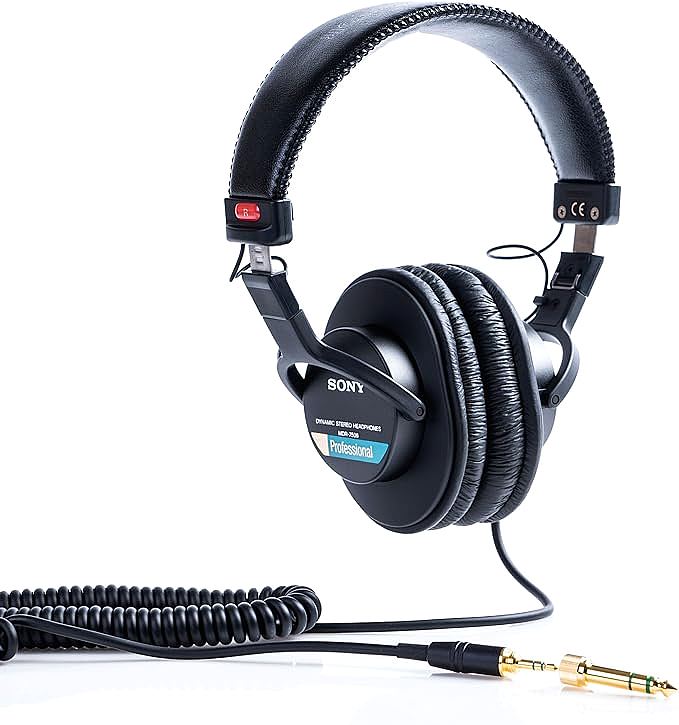
Sony MDR7506 Professional Large Diaphragm Headphone
Your audio interface sounds different from your friend's studio. You check your gains, swap cables, and still wonder why your mix translates poorly to other systems. The problem is not your gear—it is your headphones.
Most consumer headphones color sound to make it feel impressive in a listening booth. Studio monitors, by contrast, reveal what is actually there. The Sony MDR-7506 has held its position as the industry reference for three decades not by adding anything to the signal, but by removing everything that should not be there.

The Physics of Flat Response
A driver membrane moves back and forth to create sound waves. The force behind this movement depends on the magnet structure and the voice coil geometry. In typical consumer headphones, the frequency response curve includes deliberate peaks in the bass and treble regions. This creates a sound that initially impresses listeners—the bass feels punchier, the highs seem brighter.
The problem emerges when you try to mix or master using these headphones. Your low end sounds solid. Your mix leaves the studio. Then the bass drops out on car speakers. The harshness you did not hear appears on phone speakers. You have been mixing to a curve, not to accuracy.
Flat response headphones like the MDR-7506 work differently. Their 40mm driver units use neodymium magnets to achieve consistent force across the entire frequency spectrum. The impedance of 63 Ohms means the headphones can be driven properly by professional audio interfaces without needing additional amplification. The sensitivity rating of 106 dB/mW ensures that quiet details remain audible rather than disappearing into the noise floor.
The closed-back design serves a specific acoustic purpose. When the driver pushes outward, the enclosed back chamber prevents sound from escaping. When it pulls inward, the chamber provides resistance. This controlled environment means the driver responds precisely to the electrical signal without acoustic compensation from the surrounding environment.
Closed-Back Design and Sound Isolation
Open-back headphones have natural acoustic advantages for some applications. They allow air to flow, reducing resonance artifacts. Many audiophile headphones favor open-back designs for this reason.
But open-back headphones leak sound in both directions. In a recording session, your headphone mix bleeds into the microphone. In a live broadcast, ambient noise enters the monitoring path. The MDR-7506 closed-back design prevents this.
The circumaural padding creates a seal around the ear. This seal accomplishes two things simultaneously. First, it isolates the listener from external noise—useful in untreated rooms or noisy environments. Second, it prevents the monitoring signal from leaking into acoustic capture paths.
Professionals who track vocals or instruments frequently choose closed-back monitors precisely because they do not contaminate the recording environment. The MDR-7506 long coiled cable (9.8 feet) allows movement without disconnecting, important when tracking multiple performers in a single session.
The trade-off with closed-back designs is potential for listener fatigue. Without atmospheric breathing room, small resonances can accumulate. Sony addressed this through the generous padding selection and the controlled driver compliance. The ear cups do not clamp excessively, yet the seal remains effective for hours of use.
Understanding Frequency Response in Practice
The MDR-7506 frequency specification reads 10Hz to 20kHz. This range encompasses human hearing, which typically extends from 20Hz to 20kHz, with variation by age and exposure history. The low-end extension to 10Hz means the headphones can reproduce deep bass information, though such content rarely appears in traditional recordings.
More relevant is how evenly the driver reproduces this range. The MDR-7506 does not boost the sub-bass to create a impression of power. It does not emphasize upper-mids to add presence or brilliance. When properly driven, the output is essentially what the source contains.
This neutrality serves professionals differently than consumers. A mixing engineer hears exactly what the tracks contain—no more, no less. A podcaster can detect background hum that colored headphones would mask. A video editor catches click sounds that enhanced headphones might hide.
The limitation appears in casual listening. Music mastered for consumer headphones often sounds thin on flat monitors. Genres that rely on bass enhancement lose impact. This is not a failure of the headphones—it is a mismatch between the monitoring purpose and the listening context.

Historical Context and Professional Adoption
The MDR-7506 design predates modern digital audio workstations. Sony released this model in 1991, during an era when cassette recorders still dominated consumer audio and CDs were still establishing their market position. Professional studios relied on these headphones for broadcast monitoring, film post-production, and studio recording.
The timing matters because standards established during this period influenced subsequent decades. Recording studios that adopted the MDR-7506 as their reference created a consistency baseline. Mixers who learned on these headphones developed their skills using flat response as the reference point.
When these same professionals later evaluated headphones for new studios, the MDR-7506 remained the comparison standard. Not because of brand loyalty, but because everyone needed to hear the same thing. A mix prepared on MDR-7506s would translate to studios worldwide because the monitoring reference was common.
The professional headphone market subsequently fragmented. Sennheiser, Audio-Technica, Beyerdynamic, and others developed competing models. Each found adoption in specific contexts. Broadcast facilities, recording studios, film production companies, and editing suites developed their own preferences based on their acoustic environments and workflow requirements.
Yet the MDR-7506 retained its position in budget-conscious professional environments. At price points well under $100, the headphones delivered reference-quality monitoring without the investment required by more expensive alternatives.
The MDR-7506 Versus Consumer Expectations
Consumer headphone marketing emphasizes features that serve different purposes than professional monitoring. Active noise cancellation, wireless connectivity, and enhanced bass response all compromise flat response to some degree.
Noise cancellation works by generating inverse sound waves to cancel ambient noise. This processing inherently colors the audio signal. The effect might be acceptable for travel or commuting, where isolation from external noise takes priority. For mixing or critical listening, the added signal processing introduces variables that cannot be accounted for.
Wireless transmission via Bluetooth introduces latency and compression artifacts. Even with advanced codecs like LDAC or aptX, the signal path includes additional processing stages. Professional monitoring demands direct, uncompressed signal transmission. The MDR-7506 3.5mm jack with 1/4-inch adapter provides exactly this—a direct, passive signal path with no processing stages between source and driver.
Bass enhancement typically involves boosting low frequencies relative to the rest of the spectrum. This works well for genres designed with enhanced bass—electronic dance music, hip-hop, and similar styles. But for acoustic genres, classical music, speech content, or any application requiring accurate reproduction, the enhancement masks the original recording character.
Professionals who work across genres need a neutral reference. The MDR-7506 provides this by refusing to add anything. The headphones become invisible—the listener perceives the source signal directly.

Maintenance and Long-Term Value
The MDR-7506 design includes replaceable components as standard practice rather than an afterthought. The ear pads use a standard fitment that accepts third-party replacements from brands like Beyerdynamic, Comply, or generic suppliers. This matters because leatherette padding degrades over time, developing cracks and losing the sealed characteristic that defines the acoustic design.
Replacement ear pads cost between $15 and $30 depending on brand and material. Users report changing pads every 2-3 years with regular use. The investment in replacement parts is minimal compared to the cost of professional monitoring alternatives.
The headband padding follows a similar replacement philosophy. Sony designed these headphones for longevity rather than planned obsolescence. The folding construction reduces packaging size for transport, but also places stress on hinge mechanisms. With proper care, the MDR-7506 provides years of reliable service.
The non-detachable cable represents a design choice that balances reliability against convenience. Detachable cables introduce contact resistance at the connection point—over time, oxidized connectors increase noise and reduce conductivity. A fixed cable eliminates this variable entirely, at the cost of requiring complete cable replacement if damage occurs.
Professional users accept this tradeoff because the alternative introduces more potential failure points. A detachable cable can fail during a critical session. The fixed implementation ensures the signal path remains consistent from first use until cable replacement becomes necessary.
Practical Applications in Modern Workflows
Podcast production relies heavily on headphone monitoring for several reasons. Vocal tracking benefits from isolation—performers hear themselves without feedback loops. Editing requires detecting subtle issues like mouth clicks, breath sounds, and timing problems. Mastering for broadcast consistency demands reference-quality reproduction across the full frequency spectrum.
The MDR-7506 handles all three phases without requiring different equipment for each. The consistency means edits made on these headphones translate to other systems. The isolation means performers can record in less-than-ideal acoustic environments. The flat response means no surprises when the final product reaches listeners.
Video production presents similar challenges. On-set monitoring requires isolation from camera noise and director instructions. Post-production editing demands accurate dialogue reproduction and subtle sound effect detection. Final mixing needs reference consistency across playback systems.
Music production workflows vary by genre and approach. Some engineers monitor primarily through speakers, using headphones only for specific tasks like checking mono compatibility or detecting phase issues. Others work primarily on headphones due to acoustic constraints. The MDR-7506 serves both approaches—the neutral character means no adaptation is needed when switching between monitoring methods.
Field recording applications particularly favor the MDR-7506. The closed-back isolation prevents environmental sounds from contaminating the monitoring path. The portable folding design fits in equipment bags. The durable construction survives transport. The accurate reproduction reveals background noise, room characteristics, and recording quality issues.
Making the Choice
The decision between monitoring headphones and consumer models depends entirely on use case. Someone who listens casually, primarily for entertainment, benefits from enhanced bass and active noise cancellation. Someone who creates content—music, podcasts, video—needs accuracy above all else.
The MDR-7506 makes sense when the user needs to hear what is actually in the signal rather than what sounds impressive. This includes mixing, mastering, editing, recording, and any application where the monitoring decision affects the final product quality.
The price point—typically between $85 and $100—positions the MDR-7506 at the entry level for professional monitoring. This accessibility means beginners can develop their ears on reference-quality equipment without significant investment. The skills learned on flat response headphones transfer to any other monitoring system.
Professionals who already own more expensive equipment sometimes use the MDR-7506 as a secondary reference. The different perspective helps identify issues that might be missed on premium systems. No single monitoring solution reveals everything—the MDR-7506 contributes its own view of the signal.
The headphones succeed because they do not try to do everything. They do one thing—reproduce the input signal with minimal coloration—and they do it consistently. After thirty years, that approach continues serving professionals who need to hear the truth rather than an interpretation.
When your monitoring decisions affect final output quality, the stakes rise above casual listening. The MDR-7506 earns its industry standard status by removing every variable it can control. What remains is the audio itself, presented without addition or subtraction. For work that demands accuracy, that clarity justifies three decades of continued professional adoption.
Sony MDR7506 Professional Large Diaphragm Headphone
Related Essays

The Architecture of Critical Listening: Deconstructing 50mm Drivers and Closed-Back Isolation

Balanced Armature or Dynamic Driver: 2026 IEM Truths

Open Back Headphones: Why They Sound Different

Silencing the Copper Wire: The Invisible Architecture of Modern Audio

Computational Audio Soundbar: How Five Drivers Replace a Room Full of Speakers

Coaxial Audio and the Point Source Paradox: Why Perfect...

How Tiny Drivers Produce Big Sound: The Physics Behind Wireless Earbuds
How Tiny Drivers Produce Big Sound: The Physics Behind Wireless Earbuds
How Tiny Drivers Produce Big Sound: The Physics Behind Wireless Earbuds