Why Your Wireless Earbuds Last 48 Hours: The Physics Behind Battery and Sound

DIUARA A9 Wireless Earbuds
DIUARA A9 Wireless Earbuds
The DIUARA A9 Wireless Earbuds combines solar charging technology with active noise cancellation, offering up to 80 hours of battery life on a single charge — and potentially infinite playtime in sunlight.
Priced at $135.99 for Midnight Black and $199.00 for Sand Gold, it targets outdoor commuters and travelers who want to eliminate cable anxiety.
The Invisible Energy Crisis Inside Your Ear
Here is something most people never consider: the tiny wireless earbuds sitting in your pocket contain more computing power than the Apollo guidance computer, run on a battery smaller than a postage stamp, and transmit high-fidelity audio through an invisible electromagnetic jungle — all while weighing less than four grams. The fact that this works at all, let alone works well enough for a ten-hour flight, is one of the great unsung engineering achievements of the 2020s.
The real marvel is not any single component. It is the convergence of three deeply unrelated fields of physics — electrochemistry, radio wave propagation, and acoustic mechanics — packed into a device you forget is there. Understanding how these systems interlock changes the way you think about every piece of wireless audio gear you own.
Lithium-Ion at the Limit: How 320mAh Powers Two Days of Music
Every wireless earbud runs on lithium-ion chemistry, the same fundamental reaction that powers electric vehicles and smartphones. But earbuds face a constraint those devices do not: extreme miniaturization. A single earbud battery typically holds between 30 and 50 milliamp-hours. For context, that is roughly one percent of a smartphone battery. The charging case compensates by storing a much larger cell — often 300 to 500mAh — effectively acting as a portable power reservoir that refills the earbuds three to five times before the case itself needs recharging.
The chemistry itself is straightforward. Lithium ions shuttle between a graphite anode and a lithium-cobalt-oxide cathode through an electrolyte solution. Each ion carries a single positive charge. When you discharge the battery, ions flow from anode to cathode, releasing electrons through the external circuit — your earbud's processor, Bluetooth radio, and speaker driver. When you charge, the process reverses. This shuttle mechanism is reversible for hundreds of cycles, which is why lithium-ion cells maintain roughly 80 percent capacity after 300 to 500 full charge cycles.
What makes earbud batteries remarkable is not the chemistry but the power management. Modern Bluetooth earbuds consume between 5 and 15 milliwatts during playback. That number has dropped dramatically over the past decade. Bluetooth 5.3's Low Energy protocols, combined with increasingly efficient audio codecs, mean the processor can decode audio, manage the radio link, and drive the speaker while sipping current at rates that would have been considered impossibly low just five years ago.
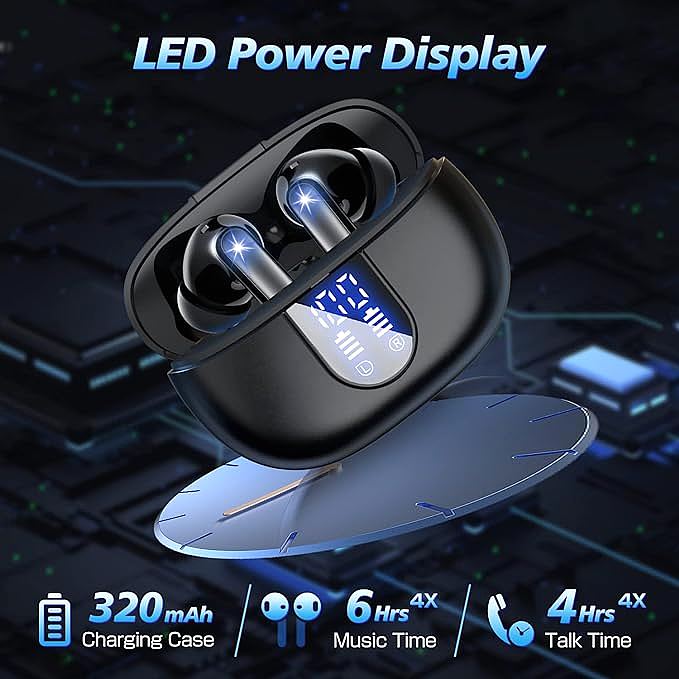
A 320mAh charging case paired with earbuds drawing roughly 8mAh each per hour yields the math behind the 48-hour total playtime claims you see on premium models. The earbuds run for roughly six hours on a single charge, the case refills them approximately seven more times, and the total adds up. The Wireless Earbuds, for example, use this exact architecture — a 320mAh case reservoir supporting multiple recharges of the individual earbud cells to reach that 48-hour combined figure.
The unsung detail is thermal management. Lithium-ion batteries degrade faster at enhanced temperatures, and a device worn inside your ear canal operates in a warm, humid environment. Quality manufacturers use battery management circuits that monitor cell temperature and reduce charge rates when heat builds up, preserving long-term battery health at the cost of slightly slower recharge times.
The 2.4GHz Battlefield: Why Bluetooth 5.3 Changed Everything
The 2.4GHz ISM band — the slice of radio spectrum Bluetooth calls home — is the most congested frequency range in the modern world. Your Wi-Fi router lives there. Your microwave oven leaks radiation into it. Every Bluetooth device within thirty meters competes for the same sliver of bandwidth. The fact that your earbuds deliver uninterrupted audio in this electromagnetic war zone is entirely due to one technique: frequency-hopping spread spectrum.
Bluetooth divides the 2.4GHz band into 79 channels, each 1MHz wide. Instead of transmitting on a single frequency, the radio hops between channels 1,600 times per second following a pseudo-random sequence known to both the earbuds and your phone. If a channel is occupied — by your neighbor's Wi-Fi, for instance — the transmission simply lands on a different channel in the next 625-microsecond slot. The receiver reassembles the data from whichever channels came through cleanly.
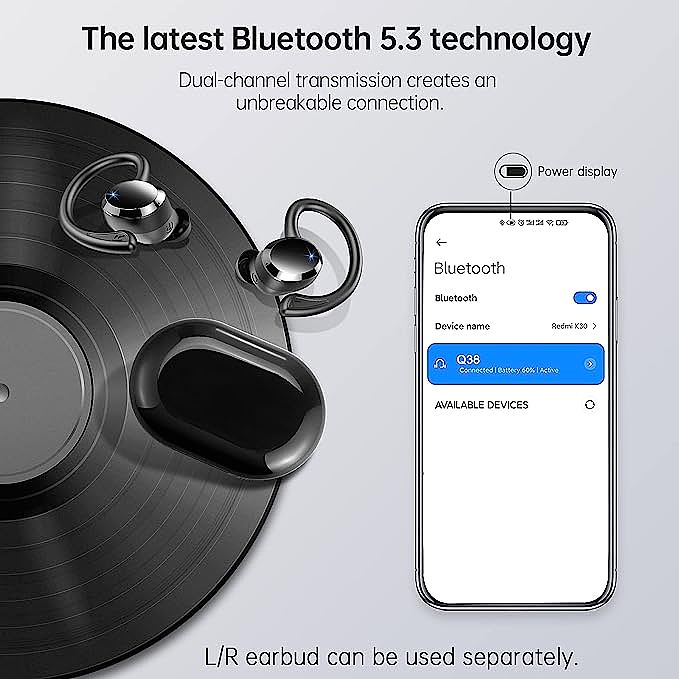
Bluetooth 5.3, finalized in 2021, introduced several refinements that matter directly for audio quality and power consumption. The most significant is Enhanced Attribute Protocol, which reduces the overhead of metadata exchanges — the background chatter between devices that keeps the connection alive. Less overhead means the radio spends more time sending actual audio data and less time on housekeeping, which translates directly to lower power consumption.
Channel classification is another quiet improvement. Previous Bluetooth versions treated all 79 channels equally, hopping across the entire band even when large sections were known to be noisy. Bluetooth 5.3 allows devices to classify channels as good, bad, or unknown, and preferentially hop among the good ones. In a dense apartment building where the lower channels are clogged with Wi-Fi traffic, this alone can reduce packet loss by double-digit percentages.
The 10-meter effective range you see quoted for most earbuds is not a hard limit but a practical threshold. Bluetooth 5.3's receiver sensitivity sits around -70 dBm, meaning the radio can decode signals as faint as one ten-millionth of a milliwatt. At 10 meters, with walls and furniture absorbing signal, you are approaching that sensitivity floor. In open air, the same earbuds might maintain a connection at 30 meters. The range limitation is rarely the radio itself — it is the environment.
LE Audio, introduced alongside Bluetooth 5.2 and refined in 5.3, deserves attention because it represents the first fundamental change to Bluetooth audio transmission in nearly two decades. Traditional Bluetooth audio uses the SBC codec (or optionally AAC, aptX, or LDAC) running on the Classic Bluetooth radio. LE Audio uses a new codec called LC3, which delivers comparable audio quality at half the bit rate. Half the bit rate means half the data to transmit, which means the radio can be active for shorter bursts, which means longer battery life. The physics chain is beautifully direct: better compression → less radio time → less energy consumed.
13 Millimeters of Physics: What Your Earbud Driver Actually Does
An audio driver is an electromagnetic motor optimized for one task: moving air. The 13mm dynamic drivers found in many modern earbuds contain three essential components — a voice coil, a diaphragm, and a permanent magnet — and their interaction is a perfect demonstration of electromagnetism at human scale.
Here is the mechanism in plain terms. The voice coil is a cylinder of thin copper wire suspended in the gap of a strong permanent magnet. When your phone sends an audio signal — an alternating electrical current — through that coil, it generates a fluctuating magnetic field. That field either attracts or repels the permanent magnet's field, depending on the current direction. The coil is attached to a thin, flexible diaphragm, so as the coil moves, the diaphragm moves with it, pushing and pulling the air in front of it.
Those air pressure variations are sound waves. Your eardrum picks them up, your cochlea converts them to nerve impulses, and your brain interprets them as music. The entire chain from digital file to conscious perception takes less than 50 milliseconds.
Driver size matters because of a basic acoustic principle: to move a given volume of air at a given frequency, you need either a large surface moving a small distance or a small surface moving a large distance. Bass frequencies require moving large volumes of air — that is why subwoofers are big. A 13mm driver has roughly 70 percent more surface area than a 10mm driver, which means it can move significantly more air at low frequencies without requiring extreme excursion. The practical result is fuller, more present bass reproduction without the distortion that comes from pushing a small driver to its mechanical limits.
The diaphragm material itself is a closely guarded engineering choice. Mylar, PET, and composite materials each have different stiffness-to-weight ratios. A stiffer diaphragm pistons more cleanly — it moves as a flat surface rather than flexing and warping — which reduces distortion. A lighter diaphragm responds faster to transients, the sharp attacks in percussion and consonants that give music its texture. The best drivers balance these competing properties.
The permanent magnet is typically neodymium, specifically N45 or N48 grade. Neodymium magnets produce fields roughly ten times stronger than traditional ferrite magnets at the same volume, which is why earbud drivers can be small enough to fit in your ear while still generating sufficient force to produce satisfying volume levels.
IPX5 and the Science of Waterproofing Electronics
The IP rating system, defined by IEC standard 60529, is more nuanced than most consumers realize. IPX5 does not mean waterproof — it means protected against water jets from any direction. The testing protocol involves a 6.3mm nozzle spraying 12.5 liters per minute at the device from a distance of 3 meters for at least 3 minutes. If the device functions afterward, it earns the X5 designation.
For earbuds, IPX5 protection is achieved through two complementary approaches. First, physical seals — gaskets around seams, conformal coatings on circuit boards, and membrane vents that allow air pressure equalization while blocking liquid water. Second, nano-coating technology, which deposits a hydrophobic molecular layer on the electronics. These coatings, typically fluoropolymer-based, are applied via vapor deposition and are measured in nanometers. Water beads up on contact and rolls off rather than wetting the surface.
The hydrophobic coating approach has an interesting physics basis. Water molecules are polar — they have a slight positive charge on the hydrogen atoms and a slight negative charge on the oxygen atom. Hydrophobic surfaces lack polar groups, giving water molecules nothing to bond to. The result is a contact angle greater than 90 degrees, meaning water forms nearly spherical droplets that easily roll off under gravity or vibration. This is the same principle that keeps lotus leaves clean.
The practical implication is that IPX5 earbuds handle sweat during intense workouts and light rain without issue. They are not designed for swimming — that would require IPX7 or IPX8, which involves immersion testing. But for the overwhelming majority of real-world scenarios, IPX5 represents the right balance between protection and the cost and complexity of additional sealing.
Why 3.6 Grams Matters More Than You Think
The human ear is not a single pressure point — it is a complex topography of cartilage ridges, depressions, and curves. An earbud that weighs more than about 5 grams begins to create noticeable downward force on the ear canal entrance, which triggers the trigeminal nerve endings that sense pressure and position. Your brain interprets this sustained pressure as discomfort, which is why heavy earbuds become intolerable after 30 to 60 minutes.
At 3.6 grams per earbud, the downward force is roughly 0.035 Newtons — light enough that the earbud is held in place primarily by friction and the natural geometry of the concha bowl rather than by pressing into the ear canal. Semi-in-ear designs, which rest against the ear canal opening rather than penetrating deeply, distribute this minimal weight across a broader surface area, further reducing peak pressure at any single point.
The ergonomic challenge is multidimensional. The earbud must be light enough to avoid triggering pressure discomfort, shaped to stay secure during head movement, and designed to maintain a consistent acoustic seal — because even small gaps between the driver and the ear canal dramatically reduce bass response. A 1mm gap can cause a 10dB loss at 100Hz, which is the difference between rich, full sound and thin, tinny audio.
Manufacturers solve this through population studies — scanning thousands of ears to identify the statistical distribution of ear geometries — and then designing for the 90th percentile, creating a shape that fits the vast majority of users without custom molding. The DIUARA A9 takes this approach with a semi-in-ear contour that follows the natural curve of the concha, relying on geometry rather than insertion depth for stability and acoustic performance.
The Convergence: Where Battery, Radio, and Acoustics Meet
Wireless audio quality is not determined by any single component. It is an emergent property of the entire signal chain: the battery provides clean, stable power to the Bluetooth radio, which maintains a low-latency connection to your phone, which delivers a decoded digital audio stream to the DAC and amplifier, which drive the mechanical diaphragm, which moves the air that reaches your eardrum. A weakness at any stage degrades the final result.
This is why specifications in isolation can be misleading. A brilliant 13mm driver powered by a noisy amplifier will sound worse than a mediocre driver with clean amplification. A Bluetooth 5.3 radio that drops packets will cause audible artifacts regardless of the codec quality. A battery that sags under load will introduce distortion into the audio chain. The engineering challenge is system-level optimization — ensuring every component is good enough that no single element becomes the bottleneck.
The next frontier is already visible. Bluetooth LE Audio's broadcast capability will allow a single phone to stream to unlimited earbuds simultaneously — imagine silent discos without the dedicated transmitter. Solid-state batteries promise higher energy density in smaller volumes, potentially extending playtime or shrinking earbud size further. And machine-learning-based noise cancellation, processing audio in real-time to adapt to your specific ear geometry and environment, is moving from premium headphones down to earbuds.
Understanding the science behind wireless audio does not diminish the experience — it amplifies it. Every time you press play, you are activating a chain of physical phenomena that took decades of research to miniaturize into something you forget is in your pocket. The better you understand that chain, the better equipped you are to evaluate what matters in audio equipment and what is marketing noise.
DIUARA A9 Wireless Earbuds
Related Essays

Silencing the Copper Wire: The Invisible Architecture of Modern Audio

The Physics of Silence: How Active Noise Cancellation Works
The Four Pillars of Unbreakable Sport Audio

How True Wireless Stereo Technology Rewired the Way We...

The Science Behind Wireless Audio: From Bluetooth Origins...

Senso PODS Plus Wireless Earbuds - True Wireless Earbuds for Everyday Use
How Hollywood, Radio Physics, and Neural Networks Built the...

Sport Earbuds Technology Explained: The Physics of Fit, Waterproofing, and Sound

Bluetooth 5.3: How Radio Physics Solves Your Wireless Audio Problems
