The Physics of Fit: Why Ear Hooks Conquer the Runner's Dilemma

VRIFOZ U8I Bluetooth Earbuds
Midway through your third mile, it happens again. The left earbud slides out. You catch it before it hits the pavement, wipe off the sweat, push it back in. Two hundred meters later, the right one follows. This is not a defect in your earbuds. It is physics working against you, and no amount of tip-swapping will fix it.
The problem is so common it has become background noise for runners. Forums overflow with variations of the same question: why do earbuds fall out when I run? The answers usually point to ear canal shape, tip material, or insertion technique. These are real factors, but they miss the structural issue. In-ear designs rely on friction to stay put, and friction is the one force that running systematically destroys.
Friction's Failure Under Motion
Every in-ear earbud depends on the same basic mechanism: a silicone or foam tip wedged into the ear canal, held in place by the friction force between the tip material and your skin. The governing equation is straightforward: F = mu * N, where F is the friction force, mu is the coefficient of friction, and N is the normal force pressing the surfaces together.
Under static conditions, this works well enough. The tip exerts outward pressure against the canal wall, generating sufficient friction to resist gravity. But running is not a static condition. Each footstrike sends a shock wave up through your skeleton to your skull, and Newton's first law means the earbud, with its own inertia, tends to keep moving even as your head decelerates and accelerates with each stride. The result is a slow outward migration that friction alone cannot arrest.
Sweat makes it worse. Much worse. Sweat is mostly water with dissolved NaCl, lactic acid, and urea, and it reduces the coefficient of friction between silicone and skin by an estimated 40 to 60 percent. That is not a minor degradation. If your earbud needed a friction force of, say, 0.15 newtons to stay in place under dry conditions, a 50 percent reduction in mu cuts the available force to 0.075 newtons. The earbud literally cannot hold on. This is precisely why ear hooks running earbuds fit so much better for active use: they bypass the friction problem entirely.
The contact area compounds the problem. A typical in-ear tip touches roughly 2 to 3 square centimeters of ear canal surface. That small area means all the holding force concentrates in a narrow ring. When any part of that ring loses grip, whether from sweat, vibration, or a slight shift in jaw position from breathing hard, the seal breaks and the earbud begins its escape.
The Cantilever Principle: A Different Kind of Lock
Ear-hook designs operate on an entirely different physical principle. Instead of relying on friction inside the ear canal, they use what engineers call a cantilever: a beam anchored at one end (the ear rim) with the load (the earbud body) suspended from the other. The ear rim, specifically the natural concavity where the helix meets the antihelix, provides a structural shelf that the hook wraps around.
This is not friction. This is mechanical interlocking, and it is the reason ear hook earbuds for running have become the preferred choice among serious athletes. The hook cannot slide out because the ear rim physically blocks its escape path. You can test this yourself: an ear-hook earbud stays in place even when you coat the hook in lotion, because the retention does not depend on surface grip. It depends on geometry.
The contact area tells the rest of the story. An ear hook distributes pressure across approximately 8 to 12 square centimeters of the outer ear, three to four times the area of an in-ear tip. Same total force, much lower pressure per unit area. That is why ear-hook designs tend to feel more comfortable over long sessions: the load is shared across a broader surface rather than concentrated in the sensitive ear canal.
There is also a subtle structural advantage that the numbers alone do not capture. The ear rim's concavity acts as a snap-fit feature, a concept familiar to anyone who has designed plastic enclosure clips. The hook flexes slightly as you place it, then seats into the concavity with a small but definite mechanical engagement. This is the same principle that keeps a laptop battery latch closed: not because it is pressed hard, but because the geometry prevents withdrawal without deliberate flexing.
Why Sweat Cannot Defeat a Mechanical Lock
Return to the friction equation for a moment. Sweat attacks mu, the friction coefficient. But in a mechanical lock, mu is not the primary retention variable. The hook stays because the ear rim blocks it, not because the hook grips the skin. Sweat can make the hook slippery, and that might affect comfort or cause slight repositioning, but it cannot make the hook pass through solid cartilage. The failure mode of friction-based retention is gradual slip-out. The failure mode of mechanical retention requires the hook to deform enough to clear the ear rim, which demands far more force than running generates.
This distinction matters for anyone who has tried larger ear tips hoping for better grip. A bigger tip increases N (the normal force), which does increase friction. But it also increases canal pressure and discomfort, and sweat still reduces mu by the same percentage. You are fighting a losing battle against a coefficient that running will always degrade.
IPX7 and the Chemistry of Sweat
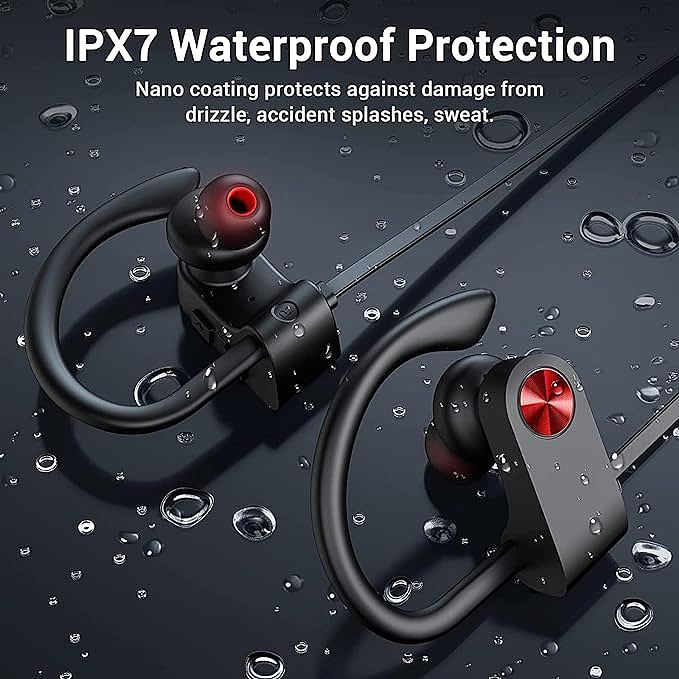
Waterproof ratings add another layer of physics that runners should understand. IPX7, defined by IEC standard 60529, means a device can withstand immersion in one meter of water for 30 minutes without harmful ingress. The X indicates no dust rating is specified, and the 7 is the second-highest liquid protection level in the standard scale.
A common misunderstanding: IPX7 does not mean swim-safe. The test is conducted in still water at room temperature. Swimming involves dynamic pressure, movement, and depth changes that the static test does not replicate. For runners, though, IPX7 is more than sufficient because sweat and rain never approach the one-meter, 30-minute threshold. This waterproof standard pairs well with ear hooks running earbuds fit requirements, since moisture resistance matters as much as retention during extended outdoor sessions.
The real threat to running headphones is not water volume. It is sweat chemistry. Sweat has a pH between 4.5 and 7.0, making it mildly acidic. It contains NaCl, lactic acid, urea, and proteins, all of which can corrode electrical contacts and degrade adhesives over time. Nano-coating technology addresses this by creating a hydrophobic surface with a high contact angle, causing liquid to bead up and roll off rather than spread and penetrate. The coating does not make the device impervious, but it significantly slows the rate at which sweat residues accumulate on sensitive surfaces.
Charging ports remain the weak point. IPX7 applies to the sealed enclosure, but an open charging port is a direct path for moisture. Sweat that has dried into a salty film can wick moisture into the port over repeated charging cycles. Wiping the port area dry before charging is not obsessive maintenance. It is basic chemistry management.
Bluetooth 5.3 in the 2.4 GHz Battlefield
The gym is an electromagnetic war zone. Multiple WiFi routers, dozens of Bluetooth devices, metal equipment that reflects and attenuates signals, all competing for the same 2.4 GHz spectrum. Earlier Bluetooth versions handled this by frequency hopping, but the hopping was blind. The radio jumped between channels without knowing which ones were already crowded.
Bluetooth 5.3 introduces Channel Classification, which is essentially traffic awareness. The radio monitors each channel's noise floor and interference patterns, then classifies channels as good, bad, or usable. Instead of hopping randomly, it preferentially uses clean channels and avoids congested ones. In a gym with six WiFi access points and forty paired devices, this targeted avoidance makes a measurable difference in connection stability.
Connection Subrating is the second relevant improvement. When interference does cause a momentary dropout, older Bluetooth stacks would renegotiate the entire connection, a process that could take hundreds of milliseconds and produce an audible gap. Subrating allows the connection to adjust parameters rapidly without a full renegotiation, reducing recovery time and making dropouts shorter and less noticeable.
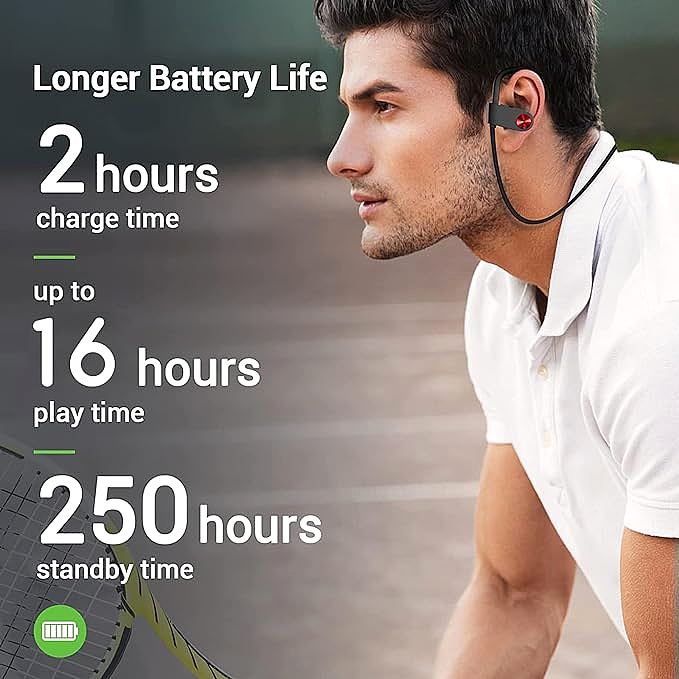
The latency improvement is real but modest. Bluetooth 5.0 typically delivered 50 to 100 milliseconds of audio latency. Bluetooth 5.3 brings that down to approximately 30 to 50 milliseconds. For music listening during a run, this difference is imperceptible. What matters more for ear hooks running earbuds fit is that the connection stays stable through miles of vibration and movement that would disconnect a loose in-ear pair. For video or gaming, it matters more. The more practical benefit is the roughly 5 to 10 percent battery efficiency gain from the Enhanced Attribute Protocol's more efficient data transfer, which contributes to longer runtime between charges. This reliability matters especially for ear hooks running earbuds fit, since a stable connection ensures the mechanical retention has time to do its job without audio interruptions.
CVC 6.0 and ANC: Two Paths, Two Destinations
These two technologies are frequently confused, and understanding the distinction clarifies what your headphones can actually do for you during a run.
ANC, or Active Noise Cancellation, operates on the receive path. A microphone samples ambient sound, the DSP generates an anti-phase waveform, and destructive interference reduces what you hear. ANC helps you hear your music more clearly in a noisy environment. It does nothing for the person on the other end of a phone call.
CVC 6.0, or Clear Voice Capture, operates on the transmit path. Dual microphones with beamforming focus on your voice while adaptive filtering suppresses ambient noise and echo. CVC helps the other person hear you more clearly. It does nothing for what you hear through your own speakers.
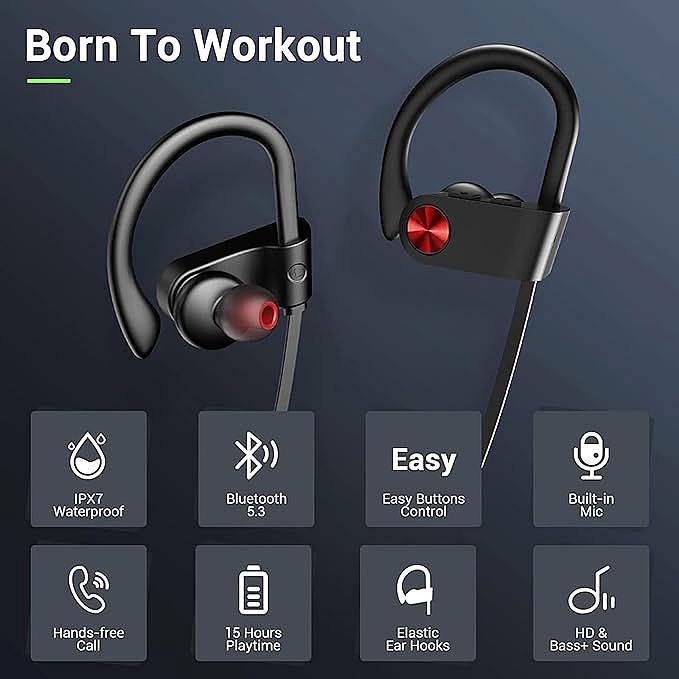
During a run with a phone call, CVC is the technology that matters. Combined with the secure retention that ear hooks running earbuds fit provides, you get both audio clarity and physical stability — two variables that determine whether your headphones survive a trail run. Wind noise, traffic, and footfall sounds are ambient noise that CVC's beamforming and filtering can reduce before your voice is transmitted. ANC would try to cancel those same sounds in your ear, but since you are not listening to music during a call, ANC provides no benefit.
Conversely, during a gym session with music, ANC is the technology that matters. The hum of treadmills, clanking weights, and background music from gym speakers are the sounds you want reduced. CVC sits idle because you are not transmitting voice.
This is not a minor distinction. Choosing headphones based on ANC performance for running calls, or CVC performance for gym music, means optimizing for the wrong variable. Both technologies have value, but they operate on completely different signal paths and solve completely different problems.
Constraint-Based Design: The Deeper Lesson
There is a broader lesson in the ear-hook versus in-ear comparison that extends beyond headphones. In-ear designs try to solve a retention problem by increasing the magnitude of a force (friction) that the operating environment (running, sweat, vibration) systematically weakens. Ear-hook designs solve the same problem by changing the type of force, from friction to mechanical interlock, which the environment does not weaken.
This pattern appears across engineering disciplines. A bridge cable that relies on friction clamps will loosen as temperature cycles cause thermal expansion and contraction. A bridge cable that relies on a mechanical pin through a drilled hole will not. The pin does not care about thermal expansion because the retention mechanism is geometric, not frictional. The ear hook is the pin. The ear tip is the clamp.
The same logic applies to the IPX7 discussion. A device that relies on gaskets alone to keep water out is fighting a losing battle as gaskets age and compress. A device with a nano-coating that causes water to bead and roll off is using the water's own surface tension against it, turning a threat into a self-clearing mechanism. Good engineering does not always mean building stronger defenses. Sometimes it means designing so the threat neutralizes itself.
The runner's dilemma is not really about finding earbuds with better tips or stickier silicone. It is about recognizing that ear hooks running earbuds fit the problem correctly by design, turning a physics challenge into a solved engineering constraint. It is about recognizing when a design philosophy is fundamentally mismatched to its operating conditions, and choosing a philosophy that works with the physics of the problem rather than against it. Ear hooks are not a feature. They are a physical argument about how retention should work, and they represent the kind of running headphone security that friction-based designs simply cannot match. For anyone searching for ear hooks running earbuds fit that actually solve the problem at a physics level, the answer is clear.
VRIFOZ U8I Bluetooth Earbuds
Related Essays

The Physics of Fit: Biomechanics and Material Science in Earbud Design

Why Won't My Earbuds Pair? Bluetooth Handshakes, Sensors, and a Fix Sequence

W23 Earbuds Won't Pair? Fixes & Resets

Why Your IPX7 Label Overpromises Waterproofing

Every Number Has a Cost: TWS Earbud Spec Trade-Offs

Aurasound BEANbuds: Tiny, Comfortable Earbuds for All-Day Wear and Sleep
Why Pricey In-Ear Monitors Can Sound Worse Than Budget Buds

Heart Rate Earbuds: How They Measure and Who Needs Them
OnePlus Nord Buds 2 - Affordable ANC Earbuds