Why Budget Wireless Earbuds Battery Claims Mislead: Specs vs Reality

Jzones U7 Wireless Earbuds
The box says 130 hours. You get eight. Maybe ten on a good day, with the volume low and Bluetooth behaving. This is not a rare complaint. It is the single most common grievance buried in customer reviews for budget wireless earbuds. The packaging promises marathon listening sessions. The hardware delivers a morning commute and an afternoon top-up. The gap between advertised battery life and actual performance plagues everyone who buys cheap earbuds -- and it is why understanding budget wireless earbuds battery life claims matters more than the number printed on the box.
The gap between advertised battery life and actual performance is not a rounding error. It is a structural feature of how budget audio products are marketed, tested, and manufactured. Understanding why requires looking past the marketing numbers and into the physics of lithium-ion cells, the mathematics of additive tolerances, and the economics of quality control at scale.
The Number on the Box Is Not a Lie -- It Is a Laboratory
When a manufacturer claims 130 hours of total playtime, that figure often comes from a specific test condition: earbuds playing at 50 percent volume, with no active features enabled, paired to a device sitting two feet away in a radio-quiet room. The charging case provides additional cycles. Eight hours per charge multiplied by sixteen recharges from the case equals 128 hours. Round up. Print the box.
The problem is that nobody listens at 50 percent volume in a radio-quiet room. Real usage involves volume adjustments, Bluetooth renegotiations, environmental interference, microphone calls, and the simple fact that lithium-ion cells do not deliver rated capacity under variable loads. Each of these factors chips away at the headline number, and they compound.
A user who keeps volume at 75 percent and takes a few phone calls might see six hours from a single charge instead of eight. That is not a defective product. That is Ohm's law meeting marketing.

Milliamp-Hours: The Metric That Hides More Than It Reveals
Battery capacity is advertised in milliamp-hours. A charging case labeled 2500mAh sounds substantial. A smartphone battery is typically 4000-5000mAh, and a tiny earbud case at half that capacity seems impressive. But mAh is only half the energy equation.
Watt-hours measure actual stored energy. The formula: Wh equals mAh multiplied by nominal voltage, divided by one thousand. A 2500mAh lithium-polymer cell at 3.7V stores 9.25 watt-hours. A 2500mAh cell at 3.85V stores 9.625 watt-hours. Same mAh rating. Different energy. Different runtime.
Most budget earbud packaging lists mAh without specifying nominal voltage. This omission is not accidental. When consumers compare two products, the one with the larger mAh number wins the comparison, regardless of actual energy stored. Voltage differences between cell chemistries and manufacturers mean that two products with identical mAh ratings can deliver meaningfully different runtimes -- a factor that makes budget wireless earbuds battery life comparisons especially tricky.
IEEE Standard 1725, which governs rechargeable lithium batteries for consumer devices, requires disclosure of voltage thresholds and cycle life data. Budget audio brands frequently operate outside the scope of this standard's mandatory provisions because earbuds fall into a regulatory gray zone -- they are small enough that detailed battery documentation is rarely enforced.
The Helicopter Pilot's Battery Problem
Aviation engineers solved this measurement ambiguity decades ago. Aircraft battery systems report capacity in both amp-hours and watt-hours because the two numbers tell different stories. Amp-hours describe starting current capability. Watt-hours describe total energy available for sustained operations. A helicopter's flight computer does not calculate range from amp-hours alone. It uses watt-hours because voltage sag under load determines how long the rotors keep spinning.
The same principle applies to earbuds. Bluetooth transceivers do not draw steady current. They pulse. Audio codecs process data in bursts. The amplifier driving the speaker diaphragm draws current in proportion to the audio signal's instantaneous amplitude. These variable loads cause voltage sag in the battery cell, and voltage sag reduces usable capacity. A cell rated at 2500mAh at a gentle 0.2C discharge rate might deliver only 2200mAh when subjected to the pulsed loads typical of wireless audio playback.
Helicopter pilots call this the difference between book performance and actual performance. The flight manual says the aircraft can hover for two hours at gross weight. In practice, density altitude, wind, and engine wear reduce that figure. The manual is not wrong. It was written for a new aircraft on a standard day. Budget earbud battery claims are written for a new device at 50 percent volume on a standard day. Neither reflects your actual operating conditions.
Additive Tolerances: When Adequate Parts Combine Into Inadequate Products
No individual component in a budget earbud is necessarily bad. The battery cell meets its rated capacity within tolerance. The Bluetooth module draws current within its specification. The speaker driver operates within its design parameters. Yet the product as a whole underperforms. Why?
Manufacturing tolerances stack. A battery cell at the low end of acceptable capacity, say minus five percent, paired with a Bluetooth module drawing current at the high end of its specification, say plus eight percent, combined with a driver assembly that is slightly less efficient than nominal, produces a cumulative deficit that no single component would trigger on its own. The product passes quality control because each part meets its individual specification. The system fails its users because the tolerances aligned in the worst direction.
Reliability engineers call this the bathtub curve. Early failures cluster in the first weeks of use, caused by manufacturing defects that escaped screening. Random failures occur throughout the product's life. Wearout failures dominate the end of service life. Budget products face elevated early failure rates because tolerance stacking creates a wider distribution of performance outcomes. Some units work perfectly. Some die in a week. The same model number, the same factory, different experiences.
Customer reviews for budget wireless earbuds reflect this distribution. A product averaging 4.6 stars out of five will have a substantial block of one-star reviews reporting dead earbuds, failed pairing, and rapid battery degradation sitting alongside five-star reviews praising longevity and reliability. Both sets of reviews are honest. They describe different units from the same production run. This variance is exactly why evaluating budget wireless earbuds battery life requires looking at multiple data points rather than relying on a single marketing number.
What Watts and Helmholtz Have in Common
Acoustic physics provides another angle on why battery claims diverge from reality. The air cavity inside an earbud housing behaves as a resonant chamber. Sound waves reflecting within this enclosed space follow Helmholtz resonance principles, where the cavity geometry, port dimensions, and air volume determine the system's resonant frequency.
When a speaker driver operates near the enclosure's resonant frequency, it requires less power to produce sound at that frequency. When it operates away from resonance, the amplifier must work harder to achieve the same output level. Budget earbuds rarely benefit from carefully tuned acoustic chambers. Their internal geometry is often dictated by packaging constraints, not acoustic optimization.
A poorly damped acoustic enclosure forces the amplifier to deliver more power to achieve target sound pressure levels. More power means more current draw. More current draw means shorter battery life. The mAh rating printed on the box tells you nothing about whether the acoustic design is helping or hurting power efficiency. A 2500mAh battery feeding an inefficient acoustic system delivers fewer hours than a 1800mAh battery powering an optimized one.
This is why two earbuds with identical battery capacities can produce dramatically different runtimes. The battery stores the energy. The acoustic design determines how quickly that energy gets spent.
IPX7: The Rating That Expires
Waterproof ratings add another dimension to the specifications-versus-reality problem. IEC 60529 defines IPX7 as protection against temporary immersion in one meter of water for thirty minutes under controlled laboratory conditions. The water is still. The temperature is stable. There is no movement, no pressure differential, no dissolved salts.
Your gym workout is not a controlled laboratory condition. Sweat contains sodium chloride, lactic acid, and urea. These compounds degrade rubber gaskets and adhesive seals over time. Temperature cycling from a cold car to a warm gym and back causes seal materials to expand and contract. Physical handling introduces micro-fractures in adhesive bonds. Each exposure reduces the seal's effectiveness incrementally.
A budget earbud that passes IPX7 certification in a testing facility in Shenzhen may lose that protection after three months of regular gym use. The certification is not fraudulent. It accurately describes the product's capability at the moment of testing. It says nothing about capability after accumulated environmental stress.
Military specification testing, by contrast, subjects equipment to accelerated life simulations: temperature cycling, humidity exposure, salt spray, and vibration profiles designed to represent years of field use. Consumer electronics testing rarely includes these protocols. The IPX7 rating on your earbuds represents a snapshot, not a warranty of long-term protection.
Discharge Rates and the Capacity Curve
Lithium-ion cells exhibit a property called rate-dependent capacity. At low discharge rates, a cell delivers close to its rated capacity. At high discharge rates, the same cell delivers measurably less. This is not a defect. It is electrochemistry.
The mechanism involves ion transport within the cell. At low discharge rates, lithium ions have time to diffuse from the electrode interior to the surface where they participate in the electrochemical reaction. At high discharge rates, ions near the surface are consumed faster than they can be replenished from the interior. The cell's voltage drops below the cutoff threshold before all the stored lithium has been utilized. The remaining capacity is still there, but it is inaccessible at that discharge rate.
For earbuds, this means that heavy usage patterns -- high volume, active noise features, frequent Bluetooth reconnections -- push the cell into higher effective discharge rates, reducing delivered capacity. A cell that provides 8 hours at 50 percent volume might provide only 5 hours at 80 percent volume, not just because the amplifier draws more current, but because the higher discharge rate itself reduces total available capacity. The manufacturer's claimed runtime was measured at the lower rate. Your experience occurs at the higher rate. This rate-dependent behavior is one of the primary reasons budget wireless earbuds battery life varies so dramatically between users.

The Power Bank Fallacy
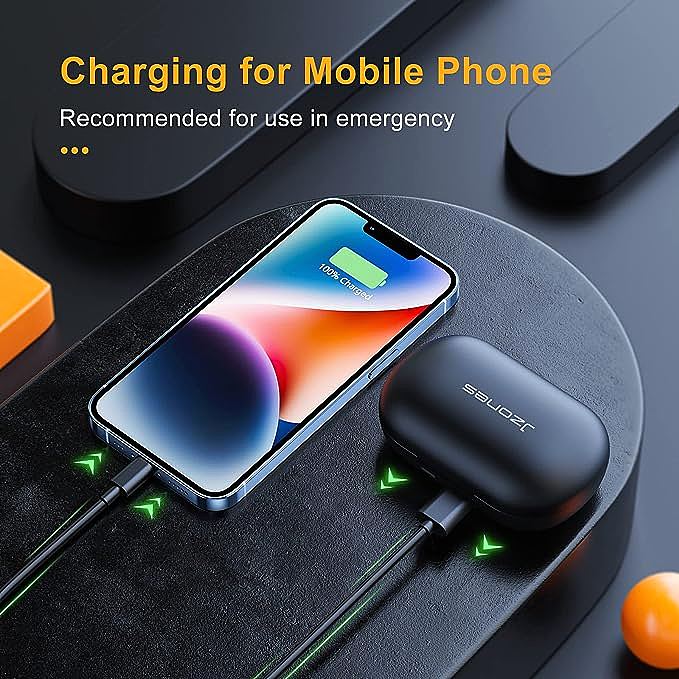
Some budget earbud cases double as emergency power banks for your phone. The marketing material lists a 2500mAh capacity and implies this is a substantial backup power source. The reality is more nuanced.
First, the case must reserve enough charge to recharge the earbuds multiple times. If each earbud holds roughly 50mAh and the case provides sixteen full recharges, that accounts for approximately 800mAh of the 2500mAh total. The remaining 1700mAh is theoretically available for phone charging.
Second, energy transfer between the case and your phone incurs conversion losses. The case battery operates at 3.7V nominal. USB output requires 5V. The step-up conversion wastes approximately 10-15 percent of the energy as heat. So 1700mAh at 3.7V becomes roughly 1250mAh at 5V after conversion.
Third, your phone's charging circuitry has its own efficiency losses. The net energy delivered to your phone's battery from that 2500mAh case is approximately 1000-1100mAh -- enough for roughly 20-25 percent of a modern smartphone's capacity. Useful in a genuine emergency. Not the backup power solution the marketing implies.
What the Absence of Disclosure Reveals
Manufacturers who publish detailed battery specifications -- nominal voltage alongside mAh, cycle life estimates, real-world runtime at multiple volume levels, discharge rate assumptions -- provide information that costs nothing to produce but much to verify. When a brand declines to share this data, the omission itself is informative.
A manufacturer confident in cell quality has no reason to obscure voltage ratings. A brand that tested cycle life and found acceptable results would advertise those numbers. A company that measured real-world runtime at 75 percent volume and was satisfied with the result would publish that figure alongside the laboratory maximum.
The absence of these disclosures does not prove poor quality. It proves that the brand has chosen not to provide evidence of good quality. In competitive markets, voluntary transparency signals confidence. Opaque specifications signal that the brand prefers you to compare products using the one metric where their number looks competitive: raw mAh. Savvy buyers who research budget wireless earbuds battery life beyond the spec sheet tend to be more satisfied with their purchase.
Reading Between the Specification Lines
Understanding the gap between battery claims and reality does not require a degree in electrical engineering. It requires asking a few questions that manufacturers rarely answer on the packaging.
What is the nominal voltage of the battery cell? Without this number, mAh cannot be converted to watt-hours, and meaningful comparison between products is impossible. What discharge rate was used for the runtime claim? If the answer is not provided, assume the gentlest possible test conditions. What is the rated cycle life? Lithium-ion cells degrade with each charge-discharge cycle. A cell rated for 500 cycles will show measurable capacity loss after 200 cycles. A cell rated for 300 cycles will degrade faster.
Budget wireless earbuds battery life claims are not fabricated. They are optimized. They represent the best possible outcome under the most favorable conditions, with every variable set to its most generous interpretation. Your actual experience will fall short because your conditions are not laboratory conditions. Your volume is higher. Your environment is noisier. Your Bluetooth signal competes with other devices. Your battery is three months old instead of brand new.
The engineering truth about battery capacity is that it is never a single number. It is a distribution shaped by chemistry, voltage, temperature, discharge rate, cycle count, and component tolerance. When shopping for affordable earbuds, knowing how to evaluate budget wireless earbuds battery life helps you look past the mAh numbers on the box. The box promises the peak of that distribution. You experience the median. The distance between the two is where disappointment lives.
Jzones U7 Wireless Earbuds
Related Essays

Corded or Cordless Random Orbit Sander: Which Costs Less

Where the Hours Hide Inside Your Wireless Earbuds
