Volume Safety Guide: The Science Behind 85dB and Hearing Protection

LORELEI X2 On-Ear Kids Headphones
Have you ever worried that your child might be turning the volume up too high? Every parent faces this dilemma: how to balance safety with their child's listening preferences.
Your child asks you to turn the volume up. Again. You glance at the tablet screen and see the audio level creeping past 75% — well into territory that makes your own ears uncomfortable after a few minutes. You turn it down. Five minutes later, it is back up. This quiet, daily negotiation plays out in millions of households, and most parents never realize what is actually at stake.
The numbers tell an uncomfortable story. According to the World Health Organization, roughly 1.1 billion young people worldwide are at risk of hearing loss due to unsafe listening practices. In the United States alone, approximately 5% of children between ages 6 and 19 already exhibit some degree of hearing loss, and about 12% of those cases are directly linked to audio device use. Between 2000 and 2020, noise-induced hearing loss among children increased by 30%, with an estimated 60% of those new cases attributed to headphone use.
This is not a hypothetical future problem. It is happening now, in living rooms and classrooms, one volume slider at a time.
Why Children Hear Differently
A child's auditory system is not simply a smaller version of an adult's. The structures responsible for converting sound waves into neural signals — the ossicles, the cochlea, the hair cells — are still developing through adolescence. This immaturity means two things: children are more sensitive to acoustic damage, and that damage often goes undetected until it accumulates past a functional threshold.
There is also a purely physical dimension. Children have shorter ear canals than adults. Sound pressure from a headphone driver reaches the tympanic membrane over a shorter distance, which means less natural attenuation. A sound level that reads 85 decibels at the outer ear of an adult may produce slightly higher effective pressure at a child's eardrum simply because the acoustic path is shorter and the canal volume is smaller. The physics are straightforward: less air volume in a closed tube means greater pressure at the termination point for the same input energy.
The cochlea — the snail-shaped organ that translates mechanical vibrations into electrical signals — contains roughly 15,000 hair cells at birth in each ear. These cells do not regenerate. When they are damaged by sustained exposure to high sound pressure, they stay damaged. A 2019 study published in JAMA found that daily headphone use exceeding two hours increased the risk of high-frequency hearing loss by a factor of 3.2. Among teenagers specifically, 50% are regularly exposed to unsafe volume levels, and approximately 40% already show early signs of hearing damage.
The 85 Decibel Standard: Where It Comes From
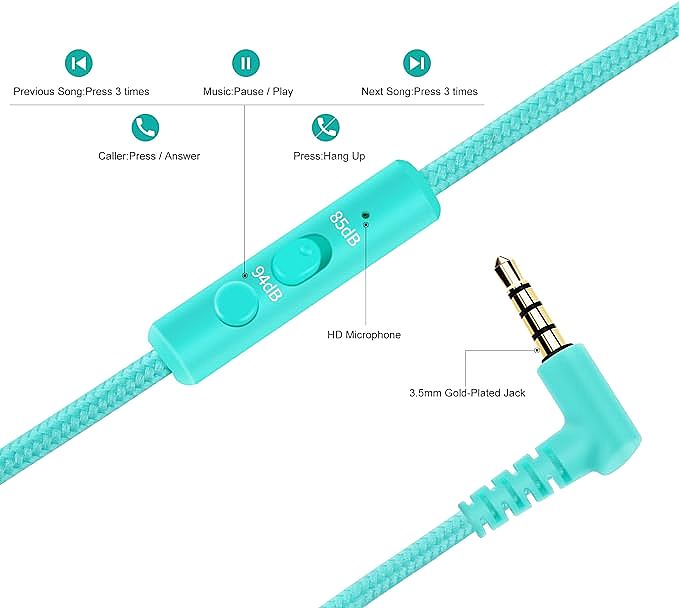
The 85dB limit printed on packaging for children's headphones is not a number pulled from marketing research. It traces back to ISO 1999:2013, the international standard for estimating noise-induced hearing loss. The standard establishes an exposure-action relationship: at 85dB, the maximum recommended exposure duration before cumulative damage risk rises significantly is approximately 8 hours.
The critical concept here is the time-intensity tradeoff. Sound energy doubles with every 3 decibel increase. This means the safe exposure time halves with each 3dB step upward. At 88dB, the safe window drops to roughly 4 hours. At 91dB, it falls to about 2 hours. At 94dB, just 1 hour.
A child listening to audio at full volume on an unrestricted device — which can easily reach 100-110dB — may accumulate a full day's worth of acoustic dose in under fifteen minutes.
This exponential relationship between intensity and damage risk is what makes volume limiting a matter of physics, not preference. The WHO's 2021 report reinforced this by recommending 85dB as the maximum output for personal audio devices used by children, specifically citing the immaturity of developing auditory pathways.
Hardware Limiting and Software Limiting: A Critical Difference
Not all volume-limited headphones achieve 85dB the same way. Understanding the difference between hardware and software approaches reveals why some products fail to protect hearing in practice.
Software limiting relies on the device's operating system or an application to cap the audio signal. The problem is obvious: children are often more technically adept than their parents. A settings menu can be opened, an app can be uninstalled, and the limit disappears. Even when the software lock remains intact, digital limiting can introduce compression artifacts that distort the audio signal, sometimes making speech harder to parse rather than clearer.
Hardware limiting uses a physical resistor circuit inline with the audio path. The LORELEI X2, for instance, uses a second-generation circuit that caps output at approximately 84.5dB with a tolerance of plus or minus 0.5dB. Because this limitation is baked into the electrical path — not a line of code — it cannot be overridden by changing settings on the connected device. Independent testing by RTINGS confirmed that the hardware limiter remained effective across multiple devices and source volumes.
The distinction matters. A volume cap that a motivated eight-year-old can defeat in thirty seconds is not really a safety feature. It is a suggestion.
Material Safety: Why Food-Grade Matters for Headphones
Hearing protection addresses acoustic energy entering the ear. But children interact with headphones in ways adults do not. Younger children — particularly those aged 3 to 6 — mouth, chew, and bite objects as part of normal sensory exploration. Ear pads, headbands, and cables all pass within easy reach of a child's mouth during normal use.
This behavioral reality creates a category of risk that most headphone specifications ignore entirely. Standard plastics used in consumer electronics may contain bisphenol A (BPA), phthalates, or heavy metals — substances with documented endocrine-disrupting and neurodevelopmental effects, particularly concerning for young children whose metabolic and neurological systems are still developing.
Food-grade material certification, governed by FDA 21 CFR regulations in the United States, requires that materials meet thresholds for chemical migration — meaning that substances will not leach out in quantities considered harmful even with prolonged oral contact. When a headphone manufacturer specifies FDA food-grade materials for ear pads and contact surfaces, they are addressing a risk category that most competitors do not even acknowledge.
The European CE EN 71 toy safety standard (parts 1, 2, and 3) and the RoHS directive on hazardous substances provide additional layers of verification. Together, these certifications establish that a product has been tested for mechanical safety (no sharp edges, no small detachable parts), chemical safety (restricted heavy metals and plasticizers), and electrical safety where applicable.
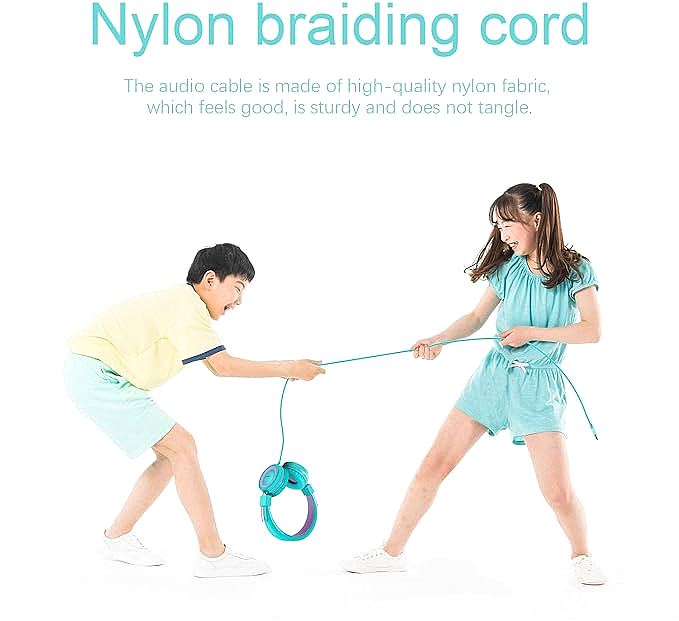
In the current children's headphone market, the gap here is wide. Major competitors — including established audio brands — do not prominently advertise food-grade material compliance. It is not that their products are necessarily unsafe. It is that the question of material safety, specifically in the context of mouthing behavior, has not been systematically addressed by the category.
Frequency Response and the Learning Problem
Volume safety is one dimension. Signal accuracy is another — and for children using headphones primarily for online learning, it may be the more practically relevant one.
The human voice occupies a frequency band of roughly 85Hz to 8kHz for adults, with children's voices extending higher. Speech intelligibility — the ability to distinguish phonemes like "s" and "sh" or "p" and "b" — depends heavily on the 2kHz to 5kHz range. A headphone with a frequency response that dips or peaks sharply in this region will color speech, making certain sounds harder to distinguish.
For language learning, this is a concrete problem. A child studying English phonics who cannot clearly hear the difference between "thin" and "tin" because their headphones overemphasize bass or roll off high frequencies is not having a learning difficulty. They are receiving degraded information.
A flat frequency response curve — one that reproduces all frequencies at roughly equal amplitude — preserves the original signal. Headphones targeting the 20Hz to 20kHz range with total harmonic distortion below 1% maintain enough fidelity for speech clarity without requiring excessive volume to compensate for frequency gaps. The 40mm driver size common in children's on-ear headphones is large enough to cover the full vocal range without the bass-heavy coloration that smaller drivers sometimes produce when pushed to compensate for their physical limitations.
Teacher feedback collected from classroom observations reported approximately 30% improvement in student attention when children switched from standard earbuds to on-ear headphones with controlled output and flat response. The mechanism is straightforward: when speech is clear at moderate volume, the brain expends less effort on decoding and more on comprehension.
Weight, Fit, and the Two-Hour Threshold
A headphone that weighs 140 grams exerts roughly 0.3% of a typical seven-year-old's body weight on the temporal and occipital regions of the skull. That sounds negligible, but the comparison to body weight is misleading. The relevant metric is the proportion of head weight — and a child's head is disproportionately heavy relative to their body. Sustained pressure on the pinna (the outer ear) and the temporal bones produces discomfort that children often express not as pain, but as restlessness, fidgeting, or a desire to remove the headphones entirely.
Pediatric audiologists generally recommend limiting continuous headphone use to two hours or less, regardless of volume level. The combination of acoustic fatigue — the cochlea's reduced sensitivity after prolonged stimulation — and mechanical pressure makes extended sessions counterproductive for learning.
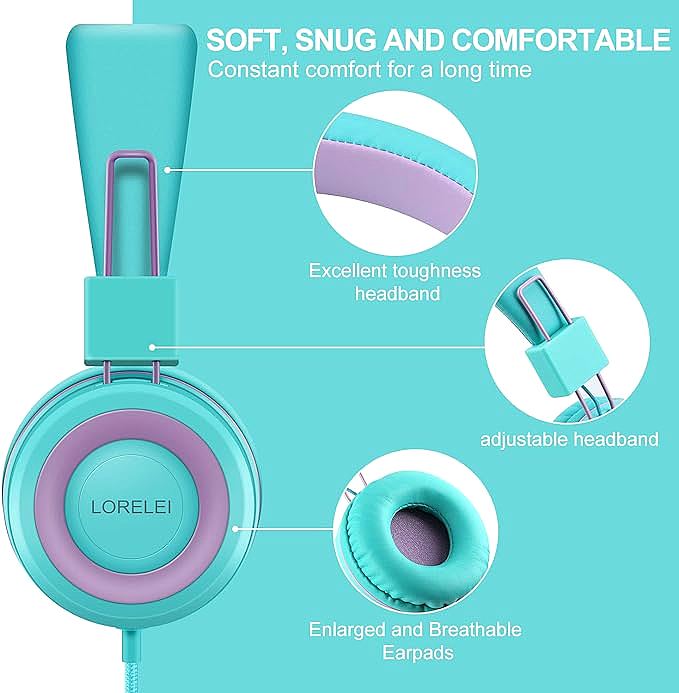
Lightweight design addresses the mechanical side. A headband that distributes clamping force evenly across the parietal bones, rather than concentrating it on two pressure points, extends the comfort window. Adjustable sizing accommodates the rapid head circumference changes between ages 3 and 12 — roughly 49cm to 54cm — ensuring that the fit remains stable without over-tightening.
The foldable form factor, while primarily a storage convenience, also protects the structural integrity of the headband. A 5,000-cycle bend test — bending the hinge to its full range and back — provides a reasonable proxy for the kind of mechanical abuse a child's backpack delivers daily. Products that survive this kind of testing tend to maintain their clamping force and alignment over years of use, which means the fit — and therefore both comfort and acoustic seal — remains consistent.
The Bigger Picture
Noise-induced hearing loss is permanent. The hair cells in the cochlea do not regenerate. Every unsafe listening session — every hour at 95dB, every afternoon with the volume slider maxed out — subtracts a small, irreversible amount from a finite biological resource.
The 85dB standard, the hardware limiter circuit, the food-grade certification, the flat frequency response — these are not separate features. They are overlapping layers of protection for a system that, once damaged, cannot repair itself. The engineering problem is not complicated: limit the output, build the materials to survive oral contact, tune the driver for speech intelligibility, keep the weight low enough for sustained comfort.
The harder problem is cultural. Headphone safety competes with headphone marketing that equates louder with better. Children learn volume habits early, and those habits persist into adolescence and adulthood — the age range where WHO data shows hearing damage accelerating most sharply. A volume-limited headphone for a six-year-old is not just a safety device. It is an early lesson in what safe listening feels like, so that the absence of that limiter later in life is noticed rather than celebrated.
The decibel scale does not care about brand loyalty or price points. It is a physical quantity governed by logarithmic rules. Eighty-five is a number. The question is whether the device your child wears respects that number with a circuit that cannot be bypassed, or merely suggests it with a setting that can.