The Invisible Symphony: How Driver Size Shapes Your Audio Experience
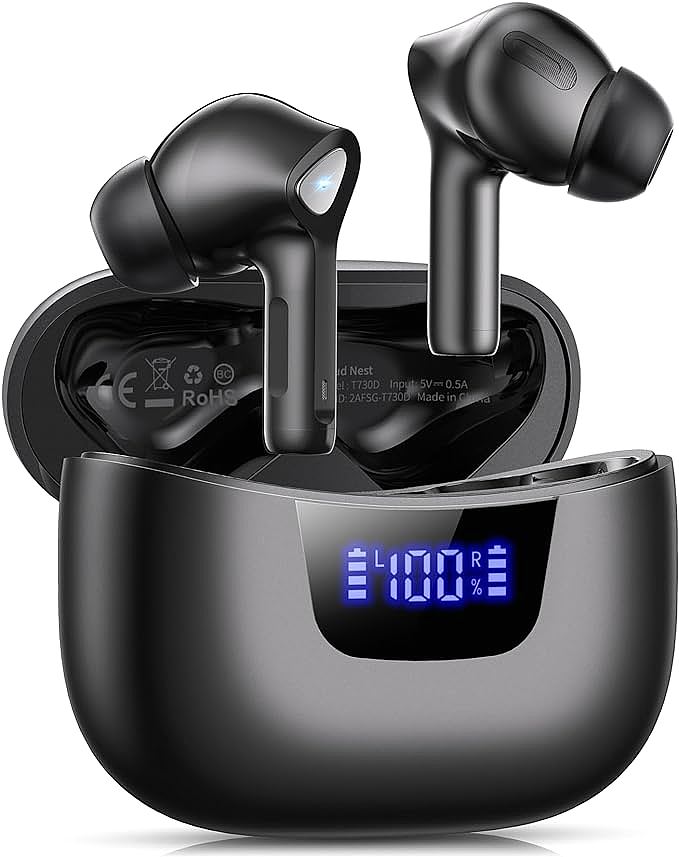
FORTECLEAR Cloud Nest Wireless Earbuds
The Spec Sheet That Speaks a Foreign Language
You open the product page. The numbers stare back: 13mm driver, 10mm driver, 8mm driver. Millimeters of what, exactly? The specification sheet treats you like an engineer, but you just want to know whether the music will sound good. This is the central problem with wireless earbud marketing today -- it publishes technical data without translating it into audible reality. A driver is not a mysterious black box. It is a physical machine governed by the same laws that move piano strings and earthquake faults. A 13mm driver wireless earbuds audio quality starts with understanding this basic principle: the driver is the heart of every listening experience, and its size determines how much air it can move, how deep the bass goes, and how clean the sound stays under pressure. Once you understand what those millimeters actually measure, the spec sheet stops being foreign and starts being useful.
What a Driver Actually Does
Every sound you hear from an earbud begins as an electrical signal. The driver converts that signal into physical motion, and that motion pushes air against your eardrum. That is the entire chain. In a dynamic moving-coil driver -- the type found in the vast majority of wireless earbuds -- the conversion happens through electromagnetic induction. A voice coil sits inside a permanent magnetic field. When alternating current from your music passes through the coil, it generates its own magnetic field that pushes and pulls against the permanent one. The coil moves. Attached to that coil is a thin diaphragm, sometimes called a cone. The diaphragm moves with the coil, displacing air. Your eardrum registers those displacements as sound.
This design dates back to 1925, when Chester Rice and Edward Kellogg at General Electric patented the moving-coil loudspeaker. Their core architecture -- magnet, coil, cone -- has remained essentially unchanged for a century. Not because audio engineering has stagnated, but because the physics are that fundamental. Electromagnetic induction is not a design choice. It is a physical fact.
Why Size Moves More Than Numbers
Here is the part most spec sheets omit: a driver's diaphragm is roughly circular, and the area of a circle scales with the square of its radius. This means a modest increase in diameter produces a disproportionate increase in surface area. A 10mm driver has a cone area of approximately 78.5 square millimeters. A 13mm driver reaches approximately 132.7 square millimeters. That 3mm difference -- barely the width of a grain of rice -- translates to roughly 69 percent more cone area.
More cone area means more air displaced per stroke. More air displacement means higher sound pressure level for the same input power, particularly at low frequencies where long wavelengths demand large movements. This is not opinion. It is Newtonian mechanics applied to acoustic radiation. Bass frequencies have wavelengths measured in meters. A 60-hertz bass note has a wavelength of about 5.7 meters. Moving enough air to make that wavelength audible at reasonable volume requires either enormous excursion (the diaphragm traveling far) or a large surface (the diaphragm pushing a lot of air at once). In the tight physical envelope of an earbud, excursion is limited by the housing. Surface area becomes the primary lever.
The Square-Cube Problem
But larger drivers carry costs. A 13mm diaphragm has more mass than a 10mm one. More mass requires more force to accelerate, which demands more current through the voice coil, which demands more power from the amplifier. The housing must be larger. The tuning becomes more complex because the larger diaphragm has its own resonant frequencies that can color the sound if not damped properly. There is a reason most budget earbuds settle for 8 to 10mm drivers. It is not laziness. It is the square-cube law: as you scale a diaphragm up, its mass increases faster than its area. At some point, the mass penalty erases the area advantage. The engineering challenge is finding the sweet spot before that penalty dominates.
The Physics of Low-Frequency Perception
Human hearing does not treat all frequencies equally. The ear is most sensitive between 2 and 5 kilohertz -- the range of human speech and, not coincidentally, the range most critical for survival in ancestral environments. Bass frequencies below 200 hertz are perceived with dramatically less sensitivity. This is why a bass note at 80 hertz needs roughly 40 decibels more sound pressure than a 1-kilohertz note to be perceived at the same loudness. The Fletcher-Munson curves, first documented in 1933, capture this asymmetry.
For earbuds, this asymmetry is a structural challenge. A tiny driver in a tiny enclosure must somehow produce enough bass to overcome the ear's insensitivity at low frequencies, without making the midrange and treble overwhelming. Equalization can help -- boosting the bass electronically -- but EQ adds distortion when it pushes a small driver beyond its mechanical limits. A larger driver, with more natural bass output from its greater air displacement, relies less on electronic correction. The bass sounds cleaner because it is produced physically rather than digitally coerced.
This distinction matters because distortion is not just a number on a measurement chart. Harmonic distortion adds frequencies that were not in the original recording. A cello's fundamental at 65 hertz might produce audible harmonics at 130, 195, and 260 hertz if the driver is straining. Those harmonics mask the actual instruments playing at those frequencies. The music loses clarity not because it gets louder, but because it gets crowded with phantom tones.
From Patent to Pocket: A Century of Compression
The Rice-Kellogg driver was not small. The original 1925 prototype used a cone roughly the size of a dinner plate, housed in a wooden cabinet that weighed as much as a small child. Shrinking that architecture from a living-room object to something that fits inside your ear canal required solving problems across multiple disciplines simultaneously.
Magnet technology had to advance. The original alnico magnets gave way to ferrite, then to neodymium. Neodymium-iron-boron magnets, developed in the 1980s, deliver roughly ten times the magnetic field strength per unit volume compared to ferrite. Without rare-earth magnets, the voice coil in a 13mm driver could not generate enough force to move the diaphragm against its own mass.
Diaphragm materials had to evolve. Paper cones work beautifully in large speakers -- they are light and stiff. But at 13mm, paper lacks the rigidity to resist deformation under the forces generated by the voice coil. Modern earbud diaphragms use composite materials: thin layers of polymer film reinforced with carbon fiber or metalized coatings that add stiffness without adding mass. The material science behind a driver membrane this small is closer to aerospace engineering than to the paper-cone loudspeakers of the 1920s.
Amplifier efficiency had to improve. A large speaker draws hundreds of milliwatts. An earbud driver operates on tens of milliwatts, powered by a battery the size of a vitamin capsule. The amplifier must deliver clean current at very low voltage rails, with minimal noise floor, because any hiss or hum is delivered directly into the ear canal with zero room acoustics to diffuse it.
Bluetooth 5.3 and the Latency Problem
Driver size determines how music sounds once it arrives. Bluetooth determines how quickly it arrives. Every wireless earbud adds latency -- a delay between the audio signal leaving your phone and the driver producing sound. With Bluetooth 4.x and the standard SBC codec, latency typically sits around 100 to 150 milliseconds. That is barely noticeable for music, but it is obvious for video, where lip sync drifts, and fatal for gaming, where you hear your own actions a tenth of a second late.
Bluetooth 5.3 reduces this latency to approximately 40 milliseconds under SBC. The improvement comes not from a single change but from several: a more efficient link layer that reduces retransmissions, enhanced attribute protocols that trim handshake overhead, and isochronous channels that let the transmitter schedule audio packets with tighter timing. Forty milliseconds is below the threshold where most humans perceive audio-visual mismatch. The lip-sync issue largely disappears.
There is a catch. SBC, the mandatory codec in all Bluetooth audio devices, maxes out at around 328 kilobits per second. Higher-quality codecs like aptX and LDAC push beyond 900 kilobits per second, preserving more detail in the original recording. But those codecs require licensing fees and dedicated hardware support, which pushes the product price above the budget tier. At the sub-$30 price point, SBC is the reality. A 13mm driver can produce more detail than SBC can deliver, which means the bottleneck is not the cone -- it is the codec.

When Water Meets Sound
An earbud that survives immersion follows a different set of physics than one that merely resists splashes. The IPX7 rating, defined by IEC standard 60529, requires a device to withstand submersion in one meter of freshwater for thirty minutes. This is not a casual splash guard. It is a controlled engineering test with defined pass and fail criteria.
The primary defense is a hydrophobic nano-coating applied to the internal circuitry. This coating exploits the same principle as the lotus leaf: a surface with microscopic structures that create a contact angle greater than 150 degrees between water and the material. At that angle, water cannot spread. It beads into nearly spherical droplets and rolls off under gravity, carrying dust and contaminants with it. The lotus effect, documented by botanists Wilhelm Barthlott and Christoph Neinhuis in 1997, is a case of biology solving a problem that materials science later replicated synthetically.
The coating has limitations. It degrades with mechanical abrasion, chemical exposure from soap or sunscreen, and UV radiation. The IPX7 test uses static freshwater under laboratory conditions. Saltwater, chlorinated pool water, and hot showers all present different chemical challenges. The rating tells you what the device survived in a lab. It does not guarantee the same performance after two years of daily use.
The Battery Inside the Battery
Wireless earbuds carry two power systems. The individual earbud battery runs the driver, amplifier, Bluetooth radio, and touch controls. The case battery recharges the earbuds between sessions. Both use lithium-ion chemistry, the same technology that earned John Goodenough, M. Stanley Whittingham, and Akira Yoshino the 2019 Nobel Prize in Chemistry.
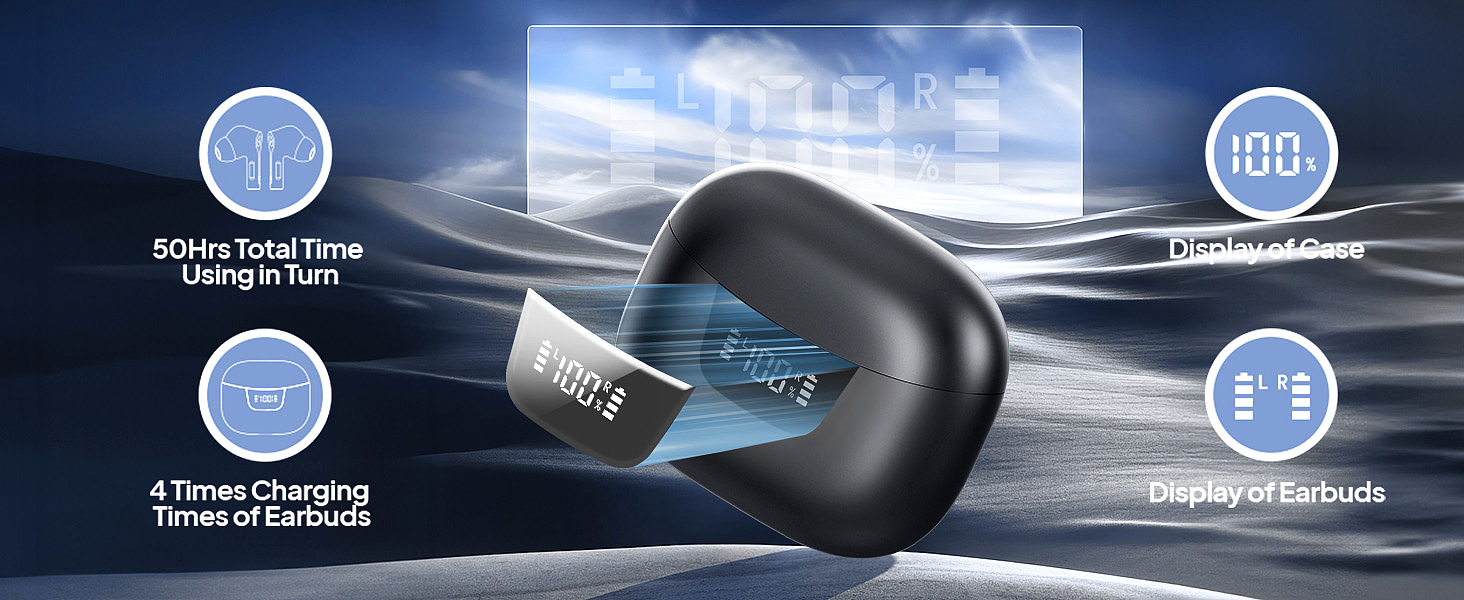
A typical earbud cell holds about 40 to 50 milliamp-hours. That is roughly 0.15 watt-hours of energy -- enough to drive the earbud for approximately five hours at moderate volume. The case holds 400 to 500 milliamp-hours, providing about four full recharges. Total system playback stretches to roughly 50 hours if you alternate: use one earbud while the other charges, then swap.
Lithium-ion cells degrade with charge cycles, heat, and deep discharge. After 300 to 500 full cycles, capacity typically drops to 80 percent of original. For a device charged daily, that means noticeable degradation within 12 to 18 months. There is no software fix for chemistry. The dual-LED power display some earbuds offer -- showing approximate charge levels for both the buds and the case -- addresses the anxiety this degradation creates. Concrete feedback replaces the uncertainty of a battery icon that lies by omission.
What Those Millimeters Mean for You
Understanding driver physics changes how you read a spec sheet. When you see 13mm, you now know to think about cone area rather than diameter. You know the 69-percent area advantage over a 10mm driver translates to stronger bass with less electronic correction. You know the trade-off is higher power draw and more complex tuning. You know that SBC limits what even a good driver can reproduce. You know that IPX7 means lab-tested immersion resistance, not lifetime waterproofing. You know that 50-hour battery life assumes alternating use, not continuous playback from both buds.
These are not marketing claims. They are the physical constraints that every earbud designer works within, regardless of brand or price. The FORTECLEAR Cloud Nest, with its 13mm driver, sits at an interesting point in this constraint space: large enough to exploit the area advantage of a bigger cone, inexpensive enough to remain accessible, and limited by the same SBC codec and lithium-ion degradation curve as every other device in its tier. When shopping for 13mm driver wireless earbuds audio quality, remember that the numbers on the spec sheet tell a story far deeper than a single millimeter measurement suggests.
The Engineering That Remains Invisible
Every time you press play, a sequence of physical events unfolds that took a century to compress into a capsule the size of a jellybean. Electromagnetic induction moves a diaphragm whose area was chosen to balance bass output against mass penalty. A radio link built on decades of protocol refinement delivers the signal with just enough speed to keep lips and voices synchronized. A chemical cell stores energy in the migration of lithium ions between crystal lattices. A synthetic lotus leaf repels water from circuits that would otherwise short and fail.
None of this appears on the box. The box says 13mm. The 13mm is the tip of an iceberg whose bulk is physics, chemistry, materials science, and a hundred years of iterative engineering. The next time you feel a bass note hit your eardrum from something smaller than your thumbnail, consider the chain of translations that made it possible: electrical to magnetic, magnetic to mechanical, mechanical to acoustic, digital to analog, wireless to wired, and all of it shrunk by three orders of magnitude from the dining-table speaker of 1925. The sound you hear is real. The engineering that produced it is invisible. That invisibility is the measure of its success.
FORTECLEAR Cloud Nest Wireless Earbuds
Related Essays

Tribit BTH96 FlyBuds C2 Wireless Earbuds : Your New Wireless Earbud Companion

JBL Tune 205BT Wireless In-Ear Headphones: The Science of Everyday Sound and Freedom

A Deeper Connection: Understanding Bluetooth 5.4 and ENC with the Nerunsa D60 Pro

Why Wireless Earbuds Sound Flat: DSP Trade-Offs Explained

YHT True Wireless Earbuds - Superior Sound and Versatile Features

Gasy Bzhe Wireless Earbuds Bluetooth 5.0 Headphone - A Budget-Friendly Option

50mm Drivers Explained: How Driver Size Shapes Headphone Sound Quality
The Physics of Acoustic Sealing: Why Fit Is the Foundation...

Why Earbuds Sound Terrible on Calls: The Physics of ENC
