The Physics of Bone Conduction: Why Bass Is Hard and How Engineers Solved It

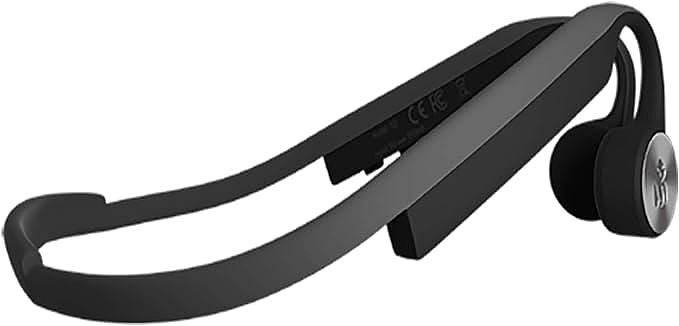
SHOKZ OpenRun Pro Bone Conduction Open-Ear Headphones
The moment you put on a pair of bone conduction headphones for the first time, something feels off. The music is there, but it arrives thin and distant, stripped of the weight you expect from a bass guitar or a kick drum. This is not a design flaw or a cost-cutting compromise. It is a fundamental constraint written into the laws of physics and the wiring of human hearing.
Understanding why bone conduction sounds the way it does requires a journey through three distinct territories: the mechanics of how sound reaches the inner ear, the physical limits of the tiny transducers that make bone conduction possible, and the peculiar ways human hearing perception amplifies certain frequencies while diminishing others.
The Two Pathways to Hearing
Human hearing evolved around a single dominant pathway: air conduction. Sound waves enter the ear canal, strike the eardrum, and set a chain of three tiny bones—the malleus, incus, and stapes—into motion. These ossicles amplify the vibrations and transmit them through the oval window into the fluid-filled cochlea, where thousands of hair cells convert mechanical motion into electrical signals the brain can interpret.
Bone conduction bypasses this entire outer and middle ear apparatus. Instead, a transducer pressed against the skull—typically against the zygomatic bone, or cheekbone—sends vibrations directly through bone tissue to the cochlea. The fluid inside the cochlea ripples, hair cells fire, and the brain perceives sound. No eardrum involvement. No ear canal. No ossicles.
This alternative pathway has been understood since at least the early nineteenth century. The German physicist Ernst Heinrich Weber demonstrated in the 1820s that a vibrating tuning fork placed against the forehead could be heard even when the ears were plugged. The French physician Jean Marc Gaspard Itard used bone conduction as a diagnostic tool for hearing loss. By the 1950s, bone conduction audiometry had become a standard clinical procedure for distinguishing conductive hearing loss (problems in the outer or middle ear) from sensorineural hearing loss (problems in the cochlea or auditory nerve).

The Traveling Wave and the Architecture of Pitch
To understand why bone conduction struggles with bass, one must first understand how the cochlea decodes frequency. In 1961, the Hungarian-born physicist Georg von Békésy received the Nobel Prize in Physiology or Medicine for his discoveries concerning the mechanics of hearing. His most important contribution was the traveling wave theory.
Von Békésy showed that the basilar membrane—a flexible strip running the length of the coiled cochlea—is mechanically graded. Near the base, where the cochlea is narrowest, the membrane is stiff and narrow. Near the apex, it is wider and more flexible. When fluid in the cochlea is set into motion, a wave travels along the membrane, growing in amplitude until it reaches a point where the membrane’s natural resonance matches the frequency of the incoming sound. High frequencies peak near the stiff base. Low frequencies travel all the way to the flexible apex before peaking.
This mechanical frequency analysis is remarkably elegant, and it works regardless of how the cochlear fluid is set into motion. Whether the vibration enters through the oval window (air conduction) or through the bone of the skull (bone conduction), the traveling wave forms and the basilar membrane responds according to its mechanical tuning.
But here is the critical detail: the amplitude of the traveling wave depends on how much energy is delivered to the cochlear fluid. And this is where bone conduction’s bass problem begins.
The Transducer Problem
Bone conduction headphones use piezoelectric transducers to generate vibrations. Piezoelectric ceramics—typically lead zirconate titanate, or PZT—change shape when an electric field is applied. Apply an alternating voltage, and the ceramic expands and contracts at the same frequency, creating mechanical vibration.
Piezoelectric materials have a natural resonant frequency determined by their size, shape, and material properties. For the small transducers used in wearable audio devices, this resonant frequency typically falls in the range of 1 to 4 kilohertz—right in the mid-to-high frequency region where human hearing is most sensitive. Below this resonant frequency, the displacement amplitude of the transducer drops steeply, at a rate of approximately 12 decibels per octave for voltage-driven operation.
This means that to produce the same physical vibration displacement at 100 hertz as at 1 kilohertz, the transducer would need approximately ten times the driving voltage. Battery-powered wearable devices have strict limits on voltage and power consumption. The transducer cannot simply be made larger, because it must fit inside a lightweight, 29-gram headphone frame. The laws of physics impose a hard constraint: small piezoelectric transducers cannot move enough air or generate enough bone vibration at low frequencies.
The Perceptual Amplifier
If the physical limitation were the whole story, bone conduction headphones would sound merely quiet in the bass region. But they sound more than quiet—they sound almost absent of bass entirely. This is where the second factor comes into play: the Fletcher-Munson effect, formally known as equal-loudness contours.
In 1933, Harvey Fletcher and Wilden Munson published a landmark study showing that human hearing sensitivity varies dramatically with both frequency and loudness. At moderate to low listening volumes—precisely the range where bone conduction headphones operate—the ear is significantly less sensitive to low frequencies. A 100-hertz tone must be approximately 25 decibels louder than a 1-kilohertz tone to be perceived as equally loud at a 40-phon listening level.
This creates a devastating feedback loop for bone conduction audio. The transducer already delivers less physical energy at low frequencies due to its mechanical limitations. The human ear is simultaneously less sensitive to whatever low-frequency energy does reach the cochlea. The two effects compound, and the listener perceives a sound that is not just reduced in bass but almost entirely devoid of it.
The problem is not that bone conduction cannot produce bass at all. It is that the bass it produces falls below the threshold where the auditory system registers it as meaningful. The signal exists, but the brain cannot hear it.
Engineering Around the Impossible
Faced with a problem rooted in both physics and physiology, engineers have developed several strategies to compensate. The most direct approach is pre-emphasis equalization: boosting the low-frequency signal before it reaches the transducer, so that the mechanically attenuated output more closely matches the desired frequency response. This works within limits, but every decibel of boost consumes battery power and pushes the transducer closer to its mechanical and thermal limits.
A more sophisticated approach involves psychoacoustic bass enhancement, a signal processing technique that exploits a quirk of auditory perception known as the missing fundamental phenomenon. When the ear hears a complex sound, the brain infers the fundamental frequency from the harmonic series, even if the fundamental itself is absent or attenuated. A bass guitar note at 100 hertz produces harmonics at 200, 300, 400 hertz and beyond. If the 100-hertz fundamental is too weak to be heard, but the harmonics at 200 and 300 hertz are clearly present, the brain fills in the missing fundamental and the listener perceives the bass note that physically does not exist.
This technique, used in various forms by technologies such as Waves MaxxBass and Dolby Bass Enhancement, is likely a core component of modern bone conduction audio processing. By carefully synthesizing and emphasizing the harmonic structure of low-frequency content, engineers can create the perception of bass without requiring the transducer to produce the fundamental frequencies it physically cannot generate.
Phase manipulation offers another tool. By dynamically adjusting the phase relationship between different frequency components, signal processors can optimize the transducer’s excursion within its available power budget, extracting the maximum possible mechanical output at the frequencies where it matters most.
The progression from PremiumPitch to TurboPitch across successive generations of consumer bone conduction devices reflects the refinement of these techniques. Each generation achieves modest but meaningful improvements in perceived bass response, not by changing the fundamental physics of the transducer, but by extracting more perceptual value from the limited mechanical output available.
The Open Ear as Feature
While bone conduction headphones make compromises in sound quality, they offer a capability that traditional headphones cannot match: they leave the ear canal completely open. This is not merely a comfort feature—it has genuine implications for auditory safety and spatial awareness.
The human ability to locate sounds in space depends on several mechanisms. Interaural time differences—the slight delay between when a sound reaches one ear versus the other—provide coarse left-right localization. Interaural level differences—the slight attenuation of sound as it passes around the head—provide additional cues. But front-back discrimination and vertical localization depend on the filtering properties of the pinna, the visible outer ear. The complex folds and ridges of the pinna create direction-dependent spectral notches and peaks that the brain uses to determine whether a sound comes from in front or behind, above or below.
Inserting an earbud or covering the ear with a headphone cup disrupts these pinna filtering cues. The listener loses the ability to accurately judge the direction of sounds—an ability that matters enormously for a runner approaching a crosswalk or a cyclist navigating city streets.
Bone conduction headphones leave the ear canal unobstructed, preserving the natural acoustic pathway for environmental sounds. The pinna continues to filter incoming sound normally, and the auditory system retains its full spatial hearing capabilities. The music arrives through the bone conduction path, while the world arrives through the air. The brain simultaneously processes both streams of auditory information, a feat of parallel processing that the human auditory system handles with remarkable ease.
The Engineering Journey from Medicine to Sport
Bone conduction technology did not originate in consumer audio. Its first practical applications were in hearing healthcare. The bone-anchored hearing aid, or BAHA, was developed in the 1970s for patients with conductive hearing loss—people whose outer or middle ears could not effectively transmit sound to the cochlea, but whose cochleas and auditory nerves functioned normally. A titanium implant screwed into the mastoid bone behind the ear provided a direct mechanical coupling point for a vibrator, bypassing the damaged outer and middle ear entirely.
The miniaturization of piezoelectric ceramics in the 1990s and 2000s made it possible to build bone conduction transducers small enough and efficient enough for wearable consumer devices. SHOKZ, founded in 2011 under the name AfterShokz, pioneered the transition from medical assistive technology to consumer sports audio.
Each generation of consumer bone conduction devices has pushed the technology further. The first generation offered functional audio with limited frequency range. The second improved comfort and battery life. The third brought better transducer design and the first generation of algorithmic compensation. The fourth generation, represented by devices with refined bass enhancement processing, achieves a sound quality that, while still audibly different from traditional headphones, is acceptable for its intended use case: providing audio entertainment and communication during physical activity without compromising environmental awareness.

The Limits of Miniaturization
The tension at the heart of bone conduction audio is irreducible. A larger transducer can produce more low-frequency output, but a larger transducer adds weight, consumes more power, and requires more clamping force against the skull. A smaller transducer is lighter and more comfortable but cannot physically displace enough volume to produce meaningful bass.
Improvements in magnetic materials, actuator design, and signal processing can shift the tradeoff curve, but they cannot eliminate it. The 29-gram weight of a modern bone conduction headphone represents a carefully optimized point on that curve: light enough to be worn for hours during a marathon, powerful enough to deliver clear audio across the speech frequency range, and algorithmically compensated enough to suggest the presence of bass that the transducer cannot fully produce.
What the Future Holds
Several emerging approaches may push beyond the current limitations. Hybrid systems that combine a bone conduction transducer with a small air conduction driver could deliver the bass from one source and the mids and highs from another, each operating in its optimal frequency range. Personalized HRTF compensation could tailor the frequency response to the individual listener’s ear geometry and bone conduction sensitivity. Advances in piezoelectric materials, including lead-free alternatives with greater low-frequency displacement, may gradually improve the physical output of the transducer itself.
But the fundamental physics will not change. Bone conduction audio will always sound different from air conduction audio because it stimulates the cochlea through a different mechanical path. The question is not whether engineers can make bone conduction sound exactly like traditional headphones—they cannot, and understanding why reveals something interesting about how hearing works. The question is whether they can make it good enough that the tradeoff becomes worthwhile.
For the runner who wants to hear approaching traffic while listening to a playlist, for the cyclist who needs to be aware of their surroundings during a training ride, for the swimmer whose ears are underwater—the answer appears to be yes. The physics of bone conduction will always impose limits on sound quality. But the engineering of perception, working at the intersection of transducer mechanics and auditory neuroscience, has found ways to make those limits matter less than they once did.
SHOKZ OpenRun Pro Bone Conduction Open-Ear Headphones
Related Essays
The Physics of Bone Conduction: Why Bass Is Hard and How...

Why Bone Conduction + Noise Cancelling Is a Physical Contradiction

Bone Conduction Headphones: Open-Ear Audio for Safety and Awareness

Hamuti X7 Bone Conduction Headphones: Experience Sound in a Whole New Way

Beyond the Eardrum: The Hidden Physics of Bone Conduction

Bone Conduction Technology Explained: How Sound Bypasses Your Eardrum

Air Tube vs Bone Conduction vs Traditional Headphones: An EMF Exposure...

How Bone Conduction Works: The Physics of Hearing Through Your Skull

Hearing Through Your Skull: The Remarkable Physics Behind Bone Conduction and the Shokz OpenMove