Beyond the Eardrum: The Hidden Physics of Bone Conduction

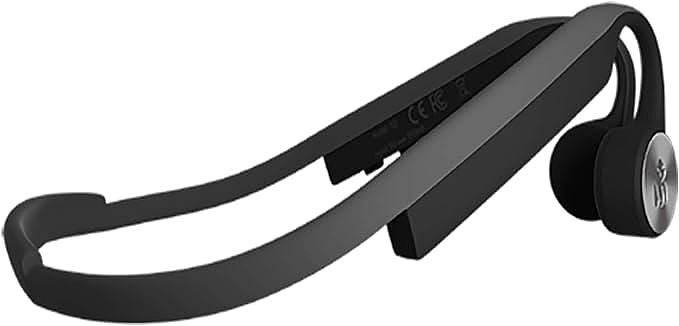
WANFEI BS01 Bone Conduction Headphones
The fastest path between a sound source and your brain doesn't go through your ear. While we spend billions perfecting the air-pressure approach—headphone drivers, earbuds, studio monitors—evolution already solved this problem using the densest material in your body: your skull.
For half a millennium, scientists and engineers have been unraveling a paradox that seems to defy common sense. Sound, we learned in school, travels through air as pressure waves. We studied the mechanics of the eardrum, the cascading bones of the middle ear, the fluid-filled cochlea that translates vibration into nerve impulses. But hidden beneath this textbook narrative lies a backup system—one that doesn't require the eardrum at all.
This is the story of bone conduction, a technology that improves the human skull into a speaker system, enabling a form of hearing that bypasses the very structures we thought were essential. And for the millions of runners, cyclists, and fitness enthusiasts who have adopted this technology, it represents a fundamental shift in how we think about audio, safety, and the physics of perception itself.
The Hearing Paradox
Consider this: when you hum while chewing, you hear your own voice clearly—but if you plug your ears, the sound changes dramatically. What you're experiencing in that moment is bone conduction in action. Your jaw vibrations travel through your skull directly to your cochlea, completely circumventing the ear canal and eardrum.
The clinical term for this phenomenon is osteoconduction, and it's as old as the human body itself. Every time you hear your heartbeat, or the rumble of your footsteps during a run, or the crunch of your morning cereal, a portion of that sound arrives via bone conduction. It's not a party trick or a laboratory curiosity—it's a core component of how we perceive the world.
The paradox deepens when you consider that the conventional pathway—air through the ear canal, vibration of the eardrum, movement of the ossicles, stirring of cochlear fluid—takes a surprisingly inefficient route. Each transition between media (air to membrane, membrane to bone, bone to fluid) loses energy and introduces distortion. The textbook description of hearing reads like a Rube Goldberg machine, each stage dependent on the last, each vulnerable to failure.
Bone conduction sidesteps this complexity entirely.
Five Centuries of Bone Science
The discovery of bone conduction is credited to Girolamo Cardano, an Italian physician and mathematician who lived in the 1500s. In his seminal work De Subtilitate, he recorded a remarkable observation: if he placed a rod between his teeth and attached the other end to a sound source, he could hear clearly. The rod wasn't conducting air waves—it was conducting vibration directly through bone.
This insight languished in relative obscurity for centuries. Medical interest persisted; hearing aids based on bone conduction appeared as early as the 1920s, when Hugo Gernsback developed an early bone conduction hearing device. But it wasn't until the 1970s that bone-anchored hearing aids gained widespread clinical acceptance, primarily for patients with middle ear damage who couldn't benefit from conventional devices.
The consumer market emerged more recently. In the past decade, bone conduction headphones have evolved from medical devices into sleek sports accessories, marketed primarily to athletes who want audio without isolation. The technology has become popular among runners and cyclists who refuse to choose between music and situational awareness.
The journey from Cardano's rod to modern temples-mounted transducers represents more than technological progress—it reflects a deepening understanding of how sound and biology interact at the most fundamental level.
The Skull as Speaker System
To understand bone conduction, we need to abandon the intuition that sound requires air. In fact, sound travels through any medium capable of transmitting pressure waves—including solids.
The physics are striking. In air at sea level, sound propagates at approximately 340 meters per second. In the cortical bone of the human skull, that speed jumps to somewhere between 800 and 3,000 meters per second, depending on the bone's density and composition at any given location.
This isn't a minor improvement. It's nearly an order of magnitude faster, which means the skull is not merely an alternative pathway—it's a fundamentally superior conductor for certain applications.
When a bone conduction transducer presses against your zygomatic arch (the cheekbone) or the mastoid process (the bone behind your ear), it generates mechanical vibrations. These vibrations aren't designed to move air; they're designed to shake your skull. The skull, being a rigid, interconnected structure, transmits these vibrations throughout its volume.
The cochlea—the spiral-shaped organ in your inner ear that actually converts mechanical energy into neural signals—doesn't care how the vibrations arrive. Whether they come through the eardrum and ossicles or directly through bone, the response is identical: hair cells bend, neurons fire, and you perceive sound.
This is why bone conduction can feel surreal at first. There's no air pressure against your eardrum, no familiar sense of sound entering from outside. The audio seems to originate inside your head, a sensation that newcomers sometimes find disorienting but experienced users learn to appreciate as natural.
Three Pathways Through Bone
Not all bone conduction is the same. Hearing researchers have identified three primary mechanisms, each dominating at different frequency ranges.
Inertial bone conduction operates at lower frequencies. When a transducer vibrates your skull at 200 Hz, the entire structure moves back and forth. But the cochlea is not rigidly attached to the skull—it floats within the temporal bone, suspended by fluid and membrane. This creates an inertia effect: the cochlear fluids lag behind the skull's motion, relative movement occurs, and the hair cells register the displacement as sound.
Compressional bone conduction takes over at higher frequencies, typically above 800 Hz. Here, the skull doesn't move as a rigid body. Instead, individual segments compress and expand in response to the vibration. These microscopic deformations directly stimulate the cochlea, particularly the basilar membrane.
Radial bone conduction represents a third pathway, where vibrations propagate outward from the transducer contact point along the skull's curved surfaces. This mode is less understood but appears significant for transducer placement and sound quality optimization.
This mechanistic complexity explains why bone conduction sounds different from air conduction. Each pathway has its own frequency response characteristics, its own distortion profile, its own perceptual signature. Audiologists who study bone conduction hearing have documented these differences extensively, noting that certain frequencies are perceived as louder or softer via bone compared to air, even at identical physical intensities.
The Occlusion Effect: Why Your Footsteps Sound Different
If you've ever run with traditional earbuds, you've experienced the occlusion effect—a phenomenon where your own footsteps sound unnervingly loud, almost like a drum solo playing inside your skull.
The physics are straightforward. When you strike the ground while running, impact energy travels through your leg bones to your pelvis and spine. Some of this energy reaches your skull via the vertebral column and jaw joint. Normally, with your ear canals open, these bone-conducted vibrations escape into the air. But sealed earbuds trap them. The energy bounces between your footfalls and your eardrum, creating a reverberant chamber that amplifies the perceived volume.
The sensation can be overwhelming. Some runners report that their footfalls become so loud that they can't hear their music at all—the percussion dominates everything. Others describe it as exhausting, a constant sensory assault that makes outdoor running less enjoyable.
Bone conduction headphones eliminate this problem entirely. Because the ear canal remains completely open, bone-conducted vibrations from footfalls dissipate naturally into the air. The music plays through your skull while ambient sounds—footsteps, traffic, birdsong—pass through your ears normally. The result is a running experience where audio feels like a soundtrack to your environment rather than a wall separating you from it.
This isn't merely a comfort benefit. The occlusion effect has safety implications. Runners often report feeling disconnected from their surroundings when using sealed audio devices, unable to gauge their own footfall intensity or hear approaching hazards. Open-ear design, by preserving natural hearing, maintains the runner's connection to their environment.
The Safety You Can't Quantify
Research on ambient noise levels for cyclists has produced illuminating data. Studies suggest that cyclists wearing bone conduction headphones experienced ambient noise levels similar to cyclists riding with no headphones at all—approximately 71 decibels in typical urban cycling conditions. This makes intuitive sense: if the ear canal is open, sound enters normally.
Compare this to sealed audio devices, which reduce ambient awareness even when not playing audio. The silicone seal provides passive noise isolation, blocking high-frequency environmental sounds. Some cyclists compensate by removing one earbud, but this creates asymmetry—audio on one side, environmental awareness on the other—and many find the arrangement uncomfortable.
The safety implications extend beyond decibel measurements. Spatial awareness—the ability to localize sounds, to know whether a car is approaching from behind or ahead, to gauge distance based on audio cues—depends on spectral filtering by the outer ear (pinna). This filtering creates subtle differences between sounds arriving from different directions.
Open-ear architecture preserves pinna filtering because the ear canal remains unobstructed. You hear not just that a car is approaching, but approximately where and how far away. This information arrives without conscious attention, processed automatically by your brain's auditory localization systems.
For runners, the benefits are similar but more personal. Hearing a cyclist's bell while absorbed in a podcast, noticing a dog barking before seeing it, registering a change in traffic flow as you approach an intersection—these micro-awareness moments accumulate into a substantially safer running experience.
No study has definitively quantified how many accidents bone conduction headphones prevent. The counterfactual is impossible to measure: we can't know which accidents didn't happen because someone chose open-ear audio. But the mechanistic argument is strong, and athletes consistently report feeling safer with bone conduction.
The Physics Trade-off
Engineering is the art of compromise, and bone conduction embodies this truth.
The fundamental challenge is that reproducing bass through bone conduction requires moving the skull—a heavy, rigid object—in ways that speakers achieve through diaphragm motion. A traditional headphone driver moves a small membrane a few millimeters to generate low-frequency pressure waves. A bone conduction transducer must vibrate your entire head to achieve the same perceptual effect.
This physics imposes real limitations. Sub-bass frequencies below 40 Hz are extremely difficult to reproduce via bone conduction. The tactile "buzz" that bone conduction users notice on their temples—particularly during heavy bass lines—is the transducer working hard against the skull's inertia. Users often describe this as pleasant at moderate levels, but excessive bass can become uncomfortable.
Volume presents another constraint. Bone conduction has a lower maximum output than air conduction headphones of comparable driver size. In noisy environments, this can be problematic. A runner cycling through a busy intersection might find that their bone conduction headphones can't achieve sufficient volume to overcome traffic noise without uncomfortably high transducer intensity.
These trade-offs explain why bone conduction hasn't replaced traditional headphones. For critical listening, for immersive entertainment, for environments where isolation is desired, conventional designs remain superior. But for specific use cases—outdoor athletics, workers who must remain aware of their surroundings, hearing aid users with certain types of hearing loss—bone conduction offers advantages that outweigh its limitations.
The Open-Ear Revolution
The past five years have witnessed a convergence of bone conduction and air conduction in what manufacturers call "open-ear" or "open-fit" designs. Companies have developed hybrid devices that combine a traditional air-conduction driver positioned outside the ear canal with bone conduction transducers.
An example of this approach uses a 13.5mm air driver—nearly twice the diameter of typical earbud drivers—to generate sound that plays toward the ear without sealing the canal. Other devices take a similar approach, with drivers that rest against the temple area rather than inside the ear.
This hybrid architecture attempts to capture the best of both worlds. The air driver provides the bass response and volume that pure bone conduction struggles to achieve. The open-ear design maintains situational awareness and eliminates the occlusion effect. The result is a headphone suitable for environments where pure bone conduction might feel insufficient.
The market evolution reflects a broader recognition that "better audio" doesn't always mean "more isolation." In an age of noise-canceling headphones that cost hundreds of dollars and block out the world so completely that they pose safety hazards, open-ear design represents a countercultural stance.
Good engineering, this perspective suggests, doesn't overcome biology—it works with it. The ear evolved over millions of years to capture environmental sound, to localize threats, to maintain spatial awareness. Headphones that respect this function rather than suppress it represent a mature understanding of the human auditory system.
The Physics of Awareness
Audiologists have a term for what bone conduction and open-ear designs preserve: acoustic transparency. The ability to hear external sounds clearly, without processing delays or spectral distortion, represents optimal function of the peripheral auditory system.
This transparency serves goals beyond safety. When your ears work normally, you experience what's called spatial audio—the ability to perceive sound as existing in three-dimensional space around you. Gaming headsets simulate this effect through audio processing. True spatial audio, achieved by simply leaving your ears open, sounds more natural because it is natural.
For runners and cyclists, spatial audio provides information about their environment that can't be captured by any simulated system. The sound of a car passing tells you its speed and trajectory. A cyclist's bell warns you from which direction they're approaching. Your own footfalls provide feedback about your gait and cadence that helps you run more efficiently.
Bone conduction headphones don't just allow this information to reach your ears—they do so without adding any processing latency, any frequency filtering, any artificial modification. The audio you hear through your skull arrives simultaneously with the audio that enters through your ear canal. Your brain combines these signals naturally, creating a unified perceptual experience that neither sealed earbuds nor headphones can replicate.
This is perhaps the deepest appeal of bone conduction technology: it represents not just a different way to listen, but a different relationship between listener and environment. Where noise-canceling headphones create an acoustic bubble—impressive engineering that effectively says "the world outside is noise to be eliminated"—bone conduction says "the world outside is information to be preserved."
In an era of increasing digital isolation, that philosophy feels almost subversive.
The Future of Hearing
What happens when this technology matures further? Current bone conduction transducers are remarkably compact and efficient, but they still represent a compromise between sound quality and wearing comfort. Future materials—perhaps piezoelectric ceramics or advanced polymers—might enable more powerful vibration with less transducer mass, improving both audio quality and comfort.
We're already seeing the emergence of bone conduction in unexpected places. Some smart glasses use bone conduction for audio output, eliminating the need for traditional speakers while maintaining privacy. Hearing aids increasingly incorporate bone conduction elements for patients who can't use traditional air conduction devices. Virtual reality systems explore bone conduction as a way to provide audio cues without blocking users' awareness of their physical surroundings.
The common thread across these applications is a recognition that human hearing is more complex than the textbook description suggests. The eardrum-and-ossicle pathway is one route to the cochlea, not the only one. Sound can enter through bone, through the jaw, through the vertebral column. The brain integrates all these signals seamlessly, constructing an auditory world that feels unified despite arriving through multiple channels.
Understanding this complexity doesn't just inform audio engineering—it illuminates something fundamental about perception itself. We tend to think of our senses as passive receptors, channels through which information flows inward. But perception is an active, constructive process. Your brain doesn't receive sound—it creates the experience of hearing, drawing on multiple sources of vibration, filling gaps, making predictions.
Bone conduction headphones work because the brain is flexible enough to interpret skull vibrations as sound. They succeed because hearing is more robust, more redundant, more adaptable than we gave it credit for.
And perhaps that's the deepest lesson of this technology. Every time we overcome a perceived limitation—every time we discover that the "essential" structure was merely convenient, that the "only possible" pathway was just the most obvious—there are deeper principles waiting to be revealed.
The fastest path between a sound source and your brain doesn't go through your ear.
But it might go through the densest material in your body.
This exploration of bone conduction technology reveals how much of human sensory capability remains underutilized, waiting for engineering that works with biology rather than against it.
WANFEI BS01 Bone Conduction Headphones
Related Essays

The Physics of Open-Ear Audio: Why Hearing Your Surroundings Changes Everything
Osteophony and Acoustics Engineering Open-Ear Transducers

Bone Conduction Headphones: Open-Ear Audio for Safety and Awareness

The Sound You Feel: How Bone Conduction Headphones Let You Hear Through Your Skull

ORANPID P-Q1: Experience Open-Ear Freedom with Air Conduction Headphones

Mu6 Ring Air Conduction Headphones: Open-Ear Comfort, Immersive Sound

Open-Ear Audio Physics: Why Bass Limitations Are Physics, Not Design Flaws

The Physics of Bone Conduction: Why Bass Is Hard and How...

Bone Conduction Technology Explained: How Sound Bypasses Your Eardrum
