Osteophony and Acoustics Engineering Open-Ear Transducers
Wireless Earbuds
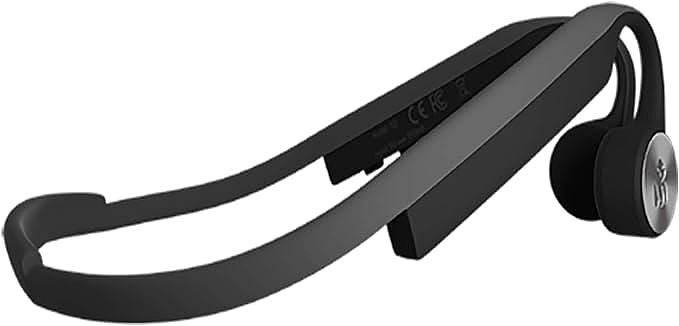
In 1814, a composer who could barely hear his own music pressed a wooden rod against his piano, clamped the other end between his teeth, and felt the notes travel through his jawbone directly into his skull. Ludwig van Beethoven had discovered, out of sheer desperation, what physicists now call osteophony — the transmission of sound through bone. Two centuries later, the same principle powers a generation of headphones that never enter your ear canal at all. Devices like the Gorilla Audio Ultra Ti2 bone conduction headphones rest against your cheekbones and vibrate your skull, leaving your ears completely open to the world around you. The physics behind this trick is more intricate than it appears.
The Backdoor to Hearing
Beethoven was 28 when his hearing began to fail. By his forties, he could barely hear conversation. Yet he continued composing, conducting, and performing — not because his ears worked, but because he found a workaround. Sound, it turns out, does not need the ear canal. It can arrive at the cochlea through an entirely separate route.
When a piano string vibrates, it creates pressure waves in the air — that is air conduction, the pathway most people associate with hearing. But those same vibrations can travel through solid objects: the piano's wooden frame, a metal rod, a human jawbone. The skull, being dense and rigid, is an excellent acoustic conductor. Sound moves through cortical bone at roughly 800 to 3,000 meters per second — up to nine times faster than through air.
The cochlea, that snail-shaped organ deep in your inner ear, does not care how the vibration arrives. Whether the stimulus comes from air pressure against the eardrum or mechanical vibration through the skull, the result is the same: fluid inside the cochlea moves, tiny hair cells bend, and electrical signals race to the brain. The auditory nerve makes no distinction. Bone-conducted sound and air-conducted sound converge on the same basilar membrane traveling wave and stimulate the same populations of hair cells.
This is the central insight of osteophony: the ear has a backdoor, and it has always been open.
What Your Skull Already Knows
Research by Stenfelt and Goode, published in 2005 and refined in subsequent studies, identified multiple pathways through which skull vibrations reach the cochlea. Three mechanisms dominate.
The first is inertial bone conduction. When the entire skull moves back and forth — as it does when a transducer vibrates against your cheekbone — the fluid inside the cochlea resists that motion. Fluid has mass, and mass has inertia. This lag creates a pressure differential across the basilar membrane, which bends and triggers the hair cells. Inertial conduction is the dominant mechanism at lower frequencies.
The second mechanism is compressional bone conduction. At higher frequencies, typically above 800 hertz, the skull no longer moves as a rigid block. Instead, it compresses and expands locally, like a sponge being squeezed. This compression directly deforms the cochlear walls, creating pressure waves in the cochlear fluid. A 2014 study published in Nature Communications demonstrated that this cochlear bone deformation produces a fast wave that closely resembles the basilar membrane wave generated by airborne sound.
The third pathway is osseotympanic conduction. When the skull vibrates, the walls of the ear canal also vibrate, radiating sound inward toward the eardrum. This is a secondary effect, but it contributes to the overall perception, particularly at certain frequencies.
Each of these pathways operates simultaneously, and their relative contributions shift depending on frequency. Below 300 hertz, the skull behaves as a single rigid body. Between 300 and 800 hertz, it enters a transitional regime with complex resonance patterns. Above 800 hertz, the skull acts as a complex resonating sphere with multiple independent vibration modes.
Five Pathways, One Destination
Stenfelt's detailed analysis identified five distinct pathways, not just three. Understanding all five reveals just how many routes sound can take through your head.
Ear canal sound pressure occurs when the vibrating skull walls radiate sound into the ear canal, which then stimulates the eardrum conventionally. Middle ear ossicle inertia matters because the tiny bones of the middle ear — the malleus, incus, and stapes — are suspended in the skull. When the skull vibrates, these bones cannot follow perfectly, creating relative motion between them and the cochlea. This pathway stays within 10 decibels of the dominant mechanism across most frequencies.
Cochlear fluid inertia, the dominant pathway across the full audible range from 0.1 to 10 kilohertz, works because the perilymph and endolymph resist acceleration. Their lag behind the vibrating cochlear walls generates the pressure gradients that move the basilar membrane.
Cochlear space compression and expansion becomes significant at higher frequencies. The bony walls of the cochlea physically deform, squeezing the fluid within. Research by Stenfelt in 2015 showed that in isolation, compression exceeds inertial motion above roughly 5.9 kilohertz.
Finally, cerebrospinal fluid pressure transmission contributes at low frequencies. Intracranial pressure waves reach the cochlea through the cochlear and vestibular aqueducts, though this pathway drops to minus 55 decibels relative to total bone conduction at 10 kilohertz.
The remarkable takeaway: your brain receives auditory information through at least five parallel channels simultaneously, all converging on the same sensory organ. It never confuses them. It does not need to, because at the level of the auditory nerve, bone-conducted and air-conducted sound are indistinguishable.
The Skull as Resonating Sphere
The physics of vibrating a human head is more complex than it sounds, because the head is not a simple object. It is an irregularly shaped bony shell filled with soft tissue, fluid, and air cavities, connected to a flexible neck.
At frequencies below 300 hertz, the entire skull moves together as a unit — rigid-body motion. This is the regime where inertial bone conduction dominates. The whole head rocks back and forth, and the cochlear fluids slosh against this movement.
Between 300 and 1,000 hertz, the skull enters a mass-spring transitional regime. Different parts of the skull begin to move at slightly different phases. Cranial sutures — the joints between skull bones — start to affect how vibrations propagate. The skull is no longer one object but several loosely coupled masses.
Above 2 kilohertz, the skull behaves as a complex resonating structure with multiple vibration modes. This is where things get tricky for headphone engineers. The vibration pattern on one side of the head differs from the other. Sound placed at the left mastoid process arrives at the right cochlea having been filtered, attenuated, and phase-shifted by the complex geometry of the skull.
A 2023 study in Scientific Reports measured contralateral bone conduction — the vibration reaching the opposite ear — in fresh frozen cadaver heads. They found that the most efficient contralateral transmission occurs between 700 hertz and 2 kilohertz, with attenuation of only 5 to 10 decibels. The front of the face showed surprisingly high contralateral transmission efficiency, a finding with implications for transducer placement.
Converting Electricity into Vibration
A bone conduction transducer does the opposite of what a conventional speaker does. In a standard speaker, the magnet is fixed and the voice coil moves, driving a cone that pushes air. In a bone conduction magnetic transducer, the coil is fixed and the magnet moves. The vibrating magnet is attached to a thin diaphragm or cantilever beam, and the entire assembly is housed in a sealed enclosure — often made of titanium.

The engineering challenges are significant. The transducer must maintain consistent coupling force against the skull. Too little pressure and the vibration does not transfer efficiently. Too much and the wearer experiences discomfort within minutes. The cantilever structure must resist twisting, which introduces harmonic distortion. And the resonance frequency — typically tuned to 0.7 to 1.2 kilohertz for medical implants — must be optimized for the specific application.
An alternative approach uses piezoelectric materials. Instead of a magnet and coil, a piezoelectric element deforms when voltage is applied. Research published in Electronics Letters in 2024 demonstrated a 7.7-fold displacement amplification using an optimized bridge mechanism. The amplifier parameters are precise: a beam thickness of 0.15 millimeters, a beam depth of 1.2 millimeters, an inclination angle of 6.5 degrees, and a beam length of 4 millimeters. These numbers are not arbitrary. Each parameter was determined through finite element analysis to maximize the mechanical advantage of the amplifier.
Piezoelectric transducers offer advantages in efficiency and compactness, but they tend to have narrower frequency response than electromagnetic designs. Most consumer bone conduction headphones currently use electromagnetic transducers for their broader frequency coverage.
Why Titanium Matters
The choice of titanium in bone conduction devices is not a marketing decision. It is a materials science decision with deep physiological roots.
Titanium has four properties that make it uniquely suited for acoustic transducers that contact the human body. First, biocompatibility: titanium can rest against skin and bone for years without triggering immune rejection or tissue degradation. Second, hermeticity: titanium enclosures seal effectively, protecting internal components from moisture and corrosion. Third, fracture toughness: titanium resists cracking under repeated mechanical stress — important when the device vibrates millions of times per hour of use.
The fourth property is perhaps the most acoustically relevant. Young's modulus — the measure of a material's stiffness — for titanium is closer to that of bone than stainless steel or aluminum. This matters for impedance matching. When two materials with similar stiffness are pressed together, acoustic energy transfers efficiently between them. When there is a large mismatch, energy reflects back at the interface.
For implanted devices, the gold standard is Ti-6Al-4V ELI, a medical-grade titanium alloy with extra-low interstitial content that maximizes ductility and fatigue resistance. Research published in MDPI Micromachines in 2022 demonstrated fabrication of micron-thick titanium diaphragms for implantable acoustic transducers, using cold-rolled titanium foils just 1 micrometer thick, patterned with deep reactive ion etching, and coated with titanium-platinum multilayers for fatigue resistance.
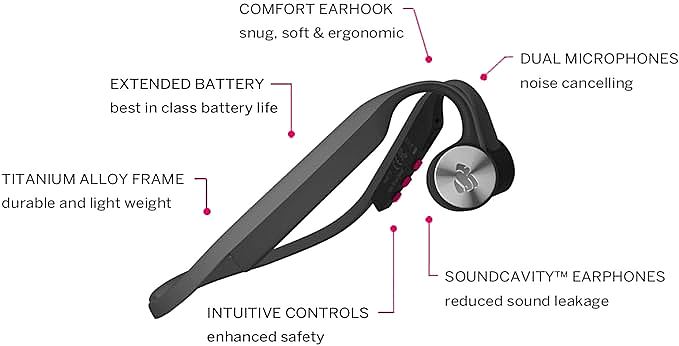
Consumer headphones use commercially pure titanium for their frames — a different grade from the implantable material, but selected for the same underlying reason. The frame must be rigid enough to maintain consistent transducer pressure against the zygomatic arch, yet flexible enough to fit different head sizes. Titanium's combination of high strength and low elastic modulus makes this possible at weights of 30 to 50 grams.
The Open-Ear Compromise
Every engineering decision is a trade-off, and bone conduction headphones make a fundamental one: they sacrifice frequency response for situational awareness.
Traditional headphones create a sealed acoustic environment. The ear canal is blocked, air pressure builds against the eardrum, and bass frequencies reproduce with authority. Bone conduction cannot replicate this pressurization. The ear canal remains open, which means no acoustic seal, no trapped air column, and fundamentally weaker bass reproduction.
The physics explains why. Low frequencies require large diaphragm excursions to generate audible sound pressure. A bone conduction transducer pressing against the cheekbone can vibrate, but it cannot pressurize an enclosed air column. The skull conducts low frequencies efficiently, but the perceived bass is always leaner than what a sealed in-ear or over-ear headphone delivers.
Engineers compensate through equalization circuits that boost low-frequency output, through larger transducers with greater displacement, and through psychoacoustic processing that tricks the brain into perceiving bass that is not fully physically present. These techniques help, but they cannot overcome the fundamental acoustic limitation of an open ear canal.
The payoff is environmental awareness. A runner wearing bone conduction headphones hears approaching cars, bicycle bells, and conversation with full fidelity, because the ear canal is completely unobstructed. This is not a minor benefit — it is a safety feature. In construction, military, and emergency response environments, the ability to receive audio communication while maintaining full situational awareness can be critical.
There is also a comfort dimension. The ear fatigue that comes from hours of sealed in-ear monitors — the pressure, the heat, the occlusion effect that makes your own voice sound muffled — does not occur with bone conduction. The trade-off is real, and it is honest: less bass, more world.
What Beethoven Could Not Have Imagined
Beethoven's wooden rod was a blunt instrument. It transmitted vibrations, but with no frequency shaping, no amplification, and no precision. Two hundred years of engineering have refined the concept into something he could not have anticipated.
Today's research points toward hybrid systems that combine bone and air conduction in a single device, using bone pathways for bass reproduction and tiny air-conducted drivers for high-frequency detail. Computational audio promises real-time frequency response correction personalized to individual skull characteristics — because every skull resonates differently, and a transducer optimized for one person produces a different frequency response on another.
Emerging materials like graphene diaphragms and single-crystal piezoelectrics offer the prospect of transducers that are simultaneously thinner, lighter, and more efficient. Metamaterials — engineered structures with properties not found in nature — could enable frequency shaping at the transducer level, before the signal even reaches the skull.
But the principle remains what Beethoven discovered in his desperation: the skull is a backdoor to hearing, and it is always open. The paradox of osteophony is that in seeking to bypass damaged ears, we discovered that bone might be the more versatile conductor after all. Sound travels through it faster. It does not require an enclosed air column. It works underwater. It works in vacuum, conducted through solid contact. The skeleton does not merely support the body — it listens.
Wireless Earbuds
Related Essays

Beyond the Eardrum: The Hidden Physics of Bone Conduction

The Physics of Bone Conduction: Why Bass Is Hard and How...

Why Your Headphones Lie to You: The Physics of Sound That...

Why Hybrid IEMs Sound Like One Voice, Not Two

Why Bone Conduction + Noise Cancelling Is a Physical Contradiction

The Science of Safe Listening: How Bone Conduction Headphones Keep You Aware
The Physics of Bone Conduction: Why Bass Is Hard and How Engineers Solved It

Why Do Headphones Sound Different? The Science of Audio Physics

The Paradox of Stillness: When Opposing Forces Create Perfect Silence
