Why Bone Conduction + Noise Cancelling Is a Physical Contradiction

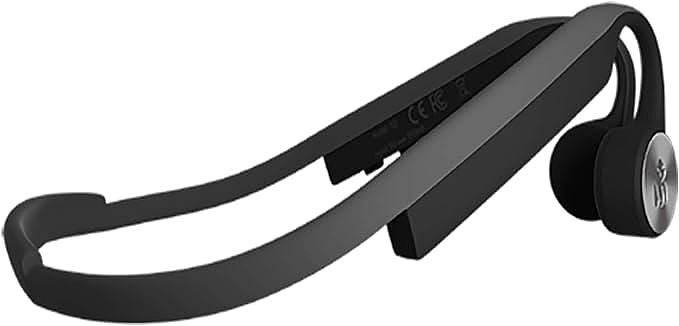
TEDATATA BL09 Sports Headphones
The problem starts with the product listing. A pair of headphones advertised as "bone conduction with active noise cancelling" promises open-ear safety and immersive silence simultaneously. You put them on. Outside noise pours in unchecked. The "noise cancelling" button changes nothing audible.
You check the comments and find someone else who wrote exactly what you suspected: "Not Noise Cancelling or Bone Conduction," confirming the failure is not in your unit but in the physics. You are not confused. The product is. The two features it claims to combine are, at a fundamental physics level, mutually exclusive.
Understanding why means examining how sound enters the human skull, how engineers attempt to erase it, and what happens when marketing collides with thermodynamics.
Two Roads to the Cochlea
Sound reaches your brain through two entirely different physical pathways. The one you use most often, air conduction, is the reason ears exist at all. Pressure waves ripple through the atmosphere at roughly 340 meters per second, funnel into the ear canal, and strike the tympanic membrane, more commonly called the eardrum.
That membrane vibrates in sympathy with the incoming frequencies, transmitting mechanical energy through three tiny ossicle bones, the malleus, incus, and stapes, which act as a lever system amplifying the signal. The stapes presses against the oval window of the cochlea, displacing the fluid inside. That fluid motion deflects the basilar membrane, and approximately 15,000 hair cells along its length convert the deflection into electrochemical signals that travel the auditory nerve to the brain. The entire chain depends on air pressure variations traveling through a sealed canal, and any breach in that seal disrupts the carefully calibrated impedance matching that makes hearing possible.
The second pathway bypasses the ear canal entirely. Bone conduction transmits vibrations through the bones of the skull directly to the cochlear fluid. When a transducer presses against the temporal bone or the mastoid process behind the ear, mechanical oscillations travel through cortical bone at speeds between 800 and 3,000 meters per second, far faster than through air. These vibrations reach the cochlea and agitate its fluid, stimulating the same hair cells that air conduction activates. The brain cannot distinguish which pathway delivered the signal. The perception of sound is identical.

Britannica identifies two distinct mechanisms within bone conduction. Compressional bone conduction operates at higher frequencies, where individual segments of the skull vibrate independently, compressing the bony otic capsule that encases the inner ear. Because the round window membrane moves more freely than the stapes footplate, the vibrations set up in the perilymph are not cancelled out, and the basilar membrane deflects to stimulate the organ of Corti.
Inertial bone conduction operates at lower frequencies, roughly below 1,500 hertz. At these frequencies, the skull moves as a rigid body. The ossicles, suspended in the middle ear cavity and loosely coupled to the skull, resist this motion due to their inertia. The result is relative motion between the stapes and the oval window, producing the same effect as if the stapes itself were vibrating independently of the surrounding skull bone structure.
A landmark 2005 study by Stenfelt and Goode, published in Otology & Neurotology, identified five major pathways through which bone conduction generates auditory perception: sound radiated into the external ear canal, middle ear ossicle inertia, inertia of the cochlear fluids, compression of the cochlear walls, and pressure transmission from the cerebrospinal fluid. Among these, cochlear fluid inertia appears to be the most significant contributor. The implication is clear: bone conduction is not a single mechanism but a family of parallel routes, each with distinct frequency sensitivities and physical dependencies.
How Active Noise Cancelling Works
Active noise cancelling operates on a principle called destructive interference. A microphone captures incoming ambient sound. A processing chip analyzes the waveform and, in real time, generates an inverse wave, a signal whose peaks align with the troughs of the incoming noise and vice versa. When the original sound and the inverse signal meet, they sum to near zero. The offending noise disappears, or at least attenuates significantly.
This process has strict physical requirements. First, the acoustic space must be sealed. Over-ear headphones create a closed cavity between the driver and the eardrum. In-ear monitors use silicone or foam tips to isolate the ear canal. Without this seal, ambient sound enters through gaps, arriving at the eardrum before the inverse wave can intercept it. The cancellation fails because the timing relationship between the noise and the anti-noise collapses. Even a small leak, a gap between the ear pad and the jaw barely wide enough to slip a sheet of paper through, can reduce cancellation by 10 to 15 decibels at low frequencies.
Second, the microphone must capture ambient sound before it reaches the eardrum. Feedforward ANC places the microphone on the outside of the ear cup. Feedback ANC places it inside, closer to the eardrum. Hybrid systems use both. Regardless of architecture, the microphone needs a predictable acoustic environment to model the noise path accurately. An open ear canal introduces chaotic, variable sound paths that the algorithm cannot track in real time.
Third, the inverse wave must arrive at the eardrum simultaneously with the noise. Sound travels approximately 34 centimeters per millisecond. In a sealed headphone, the distance between the driver and the eardrum is roughly 1 to 2 centimeters, giving the processor a window of a few tens of microseconds to compute and emit the anti-noise. This timing precision is achievable only in a controlled acoustic cavity. Open the cavity, and the geometry becomes unpredictable.

The Physical Contradiction
Here is where the two technologies collide. Bone conduction headphones, by design, leave the ear canal open. The transducer rests on the cheekbone or the mastoid, vibrating the skull while the ear remains unobstructed. This openness is the defining feature. Runners hear traffic. Cyclists hear sirens. Factory workers hear colleagues. The open ear canal is not a limitation; it is the purpose.
Active noise cancelling, by equally firm design, requires a sealed acoustic environment. The inverse wave must intercept ambient noise within a controlled cavity. An open ear canal means no cavity. No cavity means no predictable noise path. No predictable noise path means the inverse wave arrives too late, too early, or at the wrong amplitude. Cancellation collapses.
The contradiction is not a matter of poor engineering. It is a matter of physics. You cannot simultaneously maintain an open ear canal for situational awareness and a sealed cavity for destructive interference. The requirements are diametric opposites. A device that claims both is either performing one function poorly while marketing the other, or performing neither while claiming both.
A 2014 study published in Nature Communications by Tchumatchenko and Reichenbach added another layer of understanding. Their mathematical model demonstrated that deformation of the cochlear bone itself produces a fast traveling wave, distinct from the slower basilar membrane wave. This cochlear-bone wave arises because the cochlear chambers are asymmetric, meaning their cross-sectional areas differ. The deformation couples into basilar membrane motion, generating a hearing sensation. The finding matters because it confirms that bone conduction operates through direct mechanical coupling to the cochlear capsule, not through air pressure in the ear canal. Any attempt to cancel sound inside the ear canal does nothing to address vibrations already traveling through the skull bone.
Beethoven's Wooden Rod
In the early 1800s, Ludwig van Beethoven faced a crisis that would have ended most musical careers. His hearing deteriorated steadily from his late twenties onward. By 1814, at the age of 44, he was almost completely deaf. Public performances became impossible. Conversations were conducted in writing.
Beethoven found a workaround. He placed one end of a wooden rod against the soundboard of his piano and clenched the other end between his teeth, biting down hard to ensure the mechanical connection was solid. When he struck the keys, the vibrations traveled through the rod, into his jawbone, and through his skull to the cochlea. The signal bypassed his damaged middle ear entirely. He could hear, faintly and imperfectly, the music he was composing.
The physics was bone conduction. The piano soundboard vibrated. The wooden rod transmitted those vibrations mechanically. The mandible and temporal bone conducted them to the cochlear fluid. Hair cells fired. Neural signals traveled to the auditory cortex. Beethoven heard sound, not through air, but through solid matter pressed against his skull.
His method worked precisely because it avoided the ear canal. Had he tried to hear through air, the deteriorated ossicle chain would have blocked the signal. The rod sidestepped the damage. This is the same principle modern bone conduction headphones use: bypass the air pathway and deliver mechanical energy directly to the skull. The open ear canal was not an inconvenience for Beethoven. It was irrelevant.
Consider the irony. A deaf composer in Vienna two centuries ago understood the fundamental constraint more clearly than some modern product marketers. He never tried to combine bone conduction with ear canal isolation. He used bone conduction specifically because the ear canal was compromised. The technology has one job: deliver sound when the air pathway is unavailable or undesirable. Asking it to also cancel ambient noise through the air pathway it was designed to ignore is asking it to do two opposite things at once.
What About the Products That Claim Both?
Some bone conduction headphones advertise noise cancelling features. When you examine what these features actually do, the picture becomes more nuanced and, often, more misleading.
A few devices implement noise cancelling on the microphone side for phone calls, not for the listener's ears. Dual-microphone arrays can filter out background noise from your voice during a conversation. This is signal processing on the transmit path, not acoustic cancellation on the receive path. The listener still hears ambient sound through their open ear canals. The marketing copy rarely makes this distinction clear.
Other devices add earplugs or silicone tips that partially seal the ear canal. This approach compromises bone conduction's core advantage. Once the canal is sealed, you lose situational awareness. You also introduce air conduction alongside bone conduction, creating a muddled signal path where the two compete. The bone conduction transducer continues to vibrate the skull, but now ambient noise is partially blocked by the physical plug rather than electronically cancelled. This is passive noise isolation, not active noise cancellation. The distinction matters: passive isolation blocks sound mechanically with a physical barrier, while active cancellation generates inverse sound waves. They are different technologies with different limitations.
The Wireless Earbuds, listed on Amazon, illustrate the consumer confusion. The product page claims both bone conduction audio and noise cancelling functionality. One customer comment states bluntly: "Not Noise Cancelling or Bone Conduction." Whether that assessment is accurate about the bone conduction itself is debatable, but the frustration with the noise cancelling claim reflects a genuine physics problem. You cannot seal the ear for noise cancellation while keeping it open for bone conduction's intended purpose.

A Verification Toolkit for Consumers
How can you tell whether a product's claims are physically plausible? A few principles from the physics above translate directly into practical tests.
Check the ear canal. If the headphones leave your ear canal open, as all true bone conduction devices do, active noise cancelling cannot function. Period. Any ANC button on such a device either controls call-mode microphone filtering or does nothing perceptible for ambient noise.
Listen for the seal. Put on over-ear ANC headphones and lift one cup slightly off your ear. The cancellation immediately weakens. That gap, millimeters wide, is enough to break the acoustic seal. Now consider bone conduction headphones, which have no cup and no seal at all. The entire ear is that gap.
Test with a tone. Play a steady low-frequency tone, around 100 hertz, from a speaker near you. Put on the bone conduction headphones. Activate the "noise cancelling." If you can still hear the tone through your open ear at the same volume, nothing is being cancelled. The tone is entering your ear canal through air, unimpeded.
Read the specifications carefully. Look for "DSP noise reduction" or "dual-mic noise reduction." These terms typically refer to microphone-side processing for calls, not acoustic cancellation for the listener. True active noise cancelling specifications mention driver size, ANC chip models (such as Qualcomm QCC514x or similar), and decibel reduction figures. Bone conduction headphones rarely list any of these because they do not have them.
Understand the occlusion effect. If you plug your ear canal while wearing bone conduction transducers, your own voice will sound booming and muffled. This is the occlusion effect: bone-conducted sound from your vocal cords reflects off the plug and reverberates in the sealed canal. Any product that adds a seal to bone conduction headphones creates this problem. It is a trade-off that compromises the hearing experience for a marketing checkbox.
Engineering Honesty and the Limits of Physics
Every technology operates within physical constraints. Aerodynamic drag limits speed. Thermodynamic efficiency limits energy conversion. Signal-to-noise ratio limits measurement precision. These constraints are not failures of engineering. They are boundaries of the physical universe. Good engineering respects them. Good marketing should too.
Bone conduction is a proven technology with genuine applications. It serves people with conductive hearing loss, where the middle ear is damaged but the cochlea functions normally. It serves athletes and workers who need environmental awareness. It serves swimmers who cannot use air conduction underwater. These are real use cases with real value.
Active noise cancelling is equally effective. It serves commuters, office workers, and travelers who need to reduce ambient noise without turning up the volume. The physics of destructive interference, when applied within a sealed cavity, reduces low-frequency noise by 20 to 30 decibels. That is the difference between a jet cabin and a quiet room.
But combining the two in a single product, as currently conceived, violates the physical requirements of at least one of them. A sealed ear canal kills bone conduction's reason to exist. An open ear canal kills noise cancelling's ability to function. There is no middle ground because the constraint is binary: the ear canal is either sealed or it is not.
Future engineering may find a workaround. Directional acoustic interference, advanced feedforward algorithms, or entirely new transduction methods might one day allow partial noise reduction without a physical seal. But that would be a fundamentally different technology, not a combination of existing bone conduction and existing ANC.
Until then, the honest answer to a consumer asking for bone conduction headphones with noise cancelling is the same answer a physicist would give: pick one. You can hear through your bones while remaining aware of your surroundings, or you can silence the world through active cancellation in a sealed cavity. You cannot do both, because the physics of sound propagation does not negotiate with product roadmaps.
The cochlea does not care about marketing departments. It responds to mechanical energy, whether delivered by air pressure through a sealed canal or by vibration through the skull bone. It is a remarkably sensitive instrument, capable of detecting displacements smaller than the diameter of a hydrogen atom. It deserves input from engineers who respect what it can and cannot do. Beethoven, biting down on his wooden rod, understood this intuitively. He did not ask the rod to cancel the noise of Vienna. He asked it to deliver signal through a pathway that worked. Two hundred years later, that remains the correct question.
TEDATATA BL09 Sports Headphones
Related Essays

The Physics of Bone Conduction: Why Bass Is Hard and How...
The Physics of Bone Conduction: Why Bass Is Hard and How Engineers Solved It

Bone Conduction Headphones: Open-Ear Audio for Safety and Awareness

Hamuti X7 Bone Conduction Headphones: Experience Sound in a Whole New Way

Beyond the Eardrum: The Hidden Physics of Bone Conduction
Bone Conduction Technology Explained: How Sound Bypasses Your Eardrum

Air Tube vs Bone Conduction vs Traditional Headphones: An EMF Exposure...

How Bone Conduction Works: The Physics of Hearing Through Your Skull

Hearing Through Your Skull: The Remarkable Physics Behind Bone Conduction and the Shokz OpenMove