How Budget Earbuds Deliver Sound and Survive the Elements


SoundPEATS TrueFree2 Wireless Earbuds
You return home from a long night out and pop your wireless earbuds into your jacket pocket. In the morning, you realize you washed the jacket last night. The earbuds survived a full machine cycle, and now you are wondering how that is even possible. Or maybe you bought a pair of budget earbuds that are cheaper than a night of dinner for two, and you have one question: where did all the corners get cut? The honest answer is that almost none of them were. Modern true wireless earbuds bundle together a stack of mature technologies, and when that stack gets cheap enough, the whole product can cost around thirty dollars. Understanding how budget wireless earbuds work starts with looking at what one representative pair, the SoundPEATS TrueFree2 wireless earbuds, actually does every time you press play.

How a Tiny Earbud Stays Dry Inside a Wet Jacket Pocket
Waterproofing an earbud sounds simple. Just seal it shut. The catch is that an earbud must stay sealed against water while still letting sound out. The speaker has to push air, and air means gaps. Engineers solve this puzzle with three layers. First, the shell gets tightly sealed seams, usually made with an adhesive and a gasket around the battery cavity. Second, the speaker sits behind a waterproof acoustic mesh, a membrane with pores so small that liquid water cannot pass, yet air pressure can. That same idea appears in hearing aids, in-ear monitors, and even some medical devices. Third, the inside of the shell gets a hydrophobic coating. It is not a barrier, it is a repellent. Water beads up on the circuitry and rolls off instead of wicking into it.
When you see an IP code, like the IPX7 label on the box, it is a specific test from the IEC 60529 standard, not a marketing adjective. IPX7, the IPX7 label on our example pair, means the device was submerged in one meter of fresh, still water for thirty minutes in a controlled lab. Note what is missing from that sentence: no moving water, no salt, no detergent, no soap. A washing machine, with its agitation, heat, and chemistry, is a far harsher test than IPX7 ever promises. If your earbuds truly survive a laundry trip, they outlived the specification that certifies them. The certification is a floor, not a ceiling.
Why Some Earbuds Fall Out During a Run While Others Stay Glued On
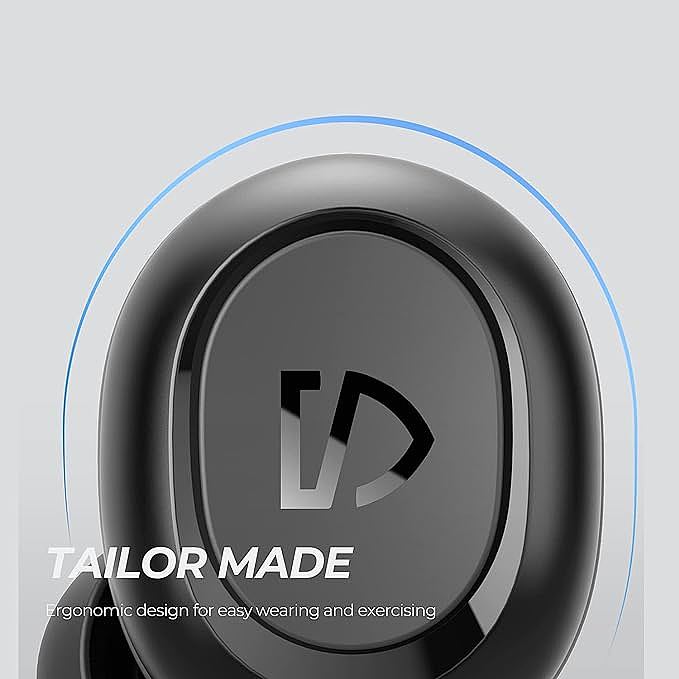
Think of the outer ear as a series of ridges and valleys. The ear cartilage curves up and forms an antihelix, a shelf-like structure that gives hardware something to hang on. Most entry-level earbuds just rest in the ear canal, and the only thing keeping them there is the friction of the silicone tip. Friction is a weak anchor. It works until you sweat, and sweat is a lubricant, so your earbud slides out mid-run.
The trick the example pair uses is an ear fin, a thin piece of flexible silicone that hooks behind or into the antihelix. You get mechanical interlock instead of just grip. Several contact points share the load, so no single spot takes all the force. There is a bonus that is not about staying in place. A tight seal inside the canal acts as a passive noise barrier. It blocks a chunk of the high-frequency noise around you, office chatter, wind, the hiss of traffic, without any electronics. That seal also matters for bass. When the canal is sealed, low frequencies have nowhere to leak out and build up inside the ear. That is why a loose pair always sounds thin. The physics of the fit is doing half of the acoustic work.
What Actually Happens Inside the Shell When Music Plays
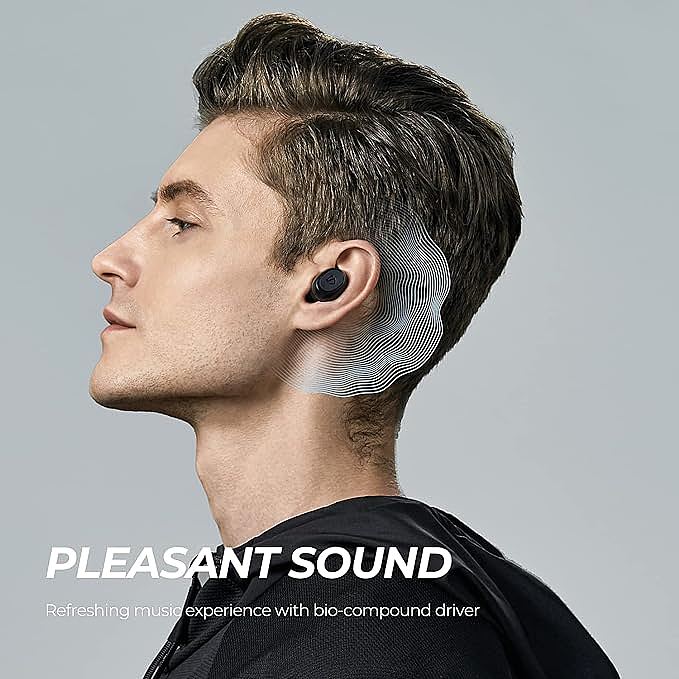
At the center of every earbud is a transducer, and the most common kind in this price class is the dynamic driver. Inside the driver, a tiny coil rides on a magnet, and that coil is attached to a diaphragm about six millimeters across, roughly the width of a pencil eraser. Audio voltage drives current through the coil, the coil pushes against the magnet, the diaphragm moves, and the moving diaphragm pushes air. For a note at 20 kHz, the diaphragm vibrates 20,000 times per second.
The diaphragm material is where the engineering tension lives. High frequencies want a light, thin diaphragm that snaps back fast. Bass wants a stiff, heavy diaphragm that moves a lot of air without flexing into odd shapes. A material that is perfect for one is wrong for the other. Budget earbuds mostly solve this with a paper or plastic diaphragm, which is fine but not ideal. Our example pair uses what the spec sheet calls a bio-cellulose diaphragm. Bio-cellulose is a web of organic fibers grown by bacteria in a fermentation tank. It has an unusually high stiffness-to-weight ratio compared with paper or plastic, so the diaphragm moves as one unit instead of breaking into separate modes. That clean, piston-like motion is what gives the sound its snap and keeps the bass from muddying the mids. You can hear the difference as a sense of instrument separation, where a guitar note and a cymbal hit stay distinct instead of blending into one blob.
Why Lip and Sound Fall Out of Sync When You Watch a Movie
If your music has no lip movement to judge it against, you will never notice it. Watch a film and the dialogue feels a half-second behind the actors. The delay is not in the earbuds, it is in the codec. Bluetooth audio ships with a baseline codec called SBC that every device must support. SBC is a workhorse, it gets the job done and it is free, but it is also slow. A typical SBC round trip, compression on the phone and decompression in the earbuds, adds roughly 170 to 270 milliseconds of delay. The human visual system is fast. That gap lands right in the range where lips and speech feel out of sync, though it is short enough that music still sounds fine.
Premium codecs, like aptX Low Latency, can push that number below 40 milliseconds, where it is imperceptible. They cost license fees, and both ends of the connection have to support them. For a product priced for the mass market, SBC is the rational choice. You get universal compatibility with every phone, computer, and tablet ever made, in exchange for a small lip-sync penalty during video. If that tradeoff bothers you, it is worth knowing that it is a feature of the codec, not a defect of your hardware, and it will not improve with an update.
The connection itself is worth a second. Bluetooth 5.0 on these earbuds is not a single radio wave to your phone. It is a frequency-hopping pattern. The device and the earbuds rapidly switch between 79 channels, each one megahertz wide, up to 1,600 times per second. The hopping dodges interference from Wi-Fi routers and microwaves, and the pattern is unique to your pairing, so it doubles as encryption. All of this runs on a low-energy profile. The earbuds keep the link alive while drinking a trickle of current, which is how the battery lasts hours instead of the ninety minutes that a naive radio design would give you.
How Long the 20-Hour Battery Claim Really Lasts
The 20 hours on a full charge is a sum, not a single number, and it is one of the places where how budget wireless earbuds work surprises first-time owners. It is four to five hours from the earbuds plus roughly four full recharges from the case. Each earbud holds a battery in the 40 to 60 milliamp-hour range, and the case carries 300 to 400 milliamp-hours. That is not a typo. The case battery is bigger than four earbud batteries stacked, and it is why the pouch that charges your earbuds can outlive a day of use with several refills in between.
Lithium-ion cells have a finite life, and that limit is not a defect. It is the chemistry. Each charge cycle grows a thin solid electrolyte film on the anode, and repeated expansion and contraction in the electrodes creates micro-cracks. After 300 to 500 full cycles, the capacity noticeably drops. A two-year-old pair that used to run five hours will quietly run three and a half, and nobody at the factory is at fault. If you store your earbuds with the battery drained for months, you accelerate the very same degradation. Keeping them around 50 percent and charging them regularly is the cheapest battery care that exists.
Why Some Budget Pairs Use Buttons While Others Use Touch Pads
Touch control and physical buttons are two answers to the same problem, and each answer creates a new problem. A touch surface reacts with almost no force, so it can misfire when you slide the earbud into place or brush your hair past it. A physical button gives you a clear click you can feel, so accidental presses are rare, but the force required to press it pushes the earbud deeper into your ear, and that force adds up over a long session. Our example pair chose buttons, which is why some users love the certainty and others complain that the buttons feel stiff. Neither is wrong. It is a trade between reliability and comfort, and different ears and different habits land on different sides of it.
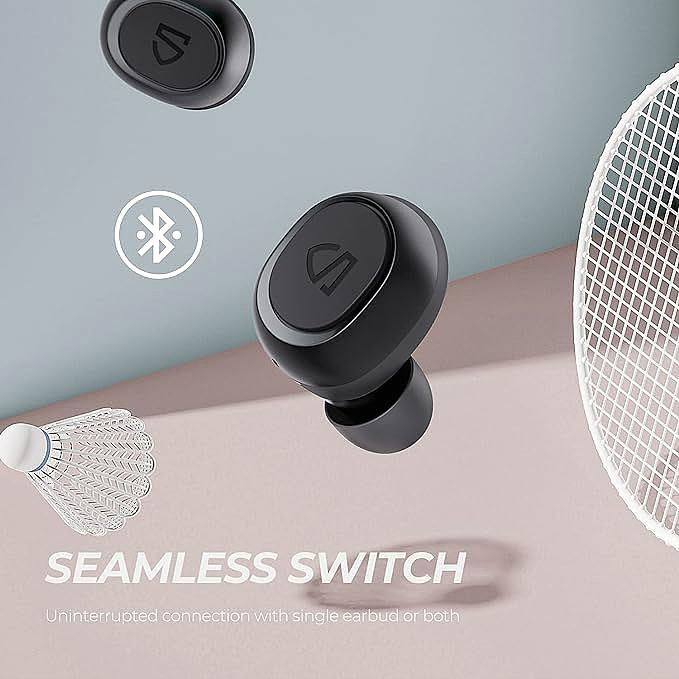
There is a second, quieter design choice that matters more than people think. Many true wireless pairs have a master earbud. One side talks to the phone and relays the audio to its sibling. If the master dies, the whole pair dies. A symmetric, masterless design lets either side work alone, which means you can leave one in for a call or for awareness of traffic and still get sound. It also removes a single point of failure. You will not see this on every cheap pair, but it is a spec worth checking.
Why a Pair of Earbuds Can Cost Thirty Dollars
Twenty years ago, true wireless earbuds were science fiction. Ten years ago, a decent pair cost 150 dollars or more. The reason they are thirty dollars today is not one miracle. It is a supply chain that got boring. The Bluetooth chip, the battery, the driver, the silicone tip, and the charging case are all mass-produced commodities, and a handful of component makers in China supply the entire world. That commoditization, plus a direct-to-consumer model that skips the retail middlemen, is what lets a budget brand ship a pair with a bio-cellulose driver, IPX7 waterproofing and a 20-hour battery for the price of a sandwich.
The flip side of a commoditized supply chain is a commoditized support experience. You will not get multi-point connection, the ability to hold links to a phone and a laptop at the same time. You will not get an app that tunes the equalizer to your hearing. You will not get a premium codec that erases the lip-sync delay. What you do get is the core experience, secure fit, clean sound, long battery, and waterproofing, at a fraction of the flagship price. If your goal is a reliable backup pair you can lose without crying, that is exactly the right tool for the job. If your goal is a single flagship pair that does everything, the flagship is still the flagship.
SoundPEATS TrueFree2 Wireless Earbuds
Related Essays

Volkano VK-1124 True Wireless Earbuds - Great Sound and Battery Life for an Affordable Price

The Engineering of Utility: Deconstructing the Modern Budget Earbud

Ludos Clamor Wired Earbuds: Unplug and Experience Sound Anew

IKG S23 True Wireless Earbuds: Lightweight and Long Battery Life Make These Affordable Earbuds a Great Buy

RUMIXI H01: Engineering the Future of Affordable Audio

Generic CBT T2390 Bluetooth Headphones - Unleash Your Wireless Freedom

: Lasuney T20 True Wireless Earbuds – IPX7 Waterproof, 35H Playtime and Great Sound Quality

Translating Radio Frequencies into Biological Resonance: The Architecture of Untethered Audio

Sony WF-1000XM3: Unpacking the Science of Early True Wireless Noise Cancellation

