Wired Sport Earbuds: The Engineering Case for Over-Ear Hooks and 3.5mm Audio


MUCRO MB-232 Wired Earbuds
Why Most Earbuds Fail During Exercise
Mid-set, between the third and fourth repetition, an earbud shifts. The left channel drops out for half a second as the silicone tip slides free of the ear canal, then catches on the collar of a shirt, then falls onto a rubber mat coated in chalk. This is not a rare failure. It is the predictable outcome of objects designed for stillness being subjected to acceleration, impact, and the slow accumulation of perspiration.
The physics working against conventional earbuds during exercise are simple and unforgiving. Gravity pulls a lightweight object downward. Inertia resists changes in motion, so every jump, sprint, and abrupt directional shift translates into a force vector that the ear canal — a smooth, slightly oily surface — cannot fully resist. Add sweat, which reduces friction further, and the result is a device that dislodges at the moment it is needed most.

Wired sport earbuds attempt to solve this through geometry rather than electronics. The MUCRO MB-232, priced at $18.99 and built around an over-ear hook combined with a wired analog connection, is one example of this approach. But the interesting story is not the product itself. It is the engineering logic underneath: how a flexible hook converts a fragile fit into a stable one, why analog audio survives where Bluetooth introduces compromise, and why sweat — the obvious enemy of any wearable — is managed through material choices rather than marketing claims. Examining those principles reveals why wired sport earbuds can hold their own against far more expensive wireless alternatives in the specific context of vigorous activity.
The Cantilever Principle Behind Over-Ear Hooks
The outer ear is not a flat surface. It is a structure of ridges, folds, and concavities — the pinna, concha, helix, and antihelix — that cartilage shapes into a reasonably repeatable geometry across most adults. An over-ear hook exploits this geometry by anchoring to a part of the body that moves relatively little even when the head bobs, twists, or accelerates sideways.
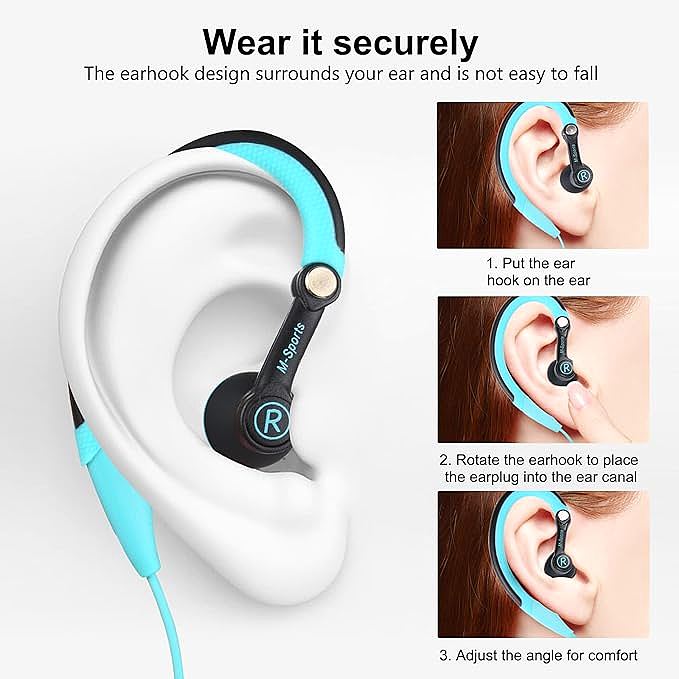
The mechanism is essentially a cantilever. A cantilever is a beam fixed at one end and free at the other — think of a diving board. In the case of an earbud hook, the fixed end is where the hook wraps over the top of the pinna and rests against the antihelix on the rear side of the ear. The free end is the earbud body itself, suspended in the concha. When the head moves, the inertial load on the earbud body produces a force that would normally pull the tip out of the canal. Instead, that force is transferred back along the hook, where the friction and curvature against the antihelix convert what would be a dislodging shear force into a compressive force against resilient cartilage.
Cartilage tolerates compression well. Skin lining the ear canal tolerates shear poorly. By rerouting the load from one tissue to the other, an over-ear hook raises the threshold of motion required to break the seal. A conventional earbud can be dislodged by a single motion — a tug, a jump, a turn of the head. Our deep dive on why earbuds fall out explains the physics behind this common frustration. A hooked design typically requires two simultaneous motions: one to lift the hook clear of the pinna, and another to withdraw the tip from the canal. That doubling of failure conditions is the difference between a wired sport earbud that stays put through a set of box jumps and one that lands on the floor.
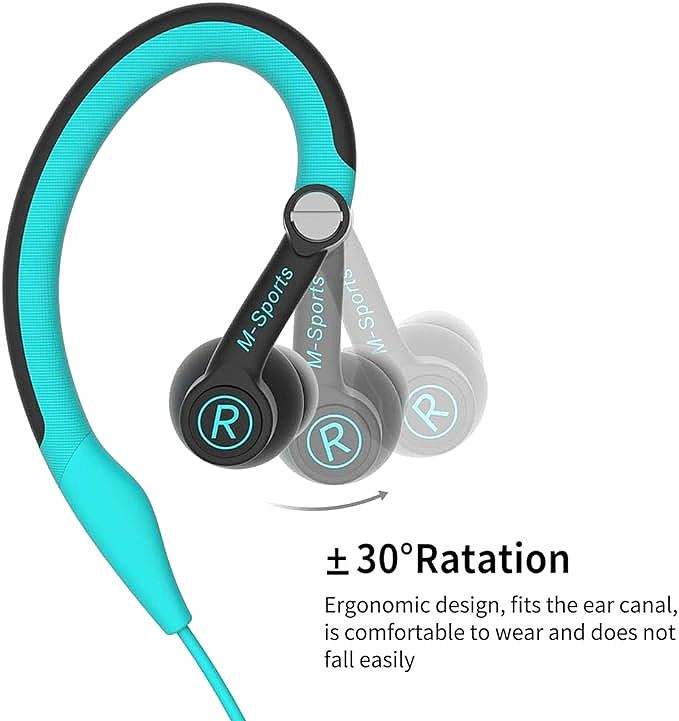
The practical evidence shows up in the activities where conventional earbuds fail predictably. CrossFit workouts with rope climbs and burpees. Trail running on uneven descents where each footstrike transmits a shock upward through the cervical spine. High-intensity interval training with its rapid changes of direction. In each case, the governing variable is not the wired sport earbud's weight but how that weight is distributed across the structures of the ear. The hook changes the distribution.
Passive Isolation and the Acoustics of an Ear Canal Seal
Once an earbud is physically stable, a second benefit follows: the silicone or foam tip can maintain a consistent seal in the ear canal. That seal is the foundation of passive noise isolation, and it works through a principle that is more mechanical than electronic.
Ambient sound reaches the ear as pressure waves traveling through air. When the ear canal is open, those waves propagate directly to the eardrum. When the canal is sealed by a compliant tip — one that conforms to the irregular shape of the canal's entrance — the tip acts as an acoustic barrier. Low-frequency content, the part of the spectrum that carries gym noise, traffic hum, and the mechanical drone of treadmills, is attenuated before it reaches the eardrum. The attenuation is not total, and it is not flat across frequencies, but it is meaningful — typically 15 to 25 decibels of reduction in the lower register for a well-fitted foam tip, somewhat less for silicone.
The safety implication matters more than the convenience. When ambient noise is high, the listener compensates by raising playback volume. Sustained volume above roughly 85 decibels is the threshold most audiologists cite for cumulative noise-induced hearing damage over an eight-hour exposure. By reducing the background level by 20 decibels, a sealed ear canal allows the same perceived loudness of music at a substantially lower actual volume. The earbud protects hearing by permitting quieter listening — an effect that requires no battery, no DSP, and no algorithm.
There is a trade-off, and it should be stated plainly. A sealed canal reduces situational awareness. For a runner on a treadmill, this is a minor concern. For a cyclist sharing a road with vehicles, or a runner crossing intersections, the loss of ambient cues — approaching footsteps, engine noise, the mechanical click of a turn signal — has real safety consequences. The same physics that makes passive isolation valuable indoors makes it a liability outdoors. The honest engineering position is that one wired sport earbud design cannot serve both contexts equally; the user must choose, or remove an earbud when ambient awareness matters more than isolation.
Sweat, Corrosion, and the Limits of Waterproofing Claims
Sweat is not water. Human perspiration is a saline solution — roughly 0.3 to 0.6 percent sodium chloride by weight, with trace potassium, lactate, and urea — at a temperature of around 35 degrees Celsius and a pH between 4.5 and 7.0. From the perspective of a small electronic assembly containing copper traces, solder joints, and a dynamic driver with a voice coil, sweat is a corrosive electrolyte. It conducts current where current should not flow, it accelerates oxidation of exposed metal, and over weeks and months of repeated exposure it migrates through seams that appeared sealed at the factory.
The defenses against sweat are material rather than electronic. Moisture-resistant polymers in the housing. Gaskets and ultrasonic welds at the seams where two halves of a shell meet. Hydrophobic nano-coatings applied to the printed circuit board inside — thin layers of fluoropolymer chemistry that raise the contact angle of water droplets so they bead and roll off rather than wetting the surface. None of these are perfect. Each is a probabilistic defense: a reduction in the rate at which moisture reaches the electronics, not an absolute barrier.
This is where the marketing language around waterproofing deserves scrutiny. An IPX rating — the Ingress Protection standard — describes how much water a device is rated to withstand, based on standardized exposure levels. IPX4 means splashing water from any direction. IPX7 means temporary immersion to one meter. A device without a published IP rating has not failed those tests; it has simply not been submitted to them. The absence of a rating tells the buyer nothing definitive about real-world sweat resistance, because the manufacturer may have chosen to skip the certification for cost reasons, or may have judged that the design exceeds the requirements without needing the label. The honest reading is that the user is relying on material choices and construction quality rather than a verified standard, and should set expectations accordingly. A wired sport earbud at this price cannot reasonably be expected to survive a lifetime of gym sessions, but its construction either manages routine sweat or it does not — and the replacement cost of a failed unit is low enough that longevity becomes a matter of economics rather than catastrophe. This is one reason wired sport earbuds remain a defensible choice for athletes who train hard enough to destroy hardware: when sweat eventually wins, the replacement cost is trivial.
Why a Wired Connection Still Outperforms Bluetooth for Sport
The argument for a wired connection during exercise is not nostalgic. It rests on three measurable engineering advantages that wireless audio, by the nature of its design, cannot match.
The first is latency. A wired analog connection transmits the electrical waveform of audio directly to the driver — there is no encoding, no radio transmission, no buffering, no decoding. The signal arrives at the speaker cone at essentially the speed of light through copper. Bluetooth, even with modern low-latency codecs, introduces somewhere between 150 and 250 milliseconds of end-to-end delay, because the audio must be compressed, transmitted over a 2.4 GHz radio link, received, and decompressed at the earbud. For music listening this latency is imperceptible. For video content it produces visible lip-sync error. For any application involving real-time audio feedback — a coaching app, a metronome for rhythm-based training, a game — the delay compounds.
The second advantage is signal integrity. An analog signal over a shielded copper cable arrives exactly as it left the source, minus a small amount of attenuation that is uniform across the audible spectrum. A Bluetooth signal arrives after lossy compression — the codec discards audio data to fit within the bandwidth constraints of the radio channel. Whether the difference is audible depends on the listener, the codec, and the source material, but the engineering fact is that wireless audio is a compressed representation of the original, not the original itself.
The third advantage is the one that matters most during a workout: zero battery dependency. A wireless earbud contains a lithium-ion cell with a finite cycle life. Each discharge and recharge cycle degrades the cell's capacity. After two to three years of daily use, the runtime that began at six or eight hours has typically fallen to half that, and the cell eventually fails entirely. A wired earbud draws power from the source device and contains no battery to degrade. It works on the first attempt every time, in cold weather that would slow a lithium cell, and after months of neglect in a gym bag. For wired sport earbuds specifically, this means the device is ready the moment it is plugged in — no pre-workout charging ritual, no anxiety about whether yesterday's session left enough charge for today's.
The economic case follows from the technical one. A wireless sport earbud typically occupies the $25 to $50 range, which amounts to a price premium of roughly 30 to 160 percent over a comparable wired model. That premium buys convenience: no cable to snag, no jack to plug in, freedom of movement. It does not buy better audio, lower latency, or longer service life. For a user whose primary context is structured exercise on a treadmill, a rower, or a weight platform — where the cable is unlikely to snag and the source device sits within arm's reach — the convenience premium is difficult to justify, and the wired alternative retains a clear cost-of-ownership advantage. Over a three-year horizon, the wireless unit also requires replacement as its battery fades, while the wired unit continues to function for as long as the cable and driver survive.
How the Four Features Reinforce One Another
None of the four design choices above — the over-ear hook, the in-ear seal, the sweatproof construction, the wired connection — operates in isolation. The interesting engineering story is how they compose.
The over-ear hook maintains the position of the earbud body in the concha. Because the body is stable, the silicone tip maintains a consistent seal in the ear canal. Because the seal is consistent, passive isolation functions as designed, and playback volume can remain at a safer level. Because the assembly is sealed, the internal electronics are protected from the sweat that vigorous activity produces. Because the audio path is analog and the device draws power from the source, none of this depends on a battery that might fail mid-workout, and none of it is interrupted by the codec negotiation or pairing handshake that occasionally derails a wireless session at the worst possible moment.
This is what deliberate engineering looks like: a set of choices that share a common context and amplify one another's strengths. The opposite — a device that mixes a poor mechanical fit with a sophisticated DSP, or a battery-powered wireless design in a price bracket where the cell will degrade faster than the buyer expects — is the result of choices made against an incompatible context.
The economic logic is similarly cumulative. A wired sport earbud at $18.99 is not merely cheaper than a $49.95 wireless alternative at the moment of purchase. It remains cheaper across the full service life, because there is no battery to replace and no charging hardware to lose. For a buyer who trains several times a week and treats wired sport earbuds as semi-disposable — a reasonable posture given the abuse they receive — the per-session cost of a wired unit approaches zero within a year. The wireless unit's per-session cost never stops accumulating.
Who This Class of Product Actually Serves
The clearest way to describe a wired sport earbud's audience is to define who benefits and who does not.
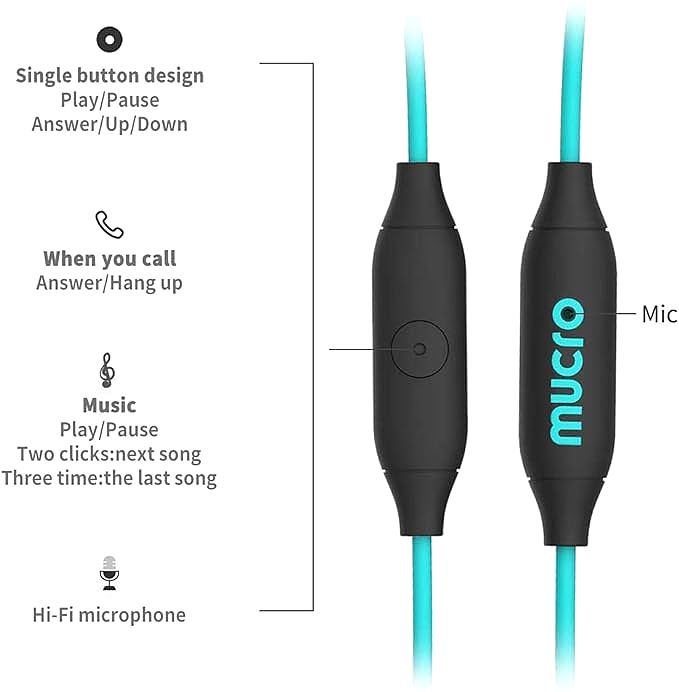
The primary user is someone engaged in structured indoor exercise — weight training, treadmill running, rowing, stationary cycling, HIIT classes — where a source device is within arm's reach and a cable will not snag on equipment. For this user, the reliability of an instant analog connection and the stability of an over-ear hook solve the two failures that actually disrupt a workout: the dropped earbud and the dead battery. An inline microphone on the cable also handles voice calls during a session, picking up speech through a small omnidirectional capsule positioned near the jaw. Because the microphone sits on a physical wire rather than relying on Bluetooth codec negotiation, call audio remains stable even in gyms with heavy wireless interference. This is the context in which wired sport earbuds outperform their wireless counterparts most clearly.
The secondary user is cost-sensitive in a principled way. Not the buyer chasing the cheapest possible option, but the buyer who has weighed the convenience premium of wireless against its trade-offs and concluded that the premium does not pay back in their use case. For this user, $19 spent on a device that lasts two or three years is a better allocation than $50 spent on a device whose battery fades within the same window.
The tertiary user owns multiple source devices — a phone with a wired jack, a laptop, a tablet, the auxiliary input on older gym equipment, an aviation or gaming headset port — and values the universality of an analog connection that requires no pairing and no protocol negotiation.
The user who should look elsewhere is the commuter on public transit who needs active noise cancellation to suppress engine drone, the phone owner whose device has no wired jack and who does not want to use a dongle, the athlete training outdoors in traffic where situational awareness is a safety requirement rather than a preference, and the listener for whom the cable itself is the deal-breaking inconvenience. None of these users is wrong; they are simply outside the design context in which wired sport earbuds make sense.
Value Without the Premium
The MUCRO MB-232 sells for $18.99 with a wired plug and $19.99 in a USB-C variant - a price point that signals budget positioning as honestly as its two colorways do. The compatibility list — iPhone models with the appropriate jack, iPod, Samsung devices — anchors the product to a specific generation of hardware rather than pretending to universality.
The interesting claim this product makes is not about itself. It is about a category. Wired sport earbuds occupy a thin slice of the audio market that wireless marketing has spent a decade trying to declare obsolete, yet the category persists because the underlying engineering argument has not changed. A cable transmits audio more faithfully than a codec. A hook holds an earbud more securely than friction alone. A device without a battery cannot fail for lack of charge. Sweat destroys electronics, and well-chosen materials slow that destruction more reliably than an unverified marketing claim. The wired sport earbuds category survives precisely because these four principles remain true regardless of how many features a wireless flagship adds.
For a buyer whose priority is reliable audio during exercise rather than the absence of a cable, the engineering case is straightforward. The least expensive device that implements the four principles competently will outperform a more expensive device that implements them partially or not at all. In that frame, the value proposition is not $19 against $50. It is the recognition that for this specific context, the older technology remains the correct technology — and paying more buys convenience, not capability. That is the case for wired sport earbuds in general, and for evaluating any single product in this category on the strength of its engineering rather than its marketing budget.
MUCRO MB-232 Wired Earbuds
Related Essays
Mucro MB-232 Wired Sport Earbuds: Secure Fit and Sweatproof Design Science

