Silencing the Copper Wire: The Invisible Architecture of Modern Audio

QHQO H3 Wireless Earbuds
Severing a headphone cable does more than cut copper. It removes the one component in the entire signal chain that has no failure mode — a direct metallic path from amplifier output to transducer input. Every replacement technology for that path introduces physics the wire never had to navigate: electromagnetic interference, electrochemical degradation, real-time lossy compression, and the relentless constraint of battery chemistry. This is the starting point for wireless audio engineering as a discipline: not making wireless sound as good as wired, but rebuilding every function the wire once provided — signal fidelity, noise rejection, timing — through software, silicon, and systems design. The field of wireless audio engineering is, at its foundation, the study of what happens when you remove a conductor and force information to travel by other means.
A modern true wireless earbud is not one device but a federation of subsystems, each pulling from the same finite power budget and the same constrained thermal envelope. The practice of wireless audio engineering is the art of keeping that federation from tearing itself apart. The Bluetooth radio, the audio codec processor, the DAC and headphone amplifier, the MEMS microphone array and its beamforming DSP, the capacitive touch interface, the battery management PMIC — all must negotiate milliwatts and microseconds with one another inside a volume that can be hidden behind a tragus. When any one subsystem overspends, another starves. This architecture makes wireless audio systems a study in inter-subsystem economics as much as in any single engineering domain.
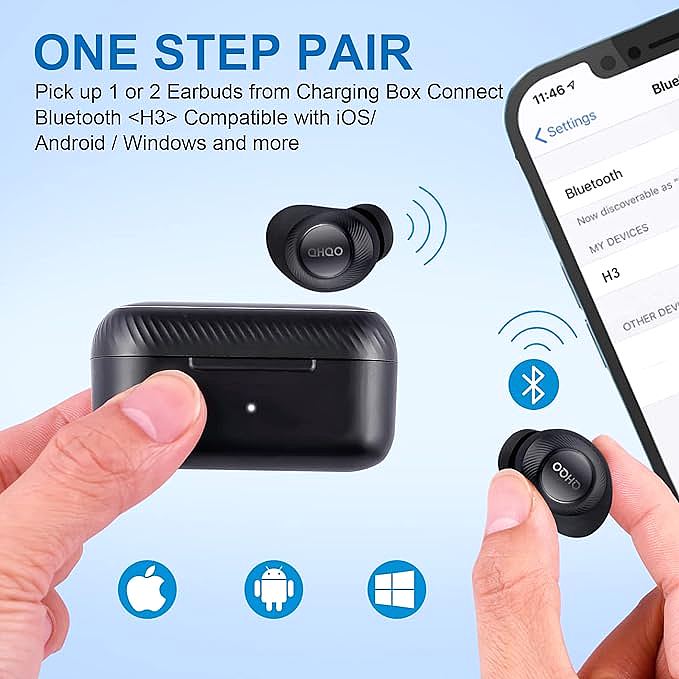
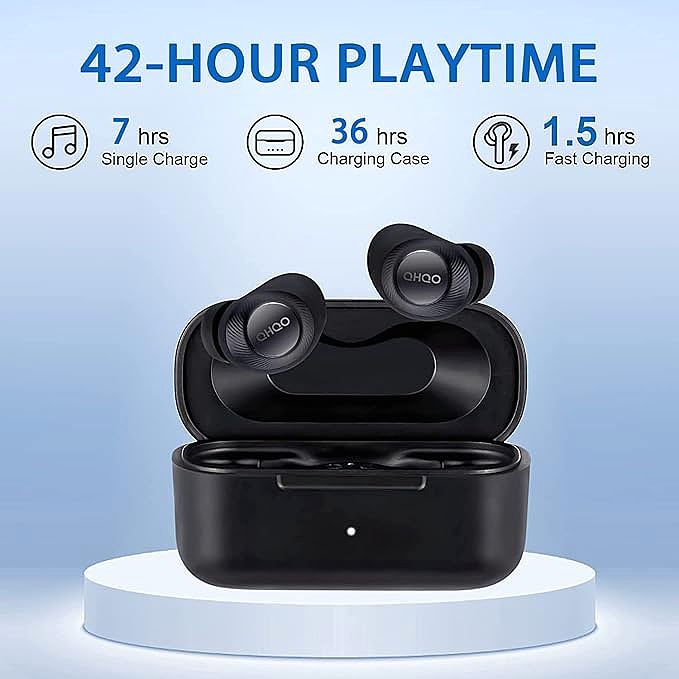
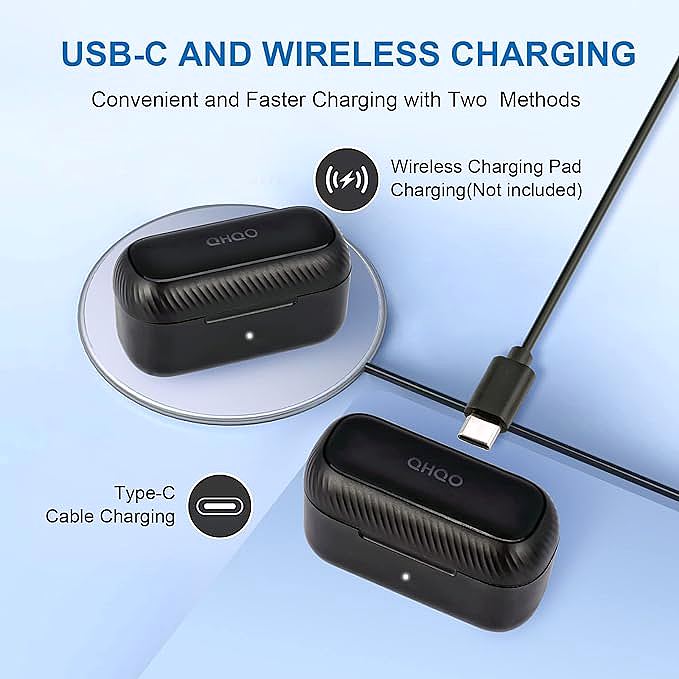
A concrete example makes these abstractions more tractable. The QHQO H3 Wireless Earbuds integrate Bluetooth 5.2, IPX7-rated waterproofing, wireless charging, and a beamforming voice array into a 58-gram package with 42 hours of total runtime. Examining its subsystems provides a window into the physics that governs all such devices — not as a product recommendation, but as an engineering case study.

Why Does a 2.4 GHz Signal Survive a Crowded Subway?
At 8:47 AM on a weekday, a New York City subway car contains roughly 120 passengers. Conservatively, 40 of them carry smartphones with active Bluetooth and Wi-Fi radios. Each phone generates emissions across the 2.4 GHz ISM band — the same 83.5 MHz-wide slice of spectrum the earbud uses. The train itself adds variable-frequency interference from traction motors and control electronics. Metallic interior surfaces create multipath reflections that bounce signals unpredictably. Human bodies, rich in water, absorb whatever reaches them.
A single-frequency radio link would fail in this environment within seconds. The Bluetooth protocol survives it through Frequency-Hopping Spread Spectrum (FHSS), a technique rooted in military communications research from the 1940s. The 2.402 to 2.480 GHz band is partitioned into 40 channels spaced 2 MHz apart. The phone and earbud share a pseudo-random hopping sequence — derived from the master device's Bluetooth address and clock — that moves the link to a new channel every 625 microseconds, yielding up to 1,600 hops per second. A collision with a Wi-Fi beacon on channel 11 lasts at most one hop interval before the link moves on. If a packet is corrupted, a retransmission mechanism recovers it on a subsequent hop.
Bluetooth 5.2 enhances FHSS with Adaptive Frequency Hopping (AFH) that performs active channel classification. The link controller monitors packet error statistics for every channel in the hopping set. Channels whose error rate exceeds a programmed threshold are removed from the active sequence and replaced with channels that exhibit clean reception. The channel map updates dynamically — when a passenger three seats away activates a mobile hotspot, the AFH algorithm detects the new interference source and remaps within connection intervals. This is not a static filter applied at pairing time. It is a continuous, real-time spectrum monitoring system baked into the baseband controller firmware.
Separately, the human body acts as a frequency-dependent attenuator. Tissue's water content — roughly 60 percent by mass in adult humans — creates a dielectric medium that absorbs electromagnetic energy through dipole relaxation. Water's permanent dipole moment of 1.85 Debye means the molecule rotates in response to an oscillating electric field. At 2.4 GHz, the field alternates polarity 2.4 billion times per second. The rotational kinetic energy dissipates into the surrounding tissue as microscopic heating. A signal path from a phone in a left hip pocket to a right-ear earbud traverses 15 to 20 centimeters of water-dense abdomen, chest, and skull tissue. Measured cross-head path loss at 2.4 GHz can exceed 25 dB in worst-case postures. The link budget must maintain connectivity across this variable — the body is not a static attenuator but a time-varying channel impairment modulated by posture, clothing, and hydration.
In the lexicon of wireless audio engineering, the human torso is an RF obstacle with a loss tangent that changes when you cross your arms. The broader challenge of untethered audio design encompasses not just routing data through the air but doing so through a transmission medium — the human body — whose dielectric properties shift with every movement.
The Electrochemistry of Tiny Power Plants
Inside every wireless earbud, a lithium-polymer cell runs a controlled electrochemical reaction whose rate must remain perfectly stable for hours despite wildly varying load conditions. The cell does not simply provide power. It provides power that must not sag, must not overheat, and must not degrade over hundreds of charge-discharge cycles — all within a volume comparable to a pencil eraser.
A Li-Po cell is a thin-film sandwich. The anode consists of graphite — carbon atoms arranged in hexagonal sheets that store lithium ions between layers during charging. The cathode is a lithium transition-metal oxide, most commonly lithium cobalt oxide (LiCoO2), structured as a layered crystal that accepts and releases lithium ions reversibly. A microporous polymer separator, typically polyethylene or polypropylene, keeps anode and cathode electrically isolated while allowing lithium-ion transport through its liquid-electrolyte-filled pores. Copper foil serves as the anode current collector; aluminum foil serves at the cathode.
During discharge, the anode releases lithium ions into the electrolyte. These ions diffuse through the separator and intercalate into the cathode's crystal lattice. Meanwhile, electrons flow from the anode current collector, through the external circuit — powering the Bluetooth SoC, the audio codec, the DAC, the amplifier — and into the cathode current collector to maintain charge neutrality. The open-circuit voltage starts at roughly 4.2 volts at full charge and declines to approximately 3.0 volts at the safe discharge floor. Below this voltage, the anode potential rises sufficiently to dissolve copper from the current collector. Dissolved copper ions can replate as metallic dendrites during the next charge cycle — needle-like conductive structures capable of piercing the separator and creating an internal short.
Volumetric energy density in earbud cells is constrained by the form factor. A 45 mAh cell occupying 0.8 to 1.2 cubic centimeters achieves roughly 150 to 170 watt-hours per liter at the cell level. At a system power draw of 15 to 25 milliwatts for active audio playback, the cell delivers 3.5 to 5 hours of operation. The margin is thin. Every milliwatt removed from the signal processing chain — through more efficient codec implementations, lower-leakage silicon processes, shorter radio active windows — returns minutes of playback. Power efficiency is not a secondary optimization. It is the binding constraint on every other design decision, and the discipline of wireless audio engineering has evolved an entire taxonomy of power-saving techniques — from silicon process selection to protocol-level duty cycling — to stretch every milliwatt-hour. This power-efficiency mindset is central to wireless audio engineering: every design choice trades sound quality against battery life.
Internal resistance, typically 100 to 300 milliohms for cells at this scale, introduces voltage droop under transient load. A bass transient demanding a 50-milliwatt current spike can momentarily depress the supply rail below the SoC's minimum operating voltage, causing a silent reset. The countermeasure involves low-ESR ceramic decoupling capacitors as close to the SoC power pins as layout permits, supplemented by conservative gain staging in the headphone amplifier to cap peak current demand.
DAC, Codec, and the Digital-to-Analog Bridge
Audio begins its life inside a smartphone as a sequence of integer samples — Pulse Code Modulation values, each a 16-bit or 24-bit number encoding the instantaneous amplitude of an analog waveform. A stereo stream sampled at 44.1 kHz generates 88,200 such values per second. To become sound, these numbers must be converted to a continuously varying voltage — the domain of the Digital-to-Analog Converter.
A DAC is architecturally a programmable voltage divider. At each sample clock tick, the converter receives a binary word and outputs a voltage proportional to its numeric value. The most common topologies are the R-2R ladder network — a resistor chain whose binary-weighted taps sum to the output — and the delta-sigma architecture, which uses oversampling and noise shaping to push quantization error into ultrasonic frequencies where a simple analog low-pass filter can remove it. The Nyquist-Shannon sampling theorem provides the theoretical guarantee: a signal band-limited to less than half the sampling frequency can be perfectly reconstructed from its samples. The reconstruction filter — a physical low-pass filter at the DAC output — removes the staircase artifacts, leaving a smooth analog waveform.
In a wired audio system, PCM data travels over conductors at a fixed clock rate. The only variable is cable quality. In a wireless system, the data must cross an RF channel whose available bandwidth is a fraction of what uncompressed audio requires. CD-quality stereo at 16-bit/44.1 kHz consumes 1,411 kilobits per second. The Bluetooth Enhanced Data Rate (EDR) physical layer delivers a theoretical maximum of roughly 3 Mbps, but the A2DP audio profile's usable throughput after protocol overhead and error correction is considerably lower. Compression is not optional.
This is where codecs enter. The mandatory Subband Coding (SBC) algorithm uses a polyphase filter bank to split the audio spectrum into 4 or 8 frequency subbands. Each subband is quantized independently, with bit allocation driven by a psychoacoustic model: subbands where the human auditory system is less sensitive — those masked by louder adjacent frequencies, or near the extremes of hearing — receive coarser quantization. The Advanced Audio Coding (AAC) codec, which Bluetooth also supports, replaces the filter bank with a Modified Discrete Cosine Transform for finer frequency resolution and achieves better perceptual quality at equivalent bitrates. Both discard information — they are lossy codecs — but the discarded data is chosen algorithmically to fall below the threshold of conscious perception.
The full signal chain — source file, decompression to PCM, wireless transport encoded as A2DP packets, codec decode, serial bus transfer (typically I2S or SoundWire), DAC conversion, reconstruction filtering, analog amplification, and voice-coil transduction — introduces latency at each stage. Total end-to-end latency, from phone to eardrum, must stay below approximately 40 milliseconds for video lip-sync and below roughly 100 milliseconds for music playback to feel instantaneous. Every buffering stage, every packet retransmission, every FFT overlap-add operation in the codec adds microseconds. Managing this cumulative latency while maintaining synchronization between left and right earbuds — which receive independent Bluetooth packets and must reconstruct a coherent stereo image — remains one of the most demanding aspects of the system. It is a challenge specific to wireless audio engineering: in a wired system, stereo synchronization is a property of the cable; in a wireless system, it must be engineered from scratch.
The Physics of Sound Reproduction
A dynamic driver transducer is, stripped to its essentials, an electromagnetic linear actuator. A cylindrical voice coil — often wound from copper-clad aluminum wire to minimize moving mass while preserving conductivity — sits within the radial magnetic field of a neodymium ring magnet. Current through the coil generates a Lorentz force perpendicular to both the magnetic field lines and the current direction, accelerating the coil and its attached diaphragm along the magnet's axis. Alternating the current polarity reverses the force direction, producing alternating compression and rarefaction of the surrounding air.
The driver's Achilles' heel is bass. Low-frequency sound waves have long wavelengths — 40 Hz corresponds to roughly 8.6 meters in air — and require moving large air volumes. The acoustic power radiated by a piston scales with the square of its surface area and the square of its peak displacement. A 10-millimeter driver with 0.5 millimeters of linear excursion can displace approximately 40 cubic millimeters of air per stroke. At 40 Hz, that is orders of magnitude below audibility in free space. Worse, in an open-baffle configuration, the sound waves from the front and rear of the diaphragm arrive out of phase at low frequencies and cancel — an effect called dipole cancellation that produces a 6 dB per octave roll-off below a cutoff determined by the baffle dimensions.
The in-ear monitor solves both problems with a sealed acoustic chamber. When a silicone eartip forms an airtight seal in the ear canal, it traps a fixed volume of air — roughly 1 to 2 cubic centimeters — between the driver diaphragm and the eardrum. The diaphragm now works against a stiff acoustic compliance: the trapped air behaves as a spring. Even sub-millimeter diaphragm excursions produce substantial pressure fluctuations in such a small, sealed volume. The acoustic impedance transformation converts the driver from a velocity source into a pressure source at low frequencies. This is why a properly sealed in-ear monitor can produce flat bass extension to 20 Hz with a driver that, in open air, would produce nothing audible below 200 Hz.
The practical consequence is that eartip seal integrity determines more of the perceived sound signature than any other single variable. A seal gap of half a millimeter acts as an acoustic high-pass filter, bleeding low-frequency pressure energy from the sealed cavity. The resulting bass roll-off can exceed 15 dB in the sub-100 Hz octave. No amount of DSP-based equalization can fully compensate — the missing acoustic energy has been physically vented from the system, and attempting to boost the electrical signal to recover it would drive the amplifier into clipping without restoring the lost sound pressure. Two listeners using the same earbuds with different seal quality are, for acoustic purposes, listening to different transducers.
Driver Size and Acoustic Trade-offs
The diameter of a dynamic driver — typically 8 mm, 10 mm, or 12 mm in earbuds — sets a fundamental trade-off between bass extension and treble clarity. Larger diaphragms move more air at low frequencies, but their increased mass limits high-frequency response. An 8 mm driver rolls off earlier but offers faster transient response; a 12 mm driver extends deeper but may smear fast passages. Audio engineers designing wireless earbuds must select driver size based on the target frequency response curve, not simply maximize diameter.
MEMS Microphones and the Art of Listening
If the speaker driver converts electricity into acoustic pressure, the microphone must perform the inverse under far more hostile conditions — capturing a single human voice from an environment dense with competing sounds, all from a sensor package smaller than a grain of rice.
This subsystem is a microcosm of the challenges that define wireless audio engineering. It begins with materials deposition and photolithographic patterning. It passes through precision analog front-end design — femtofarad-level capacitance measurement in the presence of power-supply noise and RF interference. It concludes with embedded firmware executing a real-time gesture classification state machine and an environmental-adaptation algorithm. Three distinct engineering domains, converging into a touch sensor the user experiences as a simple tap. The precision of this audio signal processing pipeline — from microphone diaphragm to digital beamformer — determines how effectively a wireless earbud isolates a single voice in a crowded environment.
Every subsystem in a wireless earbud — the FHSS transceiver navigating an electromagnetic riot, lithium ions shuttling across a polymer separator to sustain a signal processing pipeline, an MDCT codec squeezing a stereo image through a narrow RF window, a sealed acoustic cavity granting bass authority to a millimeter-scale driver, a MEMS array sculpting a directional voice beam from microsecond timing offsets, a capacitive grid decoding human intent through charge-transfer dynamics, and a PMIC policing the nanometer-thin boundary between safe discharge and catastrophic dendritic failure — depends on every other subsystem to stay within its margin. Push the radio duty cycle too aggressively and the audio buffer underruns. Shrink the decoupling capacitance to save board space and a bass transient browns out the SoC. The device works only because each discipline — RF, electrochemistry, signal processing, acoustics, materials science, embedded control — has been optimized not in isolation, but in conversation with all the others. That conversation, sustained across milliwatts and millimeters, is the essence of wireless audio engineering — a discipline that exists precisely because transmitting high-fidelity sound without wires demands not one singular innovation but a dozen, each depending on all the others to function.
QHQO H3 Wireless Earbuds
Related Essays
The Four Pillars of Unbreakable Sport Audio

How True Wireless Stereo Technology Rewired the Way We...

The Science Behind Wireless Audio: From Bluetooth Origins...

Why Your Wireless Earbuds Last 48 Hours: The Physics Behind Battery and Sound

Senso PODS Plus Wireless Earbuds - True Wireless Earbuds for Everyday Use

The Physics of Silence: How Active Noise Cancellation Works

How Hollywood, Radio Physics, and Neural Networks Built the...

Sport Earbuds Technology Explained: The Physics of Fit, Waterproofing, and Sound

Bluetooth 5.3: How Radio Physics Solves Your Wireless Audio Problems
