Bone Conduction Technology Explained: How Sound Bypasses Your Eardrum
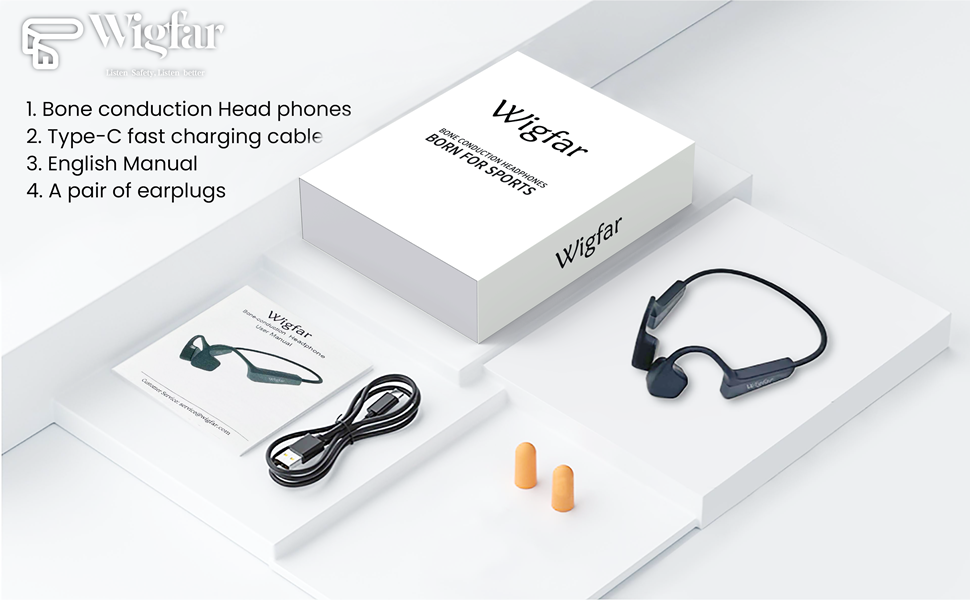
Wigfar Wig-11 Bone Conduction Headphones
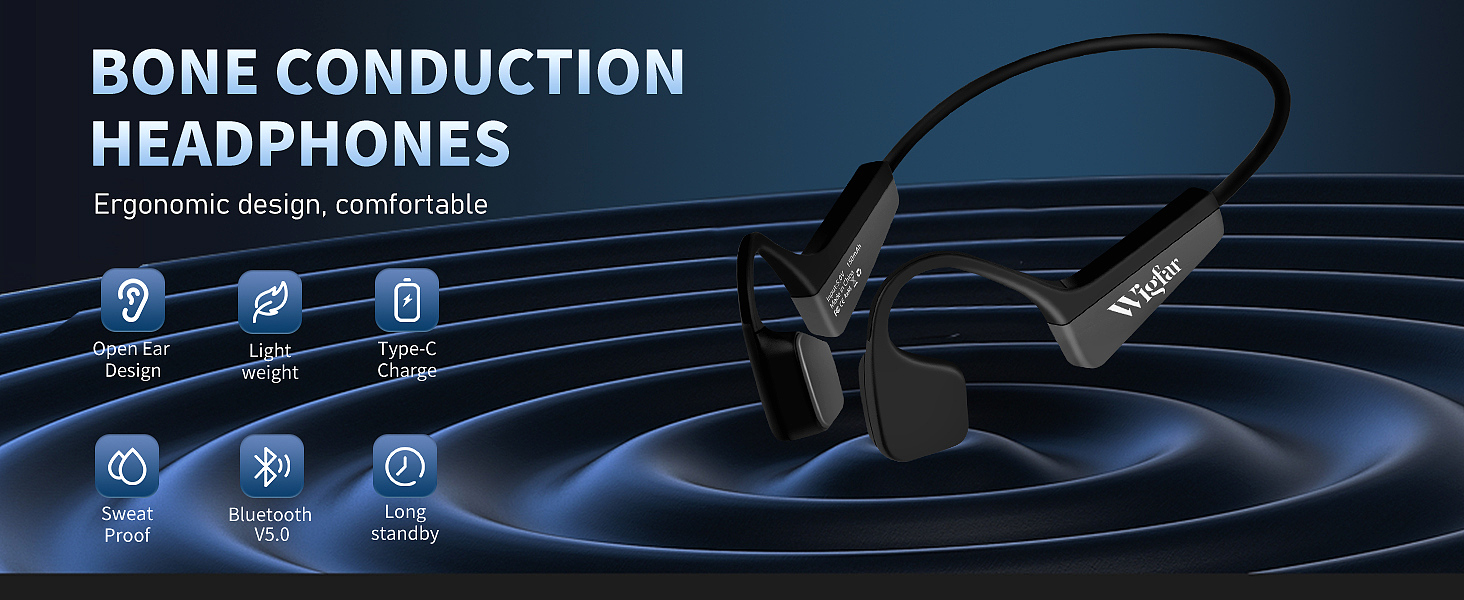
Wigfar Wig-11 Bone Conduction Headphones
The Wigfar Wig-11 Bone Conduction Headphones combines solar charging technology with active noise cancellation, offering up to 80 hours of battery life on a single charge — and potentially infinite playtime in sunlight.
Priced at $135.99 for Midnight Black and $199.00 for Sand Gold, it targets outdoor commuters and travelers who want to eliminate cable anxiety.
What Bone Conduction Actually Is
Sound is mechanical vibration. That is the first principle most people overlook. We tend to think of sound as something that travels through air and arrives at our eardrums, but vibration does not care about the medium. It travels through solids, liquids, and gases alike — and it actually moves faster through denser materials. Air conducts sound at roughly 343 meters per second. Water? About 1,480 meters per second. Bone? Approximately 4,080 meters per second. Your skull is a better conductor than the air around you.
Bone conduction bypasses the outer ear entirely. Instead of pushing air pressure waves against the eardrum, a transducer pressed against the temporal bone generates vibrations that travel through the skull directly to the cochlea — the spiral-shaped organ in the inner ear that converts mechanical motion into electrical signals for the brain. The eardrum, the ossicles (those three tiny bones called malleus, incus, and stapes), the entire middle ear mechanism: all of it is skipped.
This is not a new pathway. It is the original pathway. Before you were born, you heard your mother's voice through bone conduction — her vocal cords vibrating through her skeleton, through amniotic fluid, through your developing skull. Air conduction is the method you learned after birth. Bone conduction is the one you were born with.
Beethoven and the Wooden Rod
The most famous case of bone conduction in history belongs to Ludwig van Beethoven. By 1814, the composer was almost completely deaf. He could no longer hear his own piano through air. His solution was mechanical: he bit down on a wooden rod pressed against the piano's soundboard. The vibrations traveled through his jaw, into his skull, and reached his cochlea. He composed some of his most celebrated works — the late sonatas, the Ninth Symphony — perceiving music through his bones.
Beethoven was not the first to notice this phenomenon, but his case made it undeniable. If a deaf man can hear a symphony through his jaw, then the ear is not the only gateway to sound. The implications sat dormant for over a century.
The medical field eventually caught on. In the 1970s, Australian researchers developed the cochlear implant, stimulating the auditory nerve directly. By the 1980s, the bone-anchored hearing aid (BAHA) emerged — a titanium fixture surgically implanted behind the ear, conducting sound through the skull to bypass conductive hearing loss. The technology pathway reads like a timeline of descent: cochlear implant (1970s) to BAHA (1980s) to consumer bone conduction headphones (2000s) to affordable models in the 2010s and beyond. Medical engineering became consumer electronics, as it often does.
The Physics of Skull-Mediated Sound
Understanding why bone conduction sounds different from air conduction requires understanding what happens to vibration as it moves through the skull. The cochlea contains fluid and thousands of hair cells arranged along a basilar membrane. High frequencies stimulate cells near the base; low frequencies stimulate cells near the apex. This tonotopic map is the same regardless of how vibration arrives — whether through the eardrum or through the skull.
But the journey to get there is different, and that difference matters.
When sound enters through air, the eardrum and ossicles act as an impedance matcher. The middle ear amplifies air pressure waves into mechanical force suitable for the fluid-filled inner ear. This system is remarkably efficient at frequencies between roughly 20 Hz and 20,000 Hz — the full range of human hearing.
Bone conduction lacks this impedance-matching stage. The transducer pushes vibration directly into bone, which carries it to the cochlea. The result is a frequency response that drops off sharply below 500 Hz. Low bass notes — the kick drum, the rumble of a pipe organ, the low E on a bass guitar — are physically attenuated. The skull does not transmit them efficiently.
This is not a design flaw. It is a structural property of how bone transmits vibration. The frequency response range of typical bone conduction transducers sits between approximately 100 Hz and 10,000 Hz, compared to 20 Hz to 20,000 Hz for conventional headphones. That missing octave at the bottom and the truncated high end are the physics talking.
There is a workaround, though it comes with a trade-off. Inserting foam earplugs while wearing bone conduction headphones blocks ambient air from reaching the eardrum, which reduces the masking effect of environmental noise on the bone-conducted signal. The perceived bass improves by approximately 3 to 5 dB. You gain low-frequency presence but lose the open-ear advantage — the very reason most people choose bone conduction in the first place.
Why the Sound Leaks
Sound leakage is the second most common complaint, and it follows directly from the physics. The transducer vibrates against the skull, but it also vibrates the air around it. Those air vibrations are audible to anyone nearby, especially at higher frequencies. This is not a manufacturing defect. It is conservation of energy. You cannot vibrate a surface without also vibrating the adjacent medium.
The leakage problem intensifies with volume. Crank the transducer higher to compensate for the missing bass, and you increase both bone conduction and air radiation. The person sitting next to you on the bus hears your podcast. This is why bone conduction headphones are best suited for environments where ambient noise already masks the leakage — running trails, gym floors, open offices — and less suited for quiet libraries or shared workspaces.
The Open-Ear Advantage
If the sound quality is limited and the leakage is inherent, why does this technology persist? The answer is situational awareness.
Conventional earbuds create acoustic isolation. Even without active noise cancellation, a sealed earbud blocks the ear canal, reducing ambient sound by 20 to 30 dB. At running speeds, that isolation is dangerous. A cyclist traveling at 25 km/h needs to hear approaching vehicles. A runner on a trail needs to hear other people, animals, and environmental cues. The open-ear design of bone conduction headphones leaves the ear canal completely unobstructed. Ambient sound enters naturally.
This is not a minor benefit. Outdoor sports participation in Western markets shows approximately 35% penetration of open-ear audio devices among regular runners and cyclists. The market for bone conduction headphones has been growing at a compound annual rate of roughly 15%, driven primarily by safety-conscious athletes rather than audiophiles.
There is a secondary advantage that receives less attention: ear canal health. Prolonged use of in-ear devices creates a warm, moist environment that can promote bacterial growth and ear canal irritation. Bone conduction headphones avoid this entirely. For people with sensitive ear canals, chronic otitis externa, or those who simply cannot tolerate the pressure of earbuds, bone conduction offers a genuinely different experience.
Titanium and the Frame Problem
The physical frame of a bone conduction headphone is not just structural — it is acoustically relevant. The transducer must maintain consistent contact with the temporal bone. Any gap, even a few millimeters, degrades the coupling and reduces sound transmission. Angular misalignment of more than 15 degrees from the optimal contact point causes measurable audio quality decline.
This is where material science enters the picture. The frame needs to be flexible enough to fit different head sizes, springy enough to maintain contact pressure during movement, and durable enough to survive sweat, rain, and repeated flexing. Titanium alloys satisfy all three requirements. They have a high strength-to-weight ratio, excellent fatigue resistance, and they spring back to their original shape after deformation. The Wigfar Wig-11 uses a titanium alloy frame, the same class of material found in frames costing six times as much.
The weight of the frame also matters. A heavier headset shifts during vigorous movement, breaking the transducer-skin contact. At approximately 158 grams, the Wig-11 sits in the middle range — heavier than premium models like the Shokz OpenRun Pro at 29 grams, but light enough to maintain contact during moderate exercise. The weight difference is partly a function of the dual-driver design, which combines a bone conduction transducer with an air conduction element to supplement the low-frequency response.
The Dual-Driver Compromise
Combining bone conduction and air conduction in a single earpiece is an attempt to address the bass problem without sacrificing the open-ear design. The bone conduction transducer handles the mid and high frequencies where it performs well. The air conduction element directs low-frequency energy toward the ear canal without sealing it. The result is a modest improvement in perceived bass response while maintaining partial environmental awareness.
This is an engineering compromise, not a solution. The air conduction element adds weight, increases power consumption, and introduces a second source of sound leakage. But it illustrates a principle that runs through all of audio engineering: every design decision is a trade-off, and the best you can do is choose which trade-offs align with your use case.
When Bone Conduction Works and When It Does Not
The practical implications of the physics are straightforward. Bone conduction headphones perform well in scenarios where environmental awareness matters more than audio fidelity: running, cycling, hiking, gym workouts, office work where you need to hear colleagues, and any situation where sealed earbuds would isolate you from sounds you need to hear.
They perform poorly in scenarios where audio quality is the priority: critical music listening, mixing and mastering, any environment where bass reproduction matters. They are also unsuitable for swimming — the IP55 rating of most models, including the Wig-11, protects against dust and water jets but not submersion. For underwater use, IP68-rated models are required.
Wind noise during cycling presents another challenge. At speeds above 30 km/h, turbulent airflow across the transducer creates a low-frequency rumble that masks the already-weak bass response. Some riders report that music becomes nearly unintelligible at cycling speeds, with only the mid-range vocals remaining audible. This is a physical interaction between aerodynamics and acoustics, not a product defect.
The Safety Ceiling
One often-overlooked advantage of bone conduction is inherent volume limiting. Conventional headphones can deliver sound pressure levels exceeding 120 dB directly into the ear canal, well above the 85 dB threshold where prolonged exposure causes noise-induced hearing loss. Bone conduction transducers, because of their limited frequency response and the energy lost to air radiation, typically max out around 110 dB. The open-ear design also means that users tend to listen at lower volumes because they are not competing against ambient noise in an acoustically sealed environment.
This is not to say bone conduction headphones are hearing-safe at all volumes. Any sound that reaches the cochlea at sufficient intensity can damage hair cells, regardless of the conduction path. But the physics of the system make accidental overexposure less likely than with sealed earbuds.
The Engineering Philosophy of Incomplete Sound
Bone conduction headphones will never match the frequency response of conventional headphones. The physics of skull transmission will not change. The bass will always be attenuated. The sound will always leak. These are not problems to solve; they are properties of the medium.
What can change is the frame, the transducer efficiency, the driver configuration, and the digital signal processing. The dual-driver approach, the titanium alloy, the Bluetooth 5.0 protocol, the CVC noise suppression for calls — these are engineering responses to the constraints of physics. They push the performance ceiling upward, but the ceiling itself is fixed.
Perhaps that is the more honest way to think about bone conduction technology. It does not promise better sound. It promises different sound, delivered through a different pathway, for situations where the conventional pathway creates problems. Beethoven did not bite that wooden rod because it sounded better than air. He bit it because air had stopped working. The same logic applies today: you choose bone conduction not because it reproduces a kick drum with authority, but because you need to hear the car behind you while the kick drum plays.
Wigfar Wig-11 Bone Conduction Headphones
Related Essays

Hearing Through Your Skull: The Remarkable Physics Behind Bone Conduction and the Shokz OpenMove

CSL-Computer D101 Wireless Earbuds: Experience Sound in a Whole New Way with Bone Conduction

The Sound You Feel: How Bone Conduction Headphones Let You Hear Through Your Skull

TEDATATA AIR52 Bone Conduction Headphones: A Mini Open Earbud Providing an Immersive Music Experience

How Bone Conduction Works: The Physics of Hearing Through Your Skull

Bone Conduction Headphones: Open-Ear Audio for Safety and Awareness

Bypassing the Eardrum: The Mechanics of Cranial Audio

The Open-Ear Dilemma: Air Conduction vs. Bone Conduction Explained

Loluka Wireless Ear Clip Earbuds: Hear It All with Open-Ear Freedom
