Wireless Earbuds Battery Life: What the Numbers Actually Mean

CAPOXO N7 Wireless Earbuds
Wireless earbuds battery life typically delivers 5 to 12 hours per charge from 40 to 60 mAh cells, with total playback reaching 24 to 30 hours via a 500 to 800 mAh case. Manufacturer claims assume moderate volume, SBC codec, room temperature, and ANC off, which is why real-world results run 30 to 50 percent lower.
How Battery Capacity Is Actually Measured
Battery capacity in wireless earbuds is expressed in milliampere-hours (mAh). One mAh represents one-thousandth of an ampere sustained for one hour. A typical lithium-polymer cell inside each earbud holds between 40 and 60 mAh, while the charging case contains a larger cell ranging from 500 to 800 mAh. Budget models use smaller 30 to 35 mAh earbud cells, while premium ANC earbuds push toward 65 to 80 mAh to power the additional noise-cancellation hardware.
The energy capacity in watt-hours (Wh) provides a more physically meaningful figure. To convert, multiply the mAh rating by the nominal cell voltage (typically 3.7 V) and divide by 1000. A 50 mAh earbud cell stores 0.185 Wh, while a 600 mAh case stores 2.22 Wh. This conversion matters because a 50 mAh cell at 4.2 V fully charged holds more energy than the same cell near depletion at 3.0 V, but the mAh rating alone does not capture that voltage-dependent energy.
Manufacturers rarely publish Wh ratings for earbuds. The convention of quoting mAh persists because consumers are familiar with the unit, even though it obscures the voltage-dependent energy available under different load conditions.
The Earbud Battery: Size vs Capacity Tradeoffs

Every cubic millimeter inside an earbud competes for space. The battery, speaker driver, Bluetooth antenna, DSP chip, microphones, and sensors all share a volume constrained by the need to fit comfortably inside the human ear. A typical true wireless earbud measures 200 to 300 mm3 in internal volume, and the battery occupies roughly 30 to 40 percent of that space.
Lithium-polymer cells offer energy densities between 250 and 300 Wh per liter. At the 0.5 to 1.0 ml volume available in an earbud, this translates to roughly 40 to 100 mAh at 3.7 V. Increasing capacity requires a larger cell, which either makes the earbud physically larger or forces compromises such as a smaller speaker driver or fewer microphones.
Active noise cancellation imposes a direct battery penalty. The ANC system requires two to four microphones per earbud, a dedicated DSP core, and continuous power to drive the feedback loop. This overhead adds roughly 1.5 to 3 mA of constant draw, reducing a 6-hour battery life to approximately 4.5 to 5 hours with ANC engaged. The Sony WF-1000XM5 manages 8 hours with ANC on by using an integrated processor that combines Bluetooth and ANC functions on a single chip, reducing idle power overhead.
The Charging Case: Extending Total Playback Time
The charging case functions as a portable power reservoir. Its larger cell, typically 500 to 800 mAh, recharges the earbuds multiple times before needing its own recharge. The number of recharges depends on the case-to-earbud capacity ratio, adjusted for transfer efficiency.
Energy transfer from case to earbud occurs through spring-loaded pogo pins or magnetic contacts. Transfer efficiency ranges from 70 to 85 percent, meaning 15 to 30 percent of case energy is lost as heat and circuit overhead. A 600 mAh case recharging 50 mAh earbuds yields 12 theoretical recharges, but realistically 8 to 9 after losses.
This is why total playback time never equals a simple sum of earbud life plus case capacity divided by draw. The Apple AirPods Pro 2 achieves 6 hours from the earbuds plus 24 hours from the case for a 30-hour total. The case holds approximately 520 to 550 mAh, and each earbud draws roughly 45 to 50 mAh per charge. The 24-hour case figure reflects conservative accounting that includes transfer losses and case-level circuit consumption.
Some cases include features that consume reserve power. LED battery displays, Bluetooth proximity detection, and wireless charging coils all draw small amounts of current even when the earbuds are not actively charging. A case with a digital display may lose 2 to 3 percent of its capacity per day to these background functions if left idle.
What Drains Battery: ANC, Volume, Codec, and Temperature

Volume level is the single largest variable in real-world battery drain. The relationship between perceived loudness and amplifier power follows a logarithmic scale: doubling perceived volume requires roughly ten times the power. Moving from 50 percent to 70 percent volume can increase current draw by 40 to 60 percent, cutting a 6-hour battery life to approximately 3.5 to 4 hours.
Active noise cancellation adds a constant power overhead. The microphones sampling ambient sound at 200 to 500 Hz, the DSP computing anti-noise signals, and the speaker driver producing the cancellation waveform all consume power continuously. This overhead typically reduces battery life by 20 to 40 percent compared to ANC-off mode. The Samsung Galaxy Buds2 Pro rates 5 hours with ANC on and 8 hours without, a 37.5 percent penalty that aligns with the expected overhead for a dual-microphone ANC system.
Bluetooth codec selection significantly impacts power consumption. SBC, the mandated Bluetooth audio codec, requires minimal processing. AAC adds moderate overhead. High-resolution codecs like LDAC and aptX HD increase power draw by 15 to 25 percent because the DSP must decode a richer stream. LDAC at 990 kbps consumes roughly 30 percent more power than SBC at 328 kbps.
Temperature affects both immediate capacity and long-term health. Lithium-polymer cells lose approximately 10 to 15 percent of effective capacity at 0 degrees Celsius and up to 20 percent at minus 10 degrees. In heat above 35 degrees, chemical side reactions accelerate, permanently reducing total charge capacity over time.
How Manufacturer Test Conditions Differ from Real Use
Manufacturer battery life claims are measured under controlled laboratory conditions that rarely match real usage. The standard protocol specifies playback at 50 to 60 percent volume, a stable Bluetooth connection at 1 meter, room temperature of 22 to 25 degrees Celsius, SBC codec at default bitrate, ANC disabled, and fresh cells at 100 percent charge.
Real-world conditions introduce compounding variables. Listening at 70 to 80 percent volume in a noisy commute increases power draw by 40 to 60 percent. Using LDAC or aptX HD adds another 15 to 25 percent. ANC on reduces capacity by 20 to 40 percent. Bluetooth retransmissions in crowded 2.4 GHz environments add 10 to 15 percent. The cumulative effect can reduce a 50-hour advertised total to 20 to 28 hours of actual use.
Some manufacturers test with ANC off and publish that as the primary spec, mentioning the ANC-on figure in smaller print. The Samsung Galaxy Buds2 Pro advertises 8 hours with ANC off but only 5 hours with ANC on, a difference that fundamentally changes the value proposition for commuters who rely on noise cancellation.
The Bluetooth SIG does not enforce a standardized battery life test for wireless audio. Each manufacturer defines its own protocol, and there is no regulatory requirement to disclose test conditions. Two products both claiming 8 hours per charge may have been measured under entirely different assumptions.
Battery Degradation: Why Capacity Drops Over Time
All lithium-polymer cells degrade with use. The primary mechanism is growth of the solid electrolyte interphase (SEI) layer on the anode, which consumes lithium ions and reduces the charge the cell can hold. A typical earbud battery retains approximately 80 percent of its original capacity after 300 to 500 full charge cycles.
Given that most users complete one full cycle every 2 to 3 days, the 80 percent threshold arrives around 18 to 24 months of regular use. After 800 to 1000 cycles, capacity typically drops to 60 to 70 percent, at which point single-charge playtime may fall from 6 hours to 3.5 to 4 hours. The case battery degrades on a similar cycle count but is less noticeable because its larger absolute capacity means the same percentage loss removes fewer total recharges.
Several factors accelerate degradation. Storing cells at 100 percent charge for extended periods increases electrolyte stress. High temperatures above 30 degrees Celsius during charging accelerate chemical aging. Fast charging at high currents generates internal heat that contributes to degradation, though modern charge-management ICs mitigate this by tapering current as the cell approaches full.
One earbud often degrades faster than the other due to asymmetric usage. Users who favor one ear for calls, or who use mono mode predominantly on one side, create uneven cycle counts. After a year, one earbud may hold 70 percent of original capacity while the other holds 85 percent, creating a frustrating imbalance where the weaker bud dies hours before its partner.
Fast Charging: How It Works and Its Tradeoffs
Fast charging in wireless earbuds typically delivers 10 to 15 minutes of charging for 1 to 2 hours of playback. This is achieved by charging the cell at a higher current during the constant-current phase, before the charge IC tapers to a lower current as the cell approaches full voltage. The Sony WF-1000XM5 supports a quick-charge feature providing 60 minutes of playback from a 3-minute charge.
The tradeoff is heat generation and accelerated degradation. Charging at 1C generates roughly 2 to 3 degrees Celsius more internal heat than charging at 0.5C. Over hundreds of cycles, this additional heat contributes to faster SEI growth and capacity loss. A battery charged exclusively at 1C may reach the 80-percent threshold at 300 cycles rather than 500.
Modern fast-charging systems mitigate this risk through temperature sensors and adaptive current control. The charge IC monitors cell temperature and reduces current if the cell exceeds 40 degrees Celsius, making fast charging safe for occasional use.
The charging case typically accepts 5V/1A or 5V/2A input, limiting fast charging to the earbuds. Charging the case from empty via USB-C takes approximately 1.5 to 2 hours for a 600 mAh cell, while wireless charging takes 2.5 to 3.5 hours due to lower power transfer.
Wireless Charging: Convenience vs Efficiency Loss
Wireless charging uses electromagnetic induction to transfer energy from a pad to the case. A transmitter coil in the pad generates an oscillating magnetic field at 100 to 205 kHz, and a receiver coil in the case converts this field back into electrical current through Faraday's law of induction.
The efficiency of wireless charging ranges from 60 to 75 percent, compared to 85 to 95 percent for wired USB-C. The 15 to 25 percent energy loss dissipates as heat in both the pad and the case. A 600 mAh case that takes 2 hours to charge via USB-C may take 2.5 to 3 hours on a wireless pad, and the case surface temperature can rise 5 to 10 degrees above ambient.
Alignment between the pad coil and case coil affects efficiency significantly. A lateral misalignment of 5 to 10 millimeters can reduce efficiency by 20 to 30 percent, causing the case to charge at half the expected rate or triggering the pad's foreign-object detection. For overnight charging, wired USB-C remains the better choice: faster, more efficient, and generating less heat that degrades the battery over time.
Product Comparison: Three Real-World Examples

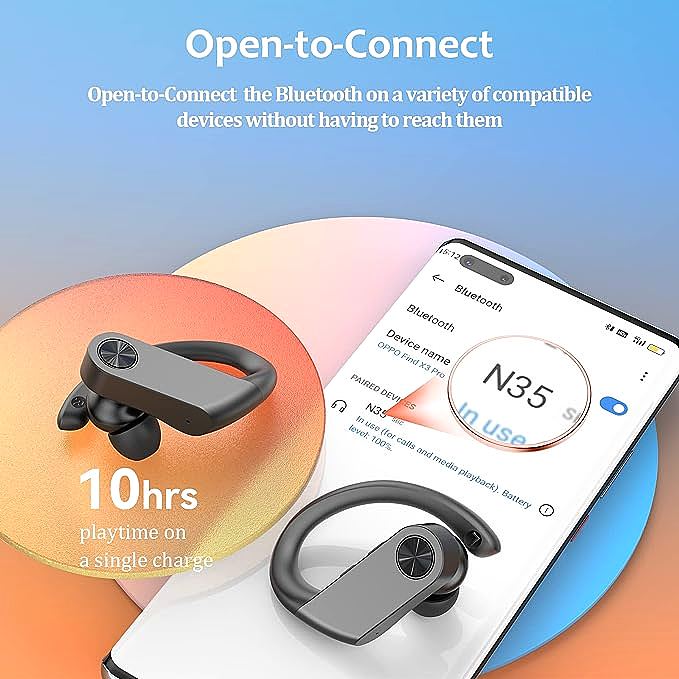
The CAPOXO N7 Wireless Earbuds sit at the budget end of this comparison, using a single 55 mAh earbud cell and a 500 mAh case to deliver 6 hours of playback per charge.
The following comparison illustrates how different design choices affect real-world battery performance. Each product represents a different approach to the capacity, ANC, and charging tradeoffs discussed above.
| Model | Sony WF-1000XM5 | Apple AirPods Pro 2 | Samsung Galaxy Buds2 Pro |
|---|---|---|---|
| Earbud battery life (ANC on) | 8 hours | 6 hours | 5 hours |
| Earbud battery life (ANC off) | 12 hours | 6 hours | 8 hours |
| Case capacity (total playback) | 16 hours additional | 24 hours additional | 18 hours additional |
| Total playback (ANC on) | 24 hours | 30 hours | 23 hours |
| Total playback (ANC off) | 28 hours | 30 hours | 26 hours |
| Quick charge | 3 min for 60 min playback | 5 min for 60 min playback | Not specified |
| Wireless charging | Yes (Qi) | Yes (MagSafe/Qi) | Yes (Qi) |
| Approximate earbud cell size | 60 to 65 mAh | 45 to 50 mAh | 50 to 55 mAh |
| Approximate case cell size | 650 to 700 mAh | 520 to 550 mAh | 500 to 550 mAh |
The Sony WF-1000XM5 achieves 8 hours with ANC on by integrating Bluetooth and ANC processing on a single custom chip, reducing idle power overhead. Its 650 to 700 mAh case provides 16 additional hours, and the 3-minute quick charge delivers 60 minutes of playback by charging the cell at high current for a short duration.
The Apple AirPods Pro 2 delivers 6 hours with ANC on and relies on the case to reach 30 total hours. The H2 chip manages power efficiently but the smaller earbud cells limit single-charge life. The 5-minute quick charge provides 1 hour of playback, and MagSafe alignment ensures consistent wireless charging efficiency.
The Samsung Galaxy Buds2 Pro has the shortest ANC-on life at 5 hours, reflecting its compact form factor and dual-microphone ANC system. The 8-hour ANC-off figure is competitive, but the 5-hour ANC-on number illustrates the power penalty of continuous noise cancellation in a small chassis. The case provides 18 additional hours for a 23-hour total with ANC engaged.
How to Estimate Real Battery Life from the Numbers
To estimate real-world battery life from manufacturer specifications, apply a derating factor based on your actual usage. Start with the advertised ANC-on figure if available, or subtract 30 to 40 percent from the ANC-off figure if ANC-on specs are not published.
For a listener using ANC at 70 percent volume with AAC codec in temperate conditions, multiply the ANC-on figure by 0.75 to 0.80. A 6-hour ANC-on rating becomes 4.5 to 4.8 hours. If you use LDAC, multiply by an additional 0.80, yielding 3.6 to 3.8 hours. At 85 percent volume in a noisy environment, multiply by another 0.75, arriving at approximately 2.7 to 2.9 hours per charge.
Calculate total usable playback by estimating case recharges. Divide the case capacity by the earbud capacity and multiply by 0.80 for transfer efficiency. A 600 mAh case with 50 mAh earbuds gives 12 theoretical recharges, but 9.6 after losses. Multiply by your derated single-charge life: if it is 4.5 hours, total playback is 4.5 times 10.6, approximately 47.7 hours, though real-world variables bring this closer to 35 to 40 hours.
Plan for degradation over time. A product delivering 35 hours on day one may deliver 28 hours after 18 months, and approximately 22 hours after 36 months. If you need a specific minimum hours-per-charge for your commute, add a 25 percent margin to your estimate.
Extending Battery Life: Practical Tips
Several user-controllable settings measurably extend battery life. Reducing volume from 80 percent to 60 percent cuts amplifier power draw by 50 to 60 percent, extending a 5-hour battery life to 7 to 8 hours. Disabling ANC when ambient noise is low eliminates the 20 to 40 percent ANC penalty entirely.
Using SBC codec instead of LDAC or aptX HD reduces DSP power consumption by 15 to 25 percent. Most Android devices allow codec selection in developer settings, and the difference in audio quality is often inaudible in noisy environments where high-bitrate codecs provide the least benefit.
Storing the case at room temperature between 15 and 25 degrees Celsius preserves capacity. Avoid leaving earbuds in direct sunlight or a hot car. If they will not be used for more than a week, discharge the case to approximately 50 percent before storing.
Keeping charging contacts clean ensures efficient energy transfer. Oxidized pogo pins increase contact resistance, causing the charging IC to generate more heat and reduce efficiency. A monthly wipe with a dry cloth or isopropyl alcohol swab maintains optimal contact.
Using mono mode for calls or situations where stereo is unnecessary doubles effective battery life per earbud. One active earbud draws roughly 5 to 7 mA while the other recharges in the case. Swapping when the active bud reaches 20 percent keeps the system running until the case itself depletes, which takes 8 to 10 hours for a full case recharging a single earbud repeatedly.
CAPOXO N7 Wireless Earbuds
Related Essays

How a 32-Hour TWS Earbud Manages Its Charge

What $9.99 Buys: BD&M BD10 Wireless Earbuds, Explained

Muitune i35 Ear Headphones: The 120-Hour Battery Math
The Math Behind 80 Hour Wireless Earbuds Battery Life

Budget Wireless Earbuds: Why Cheap Buds Die in Six Months

Sony WI-C310 Wireless In-Ear Headset: The Science Behind All-Day Wireless Audio Freedom

Anchoring Audio in Motion: The Mechanics of Athletic Wearables

Cellet XG01 Wireless Earbuds: Seamless Bluetooth 5.2 Audio for Casio G'zOne Commando

How Component Commoditization Ended the Audio Price-Quality...
