Why Your Earbuds Keep Falling Out During Runs: The Physics of Secure Fit
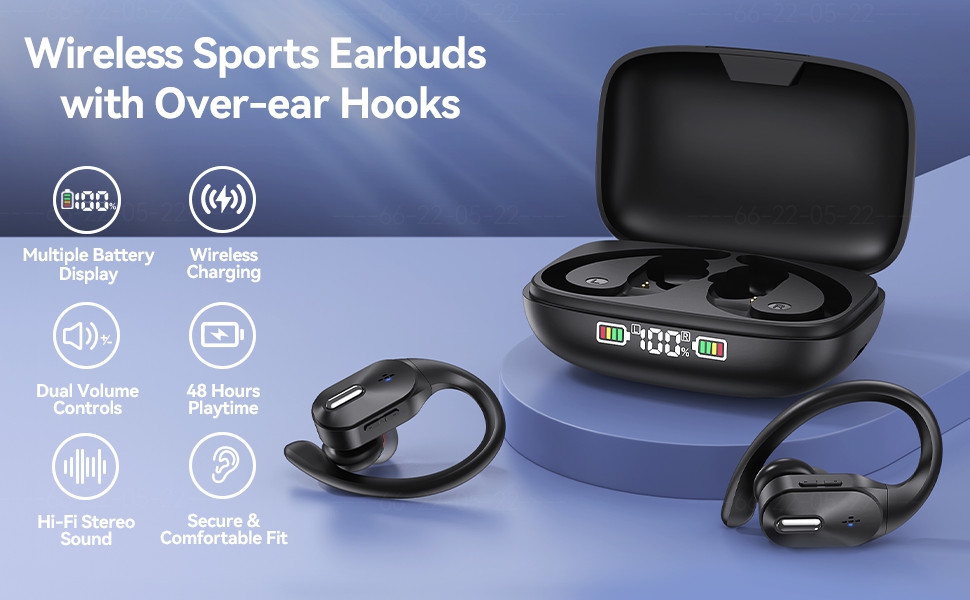
Orancu A12 Wireless Headphones
Have you ever been mid-stride on a morning run when your left earbud slips out, bounces off your shoulder, and lands somewhere on the pavement behind you? That sickening moment of searching the ground while joggers stream past is not just annoying. It is a design failure that affects nearly everyone who tries to exercise with in-ear headphones. The problem is not that your ears are the wrong shape. The problem is that most earbuds were never engineered for movement in the first place. If you search for earbuds for running with earhooks, you will find that the category exists for one reason: standard in-ear designs simply cannot defeat the physics of dislodgement during high-impact activity. The solution is straightforward — add a mechanical anchor around the ear while keeping the speaker sealed inside the canal.
Why In-Ear Friction Fails Under Motion
Most wireless earbuds rely on a single force to stay in your ear: friction. The silicone tip wedges into the ear canal, and the compressive force of the rubber against skin creates enough static friction to hold the bud in place while you sit at a desk or walk to the coffee shop. But friction is a function of the normal force pressing two surfaces together, and during running, that normal force is constantly disrupted.
Each footstrike generates a shockwave that travels up your skeleton at roughly 4 meters per second. Your skull vibrates. Your jaw moves. The cartilage of your outer ear flexes. All of this micro-motion reduces the contact pressure between the ear tip and the ear canal wall. Add sweat, which acts as a lubricant and reduces the coefficient of friction by 30 to 50 percent, and the earbud that felt secure at mile zero is working against physics by mile one.
The ear canal itself is not a static tube. It deforms when you chew, swallow, or change head position. During exercise, all of these actions happen more frequently and with greater amplitude. An earbud that depends entirely on canal friction is fighting a losing battle against a moving, sweating, vibrating target.
The Mechanical Anchor: How Over-Ear Hooks Change the Equation
Over-ear hooks solve the dislodgement problem by adding a second, independent retention mechanism. Instead of relying solely on friction inside the ear canal, a hook wraps around the auricle, the visible outer structure of cartilage that surrounds the ear opening. This creates what engineers call a mechanical anchor: a physical constraint that prevents displacement regardless of friction conditions.
The hook distributes holding force across a much larger surface area than an ear tip alone. Where an in-ear tip concentrates pressure on a few millimeters of canal wall, an over-ear hook spreads it across centimeters of auricle cartilage. This means lower pressure per unit area, less discomfort during long sessions, and critically, retention that does not depend on friction at all. Even if the ear tip loses its seal due to sweat, the hook prevents the earbud from falling to the ground.
Research on earhook retention shows a 60 to 80 percent reduction in dislodgement events relative to in-ear-only designs during high-impact activity. The hook prevents vertical displacement, the downward pull of gravity and vibration that pulls buds out, while the ear tip prevents lateral displacement, the side-to-side wiggling that breaks the acoustic seal. Together, they form a dual-constraint system that is far more robust than either alone. This is the core advantage that makes earbuds for running with earhooks the preferred choice for serious runners: the retention comes from a physical anchor, not a friction seal that sweat can defeat.
The material matters too. Most budget earhooks use TPE, or thermoplastic elastomer, which is flexible enough to conform to different ear shapes but stiff enough to maintain its hook geometry over months of use. Premium models sometimes add memory wire inserts that let users bend the hook to a custom shape, but fixed-shape TPE hooks like those on the Orancu A12 work well for the majority of ear anatomies. The tradeoff is that people with very small ears may find the one-size hook slightly loose, while those with prominent cartilage may feel pressure after extended wear.
Sweat, Capacitance, and Why Touch Controls Betray You
There is a second, less obvious problem that plagues runners using standard earbuds: touch controls stop working when you sweat. Most modern wireless earbuds use capacitive touch sensors, the same technology in your smartphone screen. These sensors detect the electrical capacitance of your fingertip to register a tap or swipe. The system works beautifully in dry conditions. During exercise, it falls apart.
Sweat is conductive. When perspiration coats the earbud surface, it creates a thin film of electrolyte that confuses the capacitive sensor. The earbud registers false touches from sweat dripping across the surface, or it fails to register intentional touches because the ambient capacitance from the moisture already saturates the sensor. Runners report phantom track skips, accidental volume changes, and voice assistant activations, all triggered by sweat, not by finger.
Physical buttons avoid this entirely. A mechanical switch operates by physical displacement: you press, a tactile dome collapses, a circuit closes. Sweat has no effect on this mechanism. You also get tactile confirmation, a small click that tells you the press registered, which is valuable when you are running at pace and cannot look at your phone to verify. The Orancu A12 uses independent physical buttons on each earbud, with dedicated volume and track controls, which means you can adjust volume mid-run without breaking stride or fumbling with your phone. This is precisely why earbuds for running with earhooks from budget brands often outperform expensive touch-control alternatives: the hardware choice matches the use case.
This is not a minor convenience. For outdoor runners, being able to lower volume quickly when you hear traffic approaching is a safety feature. Touch controls that require multiple taps or long presses, and that may or may not register depending on how sweaty you are, are a genuine hazard in those moments.
IPX5 Decoded: What the Number Actually Protects Against
The IPX5 waterproof rating appears on nearly every sport earbud box, but few people understand what it technically means or where its limits lie. The "IP" stands for Ingress Protection. The "X" means the device was not tested for dust ingress. The "5" means it can withstand water jets from any direction at a rate of 12.5 liters per minute, at 30 kilopascals of pressure, from a distance of 3 meters, for at least 3 minutes.
In practical terms, IPX5 handles heavy sweat, steady rain, and water splashes from any angle. If you run in a downpour or finish a HIIT session drenched in perspiration, IPX5 earbuds will survive. What IPX5 does not cover is submersion. Swimming requires IPX8, which tests for continuous immersion. Showering is also off-limits, not because of the water itself, but because steam can penetrate seals that liquid water cannot. Steam molecules are smaller and more mobile than liquid water droplets, and they can work their way past gaskets and adhesives that resist direct water jets.
There is another subtlety that the IP rating system does not address: sweat is more corrosive than fresh water. Human perspiration contains sodium chloride, lactic acid, urea, and skin oils. Over months of regular exposure, these compounds can degrade the rubber seals and adhesive bonds that provide the waterproof rating. This is why even IPX5 earbuds eventually lose water resistance after a year or two of heavy workout use. Wiping your earbuds dry after each session and rinsing them with fresh water weekly can significantly extend the effective lifespan of the waterproof seal. This care routine is especially important for earbuds for running with earhooks, since sweat accumulation in the hook joint can accelerate corrosion of the internal components.
Never charge wet earbuds. This is the single most common way people destroy their sport headphones. Moisture on the charging contacts causes electrolytic corrosion, which can destroy the contact plating within days. Always dry the earbuds and charging contacts before placing them in the case. This maintenance routine applies equally to any earbuds for running with earhooks, regardless of price tier — sweat corrosion is the silent killer of sport audio gear.
Battery Displays and the Psychology of Certainty
Battery anxiety is a real cognitive burden. Studies on mobile device usage show that uncertainty about remaining battery life causes measurable stress responses, even when the device has hours of charge left. The simple act of not knowing creates anxiety that knowing, even if the number is low, does not.
This is why LED battery percentage displays on charging cases have become such a popular feature in budget earbuds. A numerical readout, even one that is only accurate to within plus or minus 5 percent, eliminates the uncertainty. You glance at the case and see "73%" and you know you are fine. Compare that to the four-dot indicator on older designs, where three dots could mean anything from 51 to 99 percent, and you understand why users consistently rank the LED display as one of the most appreciated features on earbuds that have it.
The display works by reading the case battery voltage through a battery management IC. The percentage is calculated as the ratio of current voltage above the minimum threshold to the total voltage range, multiplied by 100. This is an approximation because battery voltage does not decrease linearly with charge, but it is close enough for consumer purposes. The display draws approximately 0.1 to 0.3 milliamps, which is negligible relative to the 300 to 500 milliamp-hour capacity of a typical earbud case.
The Orancu A12 shows individual earbud charge levels as well as the case level, which is useful because earbuds rarely drain at the same rate. If you use one earbud at a time for calls, the left and right batteries will diverge significantly over a week. Without per-bud readouts, you might discover that one earbud is dead just when you need both for a workout.
Bluetooth 5.1: When Good Enough Is Actually Good
Bluetooth version numbers have become a marketing battleground. Newer budget earbuds advertise Bluetooth 5.4 or even 6.1 as though the version number alone delivers a superior experience. For sport earbuds used primarily for music during exercise, the practical differences between Bluetooth 5.1 and newer versions are minimal.
Bluetooth 5.1 provides a stable connection at up to 10 meters line of sight, which is more than enough range for any scenario where your phone is on your arm, in your pocket, or on a gym bench. The latency of approximately 100 milliseconds is imperceptible for music playback. It becomes noticeable for gaming or video, where audio-visual sync matters, but during a run, you are not watching the screen.
Newer versions offer incremental improvements. Bluetooth 5.4 reduces latency to roughly 40 milliseconds with the LC3 codec, uses about 15 percent less power, and supports native multipoint connection. These are real technical advances. But for a $26 sport earbud used for running playlists, the 5 to 10 extra minutes of battery life from improved power efficiency is less impactful than simply having a larger battery cell, and multipoint connectivity is irrelevant when you pair to a single phone.
The honest assessment is that Bluetooth 5.1 is the cost-performance sweet spot for sport earbuds. Paying a premium for a higher version number makes sense if you need low-latency gaming audio or simultaneous connection to a phone and laptop. For workout use, the connection stability and power efficiency of 5.1 are entirely sufficient, and the money saved on the radio chipset can be spent on features that actually matter during exercise, like physical buttons and earhooks.
The Honest Battery Question
Battery life claims in the budget earbud market have entered an inflationary spiral. When one brand claims 60 hours, the next claims 80, and the next claims 120. These numbers are technically achievable under specific test conditions: volume at 50 percent, no microphone use, no button presses, stable connection at close range, and sometimes with the earbuds powered on but not actively playing audio.
Real-world battery life is always lower than the advertised total. For earbuds with 8 hours per charge and a case that provides 4 additional recharges, the 40-hour total claim is relatively honest. Eight hours of continuous playback at moderate volume is a figure that users consistently verify. The case recharges are less precise because the case battery degrades over time and the recharge efficiency depends on how depleted the earbuds are when you return them.
The more relevant metric for most people is: how many days can I go between charging the case? At one hour of daily workout use, 40 hours of total battery means roughly five weeks before the case needs recharging. At two hours per day, it drops to about two and a half weeks. For a commuter who uses earbuds for an hour each way plus a 45-minute gym session, you are looking at roughly one week per case charge. These are practical numbers that matter more than the headline figure. The same principle applies to earbuds for running with earhooks: the features that count during a workout are retention, control reliability, and battery certainty — not Bluetooth version numbers.
What Wireless Charging Actually Saves You
Wireless charging on a budget earbud case is a convenience feature, not a necessity. It adds roughly 30 to 60 minutes to a full charge time relative to USB-C, and it requires a separate Qi-compatible charging pad that is not included in the box. So why does it matter?
The value is in reducing friction in your daily routine. If you already have a wireless charging pad on your nightstand for your phone, placing the earbud case on the same pad before bed requires zero additional effort. No finding the cable, no orienting the connector, no remembering to plug it in. You just set it down. Behavioral research on habit formation shows that reducing the number of steps in a routine by even one dramatically increases the likelihood that the routine is maintained. A wireless charging case removes one step from the charging routine, and that makes it more likely that your earbuds will actually be charged when you need them.
Having both USB-C and wireless options is the ideal configuration. USB-C for fast top-ups when you realize you forgot to charge overnight, wireless for the daily habit of setting the case on the pad. At the $26 price point, having both charging methods is unusual. Most competitors offer one or the other, and several offer only USB-C.
Engineering for the Real World
The pattern across all of these features, earhooks, physical buttons, LED displays, IPX5 ratings, Bluetooth 5.1, dual charging, is that the best engineering decisions for sport earbuds are not about chasing the highest specification numbers. They are about solving the specific problems that runners actually encounter. Earhooks address the physics of dislodgement. Physical buttons address the failure mode of capacitive sensors in wet conditions. LED displays address the anxiety of uncertainty. IPX5 addresses the actual water exposure of sweaty exercise without over-engineering for submersion scenarios that rarely occur.
The products that endure in this market are not the ones with the biggest battery claims or the newest Bluetooth version. They are the ones that reliably stay in your ears, respond to your inputs when you are drenched in sweat, and tell you how much charge remains before you head out the door. Good engineering for sport is about eliminating failure modes, not adding features. The next time you feel an earbud shift during a run, ask yourself whether the design was optimized for your motion or for a specification sheet. The earbuds for running with earhooks category exists because friction-based designs fundamentally cannot solve this problem — and that is a physics limitation, not a manufacturing defect. If secure fit and reliable controls matter more than spec numbers, then earbuds for running with earhooks represent the category that was built for exactly that purpose: real-world performance over laboratory numbers. Among earbuds for running with earhooks in the budget segment, the Orancu A12 proves that thoughtful engineering beats specification inflation every time.
Orancu A12 Wireless Headphones
Related Essays

Wireless Earbuds That Stay Secure During Workouts: bmani T16 Review

Why Your Wireless Earbuds Keep Pausing When You Don't Want Them To: The Touch Control Problem Nobody Can Solve

The Neuroscience of Workout Focus: How Audio Engineering Protects Flow State
Beyond the Spec Sheet: Decoding the Tech That Defines True Sport Earbuds

Masterplug TWS-7500 Wireless Earbuds: Open-Ear Sound, Bluetooth 5.3 Freedom

JLab Epic Sport Wireless Earbuds: Power Your Workout with 12-Hour Battery Life

PISEN T-Dots2 Wireless Earbuds: Experience Clear Sound and Comfort

BONSORION Open Ear Headphones: Enjoy Sound, Stay Aware

bonabest S9 Wireless Earbuds: Seamless Sound & Unmatched Stability
