Why Your Wireless Earbuds Keep Dying at 4PM: The Battery Physics TWS Cannot Solve

Yarayeon HX-831 Bluetooth Headphones
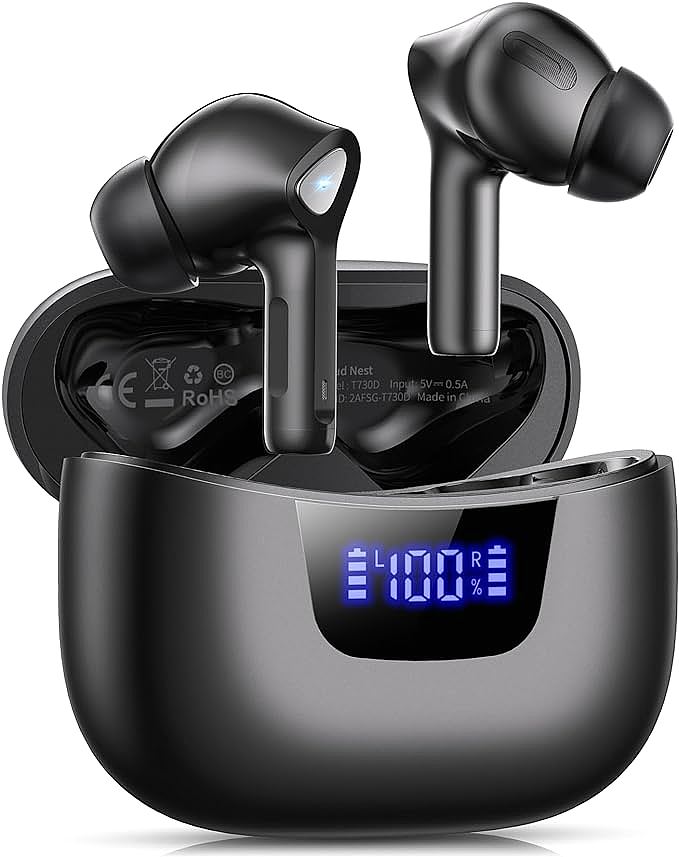
It is 4:12 PM. Your third conference call of the afternoon just started, and your left earbud flashes red twice before going silent. You dig through your bag for the charging case, fumble it open, and realize the case itself is at twelve percent. Meanwhile, your colleague on the call is still talking, completely unaware you have gone dark. This is not a rare incident. It is a structural problem baked into the very physics of true wireless stereo earbuds, and no amount of software optimization will fully fix it.
The frustration is real enough that an entire alternative form factor -- neckband headphones -- continues to sell despite the industry's overwhelming marketing push toward TWS. Not because neckbands are fashionable. They are not. They persist because they solve a physics problem that TWS, by design, cannot.

The Energy Density Ceiling Inside Your Ear Canal
A typical TWS earbud contains a battery rated between 40 and 60 mAh. That is not a design shortcut. It is a geometric constraint. The human ear canal can only accommodate a housing roughly 18 to 22 millimeters in diameter before comfort degrades sharply. Inside that volume, engineers must fit a speaker driver, a Bluetooth radio chip, an antenna, a microphone array, touch sensors, and the battery. The battery almost always loses the space negotiation.
Lithium-ion polymer cells -- the chemistry used in virtually all wireless earbuds -- deliver approximately 200 to 250 watt-hours per liter of energy density at the cell level as of 2024 manufacturing standards. Within a 40 mAh pouch cell operating at 3.7 volts nominal, you are working with roughly 0.148 watt-hours of stored energy. Divide that by the continuous power draw of a Bluetooth 5.0 radio (approximately 15 to 25 milliwatts during active streaming), an active driver, and noise processing DSP, and the math yields four to six hours of playback before the cell is depleted to its safe cutoff voltage of 3.0 volts.
This is not a software problem. No firmware update changes the volume of a cylinder or the energy density of lithium-ion chemistry. The ceiling is physical.
A neckband headphone, by contrast, places its battery in the band that rests on the collarbone. That housing can be 15 to 20 centimeters long and roughly 8 millimeters thick. The Yarayeon HX-831, for instance, fits a 280 mAh lithium-polymer cell in that band -- approximately five to seven times the capacity of a single TWS bud. At the same power draw, that translates to 18 hours of continuous playback. The band is, in effect, a wearable battery pack that happens to have earbuds attached to it.
Why Two Hours of Charging Outlasts the Case Shuffle
TWS manufacturers often cite total system battery life -- say, "30 hours with the charging case." That number masks a daily friction that users experience but rarely articulate in reviews. The TWS workflow looks like this: listen for five hours, return buds to case for 30 to 45 minutes to get roughly 50 percent charge, listen for another two to three hours, then charge the case itself overnight via USB-C. The case contains a secondary battery of roughly 400 to 600 mAh, and you are managing two separate charging schedules for what is functionally one product.
Neckband headphones eliminate the case entirely. One battery, one charging cable, one schedule. Plug in for two hours and you have 18 hours of runtime. No secondary battery to maintain, no case to forget on your desk, no surprise discovery that the case discharged overnight in your backpack. For anyone who has ever found a dead TWS case before a long commute, this simplicity is not trivial. It is the difference between charging anxiety and charging indifference.
Lithium-ion cells also degrade predictably. A quality cell retains approximately 85 percent of its original capacity after 300 full charge cycles, and roughly 70 percent after 500 cycles. For a TWS user running through a full charge cycle daily, that means noticeable degradation within eight to twelve months. A neckband user charging once every two or three days stretches those same 500 cycles across two to three years. The battery physics are identical. The duty cycle is not.

The Microphone Proximity Problem
Battery life is the most obvious advantage, but microphone placement is arguably the more consequential one for a specific and growing user base: people who spend four or more hours per day on voice and video calls.
A TWS earbud mounts its microphone on the earpiece itself, roughly 30 to 50 centimeters from the user's mouth depending on head size and ear anatomy. That distance matters enormously. Sound pressure level follows the inverse square law -- every doubling of distance reduces acoustic energy by approximately 6 dB. A microphone 10 centimeters from the mouth receives roughly 12 to 14 dB more voice energy than one mounted 40 centimeters away. That is the difference between "sounds like you are in a closet" and "sounds like you are in a parking garage," before any digital processing is applied.
Digital signal processing can partially compensate. Qualcomm's CVC 8.0 Clear Voice Capture, the algorithm used in many mid-range neckband headphones including the HX-831, performs acoustic echo cancellation up to 40 dB, suppresses environmental noise by up to 30 dB, and applies automatic gain control to normalize speech levels. But DSP works best when it has a strong input signal to begin with. No amount of algorithmic noise suppression fully recovers a voice signal that arrived at the microphone weak and drowned in ambient noise.
The neckband form factor positions its microphones at the end of the neck band, approximately 10 to 15 centimeters from the mouth. That placement is not accidental -- it is the closest practical microphone position to the vocal tract that does not require a boom arm extending toward the face. Combined with CVC 8.0's beamforming and wind noise reduction (approximately 20 dB attenuation in moderate wind), the result is consistently clearer voice transmission than TWS can achieve from the ear-mounted position.
This is why call-center workers, remote professionals, and delivery drivers -- people for whom voice clarity is not a luxury but a professional requirement -- gravitate toward neckbands despite their aesthetic disadvantage. The physics of microphone proximity are unambiguous.
The Never-Lost, Always-Ready Design Philosophy
There is a quieter advantage that rarely appears in spec sheets but surfaces consistently in user behavior: neckband headphones are functionally impossible to lose during use.
TWS earbuds are two independent objects, each roughly 5 grams, with no physical tether between them. Industry estimates place annual loss rates for TWS users at 15 to 20 percent. Roughly 8 to 10 percent of TWS users lose the charging case itself each year. These are not careless people. They are people who run, commute, work with their hands, and move through the world. Small untethered objects get lost. That is entropy, not negligence.
A neckband is a single tethered object weighing roughly 42 grams. When you take the earbuds out of your ears, they retract into the band. There is no separate case to set down and forget, no individual bud to roll under a car seat. The device either is on your neck or is not. This binary state -- present or absent, with no intermediate "somewhere in my bag" condition -- reduces the cognitive load of device management to nearly zero.
The retractable earbud mechanism itself represents an interesting engineering trade-off. Spring-loaded spools allow the earbud cables to extend and retract in under a second, keeping the wires contained when not in use. The manufacturer rates the mechanism for 5,000 or more retraction cycles. If you extend and retract the earbuds 15 times per day, that rating implies roughly 333 days of mechanical life before the rated endurance is reached. In practice, spring fatigue, dust ingress, and cable wear at the retraction point are the most common failure modes. Some users report the mechanism feeling rough or requiring two hands to operate smoothly after several months. The retractable design solves the tangle problem but introduces a mechanical failure point that fixed-cable neckbands do not have. Every engineering decision is a trade-off.

Honest Accounting: The Real Drawbacks
The drawbacks of neckband headphones are neither hypothetical nor minor. The band sits in direct contact with the skin of the neck for hours at a time. In humid conditions, during exercise, or for users with sensitive skin, this prolonged contact can cause irritation, redness, or in documented cases, more severe dermatological reactions requiring medical attention. The band material -- typically a thermoplastic polyurethane or silicone blend -- is not universally biocompatible, and manufacturers in this price segment rarely disclose the specific material composition or provide dermatological testing certificates.
At 42.5 grams, the weight is light enough that most users describe it as "barely noticeable" during the first week. But weight perception is cumulative. After eight hours of continuous wear, some users report neck fatigue or a desire to remove the device. The band can shift during running or other vigorous activity, requiring periodic repositioning. And the visual profile of a neckband -- a visible band around the collar -- reads as distinctly "tech accessory" in professional settings where TWS earbuds, tucked into the ear canal, are nearly invisible.
These are not reasons to avoid neckband headphones. They are reasons to choose them deliberately, with full awareness of what you are trading. You gain battery life, call quality, and loss prevention. You accept skin contact, mechanical complexity, and a visible form factor.
Who This Form Factor Is Actually For
The person who benefits most from a neckband is not looking for the smallest or most stylish audio device. They are looking for the one that does not quit. A software developer in video meetings four hours a day who needs their headset to last from the morning standup through the afternoon retro without reaching for a charger. A delivery driver who takes calls in traffic and cannot afford to fish a dead earbud out of a pocket while holding the handlebar. A gym regular who has lost two pairs of TWS buds in six months and wants something that stays attached during burpees.
For those use cases, the neckband is not a compromise. It is the correct answer to a specific set of constraints: long hours, voice clarity, and physical reliability. The TWS form factor wins on portability and aesthetics -- and for short listening sessions in controlled environments, those advantages are decisive. But the physics of battery capacity, microphone distance, and object permanence do not care about aesthetics.
Constraints as Design Choices
Every product category that survives the dominance of a more popular alternative does so by being materially better at something specific. Not slightly better. Structurally better, in a way that cannot be closed by a software update or a marketing campaign. The neckband headphone survives because energy density scales with volume, because sound pressure attenuates with distance, and because single tethered objects are harder to lose than paired untethered ones. These are laws of physics and probability, not matters of taste.
The retractable wire will eventually wear. The band will touch your skin for as long as you wear it. The form factor will never be invisible. These are the honest costs of solving the battery problem at the hardware level rather than working around it at the software level. Whether those costs are worth paying depends entirely on which problem you are trying to solve.
Yarayeon HX-831 Bluetooth Headphones
Related Essays

How Tiny Drivers Produce Big Sound: The Physics Behind Wireless Earbuds
How Tiny Drivers Produce Big Sound: The Physics Behind Wireless Earbuds
How Tiny Drivers Produce Big Sound: The Physics Behind Wireless Earbuds
How Tiny Drivers Produce Big Sound: The Physics Behind Wireless Earbuds

HITY A4 Wireless Earbuds Bluetooth 5.3 Headphones Touch Control – Top Choice for Music Enthusiasts

Where the Energy Goes: A Thermodynamic Look at Wireless Audio Battery Life
The Invisible Symphony: How Driver Size Shapes Your Audio Experience

What Does IPX7 Actually Protect Against? The Engineering...

Why Earbuds Sound Terrible on Calls: The Physics of ENC