Hybrid Driver Technology: Why Multiple Drivers Create the Crossover Challenge

FiiO FH5 Over The Ear Earphones
When you pick up a hybrid IEM for the first time, the marketing materials will tell you something like this: multiple drivers work together to deliver superior sound. What they fail to mention is that this cooperation is one of the hardest problems in audio engineering. The physics governing how sound waves from different drivers blend together inside your ear canal operates against the very goal the engineers are trying to achieve.
This is not a new problem. Recognizing the root causes enables engineers to design solutions that address fundamental physics rather than merely treating surface symptoms. When recording studios first encountered multi-driver loudspeaker designs in the 1960s, they discovered that adding more drivers introduced new problems that often outweighed the benefits. The studio monitors of that era were not simply arrays of speakers. They were battlegrounds where physics fought against the laws of human perception.
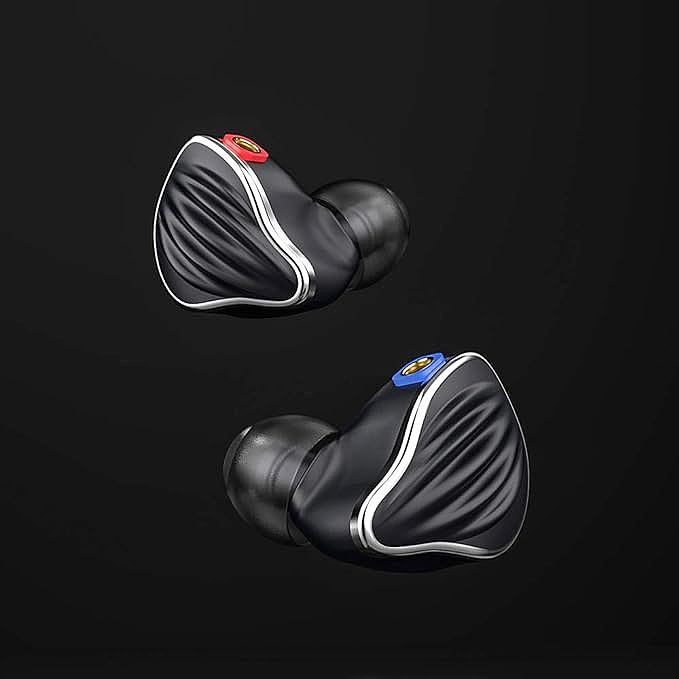
The integration of multiple driver types requires sophisticated acoustic engineering and precise manufacturing tolerances to ensure that each frequency band arrives at the listener's ear in proper temporal alignment.
The acoustic principles governing multi-driver coherence involve complex interactions between wave propagation, resonant frequencies, and time domain alignment that require sophisticated engineering solutions.
The Single Driver Limitation
Every acoustic transducer faces a fundamental trade-off between efficiency, frequency extension, and pistonic accuracy. A driver moving a large diaphragm can produce substantial bass output, but that same mass prevents it from responding quickly enough for treble frequencies. The diaphragm begins to break up at higher frequencies, producing distortions that listeners describe as "muddy" or "colored."
Balanced armature drivers solve the speed problem through an entirely different mechanical principle. The armature vibrates within a magnetic field without moving a large diaphragm. This allows for exceptional high-frequency detail and transient speed, but the small radiating surface struggles to produce meaningful low-frequency output without help from a carefully tuned enclosure.
The solution seems obvious: use both. Let the driver handle bass frequencies where its size is an advantage, and use balanced armature drivers for mids and highs where their speed excels. The physics supports this division of labor.
But physics also creates the problem.
The physical constraints imposed by the human ear canal necessitate careful balance between acoustic performance and ergonomic design in hybrid IEM implementations.
Understanding the mathematical relationships between frequency response, phase alignment, and time domain characteristics reveals why simple driver counts provide misleading indicators of sound quality.
The acoustic engineering challenges inherent in multi-driver designs demand precise calculations of wave propagation delays and careful management of inter-driver interactions.
Proper evaluation of hybrid IEM technology requires understanding the fundamental acoustic principles that govern driver interaction and frequency division.
Wave Interaction and Phase Cancellation
Sound propagates as pressure waves through air. When two sources produce sound at the same frequency, the resulting wave pattern depends entirely on the relative timing of those sources. If the compression peaks arrive simultaneously, the waves add together. If one source is delayed by exactly half a wavelength, the peaks of one wave align with the troughs of the other, and they cancel.
At 1kHz, a half-wavelength is approximately 17 centimeters. At 5kHz, it drops to about 3.4 centimeters. At 10kHz, just 1.7 centimeters.
In a hybrid IEM, the driver and balanced armature drivers occupy different physical positions. The driver typically sits deeper in the shell, often with a longer sound tube path. The balanced armature drivers are positioned closer to the nozzle. This means that even when playing a pure tone, the sound from each driver arrives at your eardrum at different times.
The consequences are severe. Frequencies near the crossover point experience partial or complete cancellation depending on the exact path length differences. The result is a dip in the frequency response right where the ear is most sensitive to discontinuities.
This phenomenon has a name in acoustic engineering: comb filtering. The frequency response curve, when measured, looks like the teeth of a comb, with deep notches repeating at regular intervals. Listeners perceive these notches as missing notes or a hollow quality to the sound.
The Crossover as a Solution and a Problem
Engineers address driver interaction through crossover networks. A crossover is a filter that determines which frequencies each driver receives. The driver gets only low frequencies through a low-pass filter. The balanced armature drivers get only high frequencies through a high-pass filter. Both see reduced power near the crossover point, where the filter rolls off, to minimize the phase interaction region.
In traditional speakers, crossovers use electrical components: capacitors block low frequencies from reaching tweeters, inductors block high frequencies from reaching woofers. The values of these components are chosen to produce the desired frequency division while maintaining phase alignment between drivers.
But hybrid IEMs present unique constraints. The shell is tiny, perhaps the size of your fingertip. Electrical components that would be unnoticeable in a speaker cabinet become significant space consumers. More importantly, electrical crossovers cannot fully solve the problem because the physical separation of the drivers in space creates arrival time differences that no electrical filter can correct.
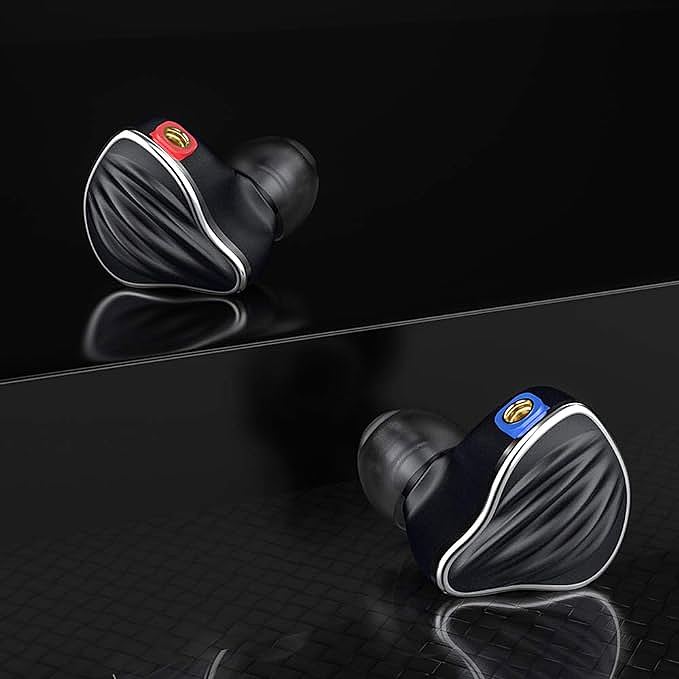
S.TURBO: Acoustic Filtering Through Physics
the brand engineers took a different approach. Instead of relying entirely on electrical filtering, they implemented a physical acoustic structure that performs part of the crossover function through mechanical design.
The S.TURBO is a specially shaped acoustic tube that extends from the driver. Its geometry is not arbitrary. The designers created what amounts to a Helmholtz resonator, a structure whose resonant frequency can be precisely calculated and controlled.
Helmholtz resonance occurs when air oscillates through an opening into an enclosed cavity. The frequency of this resonance depends on the volume of the cavity and the dimensions of the opening. Acoustic instruments like violins and the bodies of guitars exploit this principle. So do car exhaust systems, which use resonance chambers to attenuate specific frequencies.
In the S.TURBO design, the resonant peak falls within the low-frequency operating range of the driver. Below the resonance frequency, the structure behaves like a tuned port, reinforcing bass output. Above the resonance frequency, the acoustic impedance rises sharply, naturally attenuating higher frequencies before they can reach the ear canal.
This creates a physical low-pass filter without electrical components. The driver sees a load that discourages it from reproducing upper frequencies, while the bass region receives a boost that helps it compete with the more efficient balanced armature drivers.
The concept is not entirely new. Acoustic suspension speakers in the 1950s and 1960s used similar principles, trading efficiency for controlled bass response. What the brand accomplished was adapting this approach to the extremely constrained environment of an IEM shell.
Independent Sound Tubes: Eliminating Cross-Contamination
Even with optimal crossover filtering, the physical routing of sound paths within an IEM shell creates opportunities for interference. If the output from different drivers mixes before reaching the ear, the phase relationships become unpredictable and uncontrollable.
the brand addressed this through three independent sound tubes. Each tube carries the output from one driver or driver group directly to the ear canal, with no mixing point between source and destination. The balanced armature drivers for mids and highs each have their own tube. The driver uses a separate tube that incorporates the S.TURBO structure.
The mechanical arrangement ensures that the only place where the different frequency bands combine is at the ear tip, immediately before entering the ear canal. This eliminates any possibility of interference within the shell itself.
The term for this approach is "isolated acoustic chambers." It is conceptually similar to how a recording console uses separate signal paths to prevent crosstalk. Each channel maintains its integrity until the final mix point.
The engineering challenge is significant. Three tubes must fit within the shell while maintaining proper seals to prevent sound from one path leaking into another. The manufacturing tolerances are tight because any gap creates a new mixing point and reintroduces the interference problem.
The Fit Factor: Why Shell Design Matters
All this engineering assumes that the sound reaches your ear as designed. But an IEM must seal against your ear canal to function properly. The seal does more than prevent sound leakage. It completes the acoustic system.
When you insert an IEM, the air trapped between the ear tip and your eardrum forms a small resonant cavity. The volume of this cavity depends on how deeply you insert the ear tip and the shape of your ear canal. Different ear tips produce different seal volumes, shifting the resonant frequency upward or downward.
The FH5 uses a relatively short nozzle design compared to some competitors. This was likely a constraint imposed by the internal component layout, particularly the placement of the driver and its sound tube. Short nozzles work well with many ears, but they present challenges for those with deeper ear canals who need more insertion depth to achieve a proper seal.
the brand includes thirteen pairs of ear tips in the package. This is not excess. The variety of materials and shapes addresses the fundamental variability of human anatomy. Foam tips compress and expand to fill irregular canal shapes. Silicone tips with double flanges create multiple sealing surfaces. Single-flange tips offer shallow insertion for those who cannot tolerate deep fit.
The choice of ear tip affects more than comfort. Because the tip determines your ear canal volume, it directly influences the tonal balance you hear. The same IEM can sound brighter with shallow insertion or warmer with deeper insertion, all through the same mechanism of resonant frequency shifting.
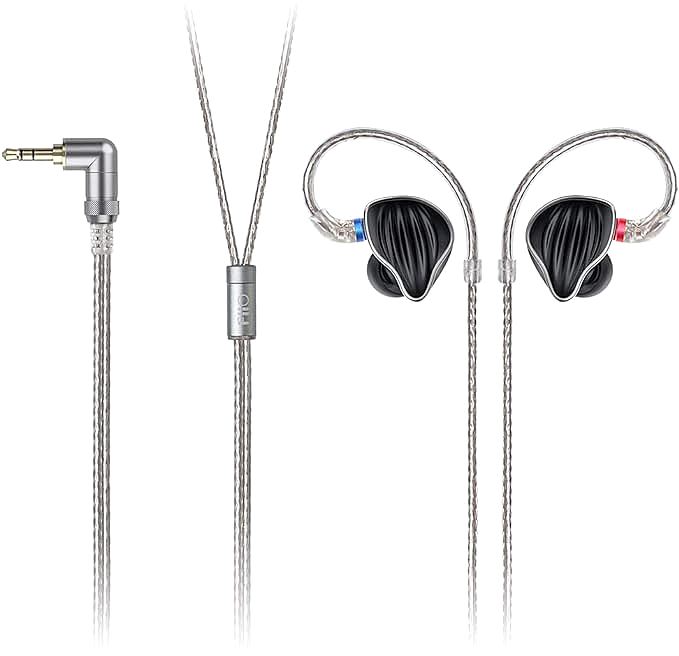
Engineering Philosophy: Coordination Over Components
The development of hybrid IEMs reflects a broader principle in acoustic engineering: system-level thinking produces better results than component-level optimization.
An engineer who focuses only on driver quality might select the recommended driver available and the recommended balanced armature drivers available, then combine them. The result would likely be disappointing. Each driver would be optimized for its individual performance without accounting for how they interact.
The S.TURBO system takes a different approach. Instead of treating the drivers as separate components to be joined, it designs the acoustic filtering as an integral function of the driver's housing. Instead of treating tube routing as a mechanical afterthought, it treats the tubes as essential acoustic components that must be precisely controlled.
This perspective has historical parallels. When stereo recording was first developed, engineers initially treated the left and right channels as independent mono signals. The resulting stereo images were technically correct but perceptually unnatural. Modern stereo recording techniques consider the interaction between channels from the beginning, treating stereo not as two mono signals but as a unified spatial system.
The lesson applies to multi-driver designs across all scales. A concert hall sound system with dozens of speakers becomes effective not through individually powerful components but through careful management of how those components cover the listening area without creating interference patterns. A multi-driver IEM becomes coherent not through superior drivers alone but through the coordination system that makes them work together.
Practical Application: Evaluating Hybrid Designs
Understanding these principles changes how you evaluate any hybrid IEM, not just the FH5.
Start by listening for the crossover region. Play music with prominent midrange vocals and check whether voices sound integrated or whether certain notes seem to disappear or shift position. Phase problems are most audible when a single sound source should span the boundary between drivers.
Check the seal. Try multiple ear tips even if the first few seem acceptable. The difference in seal depth affects not just bass quantity but overall tonal coherence. A shallower seal with the right tip might sound more natural than a deeper seal with the wrong tip.
Consider the listening environment. Hybrid IEMs with multiple drivers and complex crossover networks are not forgiving of amplifier or source imperfections. The same design that sounds smooth from a high-resolution player might reveal harshness from a compressed source. The drivers themselves do not change, but the phase interactions that create problems become more audible with cleaner upstream electronics.
The most important test is time. Phase coherence issues that seem minor in short listening sessions can become fatiguing over hours. A design that seems bright might actually be revealing crossover dips that your ear interprets as missing information. A design that seems warm might be smoothing over integration problems that mask detail.
The Broader Picture
Hybrid driver technology represents a particular solution to the universal engineering challenge of extending frequency range while maintaining coherence. The driver brings bass extension and capability that balanced armature drivers cannot match. The balanced armature drivers bring detail and speed that large moving masses cannot achieve. The engineering challenge is making these different physical principles work as a single acoustic source.
The FH5 addresses this challenge through the S.TURBO acoustic structure and independent sound tube routing. These are specific implementations of general acoustic principles that apply to any multi-driver system. Helmholtz resonance has been used in acoustic design for centuries. Independent acoustic chambers have been standard practice in studio monitor design for decades.
What changes in the IEM context is the scale and the consequences of imperfection. When drivers are separated by centimeters in a speaker system, the phase interaction is manageable. When they are separated by millimeters in an IEM, the same physical laws create problems that require more sophisticated solutions.
The deeper insight is that any multi-driver system is ultimately a coordination problem. The drivers do not need to be individually exceptional. They need to work together in ways that their individual performances suggest are impossible.
This is a common theme in engineering. The most impressive technical achievements often come not from pushing individual components to their limits but from finding ways to make components cooperate more effectively than their design would seem to allow. The hybrid IEM, at its best, is not about having more drivers. It is about achieving with multiple components what no single component can accomplish alone.
The sound that reaches your ear is not the sum of separate outputs from separate drivers. It is the product of a system designed to present itself as a single acoustic event. The engineering required to make that possible is invisible when it succeeds, which is exactly as it should be.
When evaluating any such design, look not at what components are present but at how they are coordinated. The presence of multiple drivers is a constraint as much as an advantage. The question is whether the designers treated that constraint as the primary design problem or as an afterthought to component selection.
The answer to that question determines whether the design achieves coherent sound or merely produces complicated sound.
Understanding the fundamental acoustic principles that govern multi-driver interaction enables informed evaluation beyond simple specification comparisons. The engineering challenges inherent in hybrid designs demand sophisticated solutions that account for complex wave propagation phenomena and precise temporal alignment requirements. Successful implementations achieve coherence through careful management of inter-driver relationships and frequency division characteristics.
FiiO FH5 Over The Ear Earphones
Related Essays

ISN Audio H40 and the Engineering of Hybrid Driver Sound

The Hybrid Symphony: Orchestrating Drivers and Crossovers in IEMs

The Hybrid Engine: Dynamic and Armature Synergy in IEMs

The Art of the Hybrid: Deconstructing the Science of Multi-Driver In-Ear Monitors

Balanced Armature vs Dynamic Driver: 2026 IEM Engineering Truths

The Paradox of Open-Back Headphones: Why Transparency...

Sony XBA-Z5: Three Drivers, One Mission in High-Resolution Audio

Hybrid Driver Architecture: The Physics Behind Modern IEM Sound

Why Your 8-Driver IEM Might Sound Worse Than a 2-Driver...
