Headphone EQ Modes Explained: How to Match Sound Profiles to Music Genres
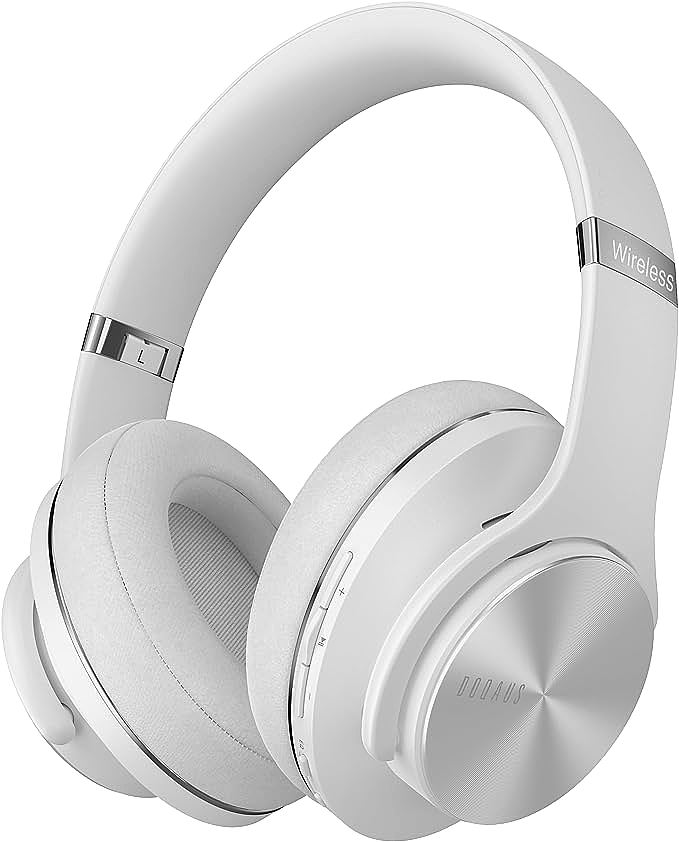
DOQAUS LIFE 3 Wireless Headphones
The Three Switches You Never Touch
You press the power button. You pair Bluetooth. You hit play. That is the full extent of most people's interaction with their headphone settings. The EQ button sits on the earcup, untouched, because its label means nothing to you. Balanced. Bass Boost. High Definition. Three words that might as well read: Mode A, Mode B, Mode C.
The problem is real: you are missing half of what your headphones can do. Most owners never switch from the default, and they pay for it in subtle quality loss. They are listening to hip-hop through a flat response and wondering why it sounds thin, or playing acoustic sets through a bass-boosted curve and wondering where the warmth went. The EQ button is right there on the earcup, but without understanding what each mode does, touching it feels like a gamble.
Here is the thing: those three words describe three completely different frequency responses. Each one reshapes the sound reaching your eardrums in a specific, engineered way. The DOQAUS LIFE 3, for instance, stores these three curves in a DSP chip inside the headphone itself. Most owners never switch from the default. They are listening to hip-hop through a flat response and wondering why it sounds thin, or playing acoustic sets through a bass-boosted curve and wondering where the warmth went.
By the end of this article, you will understand what each mode does to your music at the frequency level, why your brain perceives these changes the way it does, and exactly when to press that button.
What EQ Actually Does to Your Music
An equalizer does not make sound "better." That word has no engineering definition. What an equalizer does is simpler and more useful: it changes the relative loudness of different frequency bands. Think of it as a volume knob for each slice of the frequency spectrum, except you never touch the knobs yourself. The headphone's DSP chip turns them for you. When you select Bass Boost, the chip applies a pre-programmed gain curve to the digital audio signal before it reaches the DAC and amplifier stage. The driver then reproduces that modified signal. Nothing about the driver changes. Nothing about the source file changes. Only the relative amplitude of specific frequency regions shifts.
Your ear does not perceive frequency linearly. This is not an opinion. It is a measured fact, documented by Harvey Fletcher and Wilden Munson at Bell Labs in 1933. Their curves show that the human auditory system is significantly less sensitive to low frequencies at moderate volume levels than it is to midrange frequencies. A 60Hz tone at 60dB SPL sounds much quieter than a 1kHz tone at the same 60dB. This asymmetry is why bass boost exists as a concept at all. Your ear needs more energy in the low end just to perceive it as equal. The Fletcher-Munson curves also explain why music sounds "thin" when you turn the volume down: low-frequency sensitivity drops faster than midrange sensitivity as overall level decreases.
Here is where psychoacoustics gets counterintuitive. In the bass region, a boost of just +3dB is perceived by most listeners as roughly doubling the bass intensity. Not a minor tweak. A perceived doubling. This is why the Bass Boost mode on many headphones applies only +3 to +5dB below 250Hz rather than something more dramatic. The math of human perception handles the rest. Push the bass further and you run into masking: excessive low-frequency energy covers up midrange detail, making vocals and instruments sound distant or muddy.
The three EQ strategies map cleanly to three frequency architectures:
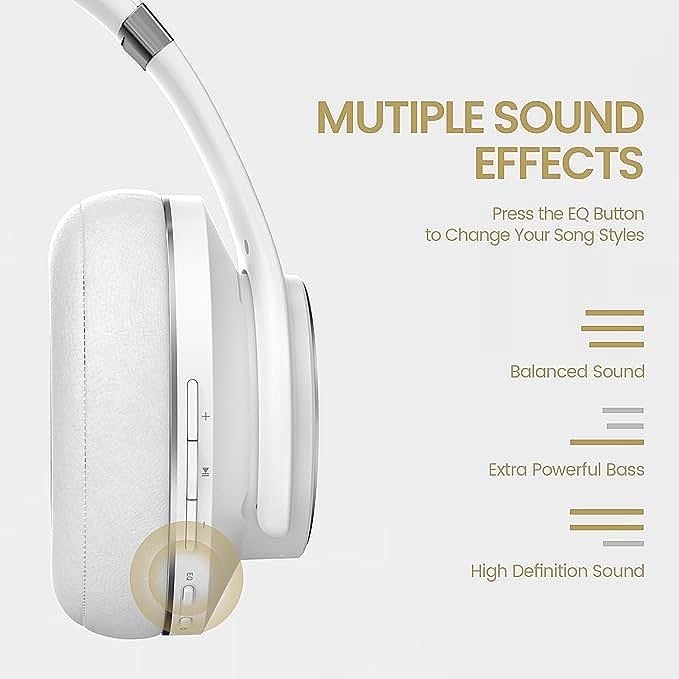
Balanced mode applies a flat, neutral response from 20Hz through 20kHz. No band is emphasized or recessed. The frequency response closely tracks the Harman target curve, which represents the average preferred sound signature derived from listener testing across hundreds of participants. In practical terms, Balanced mode gives you what the recording engineer intended you to hear.
Bass Boost mode adds approximately +3 to +5dB in the sub-bass region, specifically between 60Hz and 100Hz, with a slight recession of -1 to -2dB in the upper midrange. The result is a V-shaped signature: more low-end punch, slightly pulled-back mids, and maintained high-frequency presence. The upper-mid recession prevents the boosted bass from muddying vocal clarity.
High Definition mode applies +2 to +3dB in the 4-8kHz presence range while slightly reducing bass by about -1dB. This accentuates attack transients, the sharp initial burst of a snare hit or a plucked guitar string, and extends into the 8-12kHz "air" region. Instruments separate more clearly because the frequency band responsible for timbral identification is elevated.
To make sense of these adjustments, it helps to know the frequency map: sub-bass (20-60Hz) is felt more than heard; bass (60-250Hz) provides body and weight; midrange (250Hz-4kHz) carries most vocal and instrument fundamentals; presence (4-8kHz) governs clarity and articulation; air (8-12kHz and above) adds spatial openness.

The Persistence Problem
Most modern headphones handle EQ through a companion app. You download the app, connect via Bluetooth, adjust sliders, and save a profile. This works fine until you switch from your phone to your laptop. The EQ profile lives on the phone, not on the headphone. Your laptop receives a flat, uncorrected signal. Switch to a smart TV? Same problem. Plug into a gaming console? The app does not even exist on that platform.
This is the persistence problem, and it is more than an inconvenience. If you listen across three or four devices throughout the day, which is common for anyone commuting, working, and relaxing with the same pair of headphones, your EQ settings only follow you to one of them.
Hardware EQ solves this by storing the equalization curve in non-volatile memory on the headphone's DSP chip. The curve is applied before the signal reaches the driver, regardless of the source device. Phone, laptop, television, gaming console: the headphone applies the same frequency response to every incoming audio stream. One of the 8,100-plus reviewers for this product, a former professional drummer, put it plainly: "Once you EQ these, they stay that way."
There is a deeper design principle at work here. Three preset modes, not a parametric equalizer with adjustable Q factors and gain values. From an engineering standpoint, this looks like a limitation. No custom curves. No fine-tuning. But from a human-factors standpoint, it is a feature. A parametric EQ presents you with at least five continuous variables per band: center frequency, Q factor, gain, filter type, and band enable. Multiply that by ten bands and you have fifty parameters to manage. The cognitive cost of optimizing fifty parameters exceeds the benefit for the vast majority of listeners.
Three presets reduce that cognitive load to a single binary decision: does this sound right, or should I try the next one? The constraint is the interface. Less choice, faster decision, more time actually listening.

When to Flip the Switch
The right EQ mode depends on two variables: what you are listening to, and where you are listening. Here is how those variables interact in real scenarios.
Commuting on the subway. Low-frequency rumble dominates the noise floor. Bass Boost mode does double duty here. The enhanced sub-bass creates perceptual isolation, your brain locks onto the boosted low frequencies and partially tunes out the external rumble through psychoacoustic masking. The memory protein foam earpads provide physical isolation in the 100-500Hz range where passive sealing is most effective. The combination of physical and perceptual isolation provides more isolation than either technique alone.
Working at your desk for hours. Balanced mode. A neutral frequency response minimizes listening fatigue over extended sessions. The 40mm driver at 32Ohm impedance draws minimal current, approximately 5mA at typical listening levels, and the flat response means no frequency band is artificially emphasized to fatigue your auditory system. This is the same reason studio engineers monitor on flat-response speakers: accuracy preserves energy.
Late-night focused listening. High Definition mode. At lower volumes, your ear's sensitivity to high frequencies drops off more sharply than the Fletcher-Munson curves suggest. The +2-3dB boost in the 4-8kHz presence range compensates for this perceptual loss, revealing details that disappear at low volumes: the reverb tail on a vocal, the spatial placement of instruments in a stereo mix, the subtle breath before a trumpet entrance. This is where the "studio monitor" character of High Definition mode pays off.
At the gym. Bass Boost mode. Your movement creates low-frequency contact noise against the earpads. Bass reinforcement cuts through that interference. More importantly, low-frequency emphasis syncs with the rhythmic structure of workout playlists, which are almost universally produced with strong kick drums and bass lines designed to drive physical tempo.
Listening to spoken word. Balanced mode, without exception. The fundamental frequencies of human speech cluster between 300Hz and 3kHz, with consonant clarity depending on the 4-8kHz range. Bass boost masks these frequencies. The -1 to -2dB upper-mid recession in Bass Boost mode specifically degrades vocal intelligibility. For podcasts and audiobooks, flat is the only correct answer. High Definition mode can work for spoken word in quiet environments where the enhanced presence range adds crispness to consonants, but the trade-off is slightly increased fatigue over long sessions.
The physical environment matters as much as the content. Memory protein foam earpads create a passive acoustic seal that is most effective between 100Hz and 500Hz. This is the frequency range where mechanical vibrations from traffic, HVAC systems, and office chatter concentrate. Passive isolation handles these mid-frequency annoyances, which means your EQ choice can focus on the music rather than on compensating for environmental noise. When passive isolation is insufficient, for instance on a subway where sub-bass rumble dominates, Bass Boost provides the perceptual countermeasure.
For genre-specific guidance: classical and acoustic recordings are mixed to a neutral reference monitor, so Balanced mode preserves the dynamics and spatial imaging the engineer intended. Hip-hop and EDM are built around low-frequency impact; Bass Boost adds the +3-5dB at 60-100Hz that the genre assumes your playback system will provide. Rock and metal feature heavily compressed guitars and complex drum transients that blur together in Bass Boost; High Definition separates those layers by enhancing attack transients. Jazz sits between modes depending on what you value: Balanced for timbre accuracy, High Definition for spatial imaging. Pop varies by track: ballads in Balanced, dance tracks in Bass Boost.
The Right Frequency at the Right Time
Good equalization is not about adding something to the sound. It is about placing each frequency where it belongs for the context at hand. Bass Boost does not make music "better." It makes bass frequencies audible in environments where they would otherwise be masked. High Definition does not make music "clearer" in an absolute sense. It elevates the frequency band your ear uses to parse detail, which matters when you are listening carefully and less when you are listening casually.
The three-mode constraint carries its own logic. When you have infinite parametric control, you spend your time adjusting instead of listening. When you have three well-designed curves, you make one decision and move on. The limitation is the feature.
Next time you press that EQ button, listen for what changes and what stays the same. The music does not change. Your perception of it does. That is the entire principle. The right frequency at the right time is not about more. It is about correct.
DOQAUS LIFE 3 Wireless Headphones
Related Essays

The Physics of Silence: How Active Noise Cancellation Works

The Physics of Bone Conduction: Why Bass Is Hard and How...

Decoding Hi-Fi: What 40mm Drivers in Budget Headphones Actually Mean

Audio-Technica ATH-M30x : Science of Studio Sound & Isolation Explained

Moving-Coil Driver Technology: How Modern Headphones Convert Electricity into Sound

Sony WH-XB910N Noise Cancelling Headphones: A Bass-Thumping, Noise-Canceling Audio Feast

The Anatomy of Audio: Physics of Dynamic Drivers and Passive Isolation

The Real Reason Your ANC Headphones Still Let Voices Through

Air Tube vs Bone Conduction vs Traditional Headphones: An EMF Exposure...
