Why Does Water Destroy Bluetooth? The Physics of Underwater Wireless Failure
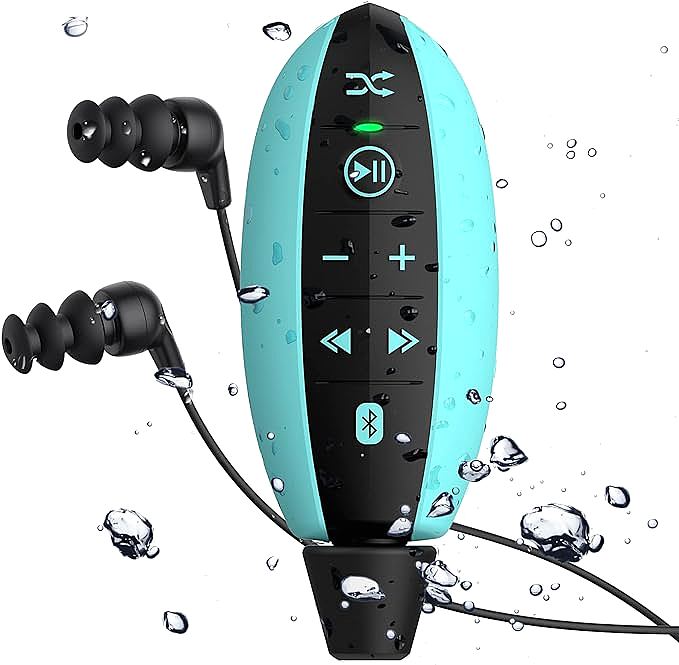
AGPTEK S19 Waterproof MP3 Player for Swimming
Your Bluetooth headphones disconnect the instant they slip below the pool surface. Not gradually. Not with static or buffering. The signal simply ceases to exist, as though someone cut an invisible wire. You surface, and the music resumes. Submerge again, silence. This is not a bug. It is not a limitation of your particular hardware. It is a fundamental property of how electromagnetic waves interact with water molecules, and no amount of firmware updates will ever fix it.
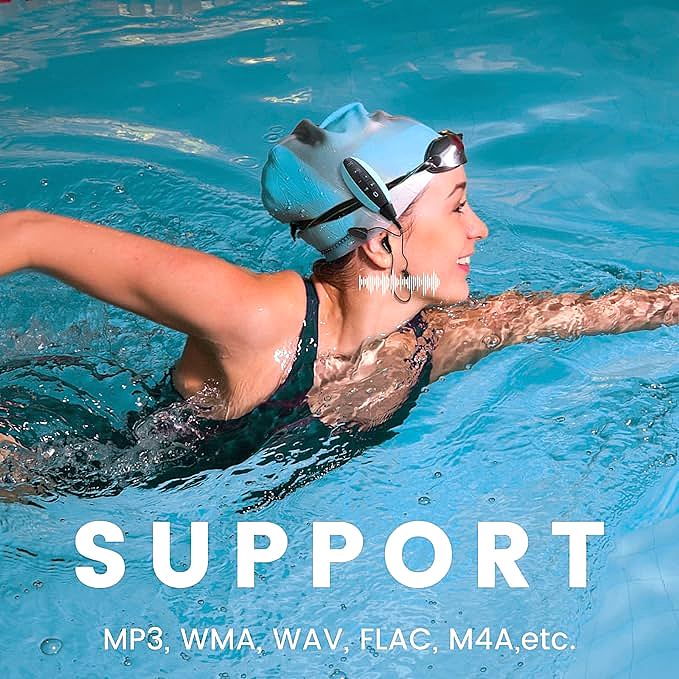
The 2.4 GHz Frequency That Water Loves to Eat
Bluetooth, along with Wi-Fi and many cordless protocols, operates in the 2.400 to 2.4835 GHz range, known as the Industrial, Scientific, and Medical (ISM) band. This frequency was chosen for a specific reason: it sits in a sweet spot where radio waves can penetrate walls, bounce around rooms, and maintain stable connections over roughly 10 meters in air. The Bluetooth Special Interest Group standardized this band precisely because it offered reliable short-range propagation in typical indoor environments.
But that same frequency has a dark side, one that becomes apparent the moment you introduce liquid. Water molecules are polar. The oxygen atom hogs shared electrons away from the two hydrogen atoms, leaving one end of the molecule with a slight negative charge and the other with a slight positive charge. When a 2.4 GHz electromagnetic wave passes through water, its oscillating electric field grabs these polar molecules and forces them to rotate, aligning their dipoles with the field direction. The field reverses 2.4 billion times per second. The molecules try to keep up.
They cannot rotate fast enough without generating enormous internal friction. That friction converts the electromagnetic energy directly into thermal energy. The radio wave literally heats the water. This process, called dielectric heating, is the exact mechanism inside a kitchen microwave oven, which operates at 2.45 GHz, barely 50 MHz away from the Bluetooth band. Your wireless earbuds and your microwave are broadcasting at nearly the same frequency. The only difference is power: a microwave dumps 1000 watts into a sealed cavity, while a Class 2 Bluetooth transmitter emits roughly 0 dBm, about one milliwatt.
The consequence is brutal. In air, a Bluetooth signal maintains usable strength over approximately 10 meters. In water, that same signal attenuates so aggressively that it becomes undetectable within 2 to 3 inches, roughly 5 to 7.5 centimeters. In seawater, where dissolved salts create a conductive ionic solution, the attenuation constant reaches 30 to 50 decibels per meter, according to data compiled from the Bluetooth SIG specifications and IEC propagation references. At those rates, even a signal amplified to military-grade power levels would struggle to cross a swimming pool.
Why Your Microwave and Your Earbuds Share a Frequency
The proximity between Bluetooth and microwave frequencies is not coincidence. Both exploit the same physical window: 2.4 GHz sits near the peak of water's dielectric absorption curve. For microwave oven engineers, this is a feature. They want maximum energy transfer from radio waves into water molecules to heat food. For wireless audio engineers, it is a catastrophe.
This shared frequency creates a design paradox. The very band that offers the most efficient wireless data transmission through dry air is also the band that water absorbs most aggressively. You cannot change the frequency to escape the problem, because the ISM band is a regulatory allocation. Devices must operate within it to be legally sold. And even if you could shift to a different band, lower frequencies that penetrate water more effectively, such as the very low frequency bands used by military submarines, require antenna structures measured in meters, not millimeters. A VLF antenna cannot fit inside an earbud.
The physics here connects two worlds that rarely share a conversation: consumer electronics and submarine communications. Naval engineers solved the underwater signaling problem decades ago, but their solution, acoustic sonar operating at frequencies between 1 and 50 kHz, trades bandwidth for penetration. Sound travels roughly 1500 meters per second in water, far faster than in air, and carries across ocean basins. But the data rate of acoustic transmission is measured in bits per second, not megabits. You can send a command to a submarine hundreds of kilometers away, but you cannot stream Spotify to it.
The Engineering Decision: Local Storage Over Wireless
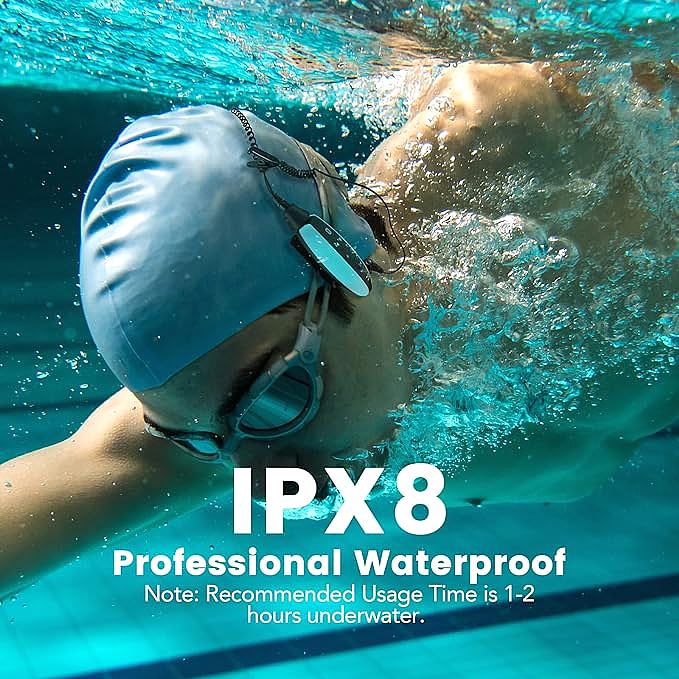
When a device manufacturer explicitly states that Bluetooth does not work underwater, as the AGPTEK S19 does in its product documentation, they are not being cautious. They are acknowledging a physical absolute. The device carries an IPX8 rating under IEC 60529, meaning it can withstand continuous immersion beyond one meter, yet its wireless capability is declared non-functional during submersion. This is not a contradiction. It is an engineering decision forced by electromagnetic reality.
The solution is to carry the data with you. NAND flash memory stores information by trapping electrons inside floating-gate MOSFETs through Fowler-Nordheim tunneling. When a high voltage is applied across the control gate, electrons quantum-tunnel through an insulating oxide barrier and become trapped in a floating gate. The presence or absence of trapped charge shifts the transistor's threshold voltage, encoding a binary state. This process requires no moving parts, generates negligible heat, and occupies microscopic physical volume. Eight gigabytes of NAND flash, enough for approximately 2000 audio tracks, fits inside a housing smaller than a postage stamp.
Solid-state storage is immune to the hydrostatic pressure that would destroy mechanical systems. A spinning hard drive relies on a read head floating nanometers above a platter; a cassette deck depends on rubber rollers and magnetic tape moving at precise speeds. Submerge either, and the pressure differential at even modest depths warps housings, misaligns mechanisms, and kills the device. Flash memory has no such vulnerability. The electrons stay trapped regardless of external water pressure, making local solid-state storage the only viable architecture for underwater audio playback.
The Sealed Enclosure Paradox
But waterproofing introduces its own acoustic penalty. To achieve an IPX8 seal, engineers must create a hermetic enclosure around the audio driver. No vents. No ports. No paths for air to escape. In a conventional headphone, small vents behind the driver diaphragm allow the trapped air mass to equalize as the diaphragm moves. Remove those vents, and you create a pneumatic spring.
Boyle's Law describes this precisely: at constant temperature, pressure and volume are inversely proportional. When the driver diaphragm pushes backward to reproduce a bass note, it compresses the sealed air volume behind it. That compressed air pushes back, resisting the diaphragm's motion. The lower the frequency, the larger the diaphragm excursion required, and the stronger the pneumatic resistance. Bass response collapses. The audio sounds thin and hollow, as though someone placed a blanket over the speakers.
Engineers partially compensate by relying on the ear canal itself. When waterproof eartips create a tight seal against the ear tissue, the air column trapped in front of the driver couples directly to the tympanic membrane. The ear canal functions as a Helmholtz resonator, a tuned acoustic cavity that reinforces specific frequency ranges. The driver's restricted motion still transfers energy efficiently into this sealed biological chamber. But the system is fragile. Break the eartip seal, allow even a thin film of water into the canal, and the resonance collapses instantly. The audio does not degrade gradually. It vanishes into a muffled, distorted mess.

Saltwater: The Slow Molecular Assassination
Fresh water is merely an obstacle to radio waves. Saltwater is an active enemy of the hardware itself. Ocean water contains approximately 35 grams of dissolved salts per liter, predominantly sodium chloride, which dissociates into sodium ions at roughly 10.8 grams per liter and chloride ions at 19.4 grams per liter, according to Britannica's seawater composition data. This ionic soup creates an electrolyte with a conductivity of approximately 5 siemens per meter.
When saltwater bridges two dissimilar metals on a device, it forms a galvanic cell. The more electrochemically active metal becomes the anode and begins to dissolve, releasing metal ions into the solution while electrons flow to the cathode. A copper charging pin in contact with a stainless steel housing screw, connected by a thin film of seawater, becomes a tiny battery. The copper ionizes. The metal literally dissolves into the ocean. Within hours, the charging terminal develops a crust of green or black oxide, an insulating layer that blocks electrical contact entirely.
This is why manufacturers include silicone caps for charging ports and warn users to rinse devices with fresh water after ocean exposure. The rinse is not cosmetic. It is a chemical intervention. Fresh water dilutes the ionic concentration below the threshold needed to sustain the galvanic reaction. Without that dilution, the corrosion continues silently every time ambient moisture reactivates the residual salt film.
Cold water adds a second threat. Water conducts heat 24 times faster than air. During a long swim in cool conditions, the device's internal temperature drops, increasing the viscosity of the lithium-polymer battery's electrolyte. Higher viscosity means higher internal resistance, which reduces the ion transfer rate between electrodes. A battery rated for 10 hours at room temperature can experience severe voltage sag in cold water, triggering premature low-battery shutdown. Users who report battery life collapsing from 10 hours to 3, and eventually to under 1 hour after several months, are observing the cumulative effects of thermal stress and undetected micro-corrosion at the charging interface.
The Unsolvable Triangle
Underwater audio engineering sits at the intersection of three competing physical demands: wireless connectivity, acoustic fidelity, and environmental survival. You can have any two. You cannot have all three. Wireless transmission requires electromagnetic waves, which water absorbs. Acoustic fidelity requires diaphragm freedom, which hermetic sealing restricts. Environmental survival requires that very sealing, which sacrifices the fidelity. Every waterproof audio device on the market represents a specific compromise within this triangle.
Devices that carry local storage and accept the acoustic limitations of sealed enclosures occupy one corner. Bone conduction systems, which bypass the eardrum entirely by vibrating the skull bones, occupy another, trading traditional sound quality for reliable underwater transmission. No current technology has escaped the geometry of this constraint. The physics of water, from its dielectric absorption to its ionic conductivity to its thermal properties, defines the boundaries of what portable electronics can achieve beneath the surface. Engineering, at its most honest, is the discipline of choosing which physical laws to obey and which limitations to design around.
AGPTEK S19 Waterproof MP3 Player for Swimming
Related Essays

Why Bluetooth Dies Underwater and Bone Conduction Thrives

FOLEY X7 Bone Conduction Headphones: Affordable yet Limited
