Electromagnetic Induction and Polymer Resonance in Mobile Audio


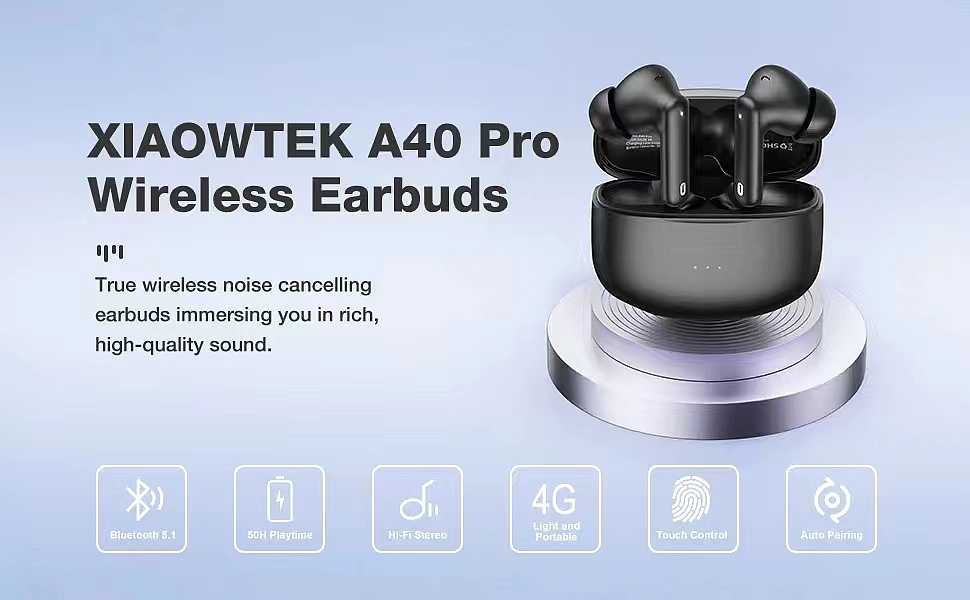
XIAOWTEK A40 Pro Wireless Earbuds
The conversion of a digital file hosted on a remote server into a physical, mechanical wave capable of vibrating the human tympanic membrane requires an extraordinary sequence of technological translations. Stripping away the aesthetic design of modern audio wearables reveals a complex ecosystem of radio frequency modulation, energy storage, and electromagnetic induction.
By deconstructing the architecture of a mass-market wearable—such as the XIAOWTEK A40 Pro Wireless Earbuds—we can examine how advanced material science and telecommunication protocols have been miniaturized to operate within a 4-gram chassis. This is not a discussion of musical fidelity, but an analysis of the physical laws required to transport and manifest sound without a physical tether.

The Logistics of the Invisible Tether
The primary barrier in wireless audio is the reliable transmission of a high-density data stream across an environment polluted by electromagnetic interference. The fundamental protocol for this transmission is Bluetooth, which operates within the 2.402 GHz to 2.480 GHz ISM (Industrial, Scientific, and Medical) radio band.
However, a static radio frequency is highly susceptible to disruption. If an earbud relied on a single frequency, a nearby Wi-Fi router or microwave oven operating on that same frequency would instantly severe the connection. The engineering solution relies on a concept originally developed for military torpedo guidance: Frequency-Hopping Spread Spectrum (FHSS).
Under the FHSS protocol, the transmitting device (a smartphone) and the receiving device (the earbud) do not communicate on a single, continuous channel. Instead, the available 2.4 GHz spectrum is divided into 79 distinct channels. The devices execute a synchronized algorithm, rapidly switching—or "hopping"—between these channels up to 1,600 times per second. If one channel encounters interference, the data packet is simply retransmitted milliseconds later on a clear channel, creating an incredibly resilient, virtually unbreakable invisible tether.
The implementation of Bluetooth 5.3 in units like the XIAOWTEK A40 Pro optimizes this telemetry. Version 5.3 introduces enhanced connection sub-rating. Instead of maintaining a constant, high-power connection even when no audio is playing, the protocol allows the devices to rapidly drop into a low-power sleep state and instantly wake up the microsecond audio data is detected. This algorithmic efficiency is the primary driver behind the 50-hour aggregate battery life reported in the specifications.
The Dynamics of the Bio-Carbon Transducer
Once the digital signal successfully traverses the air gap and is decoded by the earbud's internal processor, it must be converted back into an analog electrical current. This current is then fed into the core mechanical component of the earbud: the dynamic driver.
A dynamic driver operates on the fundamental laws of electromagnetism. It consists of three primary components: a permanent magnet, a voice coil (a microscopic spool of conductive wire), and a diaphragm (a thin, flexible membrane).
The voice coil is attached to the base of the diaphragm and suspended within the magnetic field of the permanent magnet. As the analog audio current flows through the voice coil, it turns the coil into an electromagnet. Because the audio signal is alternating current (AC), the polarity of the electromagnet reverses thousands of times per second.
This rapidly alternating polarity causes the voice coil to be violently attracted to, and then repelled by, the stationary permanent magnet. This kinetic force pushes and pulls the attached diaphragm. As the diaphragm displaces the air in the ear canal, it creates the mechanical pressure waves that the human brain interprets as sound.
The material science of the diaphragm dictates the physical limits of the audio reproduction. The ideal diaphragm must possess a paradoxical set of properties: it must be incredibly stiff to move as a perfect piston without flexing (which causes acoustic distortion), yet it must have an infinitesimally low mass to respond instantly to high-frequency electrical impulses without kinetic lag.
The XIAOWTEK unit specifies a "bio-carbon fiber composite diaphragm." Carbon fiber is utilized precisely because of its extreme stiffness-to-weight ratio. By weaving carbon isotopes into a polymer matrix, engineers create a membrane capable of arresting its momentum instantly. This prevents the physical "ringing" or lingering vibrations that muddy the acoustic output in cheaper, heavier paper or Mylar diaphragms. The 12mm diameter of the driver provides a large enough surface area to displace sufficient air mass to generate low-frequency (bass) pressure waves, a critical requirement to overcome the lack of a perfect acoustic seal in a half-in-ear design.

The Structural Reality of Hydrostatic Defense
Deploying sensitive electromagnetic coils and exposed lithium-ion batteries in an environment prone to biological moisture (sweat) and atmospheric precipitation (rain) requires severe structural interventions. The specification of "IPX7 Waterproof" is not a marketing term; it is a rigid industrial standard defined by the International Electrotechnical Commission (IEC).
The "7" in the IPX7 rating dictates a specific test parameter: the device must survive complete, continuous submersion in water at a depth of 1 meter for exactly 30 minutes without suffering catastrophic electrical failure.
Achieving this level of hydrostatic defense in a modular device requires the elimination of physical ingress points. The external chassis cannot rely on simple snap-fit plastics. The two halves of the earbud shell must be permanently bonded using ultrasonic welding, a process where high-frequency acoustic vibrations generate localized heat, melting and fusing the plastic edges into a monolithic structure.
Furthermore, any necessary apertures—such as the acoustic mesh where the sound exits, or the microphone ports—must be defended by hydrophobic acoustic vents. These specialized membranes are woven from advanced fluoropolymers (similar to Teflon) that possess a surface tension lower than that of water. The microscopic pores allow air pressure (sound) to pass through freely, but physically repel the cohesive water molecules, preventing them from bridging the gap and entering the internal circuitry.
The Physics of the Charging Vault
The logistical reality of a 4-gram wireless earbud is that its internal volume is almost entirely consumed by the acoustic driver and the microprocessors, leaving a microscopic footprint for the primary power source. A lithium-ion coin cell inside the earbud typically only holds enough energy for a few hours of continuous electromagnetic actuation.
To resolve this power deficit, the charging case acts as a required auxiliary power bank. The case houses a significantly larger, higher-capacity lithium-polymer (LiPo) battery. The interaction between the case and the earbuds relies on localized electrical contacts.
When an earbud is dropped into the case, magnetic alignment pulls the metallic charging pins on the bud directly onto the spring-loaded pogo pins within the case. This completes a physical circuit. The power management integrated circuit (PMIC) within the case monitors the voltage of the earbud's battery. If the voltage is low, the PMIC initiates a constant-current/constant-voltage (CC/CV) charging protocol, transferring the stored chemical energy from the large case battery directly into the small earbud battery.
The Hall Effect switch mentioned in the product specifications is a critical component of this ecosystem. A Hall Effect sensor detects the presence of a magnetic field. A small magnet is embedded in the lid of the charging case. When the lid is closed, the sensor detects the magnetic field and instructs the earbuds to sever their Bluetooth connection and enter a dormant charging state. The microsecond the lid is opened, the magnetic field moves away from the sensor. The sensor registers the drop in field strength and instantly triggers the earbuds to wake up and initiate the FHSS Bluetooth handshake protocol with the host device, executing the "one-step pairing" before the user even places the unit in their ear.
The Limitation of Passive Isolation
While the electronic telemetry and driver mechanics dictate the quality of the sound generated, the final acoustic perception is governed by the physical interface between the hardware and the human biology.
The XIAOWTEK A40 Pro utilizes a "half in-ear" geometry, angling the output nozzle at 108 degrees to rest against the tragus and anti-tragus of the outer ear, rather than inserting deeply into the ear canal with an expanding silicone tip.
This structural choice fundamentally alters the acoustic physics of the device. A deep-insertion silicone tip provides "passive noise isolation"—it physically plugs the ear canal, blocking external sound waves from reaching the eardrum. Without this physical seal, the half-in-ear design allows ambient environmental noise (traffic, wind, crowd chatter) to freely enter the ear canal and mix with the audio output of the dynamic driver.
To overcome this lack of physical isolation, the internal driver must be calibrated to output higher sound pressure levels (volume), particularly in the low-frequency ranges, to prevent the audio signal from being masked by the ambient noise floor. This represents a calculated engineering compromise: sacrificing absolute acoustic isolation and sub-bass impact in exchange for long-term physical comfort and heightened situational awareness.
Mastering the transition of a digital file into an acoustic pressure wave requires a deep understanding of the invisible forces at play. By analyzing the precise mathematical relationships between frequency hopping, electromagnetic driver actuation, and hydrostatic sealing, the user ceases to view the earbud as a magic tether, recognizing it instead as a highly calibrated exercise in applied physics.
XIAOWTEK A40 Pro Wireless Earbuds
Related Essays

The Logic of the Affordable Miracle: Deconstructing Budget Audio Engineering

Kurdene S10 Wireless Earbuds: Experience Superior Sound with Bluetooth 5.2 Technology

CAPOXO H06 Wireless Earbuds: Your New Workout Buds with Marathon Battery Life

How Compact Speakers Defy Bass Physics

The Invisible Freedom: When Technology Disappears Into Reliability

Kurdene S8 Mini Wireless Earbuds: Big Sound in a Small Package

Lady House XG8 Mini Headphones: Experience Clear Sound in a Compact Design

Unleash Your Inner Audiophile with the PIFFA A66 Bluetooth Headphones

Hypertech X EP1 Bluetooth Headphones: The Must-Have Active Noise Cancelling Neckband for Fitness Freaks

