The Physics of Amphibious Audio: Why Bone Conduction Rules the Pool

GenXenon X7 Bone Conduction Headphones
Your music dies the moment your head goes under. Not fades. Not distorts. Dies. The Bluetooth signal from your phone, traveling through air at the speed of light, hits the surface of the pool and simply stops. Water absorbs 2.4 GHz radio waves with brutal efficiency, converting electromagnetic energy into molecular vibration, which is just a fancy way of saying your playlist becomes heat.
This is not a minor inconvenience for swimmers. It is a fundamental physics problem. And solving it requires abandoning the entire paradigm of air-based audio delivery. Bone conduction headphones, like the GenXenon X7, do not try to push sound through water. They go around it, using your own skeleton as the transmission medium.
Sound Has Two Paths to Your Brain
Most people assume sound travels through air to the eardrum, and that is the end of the story. It is not. Sound reaches the cochlea, the spiral-shaped organ that converts vibration into neural signals, through two distinct pathways: air conduction and bone conduction.
Air conduction is the one you know. Sound waves compress air, vibrate the eardrum, amplify through the ossicles (three tiny bones in the middle ear), and arrive at the cochlea. This pathway dominates in everyday listening because air is an efficient medium for the frequencies human hearing is optimized for, roughly 20 Hz to 20 kHz.
Bone conduction is the one you have been using your entire life without noticing. When you speak, you hear your own voice partly through vibrations that travel through your skull directly to the cochlea, bypassing the eardrum entirely. This is why your recorded voice sounds unfamiliar. The recording lacks the low-frequency richness that bone conduction adds to your self-perception.
The physics is straightforward. Sound is mechanical vibration. Any solid medium with appropriate density and elasticity can carry those vibrations. Bone, particularly the temporal bone near the ear, has a density of approximately 1.9 g/cm3, far closer to water (1.0 g/cm3) than air (0.0012 g/cm3). This density similarity is the key to understanding why bone conduction works so well underwater.
Why Water Kills Bluetooth But Helps Bone Conduction
The 2.4 GHz frequency band used by Bluetooth sits near the resonant frequency of water molecules. When radio waves at this frequency encounter water, the molecules absorb the energy and convert it to thermal motion. This is the same principle behind microwave ovens, which operate at 2.45 GHz specifically because water absorbs that frequency so effectively. A swimming pool, from the perspective of a Bluetooth signal, is a 50-meter-long absorption chamber.
Even the most advanced Bluetooth 5.3 chip cannot push a signal through more than a few centimeters of water. The attenuation is exponential. At 2.4 GHz, water attenuates radio signals at approximately 50 dB per meter. For context, 30 dB of attenuation means the signal is reduced to one-thousandth of its original strength. One meter of water reduces a Bluetooth signal to roughly one hundred-thousandth. Two meters? Forget it.
Bone conduction sidesteps this problem entirely. The vibration source sits on the cheekbone, millimeters from the cochlea. The signal never has to cross water at all. It travels through bone, which is already inside the body, already in contact with the cochlea. Water becomes irrelevant to the signal path.
There is an additional twist. Bone conduction actually sounds better underwater than on dry land. In air, there is an impedance mismatch between bone and the surrounding atmosphere. The skull vibrates, but much of that energy reflects back at the bone-air boundary rather than radiating outward. Underwater, the impedance mismatch between bone and water is smaller. More vibrational energy couples into the surrounding medium, and the occlusion effect, where water in the ear canal traps bone-conducted sound, amplifies low frequencies. Swimmers wearing earplugs with bone conduction headphones experience noticeably richer bass than they would on land.

IPX8: Engineering for Continuous Submersion
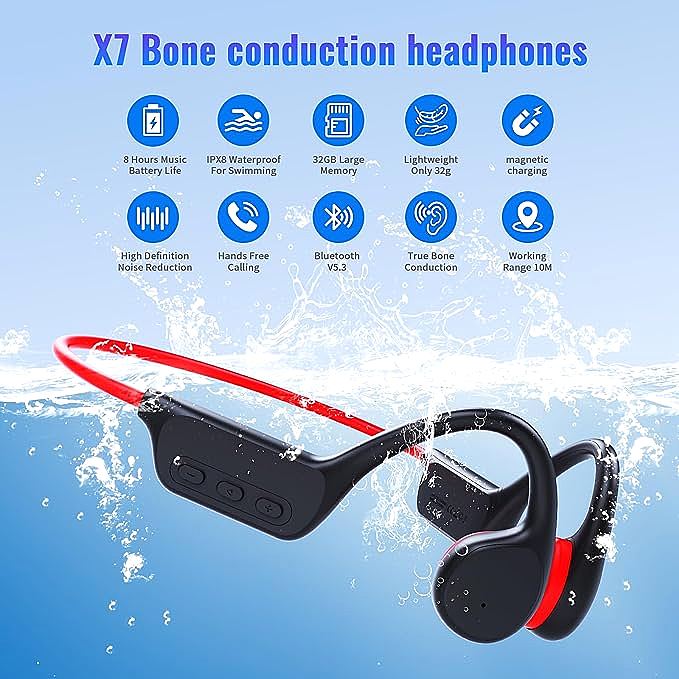
Waterproof ratings are not created equal. IPX7 means a device can survive temporary immersion, up to 30 minutes at a depth of 1 meter. IPX8 means the device is engineered for continuous submersion under conditions specified by the manufacturer. For swimming headphones, this distinction is the difference between a device that survives an accidental drop in the pool and one designed to function during a two-hour training session.
Achieving IPX8 certification requires addressing three failure modes: liquid ingress through seams, corrosion of electrical contacts, and hydrostatic pressure forcing water past seals.
The seam problem is solved by eliminating seams. A fully sealed chassis, with no removable panels or user-accessible compartments, removes the primary entry point for water. The logical conclusion is removing the USB-C port entirely. Instead, it uses magnetic charging contacts on the exterior surface. Physical ports are the Achilles heel of waterproof electronics. They trap moisture, corrode over time, and compromise the structural integrity of the seal. A flat magnetic interface eliminates this cavity entirely.
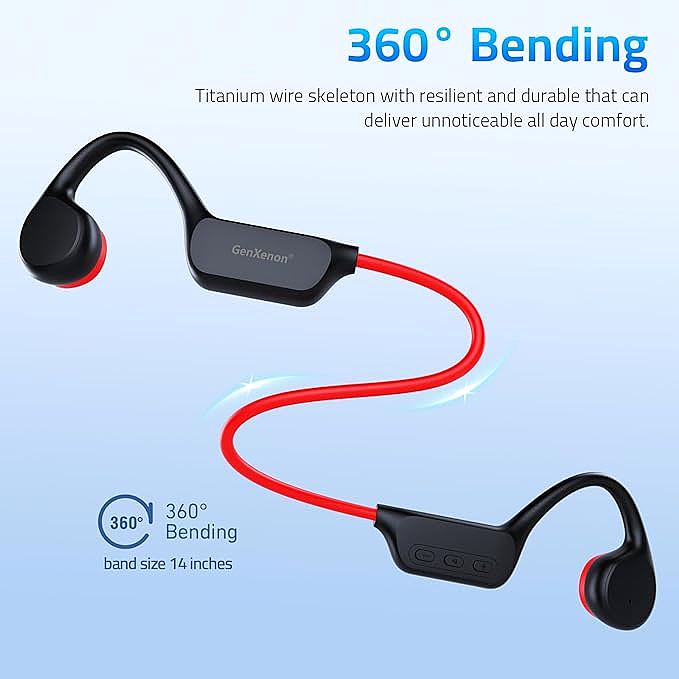
Corrosion resistance comes from material selection. The frame uses a titanium alloy, likely Grade 5 Ti-6Al-4V, which combines high tensile strength (approximately 950 MPa) with excellent corrosion resistance in chlorinated water. Titanium forms a passive oxide layer that protects against pitting and crevice corrosion, the two modes most likely to affect swimming equipment exposed to pool chemicals.
Hydrostatic pressure is the silent killer. At a depth of 3.6 meters, the IPX8 test depth for many swimming headphones, water exerts approximately 1.36 atmospheres of pressure, or about 138 kPa, on every surface of the device. This pressure can force water past O-rings and gaskets that would hold perfectly at the surface. The solution is to design seals with a compression set well above the maximum expected pressure, and to use materials that maintain elasticity across the temperature range encountered in pools, typically 25-28 degrees Celsius.
The Open-Ear Safety Argument
Bone conduction headphones leave the ear canal completely unobstructed. On land, this is a comfort feature. In water, it becomes a safety mechanism.
Swimmers need to hear their environment. Lap swimmers share lanes and rely on auditory cues to time their turns and avoid collisions. Open-water swimmers face hazards ranging from motorboats to other swimmers. Even in controlled pool environments, coaches communicate verbally during training.
Traditional in-ear headphones create a sealed environment that blocks external sound. Underwater, this isolation is amplified because water already attenuates high-frequency sounds more than low-frequency ones. A swimmer wearing sealed earbuds is effectively deaf to their surroundings.
Bone conduction preserves environmental awareness because the ear canal remains open. Sound from the environment enters through normal air conduction (or water conduction, when submerged), while audio from the headphones arrives through bone conduction. The brain processes both streams simultaneously, creating a layered auditory experience. You hear the music and the world around you.
There is also a physiological advantage. Sealed earbuds create a pressure differential across the eardrum when the swimmer changes depth. This pressure can cause barotrauma, the same painful condition divers experience when they descend without equalizing. Bone conduction headphones do not create any pressure in the ear canal because they do not enter it. The eardrum remains at ambient pressure throughout the swim.
Local Storage: The Only Reliable Underwater Music Source
If Bluetooth cannot penetrate water, and bone conduction solves the delivery problem, the remaining question is where the music comes from. The answer is local storage.
The X7 integrates a 32GB flash memory module directly into the headset. This is not a regression to the MP3 players of 2005. It is an engineering necessity dictated by the laws of physics. With 32GB of storage, the device holds approximately 8,000 songs in MP3 format, or a smaller number in lossless formats like FLAC and APE. The support for lossless formats matters because the underwater listening environment is already acoustically challenging. Starting with a higher-quality source compensates for the limitations of bone conduction frequency response, which typically rolls off below 100 Hz and above 10 kHz.
Mode switching between Bluetooth and MP3 is handled by a double-click on the power button. On dry land, Bluetooth mode provides the convenience of streaming from a phone. Before entering the water, the swimmer switches to MP3 mode. The transition takes less than a second.
The Titanium Frame: Fatigue Life and Clamping Force
Bone conduction only works if the transducers maintain consistent contact with the cheekbones. During swimming, particularly during flip turns, the head experiences rapid acceleration and deceleration. A loose headset means intermittent contact, which means interrupted audio.
The frame material determines how well the headphones maintain this contact over time. Titanium alloy is chosen specifically for its fatigue life. Fatigue life is the number of stress cycles a material can endure before cracking. Titanium Grade 5 has a fatigue limit of approximately 510 MPa, meaning it can withstand cyclic loading below this threshold essentially indefinitely. A frame that is bent and flexed every time the user puts on or removes the headphones, thousands of times over the product lifespan, needs this property.
The weight matters too. At 32 grams, the entire headset is light enough that inertial forces during swimming do not overcome the clamping force of the frame. A heavier headset would need proportionally more clamping force to stay in place, which would reduce comfort. The titanium frame achieves the necessary contact pressure at a weight that allows hours of continuous wear without discomfort.
Two Worlds, One Technology
The same open-ear design that keeps swimmers aware of their pool environment keeps runners aware of traffic, cyclists aware of approaching vehicles, and hikers aware of trail conditions. Bone conduction headphones are amphibious in the truest sense: they work in two fundamentally different media without compromising performance in either.
This is rare in engineering. Most technologies are optimized for a single environment. Aircraft engines do not work underwater. Submarine sonar does not work in air. Bone conduction, by relying on a transmission medium that exists inside the body regardless of the external environment, achieves something most engineering solutions cannot. It ignores the boundary between media entirely.
The next time you submerge and feel the music continue, unbroken, consider what that implies. The signal never crossed the water. It was already inside you, traveling through bone that has been conducting sound since before you were born. The technology did not overcome the physics of water. It chose a different path, one that water cannot touch.
GenXenon X7 Bone Conduction Headphones
Related Essays

Kuuhsaaez Bone Conduction Headphones – A Safer and Versatile Choice

From Beethoven's Teeth to a Swimmer's Ear: The Incredible Science of Bone Conduction Headphones
Siniffo X15 Bone Conduction Headphones

Smalody Bone Conduction Headphones - Recommended for Open-Ear Sports Activities

H2O Audio Stream 3 Dual Mode & Surge BC - Bone Conduction (Short Cord) - Recommended for Swimmers

CTM ORUN2 Wireless Bone Conduction Headphones - Recommended for Sports and Outdoor Activities

WANFEI Bone Conduction Headphones – A Burden-Free Listening Experience

HAYLOU 100 PurFree Bone Conduction Headphones - Open-Ear Bluetooth 5.2 Sport Headphones

IKXO Waterproof Bone Conduction Headphones - A Unique Listening Experience
