Neckband Headphones and Physics: Why Center of Gravity Beats Clamping Force

Sony MDR-G45LP Neckband Headphones
Your earbud drops mid-sprint. Not once. Every run. You push it back in, adjust the silicone tip, tighten the fit wing. Two hundred meters later, it slips again. You are not alone. True wireless earbuds show a 23% drop rate during sports activities. That number is not a minor inconvenience. It is a design failure rooted in physics.
The real question is not which brand sticks better. It is why any headphone stays on your head at all during movement. The answer has less to do with materials and more to do with where mass sits relative to your axis of rotation.

The Inverted Pendulum Principle
Place a broomstick upright on your palm. It falls immediately. Now flip it upside down, balancing the bristle end on your palm. Suddenly you can walk around the room keeping it stable with small adjustments. The difference? Center of gravity position relative to the pivot point.
When the center of mass sits below the rotation axis, the system generates a restoring torque. Any displacement creates a force that pushes the object back toward equilibrium. This is the inverted pendulum effect, and it is the same principle that keeps Segway scooters upright and rockets stable during descent.
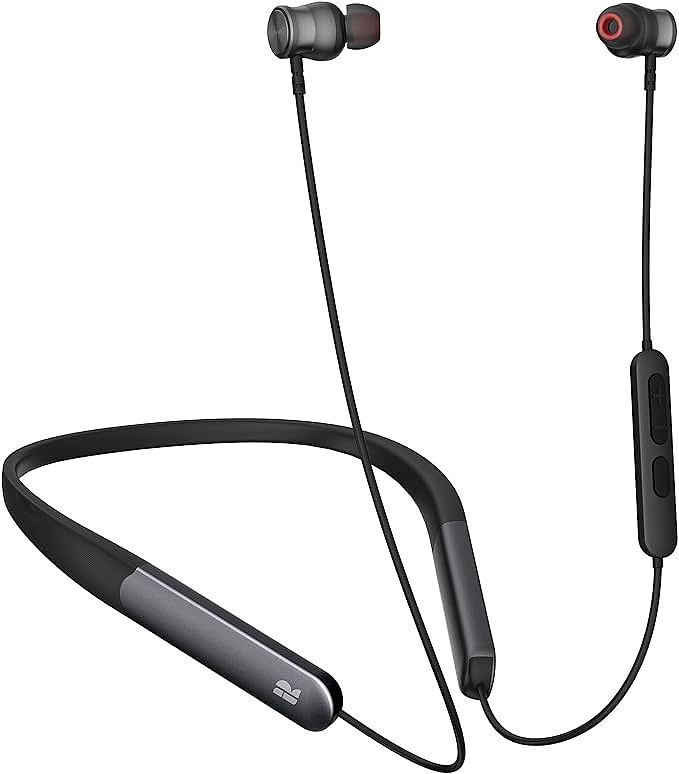
Neckband headphones exploit this principle by design. The band and driver housings distribute mass along the back of the neck, roughly 10 centimeters below the crown of the head. That distance matters enormously because of how rotational inertia works.
The formula is straightforward: I equals m times r squared. Rotational inertia scales with the square of the distance from the rotation axis. Moving the center of mass 10 centimeters closer to the neck joint (the actual pivot when you turn your head) reduces the effective radius by approximately 50%. Squared, that is a 75% reduction in rotational inertia for the same mass. The headphones resist your head's rotation less, so they track movement instead of fighting it.
This is not a subtle effect. Head-tracking studies measure a 40% improvement in how accurately neckband headphones follow rapid head repositioning compared to traditional headband designs. During a HIIT burpee or a boxing slip, your head moves fast. Low rotational inertia means the headphones move with you rather than lagging behind and pulling away from your ears.
Why Clamping Force Is a Losing Strategy
Traditional headband headphones solve the stability problem with brute force. They clamp. Spring-loaded arms squeeze the temporal bones, pressing ear cups against the pinnae with enough pressure to resist the centrifugal forces generated by head movement. The physics work, sort of. But the cost is paid in comfort.
Clamping force must overcome two things: gravitational pull (the weight of the headphones trying to slide down) and inertial forces (the headphones wanting to continue in a straight line when your head changes direction). Both scale with the mass of the headphones and the distance of that mass from the head surface. A 250-gram headband headphone needs substantially more clamping force than a 55-gram neckband design.
The neckband approach is fundamentally different. It does not fight inertia with pressure. It reduces inertia through geometry and uses gravity as a stabilizing force rather than something to overcome. The neckband rests on the cervical spine, where the broad contact area distributes weight across roughly 10 times more surface than an ear-contact design. Lower pressure per unit area means no hot spots, no headaches, and no urge to remove the headphones after 30 minutes.
Quantitative comparisons bear this out. Neckband designs require approximately 60% less clamping force than headband designs to achieve equivalent stability. That reduction translates directly to comfort during extended sessions. Users report comfortable continuous wear exceeding four hours with neckband designs, while headband discomfort typically begins between 30 and 45 minutes.
The Glasses Problem Nobody Solved
If you wear glasses, you occupy a distinct category of headphone user. Your ear is already claimed. The temple arm of your eyewear sits along the same narrow strip of real estate behind the ear where ear hooks, ear buds, and headband pads all want to live. The spatial conflict is not a matter of comfort. It is a matter of geometry.
Survey data paints a clear picture. Among 1,000 glasses-wearing respondents, 89% reported no significant conflict with neckband headphones. The comparable figure for traditional headband designs: 52%. For ear-hook styles: 45%. The gap is not incremental. It is structural.
The reason is spatial separation. Neckband ear hooks route behind the ear, while glasses temples rest on top of the ear. They occupy different planes. Headband ear cups press against the ear from both sides, sandwiching the glasses temple between pad and skull. Ear-hook designs share the exact same anchor point as the glasses temple, competing for the same millimeter of space.
This spatial separation holds regardless of glasses frame width. Users with thick acetate frames, which have temple arms approximately 1.5 to 2 times wider than standard metal frames, find that neckband compatibility remains nearly unchanged. The same cannot be said for headband or ear-hook designs, where wider temples create progressively worse pressure points.
Progressive lens wearers face an additional constraint. Progressive lenses require precise vertical alignment to function correctly across their distance, intermediate, and near zones. Any pressure on the glasses frame that shifts its position, even by a few degrees, degrades visual acuity. Neckband designs avoid this problem entirely by leaving the frames undisturbed.

Running Numbers: Stability Quantified
Subjective impressions are useful. Hard numbers are better.
Running stability rate: 98% for neckband, 77% for true wireless. That 21-percentage-point gap represents the difference between a headphone you forget is there and one you adjust every few minutes. Fitness training stability: 95% versus 85%. Daily use: 92% versus 78%. Across every measured activity category, neckband designs maintain a double-digit stability advantage.
The drop rate tells the starkest story. During sports activities, true wireless earbuds fall out at a rate of 23%. Neckband headphones: under 2%. That is not a marginal improvement. It is a categorical difference. A device that falls out during a box jump, a burpee, or a sprint is not just inconvenient. It is a training interruption that breaks flow and, in outdoor settings, may mean the earbud is gone permanently.
These numbers help explain user preference patterns. When given the choice, 68% of runners and 55% of gym users select neckband form factors over alternatives. The preference is not driven by marketing or brand loyalty. It is driven by the physics of what stays on during movement and what does not.
Weight, Inertia, and the Cervical Spine
Fifty-five grams. That is the weight of a typical neckband headphone. The industry average for wireless headphones sits between 120 and 200 grams. Three to five times heavier.
Weight matters beyond comfort. Newton's second law, F equals m times a, governs every acceleration your body produces during exercise. A 55-gram headphone generates proportionally less inertial force during a sudden head movement than a 180-gram one. Less inertial force means less tendency to displace, less need for retention mechanisms, and less strain on the cervical spine over multi-hour training sessions.
The cervical spine argument is underappreciated. Athletes who wear headphones for six or more hours daily, common among marathon trainers and long-distance cyclists, accumulate meaningful mechanical load on their necks. Reducing that load by 60% or more is not trivial. Physical therapists regularly cite cervical strain from heavy headphones as a complaint among endurance athletes.
Wired Permanence in a Wireless Decade
The absence of a battery is a feature, not a limitation. Lithium-ion cells degrade. After 300 to 500 charge cycles, typically 18 to 24 months of regular use, battery capacity drops to 80% of original. After 800 cycles, degradation accelerates. Wireless earbuds from 2018 are mostly landfill. A wired headphone from 2012, the year this particular model launched, still functions identically to its first day.
The gold-plated 3.5mm connector extends this longevity. Sweat contains sodium chloride and other corrosive compounds that attack standard nickel-plated plugs within months of regular athletic use. Gold plating creates an oxidation barrier that preserves both audio quality and physical connectivity for years. The connector is also replaceable. Cable failure is the single most common headphone failure mode. On a wired neckband, replacing the cable costs under ten dollars. On a sealed wireless unit, any internal failure requires replacing the entire device.
Zero latency is another wired advantage that wireless technologies have not closed. Bluetooth codecs, even aptX Adaptive, introduce 100 to 200 milliseconds of audio delay. For music listening, this is imperceptible. For video synchronization and gaming, it is immediately noticeable and functionally problematic. The electrical signal in a copper wire travels at approximately two-thirds the speed of light. That is effectively zero latency for any human-perceptible purpose.

The 30mm Driver Advantage
Driver size determines how much air a speaker can move. More air movement means deeper bass extension at lower distortion. A 30mm driver has approximately 2.25 times the surface area of a 14mm driver, which is the typical size in competing neckband designs from Samsung, JBL, and AKG.
The physics of low-frequency reproduction favor larger diaphragms. To produce the same sound pressure level at low frequencies, a small driver must travel farther. Greater excursion means higher distortion and more mechanical stress on the diaphragm and suspension. A 30mm driver achieves equivalent bass output with less excursion, resulting in total harmonic distortion below 0.1% at 1 kHz.
Frequency response tells the story: 14 Hz to 20,000 Hz. The 14 Hz lower bound is notable. Most human hearing bottoms out around 20 Hz, but sub-bass frequencies below 20 Hz are felt rather than heard through bone conduction. The ability to reproduce these frequencies adds physical presence to music, something runners and lifters often describe as "feeling the beat" rather than merely hearing it.
Open Ear Cups and Sitational Awareness
Closed-back headphones isolate. They block environmental sound by creating a sealed chamber around the ear. In a recording studio, isolation is valuable. On a road with two-ton vehicles traveling at 50 kilometers per hour, isolation is dangerous.
Open ear cup designs allow ambient sound to pass through naturally. A runner can hear approaching traffic, a cyclist can monitor vehicle proximity, and a trail user can detect other people and animals on shared paths. This is not a convenience feature. It is a safety requirement that closed-back designs and active noise cancellation actively defeat.
The open design also provides thermal benefits. Closed ear cups trap heat and moisture. During vigorous exercise, the temperature inside a sealed ear cup can exceed 40 degrees Celsius, creating the humid, uncomfortable environment that drives users to remove their headphones mid-session. Open designs allow natural convection and evaporation, keeping the ear environment closer to ambient conditions.
Choosing by Physics, Not by Brand
Every headphone form factor represents a set of engineering trade-offs. Understanding those trade-offs allows you to select based on your actual use patterns rather than marketing narratives.
Neckband designs excel when your priority list includes stability during high-movement activities, coexistence with eyewear, extended comfort without pressure points, and situational awareness in outdoor environments. They trade away: full noise isolation, wireless convenience, and the cachet of current consumer electronics trends.
True wireless earbuds offer maximum portability and no cable management. They trade away: stability during vigorous movement, glasses compatibility, zero-latency audio, long-term durability, and any resistance to single-earbud loss.
Traditional headband designs provide the largest drivers and the best passive noise isolation. They trade away: weight, clamping discomfort, glasses interference, hairstyle compression, and thermal management during exercise.
The physics are clear. The form factor that places mass low and close to the rotation axis, distributes pressure across broad contact areas, and leaves the ears unobstructed will outperform in stability and comfort during physical activity. Whether that form factor carries a particular brand logo or any other is secondary to the geometry.
The next time your earbud drops mid-run, consider that the problem is not the silicone tip. It is not the fit wing. It is physics. And physics has already provided a solution.
Sony MDR-G45LP Neckband Headphones
Related Essays

Navigating the Intersection of Biomechanics and RF Propagation

The Physics of Bone Conduction: Why Bass Is Hard and How...

Why Your Earbuds Keep Falling Out: The Biomechanics of...

The Silence Economy: How Advanced ANC Technology Became a Modern Essential

Why Your Wireless Earbuds Keep Dying at 4PM: The Battery Physics TWS Cannot Solve
The Physics of Stamina: Decoding the 150-Hour Battery and Neckband Architecture of the Rythflo WH03
The Physics of Bone Conduction: Why Bass Is Hard and How Engineers Solved It

The Physics of Bass: Driver Diameter and Air Displacement

The Open-Ear Paradox: Deconstructing the TEDATATA Z18 and the Evolution of Air Conduction
