The Invisible Freedom: When Technology Disappears Into Reliability


CAPOXO D7 Wireless Earbuds
It's 7:43 AM. You're standing at the bus stop, and there it is—that familiar tightness in your chest. Not anxiety about the day ahead, but something smaller and more immediate: Did I charge my earbuds last night?
You fish the case from your pocket. The LED blinks red. 20%. Enough for the commute, maybe. But what about the gym after work? What about tomorrow?
This is battery anxiety. It's the mental overhead we've accepted as the price of wireless freedom. But what if the technology could disappear? Not literally—just from your consciousness. What if you could go a week without thinking about charging? What if rain wasn't a threat but a non-event?
This is the promise of reliability. And it's more revolutionary than it sounds.
The Psychology of Battery Anxiety
Let's talk about why 50 hours matters. On paper, it's just a number. But psychologically, it's the difference between vigilance and freedom.
The Threshold of Invisible Power
Research on consumer technology suggests something counterintuitive: beyond a certain threshold, more battery life doesn't make you think more about power—it makes you think less. Once the battery exceeds your typical usage by a comfortable margin, it disappears from your mental load.
Think about your phone. If it lasts a full day, you stop checking the percentage at 3 PM. If your earbuds can survive a week of commutes without touching a charger, you stop performing that nightly ritual of "did I remember to plug them in?"
Fifty hours isn't about listening for two days straight. It's about this:
- Monday: Full charge from the weekend. No thinking.
- Wednesday: Still going. No thinking.
- Friday: You realize you haven't charged them in four days. No thinking.
The number isn't the point. The silence is.
How 50 Hours Becomes Possible
The engineering behind this psychological shift is a marriage of two technologies:
1. Lithium-Polymer Chemistry
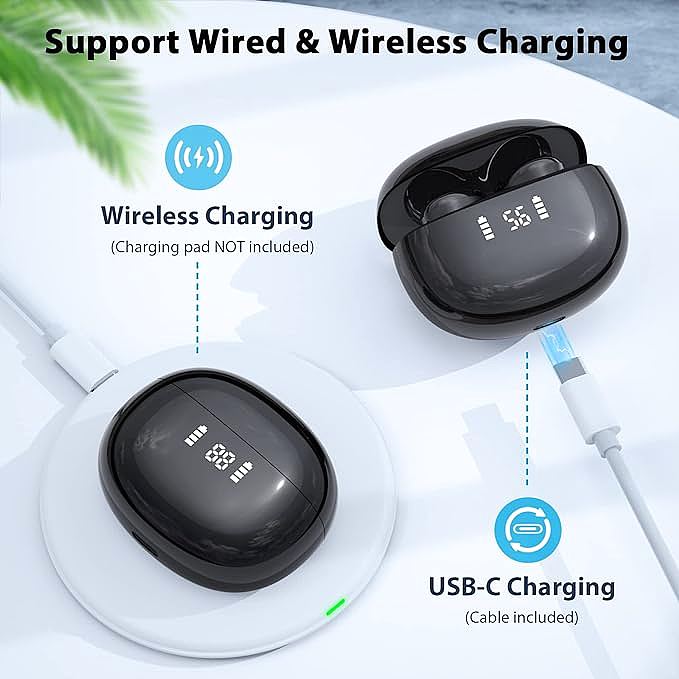
Inside your earbud case sits a battery that stores energy more densely than the nickel-based batteries of a decade ago. Lithium-polymer cells can be shaped to fit irregular spaces (like the curved interior of an earbud case) while maintaining high energy density. This isn't incremental improvement—it's a fundamental shift in how we pack power into small form factors.
2. The Case as Power Bank
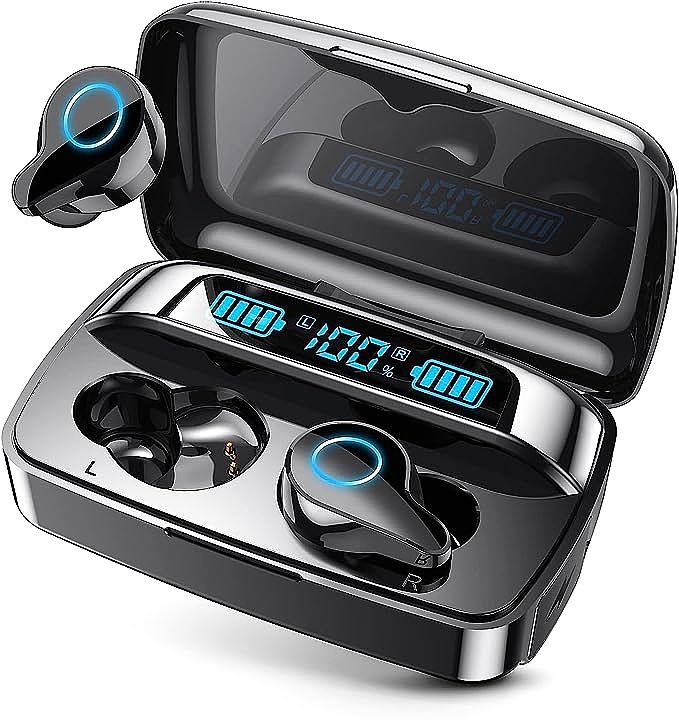
Here's the elegant part: the earbuds themselves might only hold 8-10 hours of charge. But the case is a portable power station, ready to replenish them multiple times before needing external power. The 50-hour figure isn't the earbuds alone—it's the system.
You're not buying earbuds. You're buying an ecosystem of power.
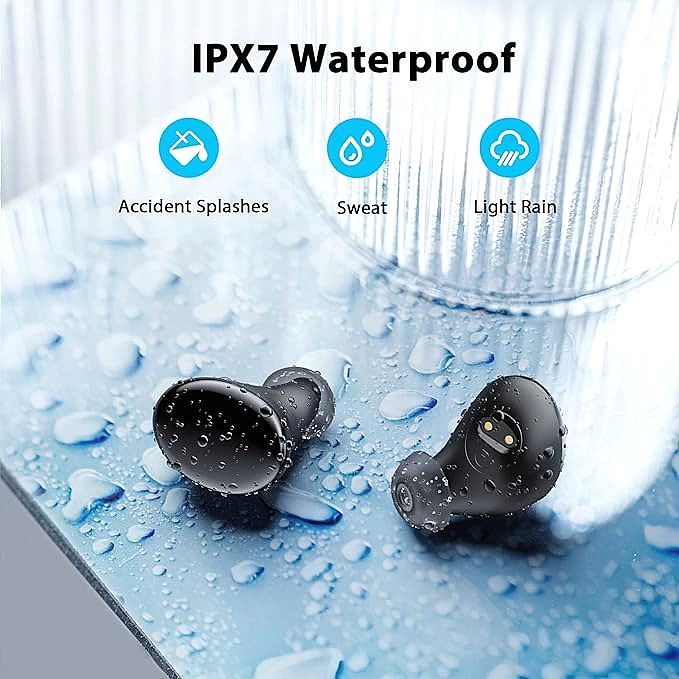
IPX7: The Boundary Between Durable and Indestructible
Now let's talk about water. Because water is the great killer of electronics, and the story of IPX7 is the story of engineers declaring war on moisture.
What IPX7 Actually Means
The "IP" in IPX7 stands for Ingress Protection—an international standard (IEC 60529) that classifies how well electrical enclosures resist intrusion. The "7" is specific: the device can survive immersion in water up to 1 meter deep for 30 minutes.
Let that sink in. Submersion. Not a splash. Not a drizzle. Full underwater immersion.
But here's where it gets interesting—and where most marketing materials won't tell you the whole truth.
The Swimming Paradox
IPX7 earbuds can survive being dropped in a puddle. They can survive a torrential downpour. They can survive sweat that would have killed earbuds from 2018.
But they're not rated for swimming.
Why? Because moving through water creates dynamic pressure—sharp spikes that exceed the static pressure of sitting at the bottom of a pool. The IPX7 test is static: place the device at 1 meter depth, leave it for 30 minutes, remove it, check if it works. Real life is messier.
A swimmer's stroke can generate pressure equivalent to several meters of depth in an instant. That's beyond the test. That's beyond the guarantee.
This isn't a limitation of the technology—it's honesty about the boundary between "water resistant" and "waterproof." No consumer earbud is truly waterproof. They're water-resistant to a specified degree. IPX7 is among the highest ratings you'll see without moving into industrial-equipment territory.
The Engineering Beneath the Rating
Achieving IPX7 requires multiple layers of protection working in concert:
Nano-Coatings: A hydrophobic layer, mere molecules thick, applied directly to the internal circuitry. Water beads up and rolls off rather than creeping along surfaces. This is the last line of defense if water breaches the outer seals.
Ultrasonic Welding: The housing halves aren't glued or screwed together—they're fused using high-frequency vibrations that melt the plastic at the molecular level, creating a bond stronger than the original material. No gaps. No seams. No entry points.
Precision Gaskets: Silicone rings, molded to tolerances measured in microns, sit at every potential entry point—the charging port, the speaker grille, the seam between housing halves. These are the first line of defense.
Membrane Vents: Counterintuitive but brilliant. Tiny barriers that allow air pressure to equalize (preventing seal failure from temperature changes) while blocking water molecules through surface tension. Your earbuds can "breathe" without drowning.
The result is an earbud that doesn't just survive water—it ignores it.
When Power Meets Protection: The Reliability Dividend
Individually, 50-hour battery and IPX7 waterproofing are impressive specs. Together, they create something more profound: a device that asks nothing of you.
Consider the scenarios where this combination matters:
The Business Traveler: You're in Singapore for a week. It's 32°C and humid enough to feel like breathing through a towel. You've got back-to-back meetings, a hotel gym session, and a sudden tropical downpour between the taxi and the lobby. Your earbuds handle the sweat, the humidity, and the rain. They also handle the fact that you forgot your charging cable and won't be back to your room for 12 hours. You don't think about either challenge.
The Ultra-Runner: Training for a 50K means long hours on unpredictable trails. Weather changes. Creek crossings happen. Sweat is constant. Your earbuds don't just survive—they become part of the rhythm. The battery outlasts your longest training run by a factor of five. The waterproofing handles everything from puddles to accidental stream crossings.
The Everyday Human: You're not an athlete. You're not a globe-trotter. You're just someone who wants their music to work, every day, without ceremony. You want to grab the case from your bag and have it work. You want to not care if it rains.
This is the reliability dividend: the technology recedes. The experience comes forward.
The Boundary of Reliability: What IPX7 and 50 Hours Don't Promise
Honesty matters. E-E-A-T isn't just a Google guideline—it's good engineering communication. So let's be clear about the edges of this reliability.
IPX7 Does Not Mean:
- Swimming or diving protection
- High-pressure water jets (IPX6 covers that—a different rating)
- Saltwater immunity (corrosion is a separate battle)
- Steam or sauna survival (heat degrades seals differently than liquid water)
50 Hours Does Not Mean:
- 50 hours at maximum volume (power draw increases with output)
- 50 years of degradation-free performance (lithium batteries lose capacity over time)
- 50 hours with active noise cancellation engaged (ANC draws additional power—though many earbuds in this category don't include ANC)
These aren't flaws. They're boundaries. Knowing them helps you use the technology well.
The Freedom of Forgotten Technology
There's a principle in interaction design: the best interface is no interface. The tool that does its job so well you stop noticing it.
Reliable power and waterproofing move wireless earbuds toward this ideal. They let the technology fade into the background of your life, leaving only the experience—the podcast that gets you through the commute, the playlist that fuels your run, the call that closes the deal.
Some modern earbuds understand this philosophy. They're not marketed as fragile treasures requiring careful handling. They're positioned as companions—devices that live in your world, on your terms, without demanding constant vigilance.
The 50-hour battery and IPX7 rating aren't just specs. They're an invitation: stop thinking. Start living. The technology has your back.
The Quiet Revolution
When the first true wireless earbuds launched, they were miracles of connectivity—and nightmares of maintenance. Four hours of battery. No water resistance. A case that was just storage, not power.
Today, the revolution is quiet. It's not about more features. It's about fewer worries.
Fifty hours means you charge once a week. IPX7 means you don't check the weather. Together, they mean the earbuds disappear into your life, doing their job without asking for attention.
This is maturity in technology. Not flashier. More reliable. Not louder. More consistent.
The next time you grab your earbuds without thinking—without that flicker of "did I charge them?"—notice what's absent. The anxiety. The calculation. The mental overhead.
That absence is the point. That's the freedom reliability buys you.
CAPOXO D7 Wireless Earbuds
Related Essays

Rulefiss I27-1 Wireless Earbuds: Top-Notch Audio Quality and Ultra-Long Battery Life Make It the Go-To Sports Earbuds

TECKNET TK-HS008 Wireless Headphones: Your Ideal Choice for Music on the Go

Wireless Earbuds Sound Quality: Drivers, Codecs and Touch Physics

The Logic of the Affordable Miracle: Deconstructing Budget Audio Engineering

Kurdene S8 Mini Wireless Earbuds: Big Sound in a Small Package

Kurdene S10 Wireless Earbuds: Experience Superior Sound with Bluetooth 5.2 Technology
Unleash Your Inner Audiophile with the PIFFA A66 Bluetooth Headphones

CAPOXO H06 Wireless Earbuds: Your New Workout Buds with Marathon Battery Life

Mood Pie C9 True Wireless Earbuds: Your Daily Jamming Companion