The Invisible Brain: How DSP Powers Clear Calls and Deep Bass in Your Earbuds


Senso Orbits Wireless Earbuds
We live in an age of pocket-sized miracles. A modern pair of wireless earbuds can isolate your voice from a noisy street, produce bass that seems to defy the laws of physics, and connect to your phone the instant you open their case. It feels like magic, but it’s not. The secret lies with an unsung hero of modern audio: the Digital Signal Processor (DSP).
Think of the DSP as the invisible brain or the conductor of a miniature orchestra inside each earbud. This tiny, hyper-specialized computer is responsible for manipulating sound in real-time, performing complex calculations that fundamentally shape what you hear and how you are heard. By examining how an affordable yet feature-rich device like the Senso Orbits Wireless Earbuds tackles two very different challenges—clear calls and powerful bass—we can uncover the dual roles this remarkable technology plays.
The Social Conductor: DSP for Crystal-Clear Conversations
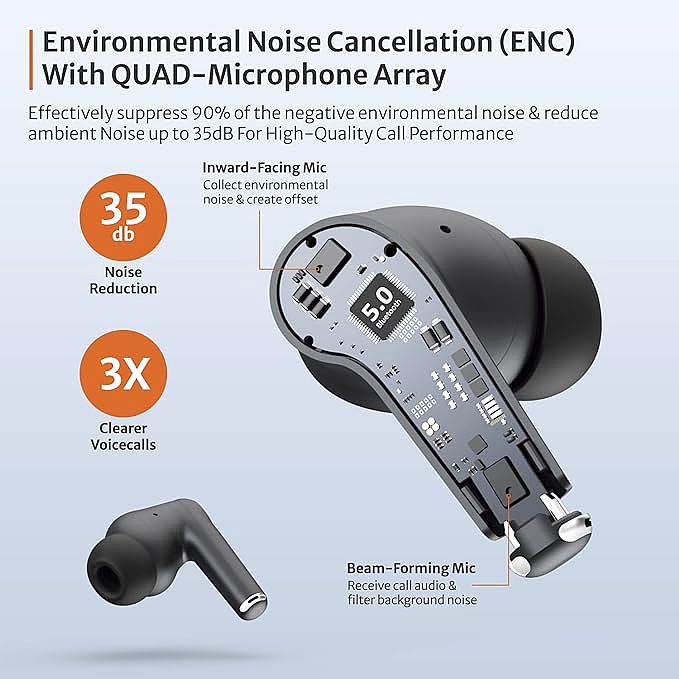
One of the most demanding tasks for any earbud is ensuring call clarity in a noisy environment. This is where the DSP acts as a brilliant social conductor, employing a technology known as Environmental Noise Cancellation (ENC).
It's crucial to distinguish ENC from its more famous cousin, Active Noise Cancellation (ANC). * ANC is for your benefit; it creates a bubble of silence for you, the listener. * ENC is for your caller's benefit; it ensures your voice is transmitted clearly, free from the noise around you.
ENC relies on a multi-microphone system. A device like the Senso Orbits, for instance, uses a four-microphone array (two per earbud). Here’s how the DSP conducts the operation:
1. Isolate the Voice: One microphone (the "vocal mic") is aimed to primarily capture your speech.
2. Listen to the World: The other microphones (the "ambient mics") capture the surrounding noise—traffic, wind, chatter.
3. Intelligent Subtraction: The DSP receives all these audio streams simultaneously. It runs sophisticated algorithms to analyze the signals, identify the unique waveform of your voice, and digitally "subtract" everything else.
The result is that only a clean, isolated vocal signal is sent to the person on the other end of the call. This complex, real-time audio filtering, once the domain of expensive communication systems, is now a standard feature powered by the DSP in accessible earbuds, transforming our ability to communicate on the move.
The Artistic Maestro: DSP for Powerful, Sculpted Sound
When you switch from a call to your favorite playlist, the DSP seamlessly transitions from a social conductor to an artistic maestro. Its second critical role is shaping the music you hear, a process known as equalization (EQ).
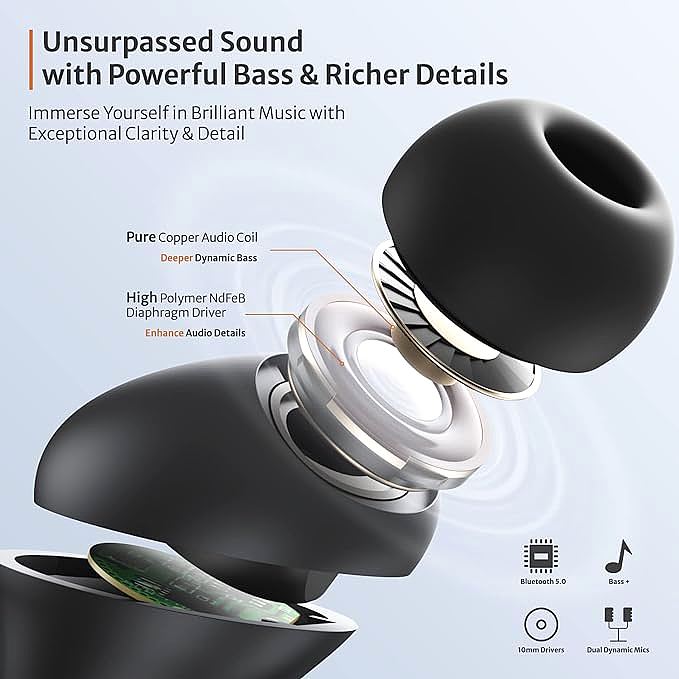
The physical challenge for any earbud is immense: a tiny speaker (the driver) must reproduce a vast range of frequencies, from the deep thrum of a bass guitar to the delicate shimmer of a cymbal. Small drivers naturally struggle with low-frequency sounds. This is where the DSP intervenes.
Engineers use the DSP to create a specific sound profile. To achieve the "powerful bass" often highlighted in products like the Senso Orbits, the DSP is programmed to intelligently boost the low-end frequencies in the digital signal before it ever reaches the driver. It's a form of acoustic alchemy, compensating for physical limitations with digital precision. This allows a tiny, lightweight earbud to produce a rich, satisfying bass response that would otherwise be impossible.
The Foundation of a Great Performance: Where Physics Meets Digital
However, the DSP's magic isn't performed in a vacuum. Its effectiveness is fundamentally dependent on the physical design of the earbuds—specifically, the acoustic seal.
An effective in-ear seal is critical for two reasons:
1. Passive Noise Isolation: It physically blocks a significant amount of external noise, giving the DSP a cleaner canvas to work with for both calls and music.
2. Bass Response: Low-frequency sound waves are long and powerful. A poor seal allows this bass energy to leak out, resulting in a thin, tinny sound, no matter how much the DSP boosts it.
This is why ergonomic details, like the unique "SNAP-ON OVAL SHAPED" eartips found on the Senso Orbits, are more than just a comfort feature. By mimicking the natural shape of the ear canal, they create a more secure and complete seal. This physical foundation is what enables the DSP's digital enhancements to be fully realized, allowing you to experience the deep bass and clear sound as the engineers intended.

Conclusion: The Unseen Intelligence in Your Audio
The next time you marvel at the clarity of a call made from a busy street or feel the satisfying punch of bass from a tiny earbud, you'll know the secret isn't magic—it's the invisible brain. The Digital Signal Processor is the quiet hero of modern audio, working tirelessly as both a meticulous engineer and a creative artist.
Understanding the central role of the DSP empowers you as a consumer. It allows you to see beyond a list of features and appreciate the underlying technology that connects them all. A device with a multi-mic array for ENC and a reputation for powerful bass is not just offering two separate features; it's signaling the presence of a capable DSP at its core. It's a testament to the incredible computational power that now fits comfortably in our ears, conducting a personal symphony just for us.
Senso Orbits Wireless Earbuds
Related Essays

How Tiny Drivers Produce Big Sound: The Physics Behind Wireless Earbuds
How Tiny Drivers Produce Big Sound: The Physics Behind Wireless Earbuds
How Tiny Drivers Produce Big Sound: The Physics Behind Wireless Earbuds
How Tiny Drivers Produce Big Sound: The Physics Behind Wireless Earbuds

DGLighting Wireless Earbuds – Recommended for Comfort and Sound Quality

TOPFREE Wireless Earbuds - A Budget-Friendly Option with Immersive Sound

What Does IPX7 Actually Protect Against? The Engineering...

Ausounds AU-Stream ANC: The Engineering Behind Accessible Noise Cancellation

JBL Reflect Aero TWS Wireless Earbuds: The Science of Sound, Secure Fit, and All-Weather Endurance

