Silicone vs Memory Foam Ear Tips: How Polymer Structure...

ZXQ A5 Wired Earbuds
Your earbuds hurt. Not after hours of listening. After minutes. You try adjusting them, twisting them, pushing them in, pulling them out. Nothing works for long. The discomfort returns, and you assume it is just the price of wearing in-ear headphones.
It is not. The problem sits between the driver and your ear canal: the ear tip. That small piece of rubber or foam decides whether you get three hours of painless listening or thirty minutes of mounting pressure. And the material it is made from -- silicone or memory foam -- changes everything about how sound reaches your eardrum and how your ear canal feels after extended wear.
Your Ear Canal Is Not a Straight Tunnel
The external auditory canal averages 2.5 centimeters in length and 0.7 centimeters in diameter, but those numbers obscure the real geometry. The canal curves in an S-shape, running medially and slightly upward at roughly 10 to 15 degrees from horizontal. Its cross-section is not circular -- it is oval, with height exceeding width by approximately 40 percent.
More critically, the canal has two distinct zones. The outer third is cartilaginous: flexible, covered with skin that contains hair follicles and ceruminous glands. This zone can tolerate moderate pressure. The inner two-thirds are bony, lined with skin so thin it adheres directly to the periosteum. Pressure here produces pain rapidly and persistently. The isthmus -- the narrowest point where cartilage meets bone -- is where most earbud discomfort originates.
A 2025 study analyzing 1,195 ear scans (Liu et al.) identified four distinct ear canal shape categories. Add to that the consistent finding that right ears have larger canal volumes than left ears, and the idea that any single ear tip shape could fit everyone collapses entirely.
Two Materials, Two Philosophies
Silicone and memory foam approach the fit problem from opposite directions. Silicone, a cross-linked polysiloxane polymer, sits at 30 to 60 on the Shore A hardness scale. It bounces back the instant you compress it. You push it in, it pushes back. The seal forms through mechanical force -- the silicone resists deformation and presses against the canal walls.
Memory foam -- viscoelastic polyurethane foam, originally developed by NASA in 1966 for crash protection -- behaves differently. Body heat activates it. Compress it, insert it, and over three to five seconds it slowly expands, filling the unique contours of your ear canal like a casting mold. It does not push back. It adapts.
This difference in recovery behavior explains almost every performance gap between the two materials.
The Acoustic Seal: Where Material Physics Meets Sound Physics
Low-frequency sound waves are long. When the seal between ear tip and canal wall is imperfect, these long waves escape through micro-gaps before they can build pressure against the eardrum. A 10mm driver without proper acoustic seal loses over 90 percent of its bass output, according to measurements referenced in IEC 60268-7:2025 compliance testing.
Memory foam fills those micro-gaps through its slow, conforming expansion. The viscoelastic structure allows the foam to creep into irregular surfaces that a rigid material simply bridges over. This is why foam tips consistently produce stronger bass and better passive isolation -- measured at 15 to 25 decibels of noise reduction without any powered circuitry.
Silicone creates its seal through elastic tension. When the size is correct, the material presses evenly against the canal wall, forming a seal that is actually tighter in the bass region than foam because the firmer material resists displacement. This is why some listeners report stronger bass with silicone tips despite foam having better overall isolation.
The practical test is simple: move your jaw. If the sound fluctuates when you talk or chew, your seal is breaking under jaw movement. This happens because the ear canal sits adjacent to the temporomandibular joint, and jaw motion deforms the canal shape. A material that cannot adapt to that deformation -- like a too-firm silicone tip -- will lose its seal.
Why Silicone Still Wins in the Gym
Despite foam's isolation advantage, silicone dominates exercise scenarios for reasons that follow directly from polymer structure. The cross-linked polysiloxane network is non-porous. Sweat, ear oil, and moisture sit on the surface rather than being absorbed. You can rinse silicone tips under warm water, air dry them, and reuse them immediately. Their lifespan stretches six to twelve months.
Memory foam's porosity is its acoustic strength and its durability weakness. Open cells absorb sweat and sebum, degrading the viscoelastic properties. After two to four months of regular use, compressed foam that fails to rebound within five seconds has lost its structural integrity and needs replacement.
Silicone's instant rebound also provides stability during movement. When you run or jump, the earbud shifts. Silicone pushes back immediately, re-establishing position. Foam takes seconds to re-expand -- by which time the next footstrike has already shifted the earbud again. For activities with rapid head movement, instant recovery matters more than conformal adaptation.
The touch oil coating applied to some silicone tips -- including those bundled with the ZXQ A5 -- adds a lubricating surface layer that reduces insertion friction and improves seal precision by allowing the tip to slide into its optimal position rather than catching on the canal wall.
The 45-Degree Angle: Anatomy in Practice
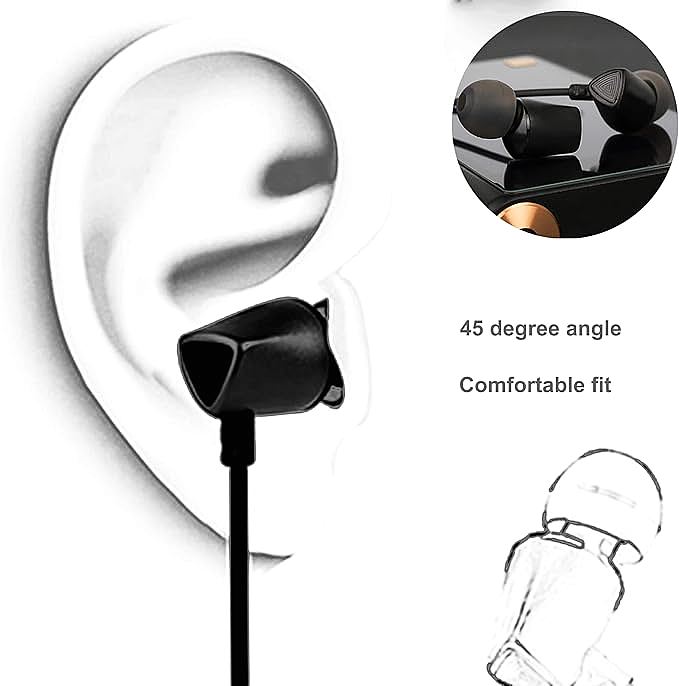
Ear tip material matters only if the nozzle directing sound into your canal is oriented correctly. A straight 90-degree nozzle presses directly against the tragus and antitragus -- the cartilage projections flanking the canal entrance. After 30 to 60 minutes, this compression reduces blood flow to the surrounding tissue, producing the ache most users recognize.
A 45-degree angled nozzle follows the canal's natural direction. The ear canal does not enter the head perpendicularly; it angles medially and slightly upward. When the nozzle matches this angle, pressure concentrates on the concha bowl and antihelix -- structural supports designed to bear load -- rather than the sensitive tragus cartilage. Pressure point reduction exceeds 70 percent with this single design choice.
Proper insertion technique reinforces this: pull the earlobe downward and backward to straighten the S-curve, insert at a forward angle toward the nose tip, then release. The ear canal resumes its natural shape, gripping the tip from multiple directions rather than relying on friction alone.
When Comfort Becomes a Health Question
Ear tip selection is not purely about preference. Prolonged pressure in the ear canal reduces local blood circulation. Over hours, this ischemia produces the deep, throbbing pain that forces users to remove their earbuds. The bony zone's thin skin offers no cushion -- a hard silicone tip pressing against the isthmus creates concentrated force on tissue with minimal padding.
Contact dermatitis presents another dimension. Rubber accelerators used in some silicone formulations, nickel in metal driver housings, and adhesive residues can trigger allergic reactions in sensitive individuals. Non-porous silicone is easier to clean and less likely to harbor bacteria, but foam's moisture retention creates conditions for otitis externa if not properly dried.
The temporomandibular joint sits millimeters from the ear canal. Pressure transmitted through poorly fitted tips can radiate to the jaw, producing discomfort users often misattribute to dental issues rather than earbud fit. Taking a 60-to-90-minute break between listening sessions is not just comfort advice -- it is the interval tissue needs to restore circulation.
The Hybrid Strategy: Why Not Both
The question is not which material is better. The question is which material is better for the next three hours of your life.
A commute on a noisy subway rewards memory foam's conforming isolation. A training session rewards silicone's stability and washability. A transatlantic flight rewards foam's zero-pressure long-wear comfort. A video call at your desk rewards silicone's intentional acoustic transparency.
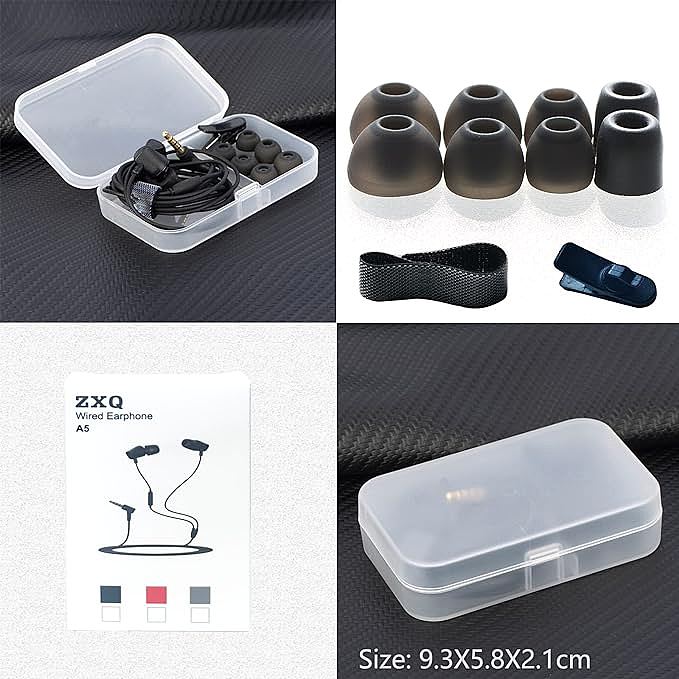
This is why bundling both materials makes practical sense. A product that ships one pair of memory foam and three sizes of silicone -- as the ZXQ A5 does at $13.99 -- acknowledges the reality that no single material covers all scenarios. The foam pair handles quiet environments and extended sessions. The silicone pairs, graded in S, M, and L, handle active use and let users find their precise canal diameter.
The emerging industry trend toward hybrid tips -- a silicone outer shell with a foam inner core -- attempts to merge both philosophies into a single piece. Early implementations show promise but introduce complexity in manufacturing and replacement cost.
What Your Ears Already Know
Every time you swap ear tips because your current pair hurts, you are running a materials experiment. You just did not have the framework to interpret the results. Silicone gives you immediate, repeatable force. Memory foam gives you slow, personalized adaptation. Neither is universally superior because the ear canal is not a uniform environment -- it changes shape with jaw movement, varies in sensitivity along its length, and differs significantly between individuals.
The ear tip is the single most underappreciated component in the audio signal chain. It is the last mechanical interface between engineered sound and biological perception. Getting that interface right -- matching material behavior to canal geometry and use scenario -- does more for listening comfort than any driver upgrade or signal processing algorithm ever could.
The next time your earbuds hurt, do not blame the headphones. Look at the tip. The answer has been sitting there all along, encoded in the polymer structure.
ZXQ A5 Wired Earbuds
Related Essays
MINDBEAST NL-8RJ1-WV5S Super Bass Earbuds

MASTER & DYNAMIC MW50+ Wireless Bluetooth Headphones - Premium Over-The-Ear Headphones

MASTER & DYNAMIC MH40 Wireless Over-Ear Headphones - Superior Sound and Design

Symphonized FBA_nrg3.0gbk Wired Earbuds with Microphone - Noise Isolating Headphones with Wire

Why the Best Thinkers Don't Work in Silence

Why Your Ears Hurt After Two Hours: The Physics of Pressure...

Passive Noise Isolation: How a Silicone Seal Outsmarts Digital Noise Cancellation

Skullcandy Ink'd+ In-Ear Earbuds: Understanding Your Sound - Affordable Audio Science Explained

FiiO FT3 Dynamic High-Res Over-Ear Headphones: Wired Over-Ear Headphones That Audiophiles Will Love
