From Wires to Wireless Freedom: The Evolution of Stable Sports Audio


Meyer U5 Wireless Earbuds
The first time you ran with earbuds, you probably remember the rhythm breaking. Not from fatigue, but from friction. A wire snagging on your jacket. An earbud slipping loose mid-stride. The music cutting out as your phone shifted in your pocket. These weren't just annoyances—they were the physical manifestations of a technology not yet ready for motion.
But the story of sports audio is one of relentless problem-solving. Each frustration sparked an innovation. Each limitation became an engineering challenge. And today, we stand at a point where the very concept of "wireless earbuds falling out" is becoming a relic of the past.
This is the story of how we got here. Not through a single breakthrough, but through decades of incremental advances in Bluetooth technology, ergonomic design, and power management. It's a tale of wires disappearing, connections stabilizing, and fit becoming so secure that you forget the technology exists.
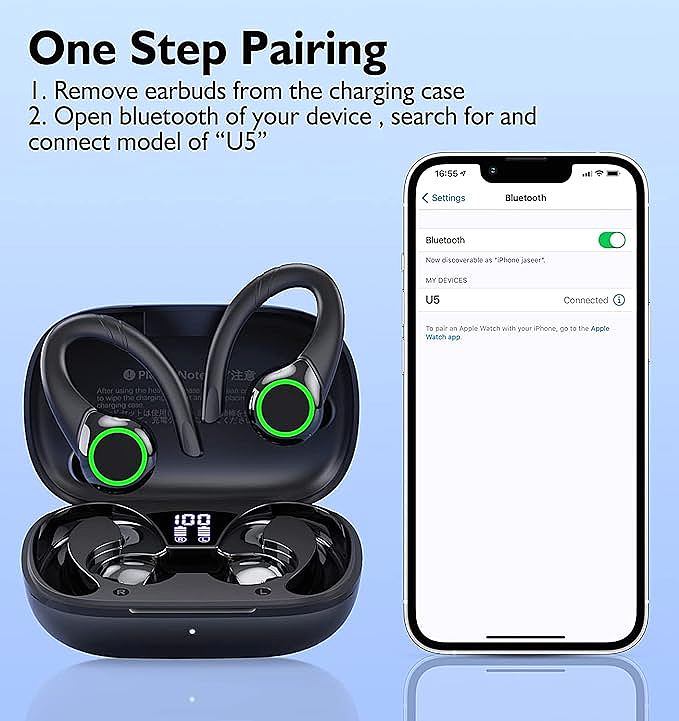
The Wire Problem: When Cables Were Cages
Rewind to the early 2000s. The iPod had just revolutionized personal audio, putting thousands of songs in your pocket. But there was a catch—a literal one. The 3.5mm headphone jack meant you were tethered, physically connected to your device by a thin, temperamental cable.
The Tangling Paradox
Cables, it turns out, have a mathematical tendency to tangle. Physicists Dorian Raymer and Douglas Smith actually proved this in 2007, spending weeks spinning strings in boxes to demonstrate that spontaneous knot formation is not just common—it's inevitable. Their research, published in the Proceedings of the National Academy of Sciences, showed that given almost any condition of movement, strings will knot themselves.
For runners, this meant a pre-workout ritual: untangling. A minute of your life, every day, devoted to freeing your earbuds from the prison of their own cord.
The Motion Problem
Even untangled, wired earbuds fought against movement. The cable acted as a pendulum, pulling on the earbud with each step. The weight of your phone or player, suspended somewhere on your body, created drag. And the connection point—where cable met earbud—was a stress point, both physically and electrically. Wires broke. Connections failed. Audio cut out at the worst moments.
The irony was palpable: technology designed to liberate your soundtrack instead became another constraint on your movement.
The Wireless Promise: Bluetooth's Bumpy Beginnings
When Bluetooth headphones first emerged, they promised freedom. The reality, however, was less graceful.
Bluetooth 2.0 and 3.0: The Early Struggle (2004-2009)
The first Bluetooth headphones were less "wireless freedom" and more "another device to manage." Pairing was a ritual that could take minutes:
- Enable discovery mode on headphones
- Search for devices on phone
- Enter a PIN code (often "0000" or "1234")
- Hope the connection held
And holding was the operative word. Early Bluetooth had a range of about 10 meters in ideal conditions, but walls, bodies, and interference could sever the connection instantly. Audio quality suffered too—the SBC codec, while functional, compressed audio aggressively, stripping away detail.
Bluetooth 4.0 and 4.2: The aptX Revolution (2009-2016)
Bluetooth 4.0 introduced Bluetooth Low Energy (BLE), a game-changer for battery life. For the first time, wireless headphones could promise days of use rather than hours. The aptX codec arrived, offering near-CD quality audio over Bluetooth—a massive leap from SBC's compressed sound.
But sports users still faced a fundamental problem: fit.
The Fit Revolution: Why Earhooks Changed Everything
Wireless technology solved the cable problem. But it created a new challenge. Without the gentle tension of a cable pulling back against the earbud, true wireless earbuds relied entirely on friction and shape to stay in place.
For many users, especially during vigorous movement, this wasn't enough.
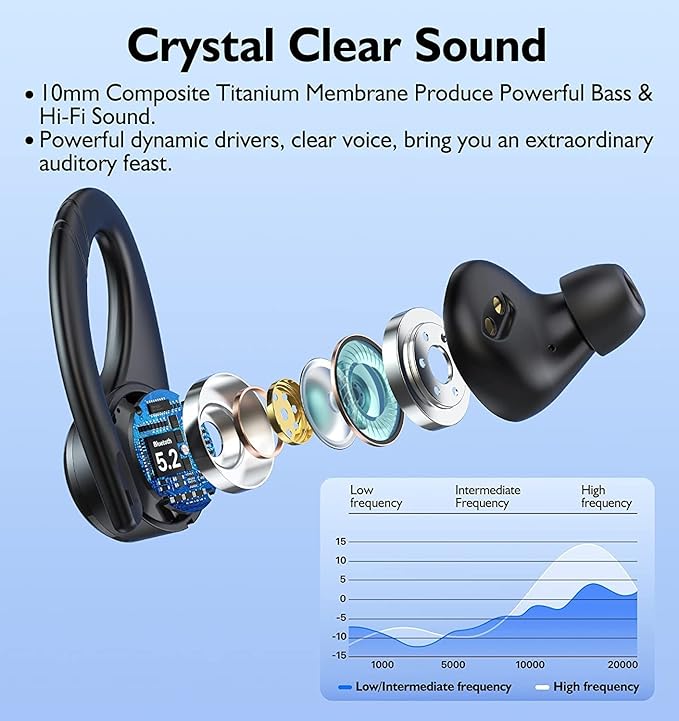
The Ergonomics of Stability
Enter the earhook. This seemingly simple addition is the product of serious ergonomic science—the study of how products interact with the human body.
The Anatomy of an Earhook
A well-designed earhook leverages three points of contact:
- The Antihelix: The outer ridge of cartilage in your ear. The hook rests over this, using gravity and tension to stay in place.
- The Concha: The bowl-shaped depression in the center of your ear. The earbud body nests here, stabilized by the hook's tension.
- The Ear Canal: The silicone tip creates a seal inside, providing both acoustic isolation and mechanical grip.
This three-point system distributes force across the ear, rather than relying on a single friction point. The result is an earbud that stays put not through aggressive clamping, but through intelligent geometry.
The Comfort Trade-Off
Early earhook designs often sacrificed comfort for security. Rigid plastic hooks could create pressure points during extended wear. The breakthrough came with flexible materials—silicone-coated hooks, memory wire, and soft-touch polymers that conform to the ear's unique shape.
Modern designs, like those found in many sports earbuds today, use lightweight, flexible earhooks that provide secure fit without fatigue. You can wear them for hours—not because they grip harder, but because they distribute pressure more intelligently.
The Codec Wars: How AAC Conquered Wireless Audio
While fit was being solved, a quiet war was raging over sound quality. The battle was fought in codecs—the algorithms that compress and decompress digital audio for wireless transmission.
SBC: The Universal Standard
Every Bluetooth device supports SBC (Sub-Band Coding). It's the minimum requirement for Bluetooth certification. But SBC was designed for compatibility, not quality. It compresses audio aggressively, discarding frequency information to reduce data size.
The result? Functional audio, but with noticeable artifacts—especially in complex musical passages.
AAC: The Psychoacoustic Advantage
AAC (Advanced Audio Coding) takes a smarter approach. It leverages psychoacoustics—the study of how humans actually perceive sound—to discard information you're least likely to notice.
For example:
- Frequency Masking: A loud sound at one frequency can hide quieter sounds nearby. AAC identifies and removes these "masked" frequencies.
- Temporal Masking: After a loud sound, your ear needs a brief moment to recover. AAC removes quiet sounds in this recovery window.
The result is more efficient compression with better perceived quality. At the same bitrate, AAC typically sounds cleaner and more detailed than SBC.
Why This Matters for Sports
When you're running, your environment is noisy—wind, traffic, gym equipment, your own breathing. Poor codec quality gets lost in this chaos. AAC preserves enough detail that your music cuts through the noise, maintaining clarity even when you're pushing hard.
Most modern wireless earbuds, including many in the sports category, support both SBC and AAC, automatically selecting the best codec your device supports.
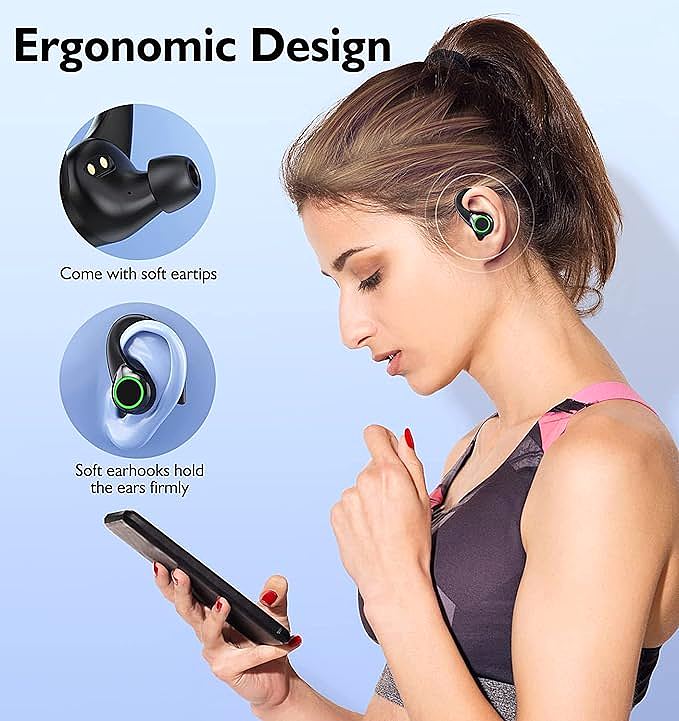
The Power Problem: Battery Evolution and the 20-Hour Milestone
Early wireless earbuds faced a brutal trade-off: size versus battery life. The smaller the earbud, the less room for a battery. But users wanted both compact design and all-day playback.
The First Generation: 3-4 Hours
The original true wireless earbuds offered around 3-4 hours per charge. The case added another 8-12 hours. For commuters, this was sufficient. For athletes training for hours, it meant mid-workout anxiety.
The Second Generation: 5-6 Hours + Case Multiplication
Battery chemistry improvements—particularly in lithium-polymer cells—allowed earbuds to pack more energy into the same space. Combined with Bluetooth 5.x efficiency, single-charge playtime extended to 5-6 hours, even at higher volumes.
But the real innovation was the charging case as force multiplier. A 400mAh case could recharge earbuds 3-4 times, delivering 20+ hours of total playback.
The LED Display Revolution
Early cases had a single LED: on or off. No nuance. Modern cases feature LED displays showing exact battery percentage. This small addition eliminated guesswork—you always know if you need to charge before your next workout.
The Water Standard: IPX Ratings and Sweat Survival
Sweat is corrosive. Salt water conducts electricity. And electronics, historically, have not mixed well with moisture.
The IP Rating System
The Ingress Protection (IP) rating system, governed by IEC 60529, standardized how we talk about water resistance:
- IPX4: Protected against water splashes from any direction
- IPX5: Protected against water jets (6.3mm nozzle) from any direction
- IPX6: Protected against powerful water jets (12.5mm nozzle)
- IPX7: Protected against immersion up to 1 meter for 30 minutes
IPX5: The Sports Sweet Spot
Most sports earbuds, including many modern designs, target IPX5. This isn't arbitrary—it's the point where protection meets practicality.
IPX5 means:
- Heavy sweat during intense workouts ✓
- Light rain during outdoor runs ✓
- Accidental splashes ✓
It doesn't mean:
- Swimming or submersion ✗
- High-pressure water jets ✗
- Steam room or sauna use ✗
Achieving IPX5 requires engineering at the molecular level—nano-coatings on circuitry, precision seals at every seam, and membrane vents that equalize pressure without admitting water.
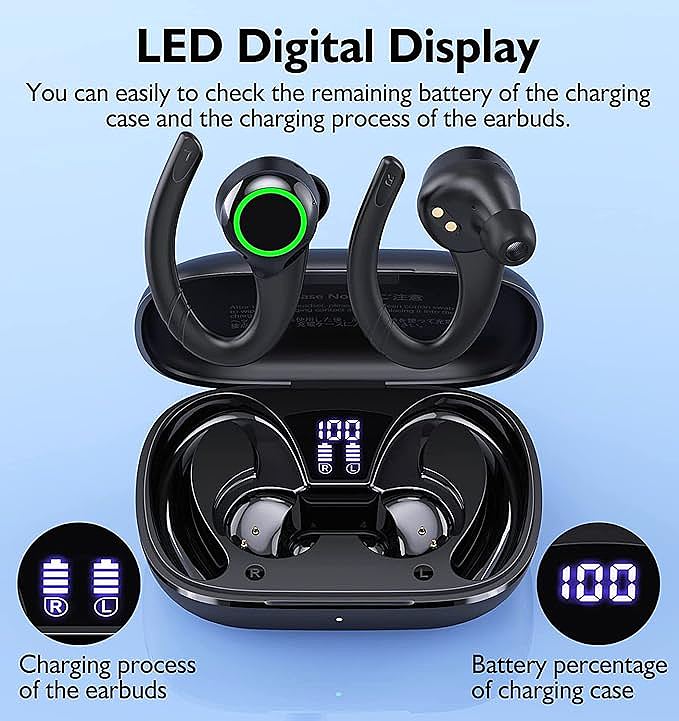
Bluetooth 5.2: The Invisible Infrastructure
While earhooks solved fit and codecs improved sound, the underlying connection—the Bluetooth itself—was undergoing its own revolution.
What 5.2 Actually Changed
Bluetooth 5.2, introduced in 2020, wasn't a radical overhaul. It was a refinement of everything that came before:
Lower Latency
The delay between audio source and your ear dropped to near-imperceptible levels. For music, this means better lip-sync when watching videos. For gaming, it means audio reacts instantly to your actions.
Better Coexistence
Bluetooth 5.2 devices are smarter about sharing spectrum. In a crowded gym, on a subway, in any environment with dozens of wireless signals, 5.2 maintains stable connections by dynamically switching to clearer channels.
Power Efficiency
Every transmission uses less energy. This compounds over time—milliwatts saved per connection session add up to hours of additional battery life over a week of use.
The Real-World Impact
Imagine running the same route every day. Some days, your connection is flawless. Other days, it stutters. With 5.2, the variance narrows. The connection becomes more like a utility—always there, always working, always invisible.
That's the hallmark of mature technology: it stops demanding your attention.
The Touch Interface: Control Without Interruption
Physical buttons on earbuds were a compromise. They required pressure—pushing the earbud deeper into your ear canal. They created failure points where water could enter. And they were hard to locate by feel during movement.
Capacitive Touch: The Surface Solution
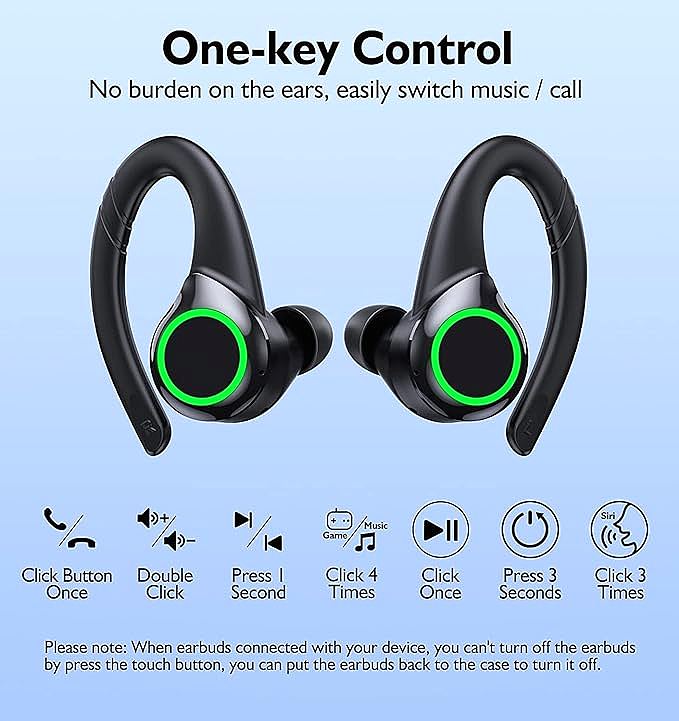
Touch controls transformed the entire earbud surface into an interface. A tap, double-tap, or long-press triggers functions without mechanical movement.
Common Touch Patterns:
| Gesture | Typical Function |
|---|---|
| Single tap | Play/pause, answer call |
| Double tap | Skip forward |
| Triple tap | Skip back, activate assistant |
| Long press | Power on/off, volume control |
| Quad tap | Mode switching (game/music) |
The elegance is in the invisibility. No buttons to find, no pressure to apply. Just tap and continue your workout.
The Listener's Reality: When Technology Matures
All of these advances—Bluetooth 5.2, earhook ergonomics, AAC codecs, 20-hour batteries, IPX5 protection—converge toward a single goal: invisibility.
When technology works as intended, you don't notice it. You notice when it fails:
- The earbud that slips during a sprint
- The connection that drops mid-call
- The battery that dies before your workout ends
But when it succeeds? You just experience your music. Your podcast. Your call. The technology recedes, leaving only the experience.
Some modern wireless earbuds embody this philosophy. They don't demand attention with flashy features or aggressive branding. They simply perform—securely, reliably, invisibly—day after day.
The Next Chapter: What's Still Being Solved
The journey isn't over. Engineers are still tackling unsolved problems:
Active Noise Cancellation in Sports Earbuds
ANC is standard in premium consumer earbuds, but rare in sports designs. Why? Because ANC creates pressure, and pressure creates fatigue during extended wear. The challenge is delivering noise cancellation without the squeeze.
Battery Density Without Weight
Lithium-polymer cells are impressive, but they add mass. New battery chemistries—solid-state, graphene-enhanced—could deliver more energy with less weight.
True Single-Earbud Independence
Many earbuds still require both to be worn for full functionality. The future is true independence—each earbud a complete system, usable alone without compromise.
Adaptive Sound Based on Activity
Imagine earbuds that detect your activity—running, lifting, cycling—and automatically adjust EQ, ANC, and ambient mode. The sensors exist. The AI exists. The integration is the next frontier.
From Frustration to Freedom
The first time you ran with wireless earbuds, you probably remember something else. Not what broke, but what worked. The moment you realized there was no wire to catch. No cable pulling at your ear. No connection to manage.
That's the destination of every technology: to disappear into its function. To become so reliable, so intuitive, that you stop thinking about it and start living with it.
The wireless earbuds of today—with their earhook stability, Bluetooth 5.2 connections, 20-hour batteries, and IPX5 protection—represent decades of problem-solving. Each feature is an answer to a frustration someone once had. Each specification is a battle won against limitation.
The next time you tap your earbud to play music, feel it stay secure during a sprint, and charge the case once a week, consider what's absent. The friction. The failure. The friction.
That absence is the point. That's the freedom that decades of engineering bought you.
Now press play. And run.
Meyer U5 Wireless Earbuds
Related Essays

Yardstick SKY50909 Earbuds: Understanding Bluetooth 5.2, DSP Audio & All-Day Battery Life

Masterplug Pods-12 Wireless Earbuds

Peakfun P3 Wireless Earbuds – Exceptional Sound Quality and Comfort

ZONWOO S1 Wireless Earbuds: Unleash Your Workout with 88H Playtime

Why Your Earbuds Keep Falling Out — And What Physics Says About Fixing It

Miniaturization and Acoustic Engineering: How 6mm Drivers Produce Full-Range Sound

How Bluetooth 5.2 Changed Wireless Earbuds: Stability, Battery, and Audio

The Invisible Compression: How Wireless Audio Codecs Preserve Sound Quality

Escaping the Acoustic Tether: The Anatomy of Modern Micro-Audio

