Bluetooth 5.3: How Radio Physics Solves Your Wireless Audio Problems

Hikapa X9 Wireless Earbuds
Your wireless earbuds disconnect. Not once, but repeatedly. You walk fifteen feet from your phone, and the audio stutters. You try to pair them again, and your phone cannot find them. The battery drains faster than advertised. These are not random failures. They are predictable outcomes of how radio waves behave in the real world.
Some wireless earbuds use Bluetooth 5.3. This version number is not marketing. It represents specific engineering solutions to problems that have plagued wireless audio since the 1990s. Understanding what changed between Bluetooth 4.2, 5.0, 5.1, 5.2, and 5.3 reveals why some earbuds work reliably while others do not.
The Radio Problem No One Talks About
Bluetooth operates in the 2.4 GHz ISM band. This is the same frequency used by Wi-Fi routers, microwave ovens, baby monitors, and countless other devices. The band is divided into 79 channels, each 1 MHz wide. When you turn on your earbuds, they must share this crowded space with everything else in your home.
The physics here is unforgiving. Radio waves at 2.4 GHz have a wavelength of approximately 12.5 centimeters. This wavelength interacts with walls, furniture, human bodies, and even water in the air. Each interaction causes reflection, absorption, or scattering. The signal that reaches your earbuds is not the signal your phone transmitted. It is a composite of multiple paths, some arriving directly, others bouncing off walls, floors, and ceilings.
This phenomenon, called multipath propagation, creates interference patterns. At certain locations, waves from different paths cancel each other out. At others, they reinforce. Move your head six inches, and you might move from a signal null to a signal peak. This is why wireless audio can work perfectly in one spot and fail in another.
Frequency Hopping: Chaos as Strategy
Bluetooth's solution to interference is counterintuitive. Instead of fighting for a single channel, it constantly moves. The transmitter and receiver agree on a pseudo-random sequence of channels, hopping 1,600 times per second. Each hop takes 625 microseconds. By the time interference appears on one channel, the devices have already moved to another.
This approach has roots in military radio systems. Frequency-hopping spread spectrum (FHSS) was proposed by actress Hedy Lamarr and composer George Antheil in 1942. Their patent described a system for guiding torpedoes that could not be jammed by enemies. The same principle now keeps your music playing when your neighbor turns on their microwave.
Bluetooth 5.3 refines this hopping mechanism. Previous versions used a fixed hopping pattern that could be predicted and, in theory, jammed. Version 5.3 introduces adaptive hopping that can avoid channels known to be congested. The controller monitors packet loss on each channel and dynamically adjusts the sequence. If channel 37 consistently fails, the system stops using it.
The Power Budget Problem
Wireless earbuds have a fundamental constraint: battery size. A typical earbud battery holds 40-60 mAh. At this capacity, every milliwatt matters. Bluetooth 5.3 addresses power consumption through several mechanisms that previous versions lacked.
The first is connection subrating. In Bluetooth 5.2 and earlier, devices in a connection must exchange packets at regular intervals, even when no data is being transmitted. These empty packets, called NULL packets, consume power without delivering value. Bluetooth 5.3 allows devices to request subrated connections, where the interval between mandatory exchanges can be extended by a factor of 18. For earbuds sitting idle in their case, this translates to significantly longer standby time.
The second mechanism involves enhanced attribute protocol (EATT). In previous versions, attribute operations were serialized. If one operation blocked, all others waited. EATT allows multiple attribute operations to run in parallel over different bearers. This reduces the time the radio must remain active, which reduces power consumption.
A third improvement concerns isochronous channels. Introduced in Bluetooth 5.2 and refined in 5.3, isochronous channels guarantee timing for audio streams. Instead of sending audio data as quickly as possible and hoping the receiver can reconstruct it, the transmitter specifies exactly when each frame should be played. The receiver buffers minimally, reducing both latency and the memory required for error concealment.
Latency: The Gaming Problem
Gamers notice latency. A 100-millisecond delay between pressing a button and hearing the corresponding sound makes rhythm games unplayable. First-person shooters become exercises in frustration. Traditional Bluetooth audio, optimized for music, could introduce 150-300 milliseconds of latency.
The problem is not transmission speed. Radio waves travel at the speed of light. The delay comes from processing. Audio must be encoded, packetized, transmitted, received, depacketized, and decoded. Each step adds milliseconds. Error correction adds more. Buffering for jitter handling adds still more.
Bluetooth 5.3's isochronous architecture addresses this by allowing the application to specify latency requirements. The controller can then choose the appropriate codec parameters, buffer sizes, and retransmission strategies. For gaming, this might mean accepting higher packet loss in exchange for lower latency. For music, the opposite trade-off makes sense.
The specification defines a parameter called Framing_Mode. In unframed mode, each isochronous packet is independent. In framed mode, packets are grouped into frames with precise timing information. Framed mode allows the receiver to know exactly when to play each sample, even if some packets arrive late or out of order. This precision enables the low-latency modes that gaming earbuds advertise.
Water, Sweat, and the IPX Question
IPX waterproofing ratings use a standardized scale. The X in IPX means the rating does not specify protection against solid particles like dust. The number that would follow X, if present, would indicate dust resistance. For earbuds, this omission is common. Dust rarely penetrates well-sealed earbud enclosures.
Water resistance is measured by the second digit. IPX4 means protection against splashing water from any direction. IPX7 means immersion in one meter of water for 30 minutes. IPX8 means continuous immersion beyond one meter, with the exact depth specified by the manufacturer.
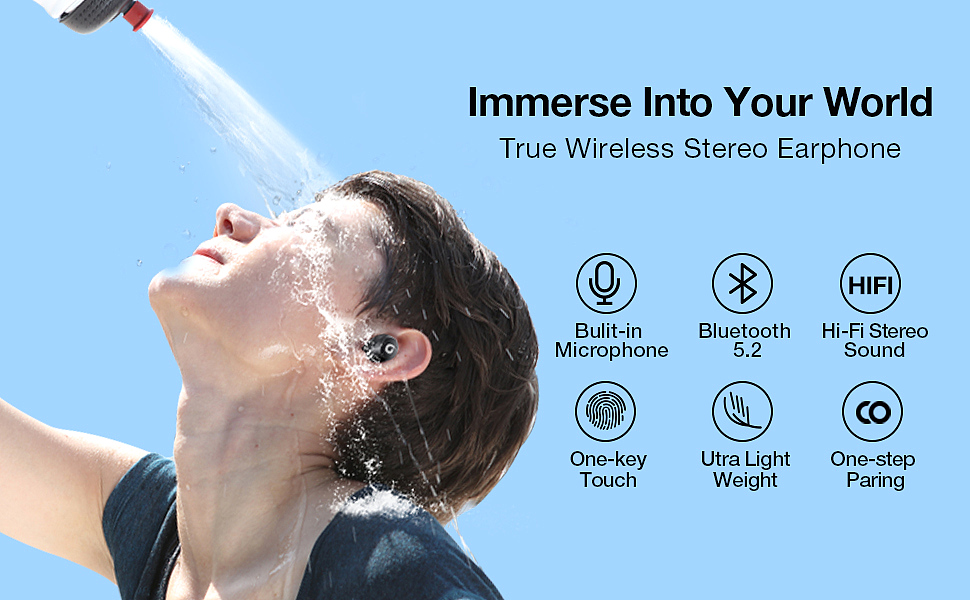
Not all earbud products disclose their IPX rating. This ambiguity is common when manufacturers omit specific ratings from product documentation. The practical difference matters. IPX4-rated earbuds survive rain and sweat. IPX7-rated earbuds survive accidental drops in puddles. Neither rating covers swimming. Chlorine and salt water degrade the protective coatings faster than fresh water.
The waterproofing mechanism itself is worth understanding. Most earbuds use nano-coating, a layer of hydrophobic material applied at the molecular level. This coating causes water to bead and roll off rather than wetting the surface. It works until it wears off. Repeated exposure to sweat, which contains salts and oils, accelerates degradation. The coating is invisible, so users cannot see when it has failed.
Touch Controls: Capacitive Sensing
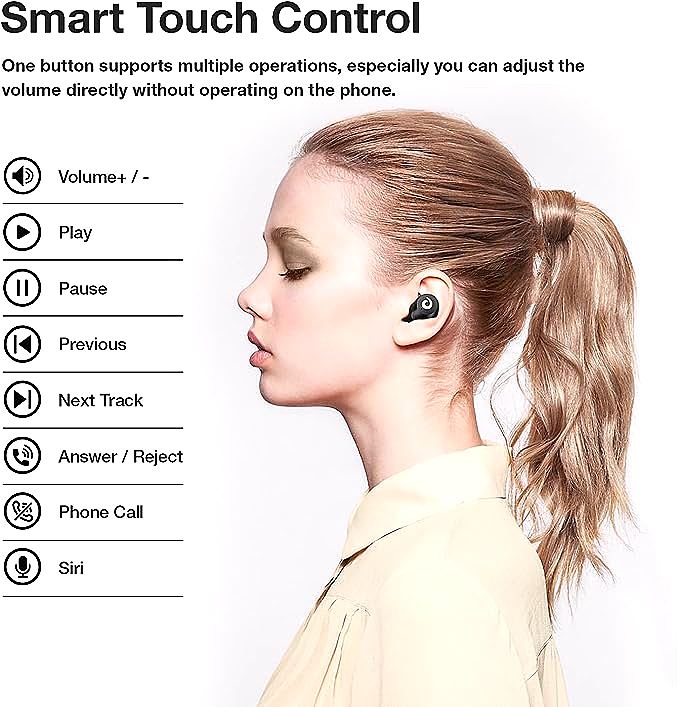
These earbuds use touch controls. A tap pauses playback. A double-tap skips tracks. Touch-and-hold adjusts volume or activates voice assistants. These gestures are detected by capacitive sensors embedded in the earbud surface.
Capacitive sensing works by measuring changes in electrical capacitance. The human body is conductive. When a finger approaches a sensor, it alters the local electric field. The sensor detects this change and interprets it as a touch. The technology is reliable in principle but challenging in practice.
False triggers are the main problem. Earbuds move in the ear. The concha, the bowl-shaped depression just outside the ear canal, can press against the touch surface. Hair can brush against it. Earrings can cause interference. A well-designed system distinguishes intentional touches from accidental contact by analyzing the pattern of capacitance change. A deliberate tap produces a sharp, localized change. A slow press from the concha produces a gradual, distributed change.
Bluetooth 5.3 does not directly address touch controls. However, the protocol's improved power management allows touch sensors to remain active longer without draining the battery. Previous versions might power down sensors during low-power states, making the earbuds unresponsive for the first few seconds after insertion. Version 5.3's connection subrating allows sensors to remain active while the radio sleeps.
The Codec Question
Bluetooth audio quality depends on codecs. The codec encodes audio at the transmitter and decodes it at the receiver. The default codec, SBC (Subband Codec), was defined in the original Bluetooth specification. It works but is not efficient. Higher-quality codecs like AAC, aptX, and LDAC offer better sound at the same bitrate or equivalent sound at lower bitrates.
The catch is licensing. AAC requires paying royalties to Fraunhofer and other patent holders. aptX requires licensing from Qualcomm. LDAC is Sony's proprietary codec. Some earbud products support only SBC to avoid these costs. Product specifications that do not list supported codecs may indicate SBC-only operation.
SBC is not inherently bad. At its maximum bitrate of 328 kbps, it provides acceptable quality for most listeners. The problem is that many implementations use lower bitrates to improve connection stability. A 128 kbps SBC stream sounds noticeably worse than a 256 kbps AAC stream, even to untrained ears.
Bluetooth 5.3's isochronous channels can improve codec performance indirectly. By guaranteeing timing, they reduce the need for large jitter buffers. Smaller buffers mean lower latency, which means less time for the codec to wait. This efficiency can allow higher bitrates at the same reliability level.
The Pairing Problem: Legacy and LE
Bluetooth has two modes: Classic and Low Energy (LE). Classic handles audio. LE handles data from fitness trackers, keyboards, and other peripherals. The two modes use different physical layers and different protocols. A device that supports both must maintain two separate radio stacks.
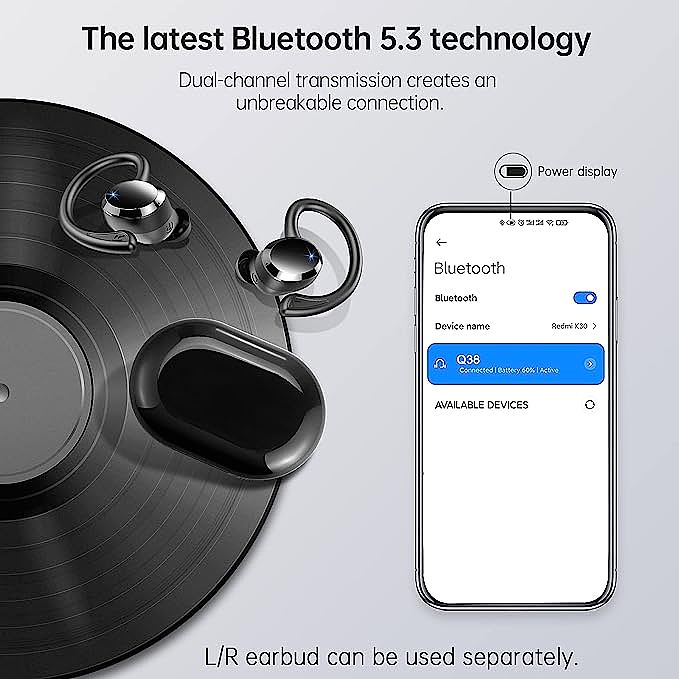
Bluetooth 5.3 continues the convergence of Classic and LE. Dual-mode devices can now share more code and hardware resources. This reduces cost and power consumption. For earbuds, the practical benefit is faster pairing. The earbuds can advertise their presence using LE, which consumes less power, then switch to Classic for audio streaming.
The pairing process itself has evolved. Early Bluetooth required a PIN code. Later versions used Secure Simple Pairing (SSP), which allowed pairing with a single button press or even automatically. Bluetooth 5.3 refines SSP with improved security. The encryption key exchange now uses elliptic curve cryptography (ECC) with 256-bit keys. This makes passive eavesdropping computationally infeasible.
What the Version Number Really Means
Bluetooth version numbers are not arbitrary. Each version introduces specific features that address specific problems. Version 4.0 introduced LE, enabling the wearable device market. Version 4.2 added LE Secure Connections and increased data packet capacity. Version 5.0 extended range and speed for LE, though these extensions do not apply to Classic audio.
Version 5.1 added direction finding, allowing devices to determine the angle of arrival and angle of departure of signals. This enables features like item finding with centimeter-level accuracy. For earbuds, this could mean automatic switching based on which earbud is in use.
Version 5.2 introduced LE Audio, isochronous channels, and the LC3 codec. LE Audio allows audio streaming over LE, which is more power-efficient than Classic. LC3 provides better quality than SBC at the same bitrate. These features require new hardware; they cannot be added to existing devices through software updates.
Version 5.3 refines 5.2's features. Connection subrating reduces power consumption. Enhanced attribute protocol improves efficiency. Adaptive frequency hopping improves reliability in congested environments. These improvements are incremental but meaningful. They do not require new hardware; devices certified for 5.2 can often be updated to 5.3 through firmware.
The Engineering Philosophy
Good wireless audio is not about adding features. It is about removing obstacles. The obstacles are physical: radio waves that reflect and absorb, batteries that hold limited energy, ears that move and sweat. Each Bluetooth version removes some obstacles while introducing new capabilities.
Bluetooth 5.3 does not solve every problem. Multipath propagation still exists. Battery capacity still limits playback time. Water still degrades coatings. But the version number represents a specific set of solutions to specific problems. Understanding those solutions helps users set realistic expectations.
The next time your earbuds disconnect, consider what is happening. Radio waves are bouncing off your walls, your furniture, your body. Your neighbor's Wi-Fi is competing for the same spectrum. Your earbuds are hopping between channels 1,600 times per second, trying to find a clear path. When it works, it is not magic. It is engineering. When it fails, it is not a defect. It is physics.
Hikapa X9 Wireless Earbuds
Related Essays

Silencing the Copper Wire: The Invisible Architecture of Modern Audio
The Four Pillars of Unbreakable Sport Audio
How Hollywood, Radio Physics, and Neural Networks Built the...

How True Wireless Stereo Technology Rewired the Way We...

The Science Behind Wireless Audio: From Bluetooth Origins...

Why Your Wireless Earbuds Last 48 Hours: The Physics Behind Battery and Sound

Why Your In-Ear Audio Keeps Falling Out -- The Physics of Staying Put
How Hollywood, Radio Physics, and Neural Networks Built the Modern Headset

Senso PODS Plus Wireless Earbuds - True Wireless Earbuds for Everyday Use
