Wireless Earbuds Sound Quality: Drivers, Codecs and Touch Physics

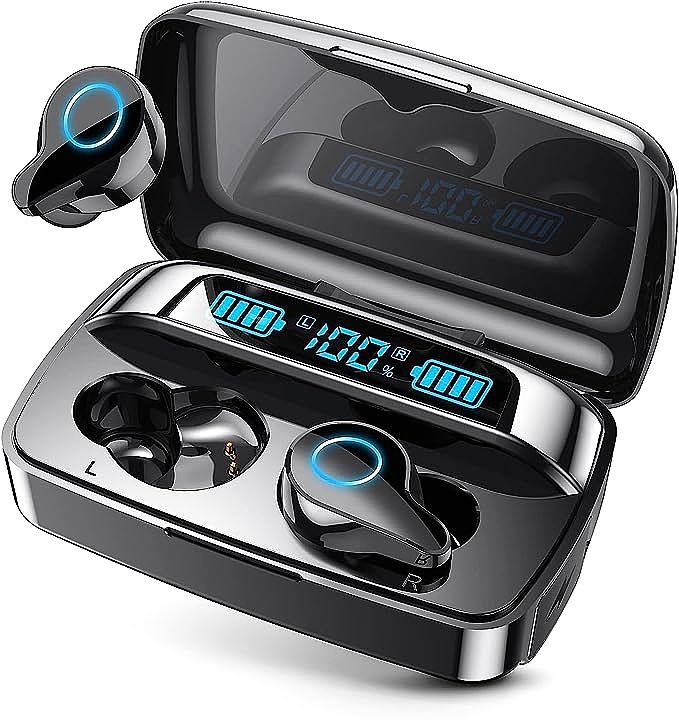
Monster N-Lite 208 Wireless Earbuds
Place one of your wireless earbuds next to a coin, and it weighs barely more than a few sheets of paper. And yet that gram-scale object reproduces a full orchestra, decodes radio signals from a phone across the room, and recognizes the difference between a tap and a long press on its outer shell. Good wireless earbuds sound quality is not one property of the hardware. It is the end result of a cascade of physics and engineering choices, and this article walks through that chain from the smallest moving part to the radio wave leaving the phone. It uses one consumer earbud, the Monster N-Lite 208, as an illustrative example rather than a product under review. Its published specs, a 13mm driver and a Bluetooth 5.3 radio, give concrete numbers to principles that apply to any pair of wireless earbuds you will ever own.
How does a tiny driver make sound?
The driver is the transducer at the heart of the earbud, the part that converts an electrical signal back into pressure waves in the air. Most in-ear devices, including the Monster N-Lite 208, use a dynamic driver, which works like a miniature speaker. An electrical audio signal flows into a fine voice coil attached to a thin diaphragm and suspended in the magnetic field of a small permanent magnet, typically neodymium. As the current in the coil changes, the coil's own magnetic field interacts with the magnet's field, and the resulting force makes the diaphragm move back and forth thousands of times per second. That motion pushes and pulls the surrounding air, and the brain interprets the resulting pressure waves as sound.
Two competing material properties decide how well the diaphragm moves: stiffness and mass. It must be rigid enough to act as a single piston instead of bending into waves of its own, and light enough to start and stop the instant the signal changes. This tension is why high-end audio engineers reach for materials such as PEEK, liquid-crystal polymer, and beryllium, all of which push the stiffness-to-weight ratio beyond what ordinary plastics achieve. Size enters the same equation: a larger surface moves more air, which helps the low end, but a larger diaphragm is also heavier and harder to control, the difference between rich bass and a smeared one.

Why does the size of the driver affect the bass?
The low end of the spectrum is the part of the sound most constrained by physics. Longer wavelengths, the ones that make up bass, need more air movement to reproduce accurately, and that air movement comes from the diaphragm's surface area. A small 6mm diaphragm struggles to push the volume of air a deep kick drum requires, while a 13mm unit has roughly double the area and can reach into the lower frequencies without straining.
The trade is control. A bigger moving mass lags behind rapid signal changes, so a large driver that is not properly controlled sounds muddy: the bass is there, but smeared. The engineering answer is a stiffer, lighter diaphragm paired with a magnet system strong enough to keep it on time. In practical terms, driver size explains a predictable pattern in the market: the deepest bass in a small form factor belongs to the designs with the largest well-controlled diaphragms, and the millimeter number printed on the box is a shorthand for the whole balance between area, mass, and magnetic force.
What role does the Bluetooth codec play in sound quality?
Everything the driver receives has to cross the room as radio first. A song on the phone is a stream of digital numbers far too large to transmit raw, so the Bluetooth stack compresses it with a codec before it leaves. For decades the default was SBC, a baseline algorithm that works but discards more of the signal than it needs to. The newer LE Audio architecture, carried on Bluetooth 5.2 and later generations such as the 5.3 radio in the example earbud, standardizes a more efficient codec called LC3.
LC3 exploits psychoacoustics, which is the study of what the ear actually notices. The codec measures where in the signal it is loud enough to mask quieter details, then spends its data budget on the parts a listener would perceive and drops the rest. The result is a codec that either sounds better than SBC at the same data rate, or preserves the same listening experience at a much lower one. That second option matters more than it sounds, because the data rate drives two things at once: power draw, since the radio is active only while transmitting, and robustness, since small packets fail faster and retransmit faster in a crowded radio environment. A lower-rate LC3 stream is what lets a pair of 5-gram earbuds run for hours on a coin-sized battery while staying connected in a busy cafe.
How does the touch surface on the shell work?
An earbud with no physical buttons still has to accept commands, and it does so with capacitive touch. The smooth outer face of the device sits above a small electrode, and a microcontroller continuously measures the capacitance of that electrode, the electric charge it can store against a grounded reference. A human finger is conductive, so the moment one touches the surface it adds capacitance, and the change is large enough to measure against the background noise.
The firmware then classifies the timing of the change. A short tap, two rapid taps, or a press held for a second each carry a distinct signature, and the mapping from signature to command, play or pause, next track, answer a call, is what makes the gestures feel natural. The design has a bonus that acoustic users rarely notice: because the interface is a sealed surface rather than a moving part, there is nothing mechanical to wear out and no gap for dust or water to enter. The touchpad and the sealed shell are, quite literally, the same structural element.

How long can the battery keep the sound going?
The driver, the codec, and the touch sensor all need power, and in a device this small the battery sets the upper limit on everything. Each earbud carries a lithium-ion pouch cell sized to run its own radio and driver for roughly five hours, enough for a workout or a commute but not a full day of listening. The charging case solves the day-scale problem with a second, larger cell: when the earbuds sit in the case, the case tops up the two small batteries one after another, extending the combined system to around thirty hours of total playtime. USB-C fast charging refills the whole system in about an hour and a half, which is how a device that plays for five hours at a time still answers a request like "how long does it last" with a day's worth of music.
Why do some wireless earbuds sound thin even with large drivers?
Bigger does not automatically mean better, because the driver is only one link in a chain that starts with a microprocessor. Each link adds distortion and takes precision, and in day-to-day listening three factors dominate. One is the codec, which sets the ceiling for wireless earbuds sound quality before a single note reaches the diaphragm: a stream compressed too aggressively loses the transients, the sharp attacks of a snare or a plucked string that make sound feel lively, and that loss survives any upgrade to the driver. The other two are physical. The sealed enclosure behind the diaphragm acts as a tuning network and can color the bass toward boomy or hollow depending on its exact volume and the fit in the ear. And the seal around the ear tip decides how much low frequency actually reaches the ear at all: without it, the short-wavelength bass leaks out around the tip instead of into the ear canal, and the low end simply disappears. A pair of wireless earbuds with superb drivers can therefore sound thin for a reason that has nothing to do with the quality of the hardware and everything to do with the last two millimeters of air.

Monster N-Lite 208 Wireless Earbuds
Related Essays

The Invisible Freedom: When Technology Disappears Into Reliability

Rulefiss I27-1 Wireless Earbuds: Top-Notch Audio Quality and Ultra-Long Battery Life Make It the Go-To Sports Earbuds

TECKNET TK-HS008 Wireless Headphones: Your Ideal Choice for Music on the Go

The Science of Wireless Audio: How Your Earbuds Create Immersive Sound

The Logic of the Affordable Miracle: Deconstructing Budget Audio Engineering

Kurdene S8 Mini Wireless Earbuds: Big Sound in a Small Package

Kurdene S10 Wireless Earbuds: Experience Superior Sound with Bluetooth 5.2 Technology
Unleash Your Inner Audiophile with the PIFFA A66 Bluetooth Headphones

ANINUALE H06 Wireless Earbuds - Affordable Quality
