Why Your Wireless Earbuds Betray You Mid-Workout: The Physics of Sweat and Signal

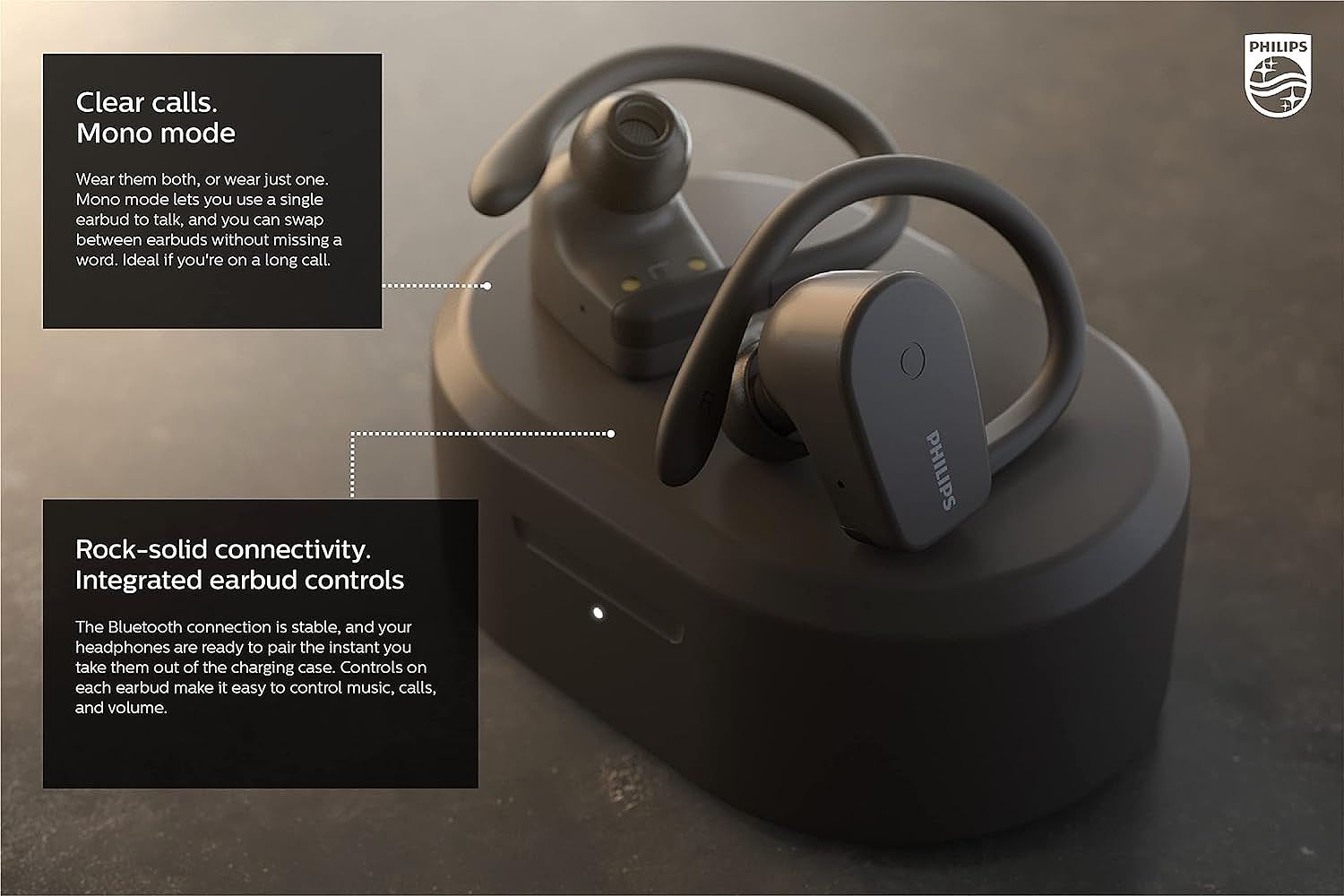
PHILIPS A5205 Wireless Sports Earbuds
Your earbuds fall out. Not at the start of your run, when everything is dry and secure. They fall out at mile three, when sweat turns your ear canal into a slip-and-slide and the Bluetooth signal stutters just as the chorus drops. The PHILIPS A5205 wireless sports earbuds attempt to solve this triple threat with wing-tip anchors and IPX5 water resistance. But to understand whether any of that matters, you need to understand why earbuds fail in the first place.
The Anatomy of a Dropout
Earbuds dislodge for three reasons, and they compound each other. First, the ear canal is not a fixed tunnel. It deforms with jaw movement. Every step you run sends a shock wave through your skeleton; your temporomandibular joint flexes, and the cartilage of your external auditory meatus shifts subtly. A bud that fits perfectly at rest becomes loose after five minutes of chewing, breathing hard, or bouncing on pavement.
Second, sweat is a lubricant. Human eccrine sweat is approximately 99% water, with trace amounts of sodium chloride, urea, and lactic acid. Its surface tension is lower than pure water, roughly 55-70 mN/m depending on electrolyte concentration. This means it wets skin and silicone more effectively than tap water, creating a thin film that drastically reduces friction between the earbud tip and the canal wall. The coefficient of static friction between dry silicone and dry skin might be 0.7-1.0. Add sweat, and it drops to 0.2 or below. That is the difference between staying put and sliding out.
Third, there is the cable effect, or rather, the absence of one. Wired earbuds benefit from an unintended mechanical advantage: the cable itself acts as a tether and a damper. When a wired bud loosens, the cable tension redistributes the force. True wireless earbuds have no such backup. Each bud is an independent mass, subject to Newton's first law, and once inertial force exceeds the friction holding it in place, it departs.
Why Bluetooth Stutters When You Move
The signal problem is separate from the fit problem, but they share a common culprit: your body.
Bluetooth operates in the 2.4 GHz ISM band, the same frequency as microwave ovens. At 2.4 GHz, the wavelength is approximately 12.5 cm. Your torso is roughly 20-40 cm across. This means your body is not transparent to the signal; it is a partial reflector and absorber. When you run, your arms swing, your head turns, and the relative positions of the earbud antenna and the phone antenna change continuously. Each posture change alters the multipath profile.
Multipath interference occurs when the radio signal reaches the receiver via multiple paths, some direct and some reflected off your body, nearby walls, or the ground. These reflected copies arrive with slight time delays, and their waveforms interfere constructively or destructively with the direct signal. At 2.4 GHz, a path length difference of just 6.25 cm (half a wavelength) can flip constructive interference into destructive interference. Your arm swinging through 30 degrees can easily change the path length by that much.
This is why Bluetooth audio does not degrade gradually. It drops in and out. The signal strength does not fade smoothly from full to zero; instead, it oscillates between strong and nearly nonexistent as you move through spatial nodes and antinodes of the standing wave pattern created by multipath reflections.
Antenna diversity, used in modern Bluetooth chipsets, mitigates this by including two antennas spaced at least a quarter-wavelength apart. If one antenna sits in a null, the other likely receives adequate signal. But antenna diversity has limits. In a compact earbud, the two antennas are only millimeters apart, which reduces their spatial separation advantage.
The Wing-Tip Principle: How Shape Fights Force
The ear wing, or fin, is the most visible design element of sport-oriented earbuds. It works on a principle older than earbuds themselves: mechanical interlock.
Friction-based retention, what standard ear tips rely on, is proportional to the normal force pressing the tip against the canal wall. Sweat reduces the friction coefficient, and jaw movement reduces the normal force. A wing tip adds a second retention mechanism: geometric constraint. The wing tucks under the antihelix, the ridge of cartilage that forms the inner rim of the ear's outer bowl. Even if friction drops to near zero, the wing cannot slide out without first deforming past the antihelix, which requires a force directed upward and outward, not the downward-and-outward force that gravity and running impacts produce.
This is the same principle that holds a doorstop in place. A wedge under a door does not rely on friction alone; it relies on the geometry of the wedge converting horizontal force into vertical normal force against the door bottom. The ear wing converts the downward pull of gravity and vibration into lateral pressure against the antihelix, which actually increases its grip.
The trade-off is comfort. A wing that fills the concha bowl creates constant pressure on the cartilage. Cartilage has no blood supply of its own; it receives nutrients through diffusion from the perichondrium, the thin membrane covering it. Sustained compression slows this diffusion, which is why ears ache after wearing winged earbuds for extended periods. The design challenge is finding the minimum wing volume that provides adequate interlock without restricting cartilage perfusion.

IPX5 and the Mathematics of Water Ingress
The IP rating system, defined by IEC standard 60529, classifies degrees of protection against solid objects and water. IPX5 means the device withstands water jets from a 6.3 mm nozzle at 30 kPa from a distance of 3 meters for at least 3 minutes. That is a specific engineering test, not a vague claim of water resistance.
But sweat is not a water jet. Sweat attacks electronics differently. It creeps. Capillary action draws moisture into gaps as small as 0.1 mm at speeds determined by the surface energy of the materials and the viscosity of the liquid. Sweat's dissolved salts make it conductive, around 5-15 mS/cm depending on concentration. When conductive liquid bridges two electrical contacts, it creates a leakage current that can corrupt digital signals or short power rails.
The defense is typically a conformal coating, a thin polymer layer applied over the circuit board. Common materials include acrylic, silicone, and polyurethane, each with different dielectric strength, moisture absorption, and thermal stability. Acrylic coatings offer good dielectric properties but poor resistance to solvents. Silicone coatings flex well but absorb more moisture over time. Polyurethane provides the best chemical resistance but is hardest to rework.
The vulnerability point is usually not the board itself but the microphone port and the charging contacts. Microphone ports must remain open to air pressure changes to function, which means they provide a direct pathway for liquid ingress. Charging contacts are exposed metal, and even when dry, the residual salt from evaporated sweat can create conductive paths that drain the battery or trigger false charging signals.
Bone Conduction: The Alternative Path
There is another way to get sound into the cochlea that bypasses the ear canal entirely: bone conduction. Sound vibrations applied to the skull, typically through the mastoid bone behind the ear, travel through bone and soft tissue to the cochlea, where they are transduced into neural signals the same way air-conducted sound is.
Bone conduction has a long medical history. It was first described in the 16th century by Girolamo Cardano, who observed that sound could be perceived through a rod held between the teeth. In the 19th century, the Weber and Rinne tuning fork tests became standard clinical tools for distinguishing conductive from sensorineural hearing loss. The principle is simple: if the cochlea is intact, bone-conducted sound will be perceived regardless of the condition of the outer and middle ear.
For athletes, bone conduction offers two advantages. First, the ear canal stays completely open, eliminating the fit and sweat problems described above. Second, environmental awareness is preserved. Runners can hear traffic, cyclists, and approaching hazards without removing an earbud. The disadvantage is bass response. Bone conduction transmits high frequencies efficiently but attenuates frequencies below approximately 250 Hz. This is because the skull acts as a high-pass filter; its mechanical impedance at low frequencies is too high for the small driving force of a typical bone conduction transducer to overcome.
This is not a minor shortcoming. Much of the perceived energy in modern music, particularly electronic and pop genres favored by runners, resides below 250 Hz. A bone conduction headset reproducing a kick drum delivers only the click of the beater against the head, not the thump of the resonating shell. Some listeners find this acceptable; others find it defeats the purpose.

The Stability Problem No One Solves
There is a deeper issue that neither in-ear wings nor bone conduction addresses: the stability of the ear canal itself as an acoustic chamber.
The ear canal is a tube approximately 2.5 cm long and 0.7 cm in diameter, closed at one end by the tympanic membrane. Acoustically, it is a quarter-wave resonator. Its primary resonance falls around 3 kHz, which is why the human ear is most sensitive in the 2-4 kHz range. This resonance amplifies sounds near 3 kHz by approximately 10-15 dB before they reach the eardrum.
When you insert an earbud, you shorten the effective tube length, which shifts the resonance frequency upward. How much depends on insertion depth, which varies with fit, jaw position, and head movement. A bud that shifts 2 mm deeper into the canal changes the resonant frequency by several hundred Hertz. This is not a subtle effect. It is audible as a change in timbre, particularly for sounds in the 3-5 kHz range where consonant intelligibility in speech and the presence range in music reside.
Every step you take while running causes micro-shifts in bud position. Each shift retunes the acoustic chamber. The result is not a steady frequency response but a fluctuating one, a slow modulation of the ear canal's natural resonance overlaid on the music. Your brain partially compensates for this, the same way it compensates for head-related transfer function changes when you turn your head. But the compensation is imperfect, and it consumes cognitive bandwidth that could otherwise be allocated to running form, traffic awareness, or simply enjoying the music.
This is the real stability problem. Not that the earbud falls out of your ear, but that it falls out of its optimal acoustic position while remaining in your ear. The music keeps playing, but it sounds different from step to step, and the cumulative cognitive load of processing those fluctuations is a hidden tax on your attention.
What This Means for How We Listen
Understanding these failure modes suggests practical approaches that do not require buying new hardware.
Foam ear tips, made from slow-recovery polyurethane, address the fit problem more effectively than silicone. When compressed and inserted, foam expands to fill the canal irregularly, creating a seal that relies on conformal contact rather than friction. Sweat still reduces surface friction, but the mechanical interlock from the expanded foam filling the canal's irregular shape provides retention independent of friction coefficient. The trade-off is durability; foam tips compress permanently after 2-4 weeks of daily use and must be replaced.
For signal stability, wearing the phone on the same side as the primary earbud reduces the body-shadow effect. Bluetooth signals at 2.4 GHz are attenuated by approximately 15-20 dB passing through a human torso. Wearing the phone in a front pocket on the left side while the left earbud is the primary receiver halves the number of body-shadow events compared to a back pocket or opposite-side placement.
The ear canal resonance shift problem has no consumer-level fix. It is a consequence of the physics of a compliant, moving tube being used as an acoustic reference. The closest analogy in engineering is attempting to use a vibrating beam as a length standard. The beam's length changes with vibration amplitude, so any measurement that depends on that length is inherently noisy. The same applies to the ear canal as an acoustic cavity during physical activity.
The Open Question
Every sport audio solution today works around the ear canal rather than with it. In-ear designs fight its geometry. Bone conduction bypasses it entirely. Neither approach treats the canal as a changing, moving structure whose motion could be measured, modeled, and compensated for in real time.
The technology to do this already exists in other domains. Adaptive optics in telescopes measure atmospheric distortion of incoming light 1,000 times per second and deform a mirror to cancel it. Active noise cancellation in earbuds already samples the acoustic environment with microphones and generates an opposing signal. Extending that feedback loop to monitor and compensate for ear canal resonance shifts, not just external noise, would require a reference microphone at the eardrum end of the canal, which is impractical with current transducer sizes. But the principle is sound.
Until then, the ear canal remains a moving target. Every runner who has fumbled with a loosening earbud at the worst possible moment has already learned what physics predicts: that a soft, sweat-lubricated, vibration-shaken tube is a fundamentally unreliable acoustic chamber. The engineering response has been to add wings, coatings, and antenna diversity. Each helps. None solves the root cause, which is that the ear was not designed to hold a speaker while running. It was designed to hear a predator approaching through tall grass, a task that requires the canal to be open, flexible, and exquisitely sensitive to change. Those same properties make it hostile to the very device we ask it to cradle.
PHILIPS A5205 Wireless Sports Earbuds
Related Essays

Silencing the Copper Wire: The Invisible Architecture of Modern Audio

The Physics of Silence: How Active Noise Cancellation Works

The Four Pillars of Unbreakable Sport Audio

How True Wireless Stereo Technology Rewired the Way We...

The Science Behind Wireless Audio: From Bluetooth Origins...

Why Your Wireless Earbuds Last 48 Hours: The Physics Behind Battery and Sound

From Stage to Studio: The Engineering Legacy Inside the Marshall Woburn III

Neckband Audio: Spatial Separation Enables aptX-HD at Budget Prices

Senso PODS Plus Wireless Earbuds - True Wireless Earbuds for Everyday Use
