How a 32-Hour TWS Earbud Manages Its Charge


Yeteky A16 Wireless Earbuds
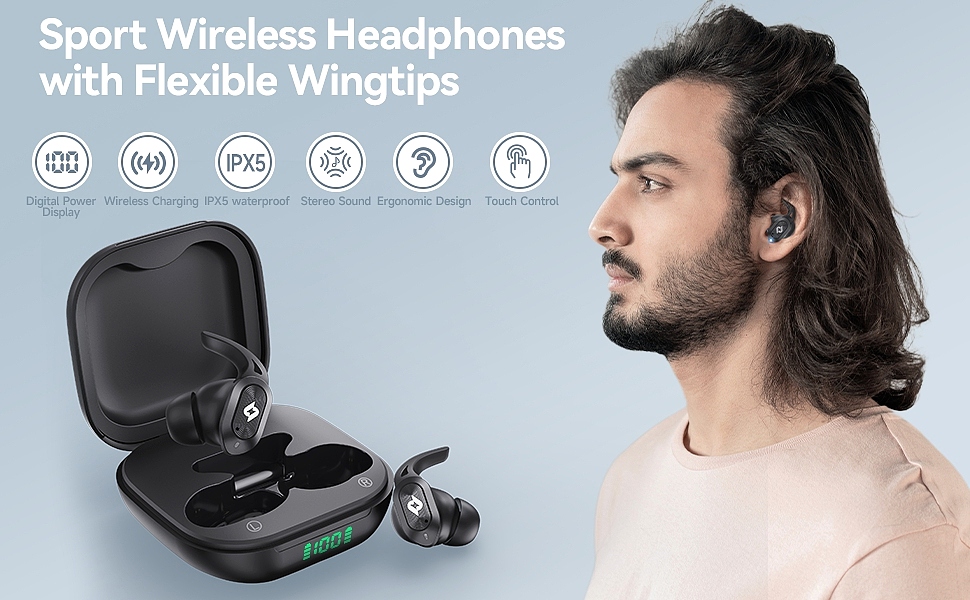
Most earbud boxes promise a few hours. A smaller group promises a full workday, and the Yeteky A16 Wireless Earbuds land in that camp. The listing claim is up to 8 hours on a single charge per bud, stretching to 32 hours total when the charging case tops the buds up three more times. That number is easy to quote. It is harder to unpack, because the 32 hours of total playback rests on a stack of small design decisions: the lithium-ion cells inside each bud, the case acting as a second battery, a digital LED display that reports where you stand, and an IPX5 rating that draws a line between sweat and submersion. Each of those decisions trades something off, and the trade is what separates a spec sheet from a product you can trust for a workday.
How a small cell stretches a charge across a day
A wireless earbud is a packaging problem before it is a sound problem. The driver, the Bluetooth radio, the touch surface and the microphone all live in a shell the size of a thumbnail, and the cell has to power that stack for hours while the bud weighs a few grams. Lithium-ion chemistry solves most of it. The energy density of a modern li-ion cell is high enough that a coin-sized pack can run the bud's radio and driver for up to 8 hours on one charge, which covers a long commute, a gym session and the ride home.
The math that turns 8 hours into 32 lives outside the bud. The case carries its own cell, large enough to deliver 3 additional full charges to the buds. Think of it as a mobile power bank sized for earbuds: every time the buds dock, charge moves from the case cell into the bud cells through a small transfer circuit, and the case display updates so you can see the reserve before you need it.
The case is a second battery
That reserve matters more than the marketing line suggests. A bud that dies at hour 7 is a different tool from one whose case holds 3 more full refills. The 24-32 hour range in the listing is the honest version of the claim: 8 hours on the bud, then up to 3 cycles of top-ups, and the combined envelope lands at 32 hours. For people who wear earbuds through an 8 hour shift and still want evening playback, the case is where the usefulness hides.
Why the LED display is more than a light show
Older bud cases flashed four diodes in steps. The set swaps that for a dual-LED digital display: the case shows a number, and each bud reports its own state. Under the hood this is a battery management system doing its visible work. A BMS samples the pack voltage and current, tracks the charge curve, and turns the result into the digits you see.
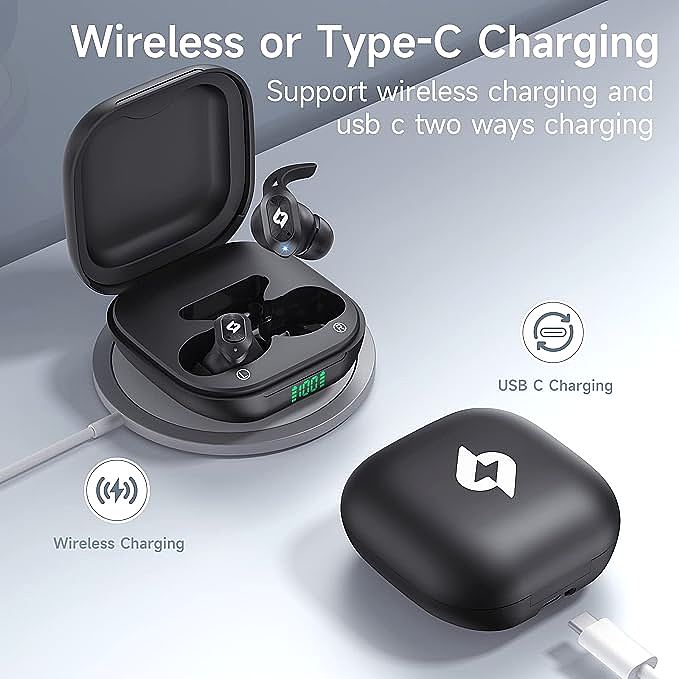
You do not need an app to read the state, and that is what the physical display is for: the number is on the case that lives in your pocket. The same BMS also handles the protective side, cutting the charge at the top of the curve and shutting the pack down before a deep discharge, which is what keeps a small li-ion pack from cycling badly. The display is the interface to all of that machinery.
How two charging paths keep the case topped up
The case refills in two ways. The case accepts USB-C through a cable in the box, and it also takes a wireless pad, a Qi-style pad or mat, if you already run one on a desk. The wireless path is convenience rather than capacity: same cell, same top-up, no cable. One honest note from the listing: the box includes the USB-C cable, not a wireless charger.
Reviewers of buds in the same price band report quick-charge behavior where a 10 minute top-up turns into roughly 3 hours of playback, with a full refill landing near 70 minutes. The listing does not publish a quick-charge figure, so treat those two numbers as the neighborhood benchmark, not the spec. The practical effect is that an overnight top-up, or even a lunch-break charge on a pad, covers a full next day of listening.
Why the pairing remembers you
The first pairing is the only one that takes effort. Pull both buds out of the case and they join to each other, then to the phone, after which the buds hold the device in memory: open the case near that phone and the connection lands without a menu dive. The listing answers are specific about the radio: the owner Q&A puts the chip at Bluetooth 5.1 or 5.2, not 5.3, which matters less for music than it sounds. In the 5.1 to 5.2 window the radio already carries the stable-link and low-power refinements, and the range that matters in a car, a couch and a backyard is covered. What the version number does not buy here is the faster codec stack of the 5.3 generation, so the sound path is the classic one: phone encodes, buds decode, and the touch surface handles play, pause, volume and the voice assistant.
What the fit system does, and where IPX5 stops
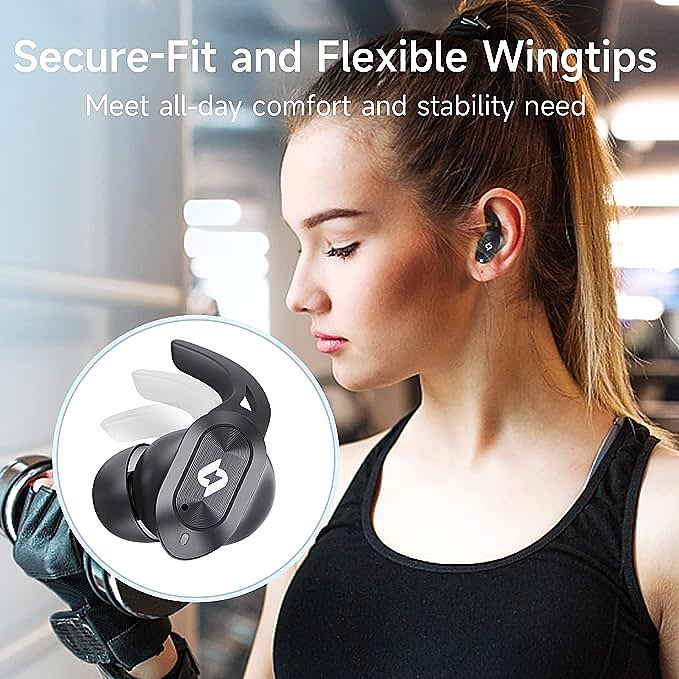
The set uses a soft flexible wingtip that wraps around the earlobe instead of relying on seal alone, plus 3 sizes of ear tips so the seal can be dialed in. The whole set, buds and case, weighs 3.52 ounces in the box, with a package measuring 3.5 x 2.91 x 1.54 inches. Light enough to forget, small enough to pocket.
Water resistance is where precision matters. IPX5 means the bud survives a jet of water from a 6.3 mm nozzle at 12 liters per minute, the test that maps to sweat and rain. The owner Q&A on the listing is direct: no swimming, no drops in the basin. IPX5 is a surface rating, not a submersion rating, and the earbud has a sealed grille on the wrong side of that line. If the plan includes the shower or the pool, the rating is the first place to look, and this set is not it.
A single-bud mode doubles the earbuds into two half-sets. Pop one out and the other keeps playing while the mate charges in the case, which is the standard answer to one ear free at a crosswalk.
Where this set sits among its siblings
Budget TWS is a crowded lane, and the 32 hour claim only means something next to the neighbors. At $49.99 (the listing price sits 38% under the $79.99 list), it lands in the same band as the Soundcore sibling at $47.99, and it competes with the XVEGA BY-16 at $31.99, which adds ANC plus call noise reduction and a larger LCD case on Bluetooth 5.4. The iHoto set at $15.99 pushes 40 hours with 13 mm drivers and an IPX7 rating, while the iJoy Gravity at $11.99 offers 30 hours, IPX4 and wireless case charging on a Bluetooth 5.0 radio. The MSHUKCOE SK18 at $35.90 aims at a different job: 24 dB of passive blocking for sleep, on Bluetooth 5.3.
The set trades raw hours for the display, the wireless pad and the wingtip fit. It is not the cheapest option in that list, and it is not the wettest-rated one either. It is the set that pairs the digital case display with a Qi pad and a secure lobe hook at under $50, which is a narrower answer to "which earbuds" than the spec sheet suggests.
What the 4.8 stars say about the set
The listing shows 4.8 out of 5 stars across 368 ratings, with 90% of those at five stars. The sub-scores split the story: comfort rates 4.9, and both sound quality and battery life rate 4.7. That distribution says the fit and the endurance are what people remember, with sound a half-point behind.
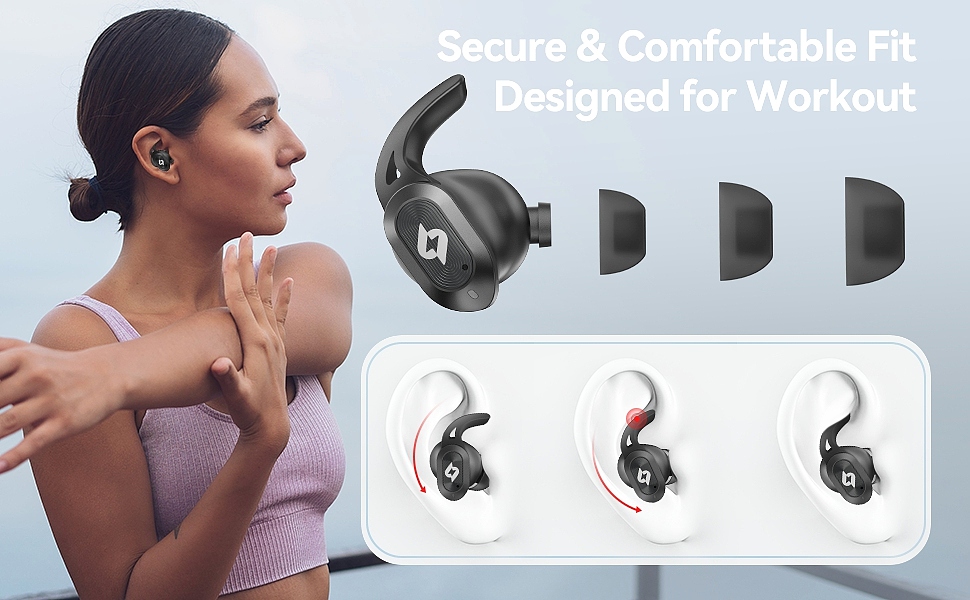
Two owner answers set the frame. One owner runs the buds through an 8 hour delivery shift and notes they stay put through jumping and head-shakes. Another warns that the set is not a swim item, and treats the IPX5 label as sweat and rain only. The rating curve and those answers point the same direction: a fit-and-battery product at a price where most buyers are shopping on value, not on a codec or a cancellation system.
A realistic way to use the numbers
Buy the 32 hours with a discount coupon. A single bud gives you the morning plus the gym, the case carries the evening, and a 10 minute charge on the move buys back a couple of hours when you run short. Plan around the IPX5 line: heavy rain and sweat are inside the rating, the pool is not. If the display number on the case is what you want, and the wingtip is the fit your ear keeps losing out of on other sets, the set sits in the middle of the budget TWS field doing exactly that, at a price just under $50.
Yeteky A16 Wireless Earbuds
Related Essays

Budget Wireless Earbuds: Why Cheap Buds Die in Six Months

Sony WI-C310 Wireless In-Ear Headset: The Science Behind All-Day Wireless Audio Freedom

How RIZIZI Built 40-Hour Wireless Earbuds for Under 20 Dollars

Why Bluetooth Earbuds Keep Disconnecting and How to Fix It

Bluetooth 5.4 and DSP: The Invisible Tech Behind Better Earbuds

Budget Earbuds Decoded: Bluetooth 5.3, Graphene & Deep Bass

Earbud Specs Explained: 13mm Drivers, Bluetooth 5.4, IPX5

How Wireless Earbuds Work: 13mm Drivers, Bluetooth 5.4 & ENC

Nerunsa D60 Pro Earbuds: Bluetooth 5.4 and ENC Explained

