The Physics of Acoustic Sealing: Why Fit Is the Foundation...
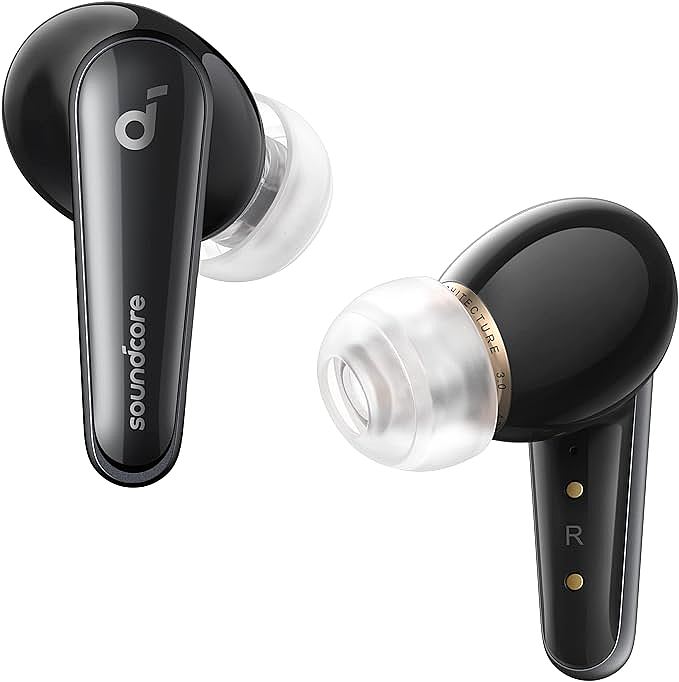
Wireless Earbuds
A car engine works because its pistons compress fuel and air inside a sealed cylinder. The walls of that cylinder are rigid, the gaps between piston and wall are measured in microns, and every stroke delivers predictable force. Remove the seal — introduce even a hairline crack — and the compression collapses. The engine still runs, but it runs poorly, wasting energy with every revolution.
Something almost identical happens inside your ear canal every time you insert a pair of product-7040. The tiny driver inside each earbud is a piston. The ear canal is the cylinder. And the soft tip pressed against the canal wall is the seal that determines whether you hear music or disappointment. In this article, we explore the science behind acoustic sealing — the physical interface that impacts bass response, sound quality, and overall audio fidelity more than any driver or codec ever could.
Devices like the Anker Soundcore Liberty 4 deliver spectacular measured performance in laboratory conditions. But those measurements assume a perfect seal — a condition that, as we will see, the international standards themselves admit is nearly impossible to replicate in real life. The difference between what an earbud can do and what it actually does for you comes down to a single physical interface.
The Piston in Your Ear Canal
Sound is a pressure wave. When a speaker driver moves forward, it pushes air molecules together, creating a region of high pressure — a compression. When it pulls back, it creates a region of low pressure — a rarefaction. These alternating compressions and rarefactions travel through the air inside the ear canal until they reach your eardrum, which vibrates in response and ultimately converts that mechanical energy into neural signals your brain interprets as sound.
For high-frequency sounds, this process is relatively forgiving. Short wavelengths carry concentrated energy, and even a poorly sealed earbud can deliver crisp treble. Bass is a completely different story. Low-frequency waves have long wavelengths — a 40 Hz bass note has a wavelength of about 8.5 meters — and comparatively low energy density. To produce audible bass from a tiny earbud driver, you need to pressurize a small, sealed volume of air. The driver acts as a piston, the ear canal acts as the cylinder, and the ear tip creates the seal that turns the canal into a closed acoustic chamber.
When the seal is effective, the driver's forward stroke compresses the trapped air, directly transmitting pressure to the eardrum. Even a driver as small as 9 millimeters can produce impactful bass when the sealed volume is small enough. This is the closed-volume principle, and it governs everything from subwoofer enclosures to in-ear monitors.
When the seal fails, the system undergoes a catastrophic improveation. Even a sub-millimeter gap between the ear tip and the canal wall converts the system from a closed chamber to what acousticians call an open baffle. High-pressure air from bass notes escapes through the leak rather than pushing against the eardrum. The energy that should have become sound simply radiates away into the surrounding air.
Research by Farmer et al. published in the Journal of the Association for Research in Otolaryngol characterized the acoustic input impedance of the ear canal, showing a low-frequency magnitude slope of approximately -6 dB per octave consistent with a stiffness-controlled system. The ear canal behaves acoustically like a transmission line up to about 6 kHz, and the quality of the acoustic sealing directly determines whether that transmission line operates in closed mode — efficient and bass-rich — or open mode — lossy and bass-poor.
When a Millimeter Steals Your Bass
The mathematics of acoustic leakage are unforgiving. According to research from Avantree's acoustic engineering division, a gap of just 0.5 millimeters between the ear tip and the canal wall can reduce bass response by approximately 40 percent. That is not a subtle degradation — it is the difference between feeling the kick drum in a rock track and wondering whether it is even present in the mix.
The reason bass is so vulnerable to leakage lies in the physics of wavelength and energy distribution. Low-frequency sound wavelengths are measured in meters, while the ear canal is measured in centimeters. In a sealed system, the entire canal pressurizes uniformly regardless of wavelength. But introduce a leak, and the pressure equalizes almost instantly for long-wavelength bass frequencies, while shorter treble frequencies remain largely unaffected because their shorter wavelengths interact with the leak differently. This is why a poorly sealed earbud still sounds bright and detailed but completely lacks warmth and body.
The practical consequence is that the single most important variable in earbud audio quality is not the driver, not the codec, not the amplifier chip — it is the fit. A well-sealed budget earbud will outperform a poorly sealed premium model in bass response every single time. The physics do not care about price points or brand names.
This principle extends beyond consumer audio. Professional in-ear monitors used by musicians on stage depend on the same closed-volume physics. Studio engineers who mix on headphones rely on acoustic sealing to hear accurate low-frequency content. The audiologist fitting a hearing aid knows that the device's effectiveness depends as much on the earmold seal as on the electronics inside. Across every application of insert audio devices, the seal is the foundation.
Your Ear Canal Is Not Standard
Here is where the problem deepens considerably. No two ear canals are identical, and the differences are not minor variations around an average — they are fundamental geometric and acoustic differences that profoundly affect how any given earbud performs.
Research by Voss and Allen published in the Journal of the Acoustical Society of America established foundational measurements of acoustic impedance and reflectance in human ear canals, measuring ten young adults with normal hearing across frequencies from 0.1 to 15.0 kHz. Their findings revealed significant inter-subject variability — the impedance characteristics of one person's ear canal can differ dramatically from another's, particularly at resonant frequencies where the canal geometry creates standing wave patterns.
A more comprehensive study by Jonsson, Schuhmacher, and Jorgensen in 2018 conducted wideband impedance measurements in the ear canals of 32 adult subjects, using magnetic resonance imaging to capture full canal geometries. The results established mean impedance values and standard deviations across the population, demographically divided by gender and age. The variability was substantial enough to explain why the same pair of earbuds can sound magnificent to one listener and genuinely disappointing to another — their ear canals present fundamentally different acoustic loads to the driver.
This variability is why ear tip fit testing has become an essential feature in modern earbud companion apps. A fit test plays a calibrated sound and measures how much acoustic energy leaks from the seal, helping users identify which tip size creates the best match for their unique canal geometry. Without this feedback, users are essentially guessing — and guessing wrong means leaving significant audio performance on the table.
The Occlusion Paradox
If a better seal always produces better bass, the logical conclusion would be to create the tightest possible seal at all times. But nature introduces a complication that makes this approach self-defeating: the occlusion effect.
The occlusion effect occurs when the outer portion of the ear canal is blocked by an earbud tip. Under normal conditions, bone-conducted sound from your own voice, chewing, and footsteps travels through the ear canal walls and radiates out through the open canal entrance — effectively acting as a natural high-pass filter that vents low-frequency body sounds before they become perceptible. When you block the canal with an earbud, this venting mechanism is eliminated. The acoustic impedance of the canal cavity increases dramatically at low frequencies, causing a corresponding increase in the perceived loudness of your own voice and internal body sounds.
Research by Carillo, Doutres, and Sgard published in the Journal of the Acoustical Society of America used finite element modeling to demonstrate that the occlusion effect can reach 40 or more decibels at low frequencies with complete canal occlusion. The effect is most prominent for shallow insertions because the cartilaginous outer portion of the ear canal wall is the primary vibration source for bone-conducted body sounds.
This creates a fundamental tension in earbud design that has no perfect solution. Better acoustic sealing means better bass response and improved passive noise isolation, but it also means more occlusion effect — that booming, hollow quality to your own voice that makes conversations feel awkward and singing along to music uncomfortable. A looser seal reduces the occlusion effect, but the bass disappears and ambient noise floods in. Every earbud design navigates this tradeoff, and the optimal balance varies from person to person because ear canal geometry varies from person to person.
The occlusion effect also explains a common user complaint: "I can hear myself talk." This is not a defect in the earbud — it is a direct physical consequence of blocking the ear canal. Some premium earbuds attempt to mitigate it through adaptive noise cancellation that generates anti-phase signals to cancel the occluded body sounds, but the underlying physics cannot be eliminated entirely.
Silicone and Foam: A Materials Duel
The choice of ear tip material is not merely a comfort preference — it is a fundamental acoustic engineering decision with measurable consequences for sound quality. Silicone and memory foam create seals through entirely different physical mechanisms, and each has distinct implications for bass response, noise isolation, and long-term performance.
Silicone tips seal through mechanical fit. The elastic polymer conforms to the general shape of the ear canal, relying on the match between the tip's diameter and the canal's diameter to create consistent pressure against the canal wall. Medical-grade silicone is biocompatible, durable, sweat-resistant, and maintains its shape over months of regular use. It provides approximately 15 to 20 decibels of passive noise isolation — enough to reduce ambient conversation to a murmur but not enough for truly immersive listening in noisy environments.
Memory foam tips, typically made from viscoelastic polyurethane with densities ranging from 30 to 50 kilograms per cubic meter, seal through an entirely different mechanism. You compress the foam to roughly 40 to 50 percent of its original size for insertion, then it slowly expands over 10 to 30 seconds to fill the unique contours of your individual ear canal. This heat-activated expansion creates a custom mold that conforms to irregular canal shapes that silicone simply cannot match. The result is significantly better noise isolation — 25 to 35 decibels, or roughly 10 to 15 decibels better than silicone — and correspondingly superior bass response.
But foam tips carry significant tradeoffs that affect their practical value. Each compression cycle reduces the foam's elasticity through a process called polymer fatigue — the molecular chains that give foam its spring gradually break and reform in compressed positions. Earwax sebum and skin oils interact with the polyurethane matrix, causing chemical breakdown that accelerates the mechanical degradation. The open-cell structure that allows foam to compress and expand gradually collapses, reducing both comfort and acoustic performance.
Perhaps most insidiously, foam tip degradation is often asymmetric — the tip in your left ear degrades at a different rate than the one in your right ear, because your ear canals are not symmetrical and you may handle each tip differently during insertion and removal. This creates a stereo imbalance that creeps in gradually enough that you might not consciously notice it, but which subtly degrades the listening experience.
Research cited by the American Academy of Audiology confirms that properly fitted foam tips improve noise isolation by 15 to 25 decibels compared to silicone. The IEEE has found that foam tips require approximately 50 percent more maintenance effort. For users seeking maximum audio fidelity, upgrading to memory foam tips represents one of the most cost-effective improvements available.
The Measurement Gap No One Talks About
Here is a fact that should trouble anyone who makes purchasing decisions based on frequency response graphs and measurement charts: the international standard for measuring earbud performance explicitly acknowledges that its measurements do not reflect real-world performance.
IEC 60318-4:2010 defines an occluded-ear simulator for measuring insert earphones in the 100 Hz to 10,000 Hz range. The standard replaced IEC 60711:1981 and extended the usable frequency range to 16 kHz. It specifies an artificial ear with carefully calibrated acoustic impedance that simulates the average adult human ear canal.
But buried in the standard's own text is a remarkable admission that every consumer should understand. The standard states explicitly: "It does not simulate the leakage between an earmould and a human ear canal; therefore, the results obtained with the occluded-ear simulator may deviate from the performance of an insert earphone on a real ear, especially at low frequencies."
Read that again. The international measurement standard for earbuds explicitly acknowledges that real-world seal quality cannot be simulated. Every frequency response graph you have ever seen for earbuds was measured with a perfect seal that almost no real human user will achieve. The bass performance shown in laboratory measurements represents a theoretical best-case scenario that most listeners will never fully experience in practice.
Professional review sites like SoundGuys and RTings use the Bruel and Kjaer Type 5128 measurement fixture, which provides anatomically accurate ear canal geometry and calibrated microphones. But even this sophisticated instrument still cannot replicate the infinite variability of human ear canals or the imperfect, asymmetric seals that real-world tips create against real ear tissue.
This measurement gap — the chasm between what a device can do under ideal laboratory conditions and what it actually does for a specific listener with a specific ear canal and a specific tip — explains why two people can have genuinely, fundamentally different experiences with the exact same earbud. It explains why one reviewer's five-star rating can coexist with another user's one-star disappointment. And it explains why tip selection and fit testing matter more than any number on a specification sheet.
Fidelity Begins at the Surface
The audio industry obsesses over drivers and codecs, amplifier chips and Bluetooth versions, frequency response curves and total harmonic distortion percentages. These specifications matter — a better driver moves air more precisely, a better codec preserves more detail in the digital signal, a better amplifier delivers cleaner power. But all of that precision is meaningless if the acoustic energy never reaches your eardrum with its integrity intact.
The seal between ear tip and ear canal is not a peripheral concern. It is the foundation upon which all other audio engineering rests. It determines whether a dual-driver architecture delivers its intended frequency separation or collapses into midrange mush. It determines whether a high-resolution codec's additional detail is actually audible or lost to leakage. It determines whether twenty-dollar foam tips can outperform a two-hundred-dollar driver upgrade.
In engineering, the interface is often the instrument. The joint between two components frequently defines the performance of the entire system. A perfectly machined engine block produces zero horsepower if the cylinder head gasket leaks compression. A perfectly tuned loudspeaker produces no bass if the enclosure has an air gap. And a perfectly engineered earbud produces no bass if the tip does not seal against the ear canal.
Fidelity does not begin at the driver. It begins at the surface — the physical boundary where the device meets the ear. Everything that happens after that boundary is shaped by what happens at it.
Wireless Earbuds
Related Essays

Cleer Goal Sport Earbuds: Hear Your Surroundings, Fuel Your Workout

The Unheard Battle: How Your Living Room Became the Final Frontier for Perfect Sound

How Compact Speakers Defy Bass Physics
50mm Drivers Explained: How Driver Size Shapes Headphone Sound Quality

The Invisible Symphony: How Driver Size Shapes Your Audio Experience

The Science Behind Wireless Audio: From Bluetooth Origins...

Semi-In-Ear Earbuds Sound Thin: Acoustic Physics and Practical Fixes

How RIZIZI Built 40-Hour Wireless Earbuds for Under 20 Dollars

Sony ZX110NC Headphones: The Science of Affordable Noise Cancellation
