Why Bluetooth Audio Sounds Worse Than Wired — And What...


aptX LDAC蓝牙音频编解码器技术解析
Why Bluetooth Audio Sounds Worse Than Wired — And What Codecs Actually Do
You pair expensive wireless headphones to your phone. The music plays. It sounds fine — until you plug in a cable and hear what was missing. The cymbal decay that never arrived. The vocal breath that vanished somewhere between your phone and your ears. Something got lost, and it was not your imagination.
The culprit sits between your audio source and your ears: a Bluetooth audio codec. This piece of software decides which parts of your music survive the wireless jump and which parts get discarded forever. Understanding how it works — and why different codecs make different trade-offs — explains more about modern wireless audio than any spec sheet ever will.

The Bandwidth Problem Nobody Solved
Bluetooth has a practical bandwidth ceiling of roughly 2 megabits per second. A standard uncompressed CD-quality audio stream demands about 1.4 megabits per second. On paper, that fits. In practice, Bluetooth shares its radio spectrum with WiFi, microwave ovens, and every other Bluetooth device within thirty feet. The available bandwidth fluctuates constantly.
This is why every Bluetooth codec compresses audio. Not because compression is desirable, but because wireless transmission is a constrained channel governed by the same information theory that Claude Shannon formalized in 1948. Shannon proved that any communication channel has a hard capacity limit — you cannot push more data through a pipe than its diameter allows. Bluetooth audio codecs exist to shrink the data stream until it fits through that pipe, while discarding as little audible information as possible.
The math is unforgiving. Uncompressed 24-bit, 96-kilohertz audio — the kind Sony's LDAC codec aspires to transmit — requires approximately 4.6 megabits per second. That is more than double Bluetooth's practical ceiling. Something has to give.
SBC: The Baseline Everything Else Built On
Every Bluetooth device on earth supports SBC, or Sub-Band Coding. The Bluetooth Special Interest Group mandates it. If you have ever connected wireless earbuds and noticed the music sounded flat or lifeless, there is a decent chance SBC was the reason.
SBC splits audio into frequency sub-bands and quantizes each one independently. Its maximum bitrate sits at 345 kilobits per second, with latency ranging between 150 and 250 milliseconds. For casual background listening, this suffices. For anything resembling critical listening, the limitations become audible — particularly in the upper frequencies where cymbals, sibilants, and room ambience reside.
SBC prioritizes one attribute above all others: universal compatibility. It was engineered to run on any Bluetooth chip, regardless of processing power or manufacturer. This pragmatic choice made wireless audio possible in the first place, but it also established a low bar that every subsequent codec has tried to clear.
AAC: The Codec Apple Chose And Never Left
When Fraunhofer Institute and Dolby Labs developed AAC, they built something fundamentally different from SBC. AAC deploys a psychoacoustic model — a mathematical simulation of human hearing — to identify which audio components the ear will perceive and which it will mask. When two tones play simultaneously at similar frequencies, the louder one covers the quieter one. AAC detects these events and discards the inaudible content.
At 250 kilobits per second, AAC achieves better perceived audio quality than SBC at 345. This is the difference between algorithms that treat all frequencies equally and algorithms that understand how human hearing actually works.
Apple adopted AAC as the sole high-quality codec across its entire hardware platform. Every iPhone, iPad, Mac, and pair of AirPods routes Bluetooth audio through AAC. This was a deliberate architectural decision. Apple's silicon and software stack are tuned to encode and decode AAC with minimal processing overhead, which translates to consistent performance and battery efficiency.
The limitation is absolute: no iPhone will transmit aptX or LDAC. Apple's customers live entirely within AAC's walls.

aptX: When Qualcomm Bought The Answer
In 2004, a British semiconductor company called CSR developed a codec named aptX. It used sub-band ADPCM — adaptive differential pulse-code modulation applied to separate frequency bands. The approach reduces latency by avoiding the complex spectral analysis that codecs like AAC and MP3 require. aptX processes audio in the time domain, which is computationally lighter and faster.
Qualcomm acquired CSR in 2015 for approximately 2.4 billion dollars. The acquisition was not about a single codec. It was about owning a foundational piece of the Android audio stack. Today, aptX support is woven into Qualcomm's Snapdragon processors, which power the majority of Android smartphones worldwide.
Standard aptX operates at 576 kilobits per second with latency between 70 and 120 milliseconds. The bitrate exceeds both SBC and AAC, and the lower latency improves synchronization for video playback. For most Android users, aptX represents the first noticeable step up from basic Bluetooth audio quality.
The aptX Family Tree
Qualcomm did not stop at aptX. They extended it into a family of specialized codecs, each targeting a different constraint.
aptX HD pushes bit depth from 16-bit to 24-bit while maintaining the same 576-kilobit bitrate. The higher bit depth expands the signal-to-noise ratio, which matters most in recordings with wide volume variation — orchestral works, live jazz, anything where the quietest and loudest moments coexist. Both the transmitting device and the receiving headphones must support aptX HD for it to activate.
aptX Low Latency sacrifices bitrate for speed. At 352 kilobits per second with latency below 40 milliseconds, it targets gaming and live performance applications where audio-visual synchronization is critical. Forty milliseconds is fast enough that most humans cannot perceive the delay between an on-screen event and its corresponding sound.
aptX Adaptive takes a different philosophical approach. Instead of a fixed bitrate, it adjusts between 280 and 420 kilobits per second in real time, responding to wireless conditions. When the radio environment is clean, it pushes toward the higher end. When interference degrades the signal, it throttles back to maintain connection stability. The latency sits between 50 and 80 milliseconds — not as fast as aptX LL, but fast enough for video calls and most gaming.
The adaptive strategy acknowledges an engineering truth: wireless conditions are never static. A codec that performs brilliantly in a quiet room may fall apart on a crowded subway. aptX Adaptive optimizes for the real world rather than the laboratory.
LDAC: Sony's Pursuit Of Wireless Transparency
Sony developed LDAC with a single objective: push Bluetooth audio as close to wired quality as physics allows. The codec reaches 990 kilobits per second — nearly three times SBC's ceiling — while supporting 96-kilohertz sampling rates and 24-bit depth. By the numbers, LDAC outspecs every other widely available Bluetooth codec.
The implementation offers three selectable modes. The 990-kilobit mode prioritizes audio fidelity. The 660-kilobit mode balances quality with connection reliability. The 330-kilobit mode favors stable connections in challenging radio environments. This flexibility mirrors aptX Adaptive's philosophy, though LDAC's top-end bitrate remains substantially higher.
LDAC is the cornerstone of Sony's Hi-Res Audio certification program, and it has been part of the Android Open Source Project since Android 8.0 Oreo. Any modern Android phone can transmit LDAC to compatible headphones without additional software.
The catch is Apple. iOS does not support LDAC, has never supported LDAC, and shows no signs of supporting LDAC. Anyone using AirPods or any Bluetooth headphones connected to an iPhone is locked into AAC at 250 kilobits per second. The entire LDAC advantage exists only within the Android world.

The Blind Spot In The Numbers
Codec specifications tell you what is technically possible. They do not tell you what you will hear.
Blind listening tests conducted by independent researchers reveal an uncomfortable truth: trained audio engineers can distinguish between aptX and LDAC with reasonable consistency, but casual listeners generally cannot. The perceptual gap narrows further when the source material is standard CD quality — 16-bit, 44.1 kilohertz. Under those conditions, aptX at 576 kilobits per second and LDAC at 990 kilobits per second sound remarkably similar because the source itself does not contain the extra information that LDAC's higher bitrate could preserve.
This aligns with a principle from information theory: a transmission channel cannot deliver more information than the source provides. Playing a compressed MP3 through LDAC will not make it sound like a master recording. The codec's capacity only matters when the input material has information worth preserving.
Where LDAC pulls ahead is with genuine high-resolution source material — 24-bit, 96-kilohertz files from services like Tidal, Qobuz, or Amazon Music HD. Under those conditions, listeners with trained ears and capable headphones report clearer instrument separation in classical music, richer low-frequency texture in electronic music, and more audible spatial cues in live recordings.
Latency: The Hidden Dimension
Bitrate and audio quality dominate codec discussions, but latency quietly shapes the user experience in ways that spec sheets rarely address.
SBC latency ranges from 150 to 250 milliseconds. At the upper end, this creates a noticeable gap between video frames and their corresponding audio — lips move, and the sound arrives a quarter-second later. Anyone who has watched a video over basic Bluetooth earbuds has experienced this.
AAC improves the situation with 100 to 200 milliseconds of latency, though the range varies depending on the device's processing capability. Apple's hardware-accelerated AAC decoding consistently hits the lower end of that range.
Standard aptX operates at 70 to 120 milliseconds. aptX Adaptive tightens this to 50 to 80 milliseconds. aptX LL drops below 40 milliseconds — close enough to wired latency that competitive gamers consider it usable for first-person shooters and rhythm games.
Research from Sennheiser's wireless audio division indicates that most humans begin perceiving audio-visual desynchronization at approximately 100 milliseconds. Below that threshold, the brain integrates the audio and visual signals into a single perceived event. This means that for media consumption and casual gaming, any codec with latency below 100 milliseconds is functionally equivalent to wired audio from a perceptual standpoint.
The Compatibility Maze
Codec support depends on three things: the source device's operating system and hardware, the receiving device's chipset, and the codec licensing between them.
Android 8.0 and later supports LDAC, aptX, aptX HD, and aptX Adaptive at the operating system level. Whether a specific phone enables all of these depends on its manufacturer and the Bluetooth chipset inside it. Samsung phones typically expose codec selection in developer settings. Other manufacturers may lock the selection behind different menus or omit certain options.
iOS supports SBC and AAC. Nothing else. This is not a technical limitation — Apple's hardware could decode aptX or LDAC without difficulty. It is a strategic choice that keeps the audio stack vertically integrated.
Windows supports SBC natively and aptX with driver installation. LDAC support requires third-party software. macOS supports SBC, AAC, and aptX natively, with limited LDAC support depending on the hardware configuration. None of Apple's desktop operating systems support aptX HD.
The practical consequence: the same pair of wireless headphones can sound noticeably different depending on which device you connect them to. Sony headphones connected to a Samsung Galaxy will use LDAC at 990 kilobits per second. The same headphones connected to an iPhone will fall back to AAC at 250 kilobits per second. The hardware did not change. The pipe did.
What The Next Generation Brings
The Bluetooth Special Interest Group's LE Audio specification introduces LC3 — a new codec that reportedly achieves audio quality comparable to SBC at half the bitrate. If the claims hold, this would effectively double the available bandwidth for audio without changing the radio layer at all. LC3 is not about pushing higher bitrates; it is about using existing bandwidth more intelligently.
Spatial audio formats like Dolby Atmos for headphones are creating demand for multi-channel Bluetooth transmission — a challenge that current stereo-only codecs were never designed to address. The next generation of codecs will need to handle not just frequency and amplitude but spatial positioning as well.
The fundamental tension remains unchanged. Shannon's limit still governs. Bluetooth still shares spectrum with everything else in the 2.4-gigahertz band. And the codec's job is still to decide what you hear and what you do not — a gatekeeper sitting between the recording studio and your ears, making millions of micro-decisions per second about which fragments of sound matter enough to survive the wireless jump.
The next time you switch between wired and wireless headphones and notice something missing, you are hearing those decisions in real time. Not a failure of engineering, but the cost of cutting the cable — paid in bits you will never get back.
aptX LDAC蓝牙音频编解码器技术解析
Related Essays

How Digital Sound Becomes Wireless: The Physics Behind...

Bluetooth Codecs: Why Wireless Audio Sounds Different on Each Device
How Digital Sound Becomes Wireless: The Physics Behind Bluetooth Audio

Sennheiser HD1 AEBT Wireless Headphones: The Science of Sound, Silence, and Style
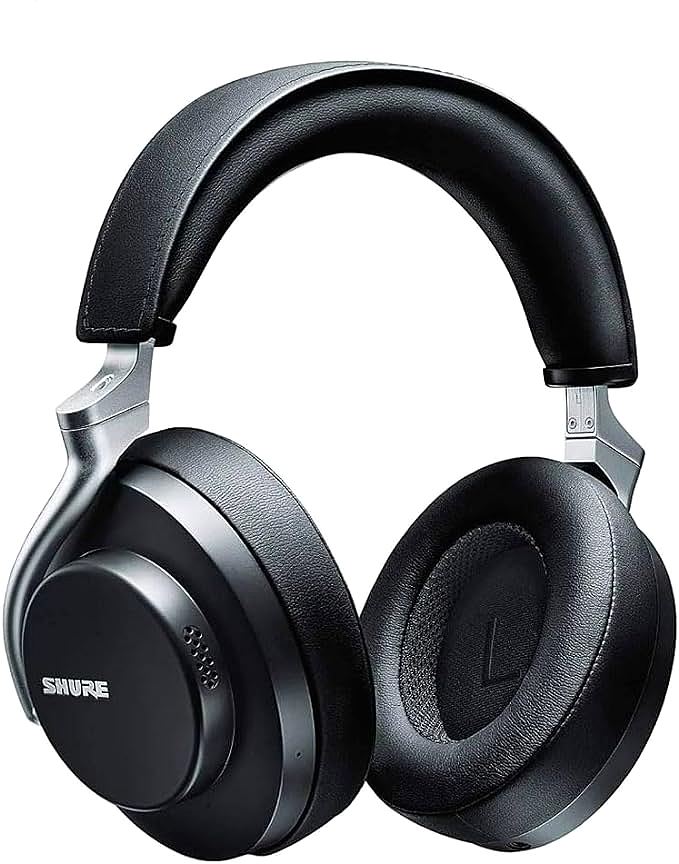
Shure AONIC 50 Gen 1: Adaptive ANC, 46-Hour Battery, and Studio-Grade Acousti...
The Invisible Symphony: How Driver Size Shapes Your Audio Experience

How Audio Frequency Response Shapes Your Bluetooth...

Why Earbuds Sound Terrible on Calls: The Physics of ENC