Open-Ear Audio Physics: Why Bass Limitations Are Physics, Not Design Flaws

WPOW Open Ear Headphones
You take off your in-ear headphones and put on open-ear devices for a morning run. The music starts, your ears feel lighter, you can hear traffic and birds. Then you notice the bass is gone. Or nearly gone. Your first instinct is that something is wrong with the headphones, or that you bought a low-quality product.
Nothing is wrong. The missing bass is not a defect. It is the predictable result of acoustic physics operating on sound waves in an unsealed environment.
Every open-ear headphone on the market shares this limitation. The difference between a $30 model and a $300 model is not whether bass disappears. The difference is how well the engineer works within the physical constraints that prevent bass from reaching your eardrum in the first place.
Understanding why bass roll-off happens changes how you evaluate these products. It also reveals what open-ear design actually optimizes for, and who benefits most from that optimization.
The Physics of Bass Loss in Open Designs
Sound moves through air as pressure variations. A low bass note at 100 hertz has a wavelength of roughly 3.4 meters. A treble note at 4000 hertz measures about 8.5 centimeters per cycle. This scale difference determines everything about how these frequencies interact with your anatomy and with open space.
In-ear headphones place the driver inside the ear canal, creating a sealed chamber between the driver and the eardrum. That chamber is typically 2 to 3 centimeters deep. Bass waves cannot escape backward or sideways. They compress against the eardrum. Pressure builds. You feel the bass.
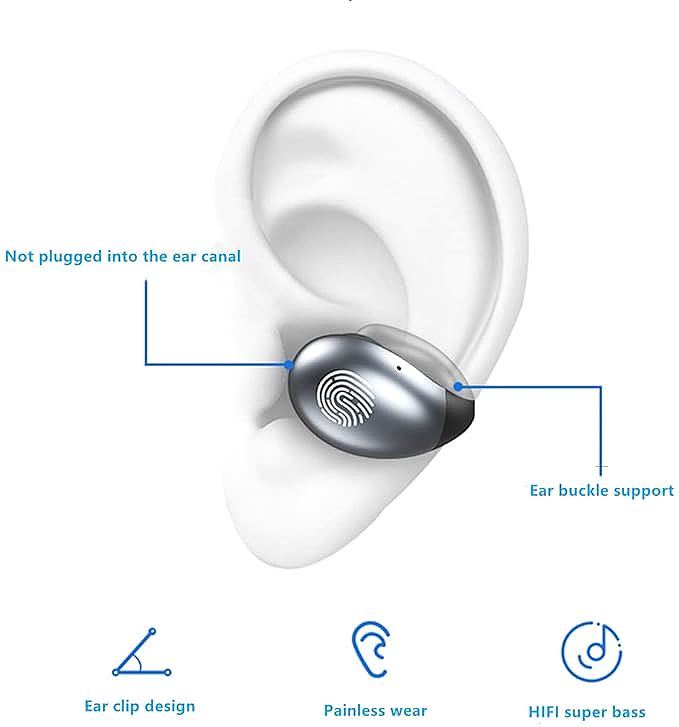
Open-ear headphones remove the seal entirely. The driver sits 2 to 4 millimeters outside the ear canal opening. Bass waves radiate outward in all directions from that point. They obey the inverse-square law: double the distance from the source and the acoustic intensity drops to one-quarter. Most of the low-frequency energy never enters the ear canal. It spreads into the surrounding air and dissipates.
The ear canal itself acts as a resonant tube. Biological acoustics research shows it naturally amplifies frequencies between 2000 and 5000 hertz by roughly 10 to 15 decibels. This resonance requires the canal to function as a closed tube terminated by the eardrum. When sound arrives from outside the canal rather than traveling down it from a sealed driver, that amplification effect disappears.
Digital equalization cannot recover what physics removes. An EQ boost raises the electrical signal sent to the driver, but it cannot create the missing pressure coupling. The bass waves still radiate outward. They still lose energy according to the inverse-square law. No software adjustment changes the fundamental acoustic behavior of an unsealed driver in open air.
This constraint applies uniformly across the category. A premium open-ear model priced at $250 does not produce more bass than a budget model at $30. Both face the same physical barrier. The difference lies in how cleanly each reproduces the frequencies it can reach, and how effectively it directs mid and high frequencies toward the ear canal.
Air Conduction and Bone Conduction Share the Same Limitation
Two technologies deliver audio without inserting material into the ear canal: air conduction and bone conduction. Both bypass the traditional in-ear seal, yet both produce reduced bass compared to sealed designs.
Air conduction sends sound waves through the atmosphere toward the ear. The driver vibrates air molecules, creating pressure waves that travel across the pinna, enter the ear canal from the exterior, and vibrate the eardrum. The inner ear receives the signal through the standard biological pathway. The only difference from in-ear headphones is the entry point. Sound originates outside the canal rather than inside it.
Bone conduction takes a completely separate route. A transducer presses against the temporal bone or cheekbone, vibrating the skull directly. Those vibrations travel through bone tissue to the cochlea, bypassing the eardrum and ossicles entirely. The cochlea detects mechanical oscillations and converts them into neural signals. Sound reaches the auditory nerve without passing through the middle ear.
Both approaches share the same fundamental limitation: neither creates a sealed acoustic environment. Air conduction loses bass because waves radiate freely into open space. Bone conduction loses bass because skull bones transmit low-frequency mechanical energy inefficiently. The cochlea responds better to fluid-borne pressure waves than to direct bone vibration at low frequencies. The result across both technologies is reduced low-end output compared to sealed in-ear designs.
The gap between driver and ear canal represents a critical engineering parameter in air conduction devices. At 2 to 4 millimeters, the driver produces a roughly spherical wavefront. Only the narrow cone aimed directly at the ear canal contributes to perceived sound. The remainder scatters. Premium designs invest in directional driver arrays and acoustic waveguides to concentrate energy toward the ear, but even advanced implementations cannot overcome the physics of open propagation.
Environmental Awareness as Measurable Safety
Open-ear design preserves both ears as acoustic receivers for the surrounding environment. This capability has quantifiable implications for outdoor safety, extending well beyond the marketing phrase ambient sound awareness.
Human spatial hearing relies on binaural processing. The brain compares microsecond timing differences, decibel intensity differences, and spectral filtering effects between the two ears to compute sound direction. This system operates continuously and unconsciously. When sealed earbuds or over-ear headphones block one or both ears, spatial processing degrades. A vehicle approaching from behind becomes harder to locate. Footsteps on an unfamiliar path lose directional specificity.
Research examining incident rates among cyclists found that those using earbuds which occluded the ear canal experienced higher collision and near-miss rates than non-users. The increased risk correlated with reduced environmental auditory input, not with distraction from audio content. The mechanism is straightforward: when you cannot hear approaching traffic, you cannot react to it in time.
Open-ear headphones maintain dual-channel auditory input. Both ears receive environmental sound simultaneously with whatever audio the device plays. The brain continues computing spatial cues without interruption. A siren, a cyclist bell, a car door opening, a pedestrian warning: all remain audible without removing the device.
The safety value scales with environment complexity. A runner on a paved trail with minimal traffic gains less from ambient awareness than a cyclist navigating mixed-speed roadways. A pedestrian walking through a busy intersection benefits significantly from hearing horns, footsteps, and verbal cues. The open-ear design functions as a genuine safety instrument in dynamic outdoor settings, not merely a comfort feature.

Why Open-Ear Devices Cannot Implement Active Noise Cancellation
Product specifications for open-ear headphones frequently list Active Noise Cancellation as a feature. This label is technically inaccurate for the open-ear form factor, and the confusion it creates affects purchasing decisions across the category.
Active Noise Cancellation operates through destructive interference. Microphones detect incoming ambient sound waves. The processor analyzes their waveform and generates an inverted copy in real time. The driver plays this anti-phase signal alongside the audio content. Where the noise wave peaks, the anti-noise wave troughs. Where the noise wave troughs, the anti-noise wave peaks. The superposition produces near-zero pressure variation at the eardrum. The listener perceives silence where noise previously existed.
This process requires a sealed acoustic chamber. The anti-noise wave must remain trapped between the driver and the eardrum long enough to interfere with incoming noise. Without a seal, the anti-noise wave escapes into the environment just as readily as the music signal. It never accumulates the pressure differential needed at the eardrum to produce cancellation. ANC in an open-ear design is physically impossible. The mathematics of wave interference do not permit it.
What open-ear devices actually provide is Environmental Noise Cancellation, abbreviated ENC. ENC serves an entirely different purpose. It targets call quality, not listening experience. Microphone arrays detect ambient noise during phone calls. Digital signal processing isolates the human voice frequency range and suppresses background sounds before transmitting the audio to the remote party. The person on the other end hears a cleaner voice. The wearer experiences no noise reduction.
Product marketing often conflates these terms. Reading specification sheets carefully reveals the distinction. ANC targets the listener experience. ENC targets the caller experience. An open-ear device advertising ANC should prompt questions about whether the specification refers to true active noise cancellation or merely environmental noise reduction for calls mislabeled for consumer appeal.
Comfort Through Weight Distribution Geometry
Open-ear headphones eliminate ear canal pressure by relocating all contact points to the outer ear. The mechanical consequence is measurable and significant for extended wear sessions.
In-ear headphones apply concentrated force inside the ear canal. Silicone or foam tips expand against canal walls, creating circumferential pressure that increases with insertion depth and tip hardness. The contact area is small. Pressure equals force divided by area. Even modest total weight becomes uncomfortable when concentrated on a tiny surface.
Open-ear headphones distribute mass across the helix and antihelix, the curved outer cartilage structures designed by evolution to support light mechanical load. The contact area is larger. The pressure per unit area is lower. A 94-gram open-ear pair spread across both sides of the head produces negligible fatigue over several hours. The same mass concentrated inside two ear canals would create significant discomfort within one to two hours.
The difference is not total weight. It is contact geometry. A pair of over-ear headphones may weigh 250 grams and feel comfortable because the headband and cushions distribute load across the skull and cheeks. A pair of in-ear monitors may weigh 8 grams and feel painful because that weight presses into a narrow canal. Weight matters less than distribution.
User feedback consistently supports this analysis. Across verified reviews for popular open-ear models, the dominant comfort descriptor is the sensation of forgetting the device is worn. This outcome traces directly to the absence of canal pressure, not to absolute weight. Users report removing in-ear headphones after two hours due to soreness. The same users wear open-ear designs for six-hour sessions with minimal discomfort.
Bluetooth Range and Structural Obstruction
Wireless range specifications state 30 feet for Bluetooth Class 2 devices under ideal conditions. Real-world performance often falls short, particularly for open-ear designs with unique structural geometry.
Many open-ear models achieve approximately 15 feet of reliable connectivity, half the advertised standard range. This reduction traces to antenna obstruction, not to inferior Bluetooth hardware. The curved arm geometry that positions the driver near the ear canal also places conductive and dielectric material between the antenna and open space. Metal housings attenuate radio frequency signals. Plastic housings cause reflection and refraction. The antenna, embedded within this structure, experiences measurable signal loss.
This is a geometric constraint inherent to the open-ear form factor, not a manufacturing defect. Designs that route the antenna away from obstructing materials can achieve closer to specification, but the trade-off between driver placement and antenna clearance remains built into the architecture.
Body position affects range noticeably. Carrying the phone in a front pocket, closer to the head-mounted device, maintains connectivity better than a back pocket position. Obstructions between the phone and headphones, including body mass, degrade signal strength. These are predictable physical effects, not random failures.
Matching Architecture to Use Case
The decision between open-ear and in-ear architectures depends on primary use context, not on absolute audio quality metrics. Each design makes explicit trade-offs that favor different scenarios.
In-ear headphones seal the ear canal. That seal traps acoustic energy, reinforcing bass and blocking ambient noise. The result is superior frequency response for music consumption, particularly genres dependent on low-end content. The cost is environmental isolation and potential comfort degradation during extended sessions. In-ear designs serve focused listening, studio monitoring, and noise-sensitive environments.
Open-ear headphones abandon the seal. That abandonment eliminates bass reinforcement and ambient noise isolation. The gain is full environmental awareness and pressure-free comfort suitable for all-day wear. Music reproduction emphasizes mid and high frequencies, adequate for speech and most vocal-centric content. Open-ear designs serve outdoor activity, collaborative workspaces, and users with canal sensitivity.
Some users adopt a hybrid strategy, maintaining both forms for different contexts. In-ears for home listening and commuting. Open-ears for running, cycling, and office use. This approach acknowledges that no single architecture optimizes every scenario.
The Engineering Trade-Off Made Explicit
Open-ear headphones represent a transparent engineering bargain. You accept reduced bass and no noise isolation in exchange for environmental awareness and pressure-free comfort. The bass limitation is not a flaw requiring correction. It is the physical cost of the chosen architecture, governed by the same acoustic laws that constrain every open-ear product manufactured.
When you notice the absence of sub-bass in open-ear headphones, you are observing the inverse-square law and the lack of pressure coupling in action. The physics are consistent. The outcome is predictable. Honest engineering designs around constraints and communicates trade-offs clearly rather than masking them with marketing language.
Understanding what open-ear technology can and cannot do allows intentional selection. The bass you do not hear is not missing. It is where acoustic physics placed it.
WPOW Open Ear Headphones
Related Essays

The Open-Ear Dilemma: Air Conduction vs. Bone Conduction Explained

ORANPID P-Q1: Experience Open-Ear Freedom with Air Conduction Headphones

Open-Ear Headphones for Running and Cycling: How Situational Audio Keeps You

Beyond the Eardrum: The Hidden Physics of Bone Conduction

Taiyoko dg08 Bone Conduction Wireless Headphones - Your Perfect Open Ear Companion for Sports

Padmate S26 Open-Ear Air Conduction Headphones: Understanding Sound Transmission Physics

Bone Conduction Headphones: Open-Ear Audio for Safety and Awareness

Air Conduction Audio: Why Open-Ear Headphones Change Everything

Architecting Transparency: Air Conduction and Spatial Awareness in Wearable Audio
