Why Bluetooth Dies Underwater and Bone Conduction Thrives

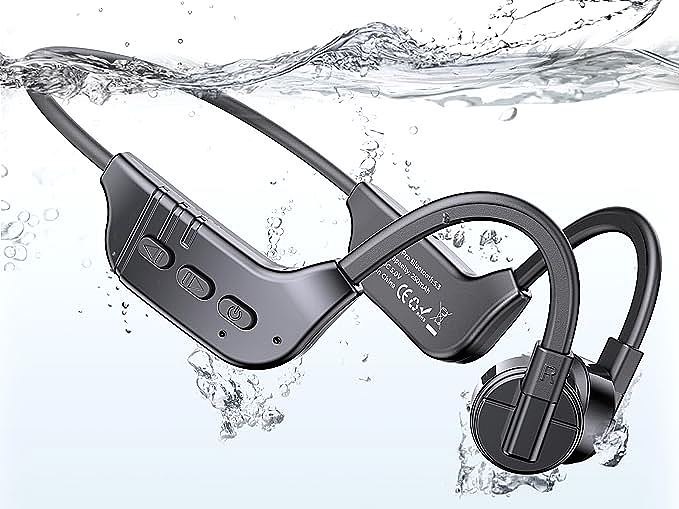
PSIER Bone Conduction Headphones IPX8 Waterproof Swimming Headphones
Your playlist stops three seconds after you dive in. The Bluetooth connection that worked perfectly on the pool deck vanishes the moment water touches the antenna. You surface, it reconnects. You dive, it drops again. This is not a defect. This is physics.
Every swimmer who has tried wireless earbuds in a pool has lived this loop. The signal cuts out, the music dies, and the frustration builds. The common assumption is that the earbuds are faulty or the Bluetooth version is too old. But the real explanation has nothing to do with product quality and everything to do with how electromagnetic waves behave when they meet water.

The Invisible Wall: How Water Kills Radio Signals
Bluetooth operates at 2.4 GHz, a frequency band that sits comfortably in the microwave region of the electromagnetic spectrum. In air, a 2.4 GHz signal can travel tens of meters without significant loss. Underwater, that same signal barely penetrates a few centimeters.
The mechanism is dielectric loss. Water molecules are polar, meaning they carry a positive charge on one end and a negative charge on the other. When an electromagnetic wave passes through water, its oscillating electric field forces these polar molecules to rotate in response. That rotation converts electromagnetic energy into thermal energy. The signal does not bounce off the water. It gets absorbed, molecule by molecule, turned into heat too small to feel but large enough to silence your music.
The numbers are stark. In freshwater, which has a conductivity of approximately 0.01 siemens per meter, a 2.4 GHz signal loses between 11 and 110 decibels per meter. In seawater, with a conductivity of roughly 4 siemens per meter, the loss jumps to between 110 and 1100 decibels per meter. For context, a loss of just 3 decibels cuts signal power in half. At 110 decibels of attenuation per meter, the signal is effectively gone within millimeters.
This is not a problem that a better antenna or a newer Bluetooth version can solve. The physics of water itself is the barrier.
Sound Travels Differently Through Different Worlds
Here is where the story takes a turn that most people never consider. While water destroys electromagnetic signals, it dramatically enhances mechanical ones.
Sound is a mechanical wave. It propagates through the vibration of molecules in a medium. The efficiency of that propagation depends on the density and elasticity of the medium. Air, with a density of 1.2 kilograms per cubic meter, allows sound to travel at 343 meters per second. Water, with a density of 1000 kilograms per cubic meter, carries sound at 1480 meters per second. Bone, at roughly 1900 kilograms per cubic meter, transmits sound at approximately 3600 meters per second.
Water is roughly 800 times denser than air. That density gives mechanical vibrations a far more efficient transmission pathway. This is why you can hear someone knocking on the hull of a boat from far more clearly underwater than you could hear them shouting through air. The medium that kills radio is, paradoxically, the medium that amplifies vibration.

Bypassing the Ear Canal Entirely
Bone conduction exploits this paradox. Instead of sending sound waves through the air into your ear canal, a bone conduction transducer presses against your cheekbone or skull and delivers mechanical vibrations directly through bone to the cochlea, the spiral-shaped organ in your inner ear that converts vibration into neural signals.
The traditional hearing pathway works like this: sound waves enter the ear canal, vibrate the eardrum, which oscillates three tiny bones called ossicles, which then transfer that vibration to the fluid inside the cochlea. Bone conduction skips the first three steps. The vibration goes straight from skull to cochlea.
This is not a new invention. Ludwig van Beethoven, nearly deaf in his later years, discovered he could hear music by clenching a rod attached to his piano between his teeth. The vibrations traveled through his jawbone directly to his inner ear, bypassing his damaged eardrum and ossicles entirely. The principle has been understood for over two centuries. What has changed is the miniaturization of transducers that can deliver those vibrations precisely and comfortably.
Underwater, this pathway becomes even more effective. The water surrounding your head couples with the transducer and the skull, creating a denser transmission path than air alone. The vibration does not need to compete with air gaps or loose fittings. Water fills every contour, providing continuous contact between the transducer surface and the bone beneath the skin.
The IP Certification Puzzle
If you have shopped for waterproof headphones, you have encountered the IP rating system. The two most common ratings for swimming-capable devices are IPX8 and IP68, and the difference between them is widely misunderstood.
IP stands for Ingress Protection, a standard defined by the International Electrotechnical Commission. The first digit rates protection against solid particles like dust. The second digit rates protection against water. An IP68 rating means level 6 dust protection, which is complete sealing against dust ingress, combined with level 8 water protection, which means the device can withstand continuous submersion under conditions defined by the manufacturer. An IPX8 rating means the dust test was not performed, represented by the X, but the water protection is also level 8.
The critical detail is that the level 8 water test is not standardized. According to the GB/T 4208-2017 standard, which aligns with IEC 60529, the conditions for IPX8 testing are negotiated between the manufacturer and the testing laboratory. One company might test at 1 meter for 30 minutes. Another might test at 3 meters for 1 hour. Both can legally print IPX8 on their packaging.
This means IP68 does not necessarily offer better waterproofing than IPX8. It offers the same water protection plus dust protection. For swimming, where dust is not a concern, IPX8 is sufficient. Paying more for IP68 in a swimming context is paying for a feature you will never use.
There is a further caveat. Even with a valid IPX8 or IP68 rating, manufacturers often exclude water damage from warranty coverage. The certification confirms the device passed a controlled laboratory test. It does not guarantee performance under the dynamic, high-pressure, chlorinated, or saltwater conditions of actual swimming.

Why MP3 Mode Is Engineering, Not Compromise
When recording studios first started experimenting with waterproof audio equipment, they encountered the same Bluetooth limitation that swimmers face. The solution was not to fight the physics but to work around it. Store the audio files locally on the device and play them back without any wireless signal.
This is the MP3 mode found in swimming-oriented bone conduction headphones. Devices like the Shokz OpenSwim use built-in flash storage to hold music files, then play them through bone conduction transducers with zero reliance on wireless communication. Some models offer both Bluetooth and MP3 modes, but underwater, only the MP3 mode functions.
The absence of Bluetooth in a swimming headphone is not a feature that was cut to save cost. It is a design decision rooted in physical reality. Bluetooth cannot work underwater. Building a Bluetooth radio into a device that will spend its operating hours submerged adds weight, cost, and complexity for a feature that will never function during use. A device that carries only MP3 mode is not a lesser product. That simplicity is a strength, not a limitation.
Every swimming-capable headphone on the market that actually works underwater relies on local storage. Bluetooth-only models carry IPX8 or IP68 ratings, but without MP3 mode, they cannot deliver audio once submerged. The certification protects the hardware. It does not solve the signal problem.
Freshwater Versus Saltwater: Two Different Enemies
The type of water matters more than most swimmers realize. Freshwater has a conductivity of approximately 0.01 siemens per meter. Seawater sits around 4 siemens per meter, roughly 400 times more conductive. Higher conductivity means faster attenuation of electromagnetic signals and greater electrochemical stress on exposed metals and seals.
Chlorinated pool water falls somewhere between the two, with the added concern that chlorine accelerates the degradation of rubber seals and silicone gaskets. Saltwater introduces chloride ions that corrode metal contacts and can compromise waterproof seals over time. A few devices are explicitly rated for saltwater compatibility, a specification that required additional sealing and material selection beyond what standard IPX8 testing demands.
For bone conduction specifically, the medium changes the coupling efficiency. Sound travels faster in saltwater than in freshwater due to the higher density and salinity, which slightly improves the mechanical transmission path. But the improvement is marginal compared to the much larger gap between air and water transmission.
The Paradox of Constraint
There is a broader lesson here about how engineering constraints shape design. The inability of Bluetooth to function underwater is not a failure of wireless technology. It is a predictable consequence of the interaction between electromagnetic waves and polar molecules. The response, building devices that store audio locally and transmit through bone, is not a workaround. It is a different solution shaped by a different set of physical realities.
When the environment changes, the optimal design changes with it. What works on dry land, where air is the transmission medium and line-of-sight radio communication is trivial, does not work underwater, where water absorbs radio energy but carries vibration with extraordinary efficiency. The best tool for the job depends on the job, not on the label on the box.
The next time you see a swimming headphone advertised without Bluetooth, consider what that absence means. It means the engineers understood the problem. They chose not to include a feature that would fail the moment you needed it most. In engineering, knowing what to leave out is as hard as knowing what to put in.
PSIER Bone Conduction Headphones IPX8 Waterproof Swimming Headphones
Related Essays

Why Headphones Stop Working Underwater: Sound, Water, and...

Bone Conduction Underwater: How Sound Bypasses the Bluetooth Barrier

The Physics of the Pool: Decoding RF Attenuation and Hydrodynamic Acoustics in the Relxhome X7S
Beyond Bluetooth: The Science of Why Swimming Headphones Need an MP3 Player

ZHYH Sport Headphones: A Splash-Proof Bargain for Underwater Audio

Xmenha ZXY-DEJX802-Violett Wireless Headset Clip On Open Ear Earbuds Bone Conduction Head Set Workout Cycling Running Work Headphone

Aftershokz Aeropex (Rebranded as Shokz OpenRun) - Open-Ear Bluetooth Bone Conduction Sport Headphones

Drecolotvte DR2023K9A Bone Conduction Headphones – Recommended Choice

NC Bone Conduction Wireless Bluetooth Sports Running and Cycling Headset – Lightweight Design for Comfortable Movement
