Dual Microphone Beamforming in Budget Earbuds: Call Quality and Array Design

Belkin AUC004btBL SoundForm Rise True Wireless EarBuds
You are on a video call. The coffee grinder roars behind you. This is the exact scenario where beamforming microphone earbuds prove their worth -- and why the difference between a $30 and a $300 pair of earbuds comes down to how they handle your voice, not your music. Your colleague asks you to repeat yourself for the third time. You grip the earbud, speak louder, and the noise only gets worse. This is not a volume problem. It is an architecture problem. The tiny microphones inside your earbuds were never designed to separate your voice from the world around you -- at least, not without help from a second microphone and the physics of wave interference.
Most people shopping for wireless earbuds under fifty dollars check three things: battery life, sound quality, and water resistance. Call quality sits somewhere near the bottom of the checklist, if it appears at all. Yet for the growing population of remote workers spending hours each day on voice and video calls, microphone performance is the feature that matters most -- and the one most often neglected by manufacturers competing on audio specs and battery numbers.
Why Single Microphones Struggle with Background Noise
A single microphone captures everything. Your voice, the air conditioner, the dog barking two rooms away -- all of it arrives at the same diaphragm, gets converted into the same electrical signal, and travels down the same pipeline to the person on the other end. The digital signal processor inside the earbud can attempt to filter out noise after the fact, but it faces an impossible task: it cannot reliably distinguish your vocal frequencies from ambient frequencies that overlap the same range.
The technical term for this is single-channel noise suppression. It works reasonably well in quiet environments, where the noise floor sits below 40 decibels and your voice dominates the signal by a wide margin. In a typical office, this is adequate. In a coffee shop humming at 65 decibels, or on a windy street pushing 70 decibels and above, single-mic systems begin to collapse. The DSP either removes too much, making your voice sound robotic and hollow, or removes too little, leaving the caller drowning in ambient sound.
This is not a software problem that can be patched. It is a fundamental limitation of having only one information source. With one microphone, the system has no spatial reference. It cannot tell where sound is coming from. It cannot point itself at your mouth and ignore the rest. It is like trying to find a specific person in a crowd while blindfolded -- you can hear them, but you cannot separate them from the noise around them.

How Beamforming Uses Two Microphones to Create Directional Hearing
Beamforming solves the spatial problem by adding a second microphone. In beamforming microphone earbuds, this approach creates a directional listening pattern that isolates your voice from surrounding noise. The principle draws from wave interference physics: when two microphones are placed a specific distance apart, sounds arriving from different directions reach them at slightly different times. Your voice, coming from the direction of your mouth, hits the primary microphone a fraction of a millisecond before it reaches the secondary one. Background noise, arriving from other angles, hits both microphones with different timing patterns.
The DSP inside the earbud compares these two signals. By analyzing the phase difference -- the tiny time offset between what each microphone hears -- the processor can construct a directional pickup pattern. Think of it as an invisible cone of sensitivity pointing toward your mouth. Sounds inside the cone are amplified. Sounds outside the cone are attenuated. The technical name for this is phase cancellation: the secondary microphone captures a noise reference, and the DSP subtracts that noise from the primary signal.
This is not theoretical. Dual-microphone beamforming -- the core technology behind beamforming microphone earbuds -- is the same principle used in hearing aids, conference room speakerphones, and military communications headsets. The difference is that those systems have large housings with carefully engineered microphone spacing, while true wireless earbuds must cram everything into a shell the size of a jellybean. The spacing between the two microphones in a TWS earbud might be only 8 to 15 millimeters. This constraint limits how low a frequency the beamformer can effectively steer -- longer wavelengths at low frequencies require wider microphone spacing for effective cancellation. That is why even dual-mic earbuds still struggle with low-frequency rumble from air conditioners and traffic.
MEMS Microphones: The Tiny Components That Make This Possible
The microphones inside modern wireless earbuds are not the condenser capsules found in studio microphones. They are MEMS devices -- Micro-Electro-Mechanical Systems -- built on silicon wafers using the same photolithography processes that manufacture computer chips. A MEMS microphone contains a microscopic diaphragm etched into silicon, suspended over a backplate. Sound pressure moves the diaphragm, changing the capacitance between the diaphragm and backplate, and an integrated amplifier converts this into a digital signal.
MEMS microphones offer several advantages for earbuds. Their small size and low cost make beamforming microphone earbuds economically viable even at the budget end of the market, where margins are typically thin. They are tiny -- typically 3 to 4 millimeters per side. They are consistent -- manufacturing tolerances are tighter than conventional microphones, which means the two microphones in a beamforming pair are closely matched in sensitivity and frequency response. This matching matters: if one microphone is louder than the other, the phase cancellation calculation produces artifacts instead of clean voice.
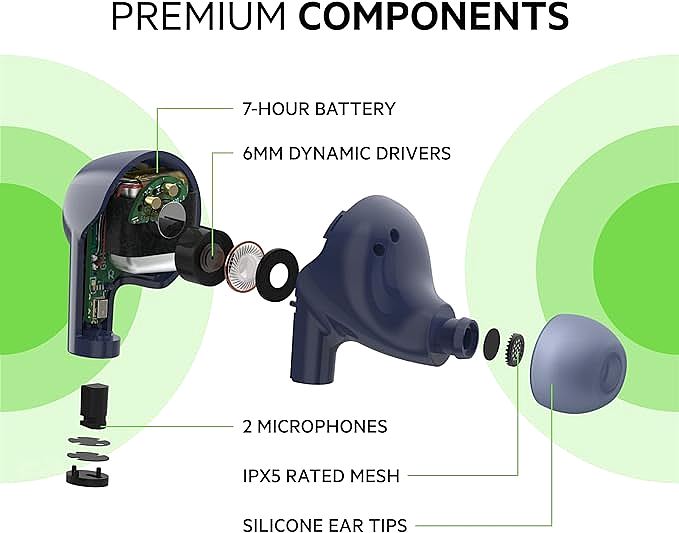
They are also cheap. The bill of materials for a single MEMS microphone is under one dollar at volume. This is why dual-microphone configurations have migrated from premium products down to the sub-fifty-dollar segment. The Belkin SoundForm Rise, priced at $39.99, carries dual MEMS microphones with beamforming in each earbud -- a configuration that would have been exclusive to products three times its price just a few years ago.
Why Mic Spacing and Housing Design Matter More Than Mic Count
Here is the insight that most marketing materials omit: two microphones do not automatically produce better call quality. The effectiveness of beamforming depends on three physical parameters that have nothing to do with the microphone count printed on the box.
First, microphone spacing. The distance between the two microphones determines the lowest frequency the beamformer can steer. Wider spacing enables cancellation of lower frequencies. In a compact earbud, the spacing is constrained by the housing size, which means low-frequency noise cancellation is inherently limited regardless of how sophisticated the DSP algorithm is.
Second, microphone placement relative to the mouth. The primary microphone needs a clear acoustic path to the user's voice. If it is positioned on the inner face of the earbud, tucked against the concha of the ear, it receives voice signal that has bounced off the ear and lost high-frequency content. If it is on a stem or protruding surface, it captures more direct voice energy. This is why earbuds with microphone stems -- like the AirPods form factor -- tend to outperform flush-fit designs for call quality, all else being equal.
Third, acoustic port design. MEMS microphones have a small port that admits sound. The size, shape, and placement of this port affect the microphone's frequency response and its susceptibility to wind noise. A poorly designed port can create turbulence that generates its own noise, overwhelming the beamforming algorithm. Wind noise is the Achilles heel of all budget earbuds, and dual-mic systems with dedicated wind reduction algorithms perform measurably better than those without.
The implication is straightforward: when comparing earbuds for call quality, the number of microphones tells you less than the physical design of the earbud itself. The presence of beamforming microphone earbuds in a product lineup signals that the manufacturer prioritizes call performance over spec-sheet competition. A well-engineered single-mic system with a good acoustic port and effective noise suppression can outperform a poorly spaced dual-mic system. The Belkin SoundForm Rise benefits from a housing design that positions its dual MEMS microphones with enough spacing to enable effective beamforming in the mid-frequency range where human voice carries most information -- roughly 300Hz to 3kHz.
Three Scenarios That Reveal Real Call Quality
Laboratory measurements tell part of the story. Real-world performance tells the rest. Call quality behaves differently across three common environments, and understanding these differences provides a practical framework for evaluating any earbud.
In a quiet office at 40 decibels, most budget earbuds perform adequately. Even basic beamforming microphone earbuds can separate your voice from the ambient hum of HVAC systems and distant conversations without noticeable latency. The noise floor is low enough that even single-microphone systems can produce intelligible voice. The differentiator here is comfort and battery life, not microphone architecture. If your primary calling environment is a quiet room, spending extra on beamforming provides diminishing returns.
In a coffee shop or coworking space at 65 decibels, the picture changes. Ambient conversation, espresso machines, and background music create a noise spectrum that overlaps heavily with human speech frequencies. Single-mic systems begin to produce noticeable artifacts as the DSP works harder to separate voice from noise. Dual-mic beamforming provides a measurable advantage here: the directional pickup pattern rejects off-axis sound, and the phase cancellation removes a significant portion of the ambient noise before the DSP has to work on what remains. User reviews of dual-mic earbuds consistently report that callers on the other end notice clearer voice in this environment.
Outdoors on a windy street at 70 decibels and above, all budget earbuds struggle. Wind creates broadband turbulence that hits the microphone ports directly, producing low-frequency rumble and mid-frequency artifacts that overwhelm both single-mic and dual-mic systems. Dual-mic earbuds with wind detection algorithms -- which temporarily reduce sensitivity on the secondary microphone when wind is detected -- perform slightly better, but no sub-fifty-dollar earbud delivers clean voice in sustained wind. This is a physics problem, not a price problem. The solution requires either a windscreen or a boom microphone, both of which defeat the purpose of a compact true wireless design.
The Signal Processing Layer: What Happens After the Microphones
Beamforming is only the first stage of noise management. Inside beamforming microphone earbuds, the processed signal moves through additional layers that further refine voice isolation before reaching your call partner. After the dual-microphone array creates a directional signal, the DSP applies additional processing. The most common algorithm in budget earbuds is Qualcomm's cVc (Clear Voice Capture), now in version 8.0. cVc operates on the beamformed output, applying spectral subtraction to remove residual noise, automatic gain control to maintain consistent voice volume, and comfort noise generation to mask artifacts.
The interaction between beamforming and cVc is important. Beamforming reduces the noise before cVc processes the signal, which means cVc has less noise to remove and introduces fewer artifacts. This is the real advantage of the dual-mic approach: it is not that beamforming alone produces clean voice, but that it reduces the workload on the downstream processing, resulting in a cleaner final signal.
Some manufacturers add a third layer: AI-based noise reduction. Anker's Life P3, for example, uses a neural network trained on voice and noise samples to further separate speech from background sound. This can improve performance in challenging environments, but it also introduces latency and can produce unnatural-sounding voice when the model makes errors. At the budget price point, the quality of AI noise reduction varies significantly between implementations.
The codec -- SBC or AAC -- operates at a different layer entirely. Beamforming and noise processing happen before the audio signal is encoded for Bluetooth transmission. Whether your earbud uses SBC or AAC does not affect how well the microphones capture and process your voice. It does affect how the processed voice sounds to the person on the other end after transmission, but the difference is subtle compared to the impact of microphone architecture and noise processing.
What Verified User Data Reveals About Budget Call Quality
Customer reviews provide a ground truth that laboratory measurements cannot. Across 1,200-plus online ratings for the SoundForm Rise, call quality emerges as a consistent positive theme, with multiple verified purchasers reporting that callers describe their voice as clear even in moderately noisy environments. This aligns with what the dual-mic beamforming architecture predicts: directional pickup provides a tangible benefit that the person wearing the earbuds cannot directly perceive but the person on the other end can.
The same review corpus reveals three recurring complaints that illustrate the tradeoffs inherent in budget earbud design. Battery life falls short of the claimed 7 hours per charge, with most users reporting 4 to 5 hours of actual use. This is consistent with industry-wide overstatement of battery performance, which is typically measured at 50 percent volume with no active features engaged. Real-world use at higher volumes with continuous Bluetooth and microphone operation draws significantly more power.
Connectivity dropouts, particularly when the phone is in a pocket on the opposite side from the active earbud, point to Bluetooth 5.0's limitations with body-area signal propagation. The human body absorbs 2.4GHz radio energy, and the small antenna inside an earbud has limited transmission power. This is not unique to any single product -- it is a constraint of the form factor.
Fit issues reported by users with smaller ears highlight another underappreciated factor in call quality: acoustic seal. A loose earbud not only leaks bass response but also changes the acoustic path between the mouth and the microphone. When the earbud shifts position, the beamforming algorithm's assumed direction to the mouth becomes inaccurate, reducing the effectiveness of directional pickup. Fit is not just a comfort issue. It is a call quality issue.
A Practical Framework for Evaluating Earbud Call Quality
When shopping for beamforming microphone earbuds, look beyond the microphone count advertised on the packaging. The physical arrangement, the MEMS sensor quality, and the DSP algorithm working behind the scenes matter far more than whether a product claims two, three, or four microphones.
Instead of relying on manufacturer claims or review scores, remote workers can evaluate call quality using a simple three-step method that accounts for their specific environment.
Identify your primary calling environment. If it is a quiet home office, almost any earbud with a MEMS microphone will suffice. If it is a shared workspace or coffee shop, prioritize dual-mic beamforming. If it is outdoors, accept that no budget earbud will deliver consistently clean voice and consider a headset with a boom microphone instead.
Test with a real call, not a voice memo. Voice memo recordings bypass the Bluetooth transmission chain and do not reflect the codec compression and network conditions that affect live calls. Call a friend or colleague, ask them to describe your voice quality, and have them evaluate you in both quiet and noisy conditions.
Check the fit. If the earbud moves when you talk or turn your head, the beamforming direction is shifting. Try different ear tip sizes until you find a seal that holds the earbud stable. This single adjustment can improve call quality more than switching to a more expensive product.
The Engineering Philosophy of Constraint
Every constraint forces a design choice. In beamforming microphone earbuds, the tight space inside an earbud case means engineers must choose MEMS sensors over larger alternatives, pair them with careful spacing rather than adding more microphones, and rely on signal processing to do the heavy lifting that hardware alone cannot achieve.
Budget wireless earbuds exist at the intersection of competing constraints. Size limits microphone spacing. Price limits DSP capability. Battery limits processing power. The manufacturers that produce the best call quality at this price point are not the ones that add the most features. They are the ones that make the fewest compromises on the features that matter for voice.
Dual-mic beamforming is not a premium feature. It is a physics-based solution to a physics problem, enabled by the falling cost of MEMS silicon and the increasing efficiency of DSP algorithms. As this technology continues to migrate downward in price, the real differentiator will shift from whether an earbud has beamforming to how well its physical design supports the beamforming algorithm -- the spacing, the placement, the acoustic porting, the fit.
The next time you struggle to be heard on a call, the problem is not that you need to speak louder. The problem is that your earbuds are listening to everything equally. Good call quality is not about adding more microphones. It is about giving the microphones you have the geometry and the processing they need to point at your voice and ignore the world behind it.
Belkin AUC004btBL SoundForm Rise True Wireless EarBuds
Related Essays

How ENC Earbuds Actually Work: Beamforming, DNN, and AI Noise Cancellation Explained

Why Earbuds Sound Terrible on Calls: The Physics of ENC

Why Your Noise-Cancelling Earbuds Still Let Sound In

The Mechanics of Clarity: ENC Beamforming and Driver Physics

Beyond the Spec Sheet: The Engineering Behind Reliable Sport Audio and Clear Communication

The Physics of Clarity: Deconstructing Quad-Mic Beamforming and Energy Density in TWS Audio

The Unseen Science of Belonging: How an AI Owl Is Fixing Our Broken Hybrid Meetings

JBL Tour Pro 2: Hear the Future with Smart Earbuds

NUU U30 Buds B Wireless Earbuds - Great Noise Cancelling Earbuds for Outdoor Activities
