Passive Noise Isolation: How a Silicone Seal Outsmarts...


Sony MDR-EX15LP In-Ear Headphones
You plug in a pair of earbuds, press play, and the subway car is still right there. The rumble, the conversation three seats away, the screech of steel on steel. Your music sounds like it is playing from the bottom of a swimming pool. You turn the volume up. Now you have two problems: the noise is still there, and your hearing is taking damage.
This is not a failure of your earbuds. It is a failure of understanding. Most people reach for volume or active noise cancellation to solve the wrong problem. The real problem is acoustic leakage, and the solution is older than the transistor.

The Physics of Leakage: Why Sound Escapes

Sound is a pressure wave. When your earbud sits loosely in your ear canal, it creates an open pipe. The speaker driver pushes air forward, generating the music you want, but that same air pressure also escapes backward through the gaps between the earbud and your skin. Low-frequency energy, the bass frequencies between 20 and 250 Hz, is especially prone to leakage because those wavelengths are long and require an enclosed space to develop pressure.
Think of it like trying to fill a bucket with a hole in the bottom. No matter how much water you pour in, the level never rises. In acoustic terms, without a sealed cavity, the speaker diaphragm is pushing air into an effectively infinite volume, and the pressure never builds. The bass frequencies simply never materialize as audible sound.
This is why a loose earbud sounds tinny. It is not that the driver lacks bass capability. The bass energy is being generated but immediately lost, radiating outward rather than inward toward your eardrum.
The Three Leakage Paths in Order of Impact
Before the seal quality question comes the anatomy question: where does sound actually get through a passive fit? Three paths, in order of typical contribution for most wearers. First, the tip-to-ear canal interface: if the silicone edge is not fully seated, a 2 mm gap lets high frequencies through far more than low ones, because high-frequency wavelengths are shorter and diffract around small openings. Second, the canal air column behind the tip: if the tip is too short, the sealed volume behind it is large, and the effective isolation drops even with a tight fit. Third, the pinna: sound that diffracts around the outer ear rather than through the canal. This is the path passive isolation cannot fix, and it sets the ceiling at roughly 25 to 30 dB for most adults. Knowing which path dominates in your own ear is what makes the seal test in the next section meaningful rather than a pass-or-fail exercise.
Passive Isolation: Blocking Sound Without Electronics

Passive noise isolation works on a principle that is almost embarrassingly simple: if sound cannot get in, you do not need to cancel it. A properly fitted silicone ear tip creates a physical barrier in your ear canal. The soft, conformable material presses against the irregular contours of your ear canal walls and seals the gap.
The mechanism is identical to a door closing on a noisy room. No signal processing, no phase inversion, no battery required. The sound wave from the outside hits the silicone barrier and is either reflected back or absorbed as mechanical vibration in the silicone material. The transmission loss depends on the mass and compliance of the barrier, but even a few milligrams of silicone can attenuate mid and high frequencies by 20 to 30 decibels.
Low-frequency attenuation is harder for passive isolation alone. A subway rumble at 80 Hz has a wavelength of approximately 4.3 meters, and sealing that out requires a barrier with significant mass. This is where the misconception arises that passive isolation is inferior to active noise cancellation. It is not inferior; it operates on a different frequency range. Passive isolation excels where ANC struggles: the mid and high frequencies of human speech, keyboard clicks, and ambient chatter. ANC excels at the low-frequency droning that passive methods struggle with. They are complementary, not competing.
The Acoustic Seal: Where Engineering Meets Anatomy
The single most underrated component in any in-ear headphone is the ear tip. Not the driver, not the frequency response curve, not the impedance rating. The ear tip. A well-sealed ear tip from a product like the Sony MDR-EX15LP, which ships with three sizes of silicone tips, can produce bass response that rivals earbuds costing ten times as much. Not because the driver is exceptional, but because the seal allows whatever bass the driver produces to actually reach the eardrum.
The human ear canal is not a uniform cylinder. It varies in diameter from roughly 5 to 10 millimeters, has a slight S-curve, and differs between left and right ears on the same person. This anatomical variability is why ear tips come in multiple sizes and why finding the right fit is a process, not a one-time event. A tip that seals perfectly at rest may leak when you move your jaw, because the temporomandibular joint sits directly adjacent to the ear canal and deforms its shape with every chew, yawn, or word spoken.
The material matters too. Silicone is the most common ear tip material because it is hypoallergenic, durable, and compliant enough to conform to canal walls. Foam tips, made from memory foam similar to what is used in hearing protection for construction workers, offer even better isolation because they expand to fill every contour. The trade-off is longevity: foam degrades over weeks or months, while silicone can last years.
What the Numbers Actually Measure
The decibel column in any earbud spec sheet is not a single number. Isolation figures are measured in one of two ways, and the difference matters for how much to trust them. The first is in-canal attenuation, measured with a calibrated ear simulator in a laboratory: the ear is a mechanical model, the seal is engineered, and the number is reproducible but tells you nothing about how it will behave in your specific ear canal. The second is field measurement, where the figure comes from wearer testing and varies with head size, hair volume, and how carefully the tip is seated. A laboratory figure of 25 dB that is quoted without stating which method produced it is doing more marketing than measurement. The practical translation: take the spec-sheet number and discount it by one third for real-world use, which is why the seal test in this article is the only figure that actually applies to you.
The Decibel Arithmetic of Volume and Isolation
Here is a number that should change how you think about earbuds: a 10 dB reduction in ambient noise is perceived by the human ear as roughly half as loud. A good silicone seal provides approximately 20 to 25 dB of passive isolation in the speech frequency range. That means the ambient office chatter that was at 65 dB SPL arrives at your eardrum at roughly 40 to 45 dB, which is below the level of quiet conversation.
Now consider the alternative. Without isolation, you need to raise your music volume above the noise floor to hear it clearly. If the ambient noise is 65 dB, you need your music at roughly 70 dB to perceive it as audible over the background. With isolation reducing that background to 40 dB, you can listen at 45 dB and achieve the same perceived clarity. That is a 25 dB reduction in listening level. Over hours of daily use, that difference is the margin between safe exposure and cumulative hearing damage.
The World Health Organization has documented that approximately 1.1 billion young people are at risk of hearing loss due to unsafe listening practices. Much of this is attributed to personal audio devices played at excessive volumes. The root cause is not the device itself. It is the lack of isolation that forces the user to compensate with volume.
Why Wired Audio Has a Latency Advantage No Algorithm Can Fix
When studios first encountered digital audio workstations in the 1990s, one problem dominated every session: latency. The round-trip delay from microphone input, through analog-to-digital conversion, through processing, through digital-to-analog conversion, and out the headphones created a measurable gap between performance and monitoring. Even 10 milliseconds of latency is perceptible to trained musicians and causes timing errors in recording.
Bluetooth audio introduces the same problem at the consumer level. The Bluetooth codec, whether SBC, AAC, aptX, or LDAC, must encode the audio signal, transmit it wirelessly, decode it on the receiving end, and buffer it to prevent dropouts. This pipeline adds between 150 and 300 milliseconds of latency in typical use. Video streaming services attempt to compensate by delaying the video track, but live applications like gaming or video calls cannot be pre-delayed. The result is lip-sync errors, gameplay lag, and the uncanny sensation of hearing your own voice a fraction of a second after speaking.
A wired 3.5mm connection has latency measured in microseconds. The electrical signal propagates through copper at approximately two-thirds the speed of light. For a one-meter cable, the propagation delay is roughly 5 nanoseconds. This is effectively instantaneous by any perceptual standard. The analog signal arrives at the driver at the same moment it leaves the amplifier, with no encoding, buffering, or retransmission.
This is not a subtle difference. In competitive gaming, where audio cues like footsteps can determine the outcome of a match, a 200-millisecond latency advantage is the difference between hearing an opponent first or hearing them too late. Professional esports players consistently use wired headsets for this reason, even when practicing in environments where wireless would be more convenient.
The Disposable Paradox: When Planned Obsolescence Becomes Honest Engineering
There is an uncomfortable truth in consumer audio: the products that last the longest are often not the best engineered. They are the ones that are cheapest to replace. A product that costs eleven dollars and lasts eighteen months has a total cost of ownership that is still lower than a product that costs two hundred dollars and lasts three years. This is not an argument for disposability. It is an observation about the economics of marginal utility.
When Sony designed the MDR-EX15LP, the engineering priorities were transparent: a functional driver, a compliant silicone tip, and a thin cable that would not tangle excessively. Durability beyond a certain threshold was not a priority because the price point made replacement trivial. The result is a product that is honest about what it is. It does not promise longevity. It promises function at a specific cost.
Compare this to wireless earbuds that cost twenty times as much. Their lithium-ion batteries degrade after two to three years of charge cycles, regardless of how carefully they are treated. The Bluetooth chipset becomes obsolete as newer protocols emerge. The proprietary charging case introduces another point of failure. A product that promises premium longevity but delivers planned obsolescence through battery chemistry is, in a meaningful sense, less honest than a product that makes no longevity promises at all.
The Seal Test: A Practical Method
There is a simple test anyone can perform to evaluate the quality of their earbud seal. Insert the earbuds, play music at a moderate volume, and then gently press each earbud further into the ear canal. If the bass response suddenly increases, your seal was incomplete. The improvement you hear is not the driver working harder. It is the same bass energy that was already being produced but was escaping through the gap.
To find the right tip size, start with the largest tip that fits comfortably. A tip that is too small will slide in easily but will not create sufficient contact pressure against the canal walls. A tip that is too large will feel uncomfortable after a few minutes and may gradually push itself out. The correct size creates a slight negative pressure when you gently pull on the earbud, a sensation of gentle resistance, as if the earbud is being held in place by a vacuum. That vacuum effect is precisely what maintains the seal.
If none of the included sizes provide a good seal, third-party ear tips in hybrid sizes between small and medium or medium and large are available. This small investment, typically five to ten dollars, can transform the performance of any in-ear headphone regardless of price.
The Frequency Domain: Mapping Isolation to the Real World
Passive isolation is not uniform across the frequency spectrum. The insertion loss curve of a typical silicone ear tip looks like a hill: minimal attenuation below 100 Hz, rising steeply through the midrange, peaking around 2 to 4 kHz at 25 to 35 dB, and then gradually declining at very high frequencies where the wavelength is short enough to transmit through the silicone material itself.
This curve maps well onto the real-world noise spectrum. Urban environments are dominated by low-frequency energy from traffic and HVAC systems, mid-frequency energy from human speech, and high-frequency energy from alarms and mechanical devices. Passive isolation addresses the mid and high frequencies directly, which happen to be the most perceptually distracting. The low-frequency rumble that remains is less cognitively intrusive, which is why people report that passive isolation makes ambient noise feel like it is "further away" rather than completely absent.
Active noise cancellation inverts this coverage. ANC is most effective below 1 kHz, where the longer wavelengths give the feedback microphone and processing circuitry time to generate an anti-phase signal. Above 2 kHz, ANC effectiveness drops sharply because the shorter wavelengths change too quickly for the processor to track. The ideal noise reduction system uses both: passive isolation for mid and high frequencies, and ANC for low-frequency rumble. One does not replace the other. They occupy different regions of the spectrum.
What the Earbud Market Gets Wrong
The audio industry has spent two decades optimizing metrics that are easy to measure and market: driver size, frequency response range, Bluetooth version, and codec support. These are specifications that fit neatly on a product page. The quality of the acoustic seal, which has a larger impact on perceived sound quality than any of these metrics, is reduced to a footnote: "includes 3 pairs of ear tips."
This is backwards. The seal is the foundation. Without it, the driver has no acoustic load, the frequency response is undefined, and the isolation is zero. With it, even a modest driver in a budget earbud can deliver satisfying bass, clear mids, and adequate isolation for most environments. The difference between a poorly sealed premium earbud and a well-sealed budget earbud is not subtle. The sealed budget earbud will sound better every time.
The next time you evaluate an in-ear headphone, look past the driver specs and the codec list. Ask instead: does it seal? Does it stay sealed when I move? Does it come with enough tip sizes to accommodate my anatomy? The answers to those questions will tell you more about how the product will perform in your ears than any frequency response graph ever could.
Good audio engineering is not about adding complexity. It is about ensuring the fundamental mechanism works before layering on features. A sealed ear canal is that fundamental mechanism. Everything else, from ANC to high-resolution codecs, is built on top of it. If the foundation is leaky, the building will not stand.
Sony MDR-EX15LP In-Ear Headphones
Related Essays

Titanium Diaphragms, aptX Codecs, and the Case Against ANC in Sub-$100 Earbuds

How Do Wired Earbuds Work? The Physics Behind Superior Sound

The Analog Advantage: Why the LORELEI X6's Wired Tech Beats Wireless on a Budget

The Physics of Your Wired Earbuds, Explained
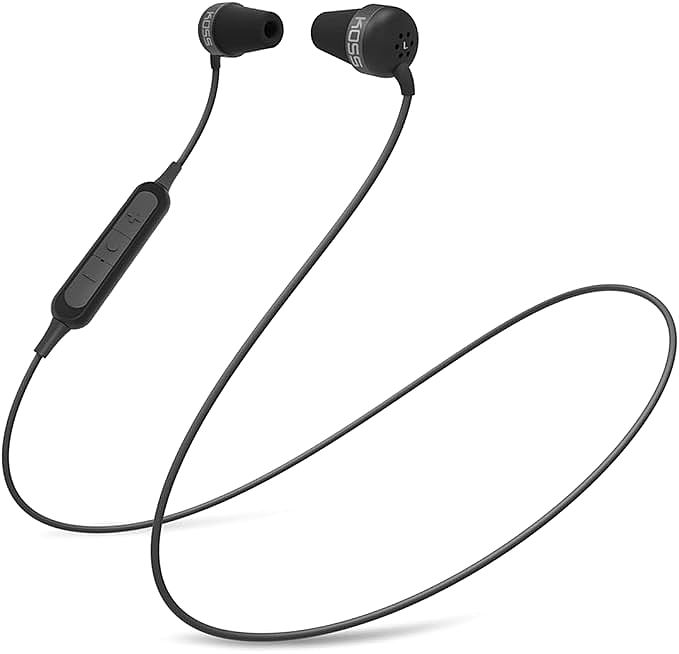
The Physics of Foam: Why the Koss 'The Plug' Wireless...

H2O Audio Stream 3 and Surge S+ Earbuds – Waterproof MP3 Player for Swimming

MOYAGOA MFi Certified AirPods Pro Wireless Earbuds – Top-notch Features and Performance

Masterplug Pods-12 Wireless Earbuds

Zonyee Wireless Bluetooth Earbuds - Immersive Sound Experience

