What IP7, Bluetooth 5.3, and 140H Battery Actually Mean for...

Motast I09 Wireless Earbuds
Your earbuds die during a commute. Not at the end. Halfway through. The spec sheet promised 140 hours.
You checked the IP7 certification before stepping into the rain, and now the left bud crackles. The Bluetooth 5.3 connection still drops on the subway platform. The numbers on the box told one story. Your ears heard another.
The gap between what a spec sheet claims and what a listener experiences is not deception, exactly. It is a translation problem. The engineers who wrote those numbers followed strict testing protocols defined by international standards bodies. But those protocols measure conditions nothing like your morning train ride, your sweaty gym session, or the two-year aging curve your earbuds will actually live through. Understanding what each specification measures, and what it deliberately leaves out, is the difference between trusting a label and reading it.
The Bluetooth Version Tunnel: Why 5.3 Is Not Just a Number
Bluetooth versions are not like software updates where each new version adds visible features. The protocol has moved through 5.0, 5.1, 5.2, and 5.3 while keeping the same 2 Mbps maximum throughput and roughly 200-meter line-of-sight range since version 5.0. What changes between versions is how efficiently that bandwidth gets used, and how the radio handles the chaos of the 2.4 GHz ISM band it shares with WiFi routers, microwave ovens, and USB 3.0 interference.
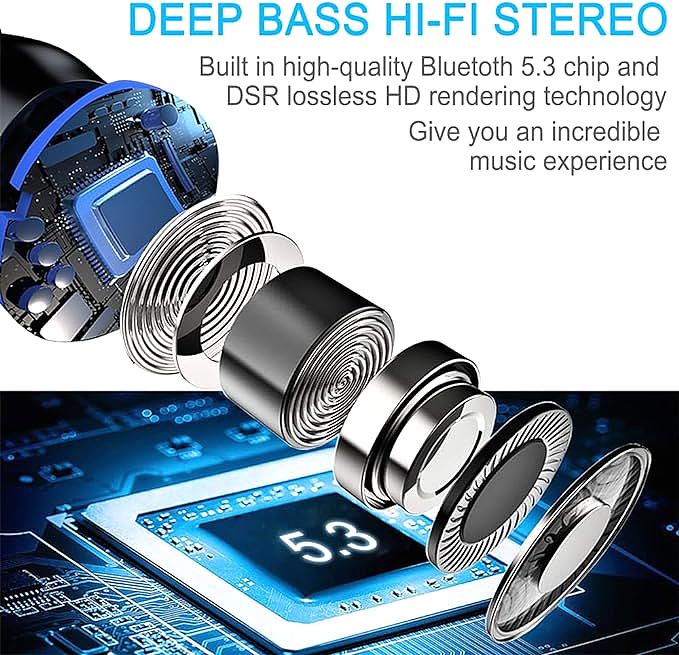
Bluetooth 5.3 introduced three changes that matter for earbuds specifically. Connection Subrating lets the earbud switch between high-power and low-power connection intervals without the full re-negotiation handshake that earlier versions required. During a music stream, the earbud needs data at regular intervals. But between songs, or during a pause, it can drop to a low-power link state almost instantly. The result: up to 50 percent less power consumed during those idle periods compared to Bluetooth 5.0, which kept the connection at a fixed interval regardless of whether data was flowing.
Periodic Advertising with Connectionless Data Sync enables multipoint pairing with switching latency under 200 milliseconds. On Bluetooth 5.0, switching your earbuds from a phone call to a laptop audio stream took 500 to 800 milliseconds, a gap long enough to clip the first syllable of whatever you were trying to hear. The 5.3 protocol reduces that gap to a threshold the human ear barely registers.
The third change is two-thirds rate LDPC forward error correction coding. In a crowded apartment building where dozens of WiFi access points and Bluetooth devices compete for the same narrow slice of radio spectrum, earlier Bluetooth versions either retransmitted corrupted packets or dropped them. LDPC coding allows the receiver to reconstruct damaged packets without requesting a retransmission, which means fewer audible dropouts in congested RF environments like subway stations and shopping malls.
There is a catch. Bluetooth 5.3 on the box does not guarantee any of these features. The version number indicates the maximum capability of the protocol stack, but the earbud manufacturer decides which optional features to implement. An earbud can advertise Bluetooth 5.3 while supporting only the mandatory SBC codec and none of the LE Audio extensions that make 5.3 meaningful. The codec support list, not the version number, tells you whether the hardware actually uses the protocol's capabilities.
| Bluetooth Version | Power Efficiency vs 5.0 | Key Addition for Earbuds |
|---|---|---|
| 5.0 | Baseline | 2 Mbps throughput, SBC/AAC codecs |
| 5.1 | +10% | Direction finding (irrelevant for earbuds) |
| 5.2 | +15% | LE Audio LC3 preview |
| 5.3 | +25-50% | Connection Subrating, Periodic ADI Sync, LDPC coding |
IP7 and the Illusion of Permanent Waterproofing
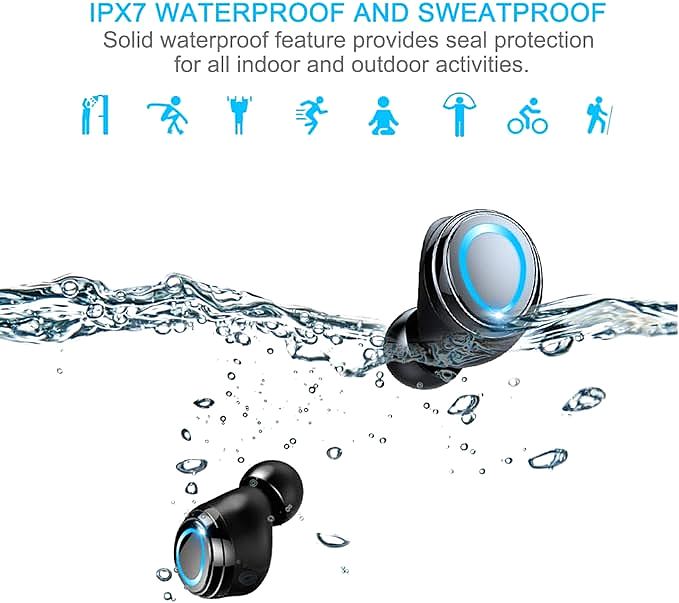
The IP rating system, codified in IEC 60529, uses two digits to describe ingress protection. The first digit covers solid particles like dust. The second covers liquids. IP7 means the device passed a specific laboratory test: immersion in one meter of still, fresh water for thirty minutes, starting from a brand-new, unaged unit. That is the entire test.
The distinction between IP7 and IPX7 is the first digit. IP7 includes a dust protection rating of 5 or 6, meaning limited or no dust ingress. IPX7 means the dust digit was not tested at all. For earbuds, which sit in ear canals full of wax, skin oils, and debris, the dust protection matters more than most people assume. IP67, which guarantees complete dust-tightness plus the same water immersion protection, is a more meaningful rating for in-ear devices than IPX7.
But the larger problem is what the IP test does not simulate. The test uses still, fresh water at room temperature. It does not account for the chlorine in pool water, the salt in ocean water or human sweat, the mechanical force of waves against a swimming earbud, or the heat inside a dishwasher. Salt water and chlorinated water corrode metal contacts and degrade silicone seals at rates far exceeding fresh water. The mechanical agitation of swimming creates varying pressure that exceeds the static one-meter pressure the IP7 test assumes.
The most significant omission is time. The IP rating applies only to a new device. According to industry testing data, approximately 60 percent of IP7-rated earbuds lose meaningful water resistance after twelve months of regular use. The mechanism is straightforward: the silicone and TPU gaskets that seal the earbud housing degrade through repeated thermal cycling, UV exposure, and chemical contact.
Salt from sweat creates galvanic corrosion on the metal charging contacts. The charging port gasket wears from daily plug and unplug cycles. Isopropyl alcohol, commonly used for cleaning, accelerates the breakdown of rubber compounds. The ultrasonic welds that join the housing halves can develop micro-fissures from thermal expansion and contraction.
Materials science explains the timeline. Silicone rubber, the most common gasket material in IP7 earbuds, undergoes chain scission when exposed to UV radiation and ozone. The polymer chains that give the material its elasticity break down progressively, reducing the compression set that maintains the seal. A realistic expectation for waterproof lifespan under normal use conditions is two to three years, after which the seal integrity drops below the IP7 threshold even if the device has never been submerged.
| Scenario | IP7 Safety | Reason |
|---|---|---|
| Rain | Safe | Low pressure, fresh water |
| Puddle drop | Safe | Brief immersion, low depth |
| Washing machine (in pocket) | Risky | Detergent + agitation exceed test conditions |
| Swimming | Risky | Movement and motion exceed static test |
| Salt water / ocean | Not safe | Corrosion degrades seals rapidly |
| Dishwasher | Not safe | Heat + detergent far exceed test parameters |
140 Hours: The Battery Math Nobody Does
The 140-hour claim follows a specific formula. Each earbud carries a 40 to 60 mAh lithium-ion cell. The charging case holds a 500 to 800 mAh battery. The manufacturer calculates: ten hours of playback per charge at 50 percent volume with ANC disabled, multiplied by fourteen full recharges from the case, equals 140 hours total. Every variable in that formula is optimized to the test bench, not to your life.
Real-world battery performance depends on five factors the spec sheet rarely mentions. Volume level is the most dramatic: listening at 70 percent volume drains the battery 40 to 60 percent faster than 50 percent volume because the amplifier must deliver more power to the driver. Active noise cancellation reduces total battery life by 30 to 50 percent because the ANC microphones and processing chip draw continuous power.
The codec matters: aptX Adaptive consumes approximately 15 percent more power than SBC at the same volume because it processes more audio data per second. Call mode adds roughly 20 percent power drain because the beamforming microphones and cVc 8.0 signal processing run alongside audio playback. Distance from the source device also plays a role: beyond three meters, the radio must increase transmission power to maintain the link.
| Condition | Single Charge | Total with Case |
|---|---|---|
| 50% volume, ANC off | 8-10H | 100-120H |
| 70% volume, ANC off | 5-7H | 70-90H |
| 50% volume, ANC on | 4-6H | 50-70H |
| 70% volume, ANC on | 3-4H | 40-55H |
The degradation curve compounds the gap. Lithium-ion cells lose capacity on an exponential, not linear, trajectory. The first 100 charge cycles produce 15 to 20 percent visible capacity loss.
After that initial steep drop, degradation slows to approximately 2 to 3 percent per 100 cycles. For someone using earbuds six hours per day, 200 cycles accumulate in roughly 33 to 50 days. After one year of daily use, the 140-hour total becomes approximately 80 to 90 hours, and that assumes the case battery has not also degraded.
There is a deeper engineering tension at work. The effective capacity of an earbud battery is only 40 to 60 percent of its rated mAh because real-world current draw ranges from 15 to 30 mA, while the test standard measures at a 5 mA discharge rate. Battery manufacturers rate their cells at low discharge rates because lithium-ion chemistry delivers more total energy when drained slowly. Earbuds drain their cells quickly, which means the usable energy is substantially less than the label suggests.
Two Kinds of Noise Cancellation That Are Not the Same Thing
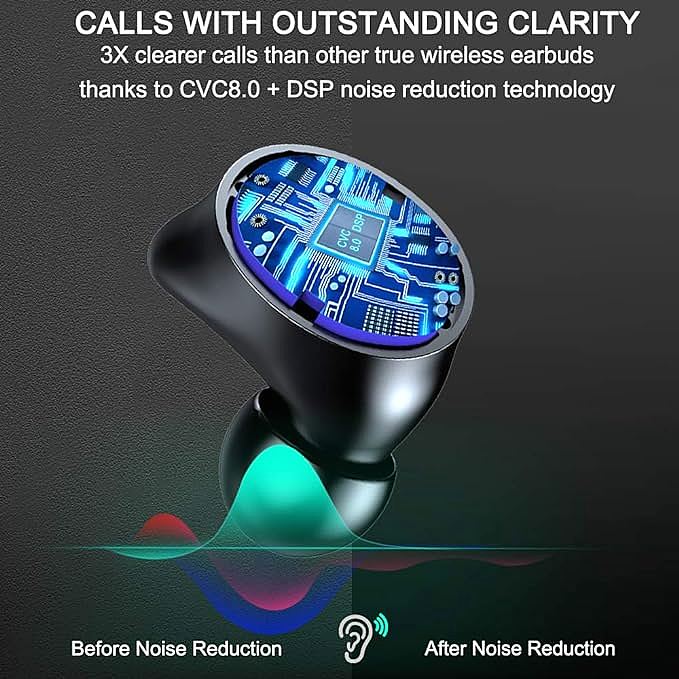
cVc 8.0 and ANC both cancel noise, but they operate on completely different signal paths and serve different people. ANC, or Active Noise Cancellation, uses microphones on the earbud to pick up ambient sound, then generates an inverse waveform through the speaker driver to cancel that sound before it reaches your eardrum. It protects the listener from the environment. cVc 8.0, or Clear Voice Capture, uses beamforming microphones with adaptive algorithms to isolate the 300 Hz to 3.4 kHz voice frequency range while suppressing background noise. It protects the person on the other end of the call from your environment.
The distinction matters for battery life and for expectations. ANC draws power continuously because the noise profile of your environment changes constantly, requiring real-time processing. cVc 8.0 draws power primarily during calls, and its processing load is lower because it targets a narrower frequency band. An earbud that advertises both features is not advertising redundancy. It is describing two separate systems that happen to share the same microphone hardware but process different signals for different recipients.
This confusion extends to how people evaluate earbud specs. A product listing that mentions noise cancellation without specifying which type, or that presents cVc and ANC as a single feature, is either being imprecise or hoping you will not ask. The practical test is simple: if the noise cancellation works when you are not on a call, it is ANC. If it only improves how you sound to others, it is cVc.
Reading the Spec Sheet Like an Engineer
Every specification on an earbud box follows the same pattern: it measures one narrow attribute under one specific condition. The skill is not in reading the number but in understanding what condition produced it and how far that condition is from your own. A framework for evaluating any earbud spec sheet follows a consistent sequence.
Check the Bluetooth version against the codec list. Bluetooth 5.3 without LC3 or aptX Adaptive support means the hardware uses the protocol version but not its most efficient audio features. The version number alone is a necessary but insufficient signal.
Decode the IP rating by reading both digits. IP67 is more informative than IPX7 for earbuds because dust ingress affects in-ear devices disproportionately. If the listing says IP7 without referencing IEC 60529, the certification may be self-certified rather than independently tested.
Reverse-engineer the battery claim. Divide the total hours by the number of charge cycles the case can provide, typically 10 to 14. If the resulting per-charge playback is under six hours, the total claim is likely measured at minimum volume with ANC disabled. A realistic per-charge expectation at 50 percent volume with ANC off is 6 to 10 hours for current-generation hardware.
Check the driver size against the 6 to 13 mm sweet spot. Drivers under 6 mm produce limited bass response but faster transient attack. Drivers over 14 mm deliver deeper bass but slower response, and are typically found only in over-ear headphones. The 6 to 13 mm range covers the balanced response most listeners expect across genres.
Verify the weight. Earbuds under 6 grams per bud are comfortable for two to three hours of continuous wear. Above 8 grams, discomfort sets in after about one hour. A claimed weight under 4 grams per bud is physically unlikely for a device containing a Bluetooth 5.3 radio, battery, driver, and microphone array.
| Specification | What It Measures | Good Value | Warning Sign |
|---|---|---|---|
| Bluetooth Version | Protocol generation | 5.2 or newer | 4.2 or older |
| Codec Support | Audio compression formats | SBC + AAC + aptX | SBC only |
| IP Rating | Ingress protection | IPX5 or higher | IPX4 or no rating |
| Battery (per bud) | Individual cell capacity | 40-60 mAh | Under 30 mAh |
| Battery (case) | Case cell capacity | 500-800 mAh | Under 300 mAh |
| Driver Size | Diaphragm diameter | 6-13 mm | Under 6 mm or over 14 mm |
| Weight per bud | Comfort threshold | Under 6g | Over 8g |
The spec sheet is not lying. It is speaking a language that assumes you know the testing conditions behind each number. The engineers who wrote the IEC 60529 standard, the Bluetooth SIG specifications, and the battery test protocols were not trying to mislead anyone. They were trying to create reproducible measurements.
Reproducibility and realism are different goals. A measurement that gives the same result every time in a lab may tell you almost nothing about what happens on a rainy Tuesday commute two years from now. The spec sheet tells you what the device can do on its first day, under ideal conditions, measured by a standardized procedure. Your job as a reader is to translate that into what it will do on its three hundredth day, under your conditions, measured by your ears.
Motast I09 Wireless Earbuds
Related Essays

RICOO I14 Wireless Earbud AIR 2 Pro – A Premium Audio Experience

The Science Behind Budget Wireless Earbuds: OYIB RS7 Deep Dive

The Surprising Science in Budget Earbuds: How Bluetooth 5.3 and Graphene Drivers Deliver Premium Sound

DOBOPO A20-1 Wireless Earphones: A Sweat-Proof Battery Beast for Workouts

Kinetic Audio: The Physics of Sound in Motion

The Missing Manual: How to Pair, Reset and Master Wireless Earbuds

OMFG BB13 Wireless Earbuds - Advanced Features and Comfortable Design

Keklle2 Wireless Earbuds – Crystal Clear Sound and Waterproof Design

HITY A4 Wireless Earbuds Bluetooth 5.3 Headphones Touch Control – Top Choice for Music Enthusiasts
