The Surprising Science in Budget Earbuds: How Bluetooth 5.3 and Graphene Drivers Deliver Premium Sound


Jxrev J51 Wireless Earbuds
There’s a subtle, almost magical moment that many of us experience daily. You lift two small, lightweight objects from their case, place them in your ears, and with a tap, the noise of the world recedes. It's replaced by a soundscape entirely of your own choosing. This experience feels simple, almost trivial. Yet, beneath that simplicity lies a stunning collaboration of physics, advanced materials, and clever engineering.
Have you ever held your wireless earbuds—especially an affordable pair—and genuinely wondered, "How is this even possible for the price?" It’s a great question. You're not just holding a simple gadget; you're holding a marvel of miniaturized science.
Let's pull back the curtain. We’re not here to review a product, but to use a common, accessible model like the Jxrev J53 as our classroom specimen. Think of it as our guide to understanding the incredible technology that has become available to everyone. We'll explore the core scientific principles that turn these unassuming plastic shells into powerful portals of personal audio.
The Digital Handshake: How Your Audio Travels Through Thin Air
The first piece of the puzzle is the wireless connection itself. This is the realm of Bluetooth, a technology so deeply integrated into our lives that we often forget to be amazed by it. It’s more than just a switch you flip on your phone; it's a highly organized, multi-lane digital highway operating on a specific slice of the 2.4 GHz radio frequency band.
The name itself is a nod to Harald "Bluetooth" Gormsson, a 10th-century king who united Danish tribes. The technology's creators envisioned a similar goal: one universal standard to unite the fragmented world of device communication.
When your earbuds connect to your phone, they perform a complex digital "handshake." This is governed by specific rules, or protocols. For instance, the A2DP (Advanced Audio Distribution Profile) protocol is the specialist that ensures your music streams in high-quality stereo.
But this highway is incredibly crowded with signals from Wi-Fi networks, microwave ovens, and countless other devices. So, how does your music stay perfectly clear and stable? The answer is a brilliant technique called Frequency-Hopping Spread Spectrum (FHSS).
Imagine a delivery person trying to cross a city gridlocked with traffic. Instead of staying on one congested main road, they rapidly dart between 79 different side streets, changing their path 1,600 times every single second. This constant "hopping" makes it nearly impossible for a traffic jam on any single street (a moment of interference) to stop the entire delivery.
Modern versions, like the Bluetooth 5.3 found in many current earbuds, are focused on making this highway even more efficient. They are engineered for: * Lower Energy Consumption: This is the secret to longer battery life. The connection sips power instead of guzzling it, meaning more listening time for you. * Lower Latency: This refers to the tiny, sometimes imperceptible, delay between what you see on screen and what you hear. For music, it’s not a big deal. But for watching movies or playing games, low latency is critical for an immersive, in-sync experience. * Greater Stability: The connection is stronger and more resilient, meaning fewer annoying dropouts when you put your phone in your pocket or walk into another room.
The Sound Engine: Crafting Audio from Code
Once the digital signal arrives at the earbuds, the real transformation begins: turning ones and zeros into the physical vibrations we perceive as sound. This is the job of the driver—the absolute heart of any headphone or speaker. The simplest way to think of a driver is as a tiny, hyper-precise loudspeaker.
A driver contains three key parts: a magnet, a voice coil (a tiny coil of wire), and a diaphragm (a thin membrane). When the electrical audio signal passes through the voice coil, it generates a magnetic field. This field interacts with the permanent magnet, causing the coil—and the diaphragm attached to it—to vibrate thousands of times per second. These vibrations push and pull the air, creating the sound waves that travel into your ear.
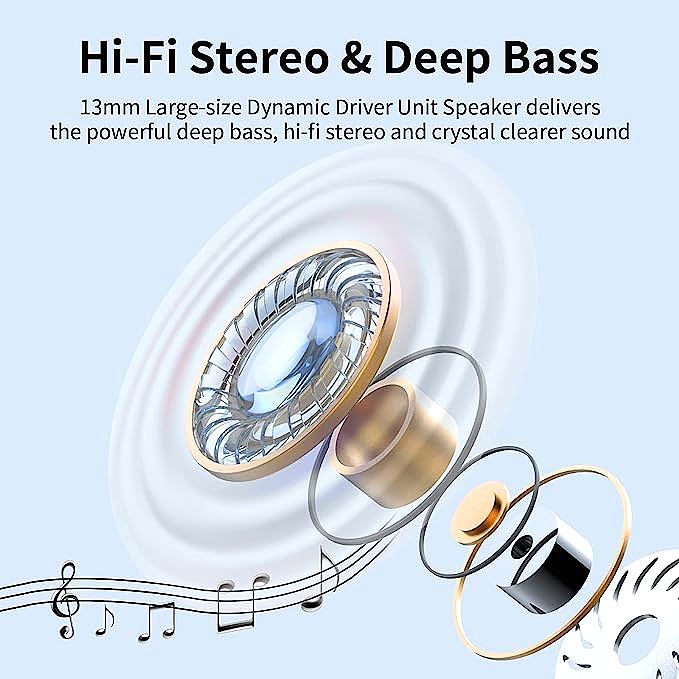
The size of the driver plays a role; a larger diaphragm, such as the 13mm drivers often cited in earbuds like the J53, can move more air. This generally helps in producing richer, deeper bass frequencies. However, the true magic lies in the diaphragm's material. For over a century, audio engineers have pursued the perfect material: something incredibly stiff (to prevent sound distortion), extremely light (to respond instantly to the signal), and well-damped (to stop unwanted ringing).
This is where cutting-edge material science enters the picture. You might see a term like "graphene driver" and dismiss it as marketing jargon, but it represents a genuine leap in audio technology. Graphene is an extraordinary material, consisting of a single layer of carbon atoms arranged in a honeycomb pattern. It's about 200 times stronger than steel but is unbelievably lightweight and thin.
When used as a diaphragm material, graphene's properties are game-changing: * Its immense stiffness allows it to move as a single, unified surface. This piston-like motion reproduces sound with incredible accuracy and minimizes distortion. * Its feather-light weight means it can react to the electrical signal with near-instantaneous speed, preserving the subtle, fleeting details in music that lesser materials might miss.
This is how a budget-friendly pair of earbuds can produce a soundstage that is surprisingly clear, detailed, and expansive. The journey from paper cones in early speakers to these atom-thin sheets of carbon is a testament to relentless innovation.
The Invisible Armor: Engineering for the Real World
All this amazing technology is useless if it can't survive a morning run, a sudden rain shower, or the humidity of a gym. This is where rugged design creates an invisible fortress around the sensitive electronics.
You've probably seen ratings like IP7. This isn't just a random number; it's a formal grade from the Ingress Protection (IP) code, an international standard. The second digit, '7', specifically rates its protection against liquids. A '7' rating signifies that the device can survive being submerged in up to one meter of fresh water for 30 minutes.
Achieving this in a device full of openings for speakers and microphones is a serious engineering challenge. It's accomplished through a combination of tightly sealed casings, rubber gaskets, and most importantly, hydrophobic nano-coatings.
Picture the internal circuit boards being coated with a material that behaves like a microscopic forest of needles. Because of surface tension, when a water droplet touches this surface, it can't spread out and wet the electronics. Instead, it beads up and rolls right off, just like water on a lotus leaf. This superhydrophobic layer is the final line of defense, ensuring that sweat and water don't end your listening session.
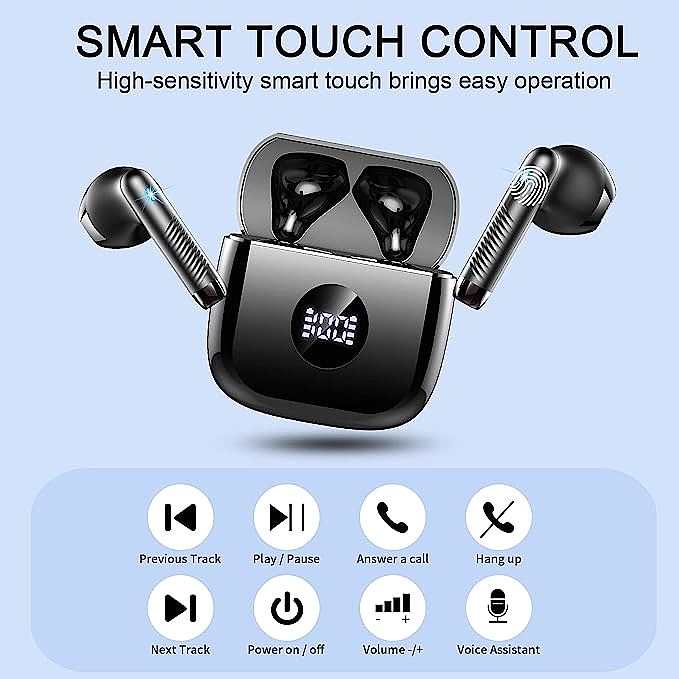
Combine this with an ultra-light build—each earbud can weigh as little as 3 grams (for comparison, a U.S. penny weighs 2.5 grams)—and an ergonomic shape molded from studying the human ear, and you get a device that's not just durable, but so comfortable it almost disappears.
The Power Equation: The Science of All-Day Listening
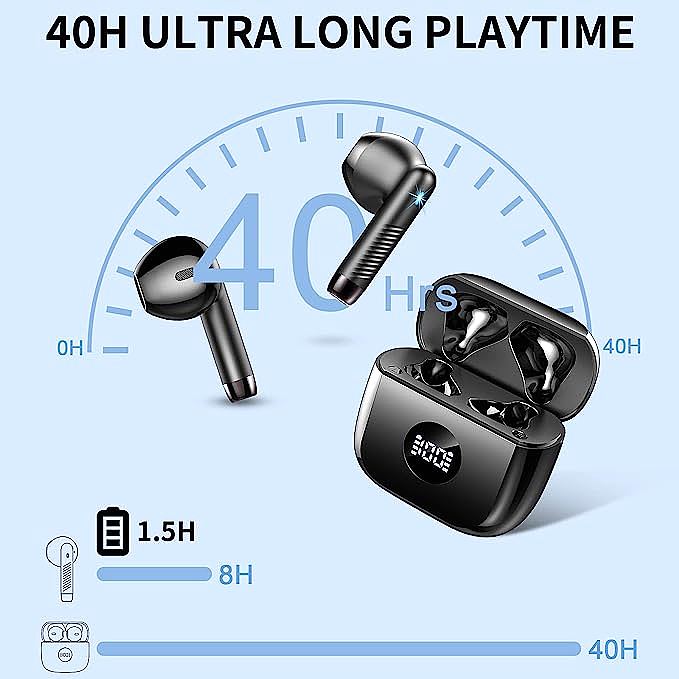
Finally, every component needs power. The perpetual challenge of the wireless era is battery life. When a product claims a total playtime of 40 hours, it's not just about using a bigger battery. It's a masterful balancing act of chemistry and efficiency.
The earbuds themselves contain tiny Lithium-Polymer batteries, but the charging case is their home base and refueling station. The case is essentially a dedicated power bank designed to top them off multiple times. The real secret to longevity, however, is efficiency. The low-power architecture of the Bluetooth 5.3 chip, managed by a dedicated power control circuit, ensures that every drop of energy is used intelligently.
When it's time to charge the entire system, the universal adoption of USB-C allows for faster and more efficient power transfer, meaning the case can be fully juiced up in about 1.5 hours, ready for another day's worth of audio.
So, the next time you place your earbuds in your ears, take a second to appreciate the complex ballet of science you've just initiated. It’s a performance starring the disciplined hopping of radio waves, the precise vibration of next-generation materials, the defiance of water-repelling microscopic shields, and the quiet marathon of hyper-efficient power management. It's proof that you don't need to spend a fortune to hold a piece of beautifully applied science in your hand.
Jxrev J51 Wireless Earbuds
Related Essays

The Science Behind Budget Wireless Earbuds: OYIB RS7 Deep Dive

RICOO I14 Wireless Earbud AIR 2 Pro – A Premium Audio Experience

What IP7, Bluetooth 5.3, and 140H Battery Actually Mean for...

Beyond the Spec Sheet: Decoding the Tech That Defines True Sport Earbuds

CXK E16 Wireless Earbuds: Your Gateway to Superior Sound and Seamless Connectivity

Jrwaro S13-BK01 Wireless Earbuds: Long Battery Life and Clear Calls Make These Buds a Win

WUYI S10 True Wireless Earbuds: A Real Bang for Your Buck with HiFi Sound
FORTECLEAR Wireless Bluetooth Earbuds: The Top Choice for Wireless Earbuds

hadbleng Q28S-PRO Wireless Earbuds: Unleash the Power of Sound, Anytime, Anywhere

