Wasart J55 Wireless Earbuds Review: Bluetooth 5.3, IP7, and 40-Hour Battery E...


Wasart J55 Wireless Earbuds
The Problem With Budget Wireless Earbuds
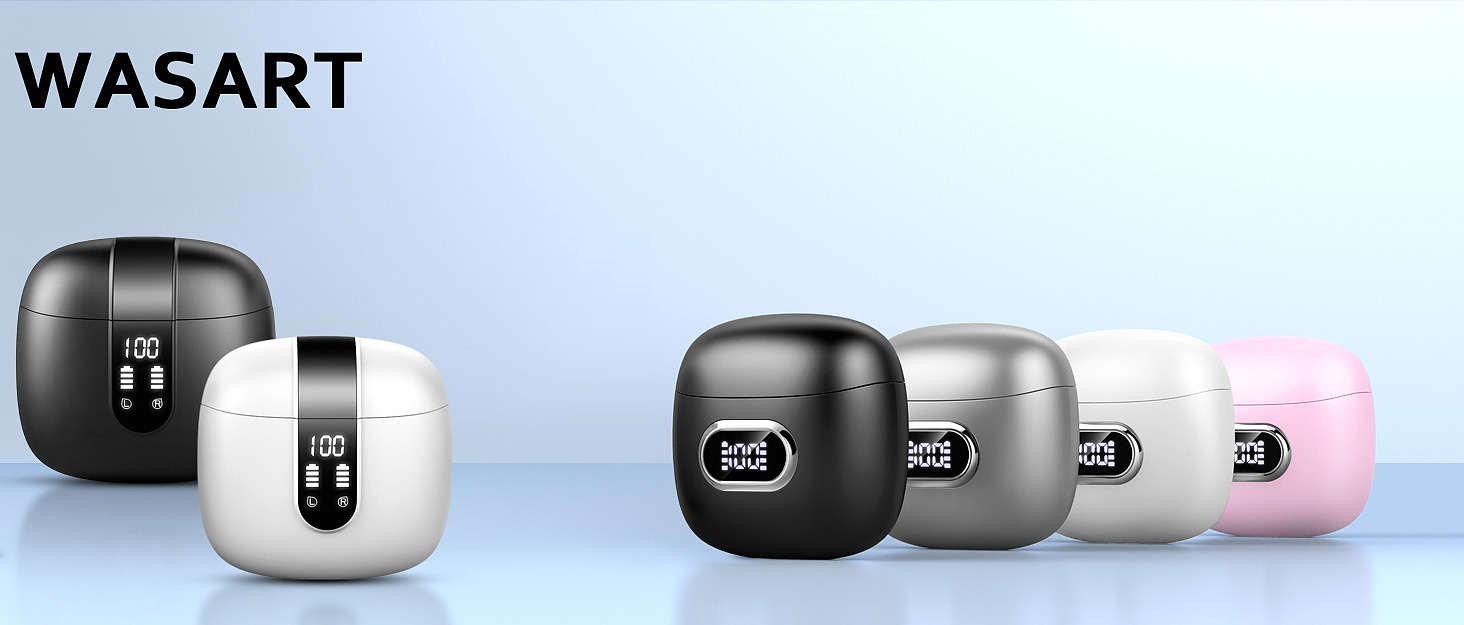
You are staring at a wall of wireless earbuds, every box plastered with specs that blur together. Bluetooth 5.3, IP7, 40 hours, 4.3 grams. The numbers pile up, but nobody tells you what they mean for your morning run or your commute. A $30 pair like the These earbuds makes big claims, and you have no way to know if those claims hold water, literally or figuratively. The gap between spec sheet and real experience is where most buyers get lost. This article closes that gap by unpacking the engineering behind three numbers that matter most: the Bluetooth version, the waterproof rating, and the battery system.
What Bluetooth 5.3 Actually Changes For You
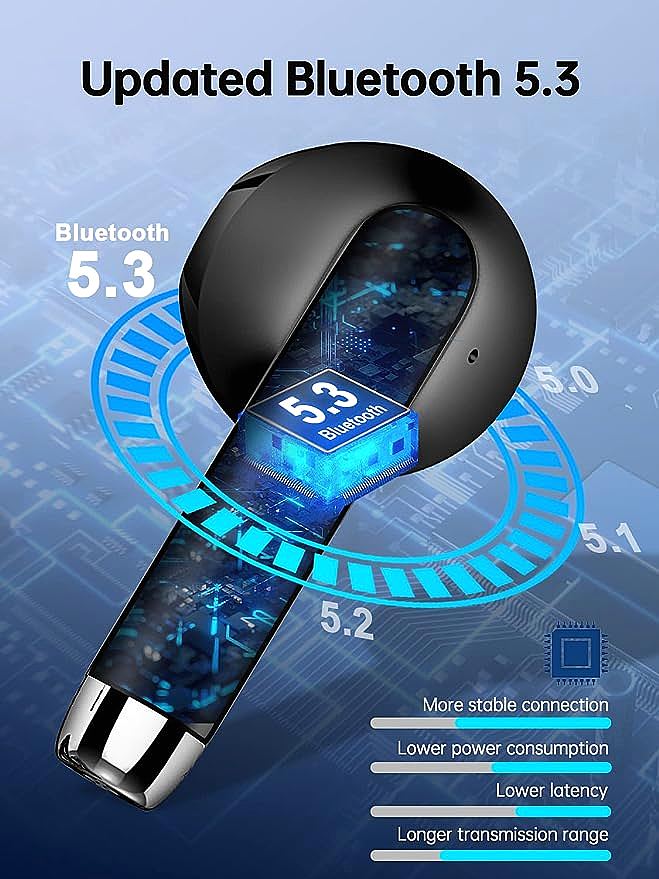
Bluetooth 5.3 shipped in 2021, but it reached budget earbuds only recently. The version number sounds incremental, but the internals shifted in ways you can feel. Three changes matter for earbuds.
Connection subrating is the first. In older Bluetooth versions, switching between active and low-power states took hundreds of milliseconds. Bluetooth 5.3 introduced a faster transition path. For your earbuds, this means the connection wakes from its idle state and resumes audio transmission with less delay. You notice this when a notification sound cuts through silence and the earbud responds instantly rather than stuttering for a beat.
The isochronous channels fix is the second. Bluetooth 5.0 introduced dual audio streaming for true wireless earbuds, but early implementations suffered from left-right desync. Bluetooth 5.3 tightened the timing window for isochronous data, meaning both earbuds receive their audio packets with more precise synchronization. The audible difference is subtle, but it matters for stereo imaging and for avoiding that disorienting feeling where one ear hears the bass slightly ahead of the other.
Power efficiency is the third. The 5.3 spec refined how often the radio checks for connection status. A radio that checks less often draws less current. In earbuds where the battery is measured in milliamp-hours, every milligram of saved power translates to minutes of playback.
None of these changes are dramatic on their own. Together, they add up to a connection that drops less, syncs better, and drains the battery slower. At the $30 price point, getting Bluetooth 5.3 instead of 5.0 or 5.1 means the manufacturer chose a newer chipset. That choice tells you something about the underlying hardware quality, even if the spec sheet does not spell it out.
IP7 Waterproofing: What It Really Means
The IP code system is one of the most misunderstood specs in consumer electronics. IP7 means a device was tested for immersion in one meter of water for thirty minutes under controlled conditions. That is more specific than most people realize, and the specificity matters.
The first digit in an IP rating refers to solid particle protection. IP7 starts with 7, which means dust-tight. No dust enters the enclosure under test conditions. For earbuds, this matters because sweat carries dust and skin particles that can work their way into seams over months of use.
The second digit is 7, which covers immersion. One meter, thirty minutes, still water. That is the key qualification. Still water, not moving water. Not a swimming pool with chlorine. Not a shower with pressurized water hitting the seal directly. The test is a gentle dunk in a laboratory tank.
What does this mean for your use case? Rain during a run is fine. Heavy sweat is fine. Rinsing them under a tap is probably fine if the water pressure is low. Swimming is not what IP7 is rated for despite what some marketing materials imply. Pool water contains chlorine that degrades seals over time, and swimming involves water moving past the earbuds at speed, which tests a different failure mode than still immersion.
Many earbuds in this category add a nano-coating on top of the IP7 rating. This is a hydrophobic layer applied at the molecular level during manufacturing. It causes water to bead and roll off rather than wetting the surface. The coating does not replace the IP rating. It provides a second line of defense for the external surfaces and the charging contacts, which are the most vulnerable points after the primary seals. Over time, the coating wears off through friction and contact with skin oils. It is not permanent, but it extends the practical durability window.
The honest boundary for IP7 earbuds is this: they handle what exercise throws at them. Rain, sweat, accidental splashes. They do not handle swimming, diving, or sustained water pressure. Understanding that boundary prevents both overconfidence and unnecessary caution.
The 40-Hour Battery System, Broken Down
A 40-hour battery claim on a $30 earbud raises valid questions. The number is always a combination of earbud battery plus case battery, and the split tells the real story.
The earbud battery in this class typically holds 40 to 50 milliamp-hours. At a moderate volume with Bluetooth 5.3 managing power, the draw averages around 5 to 6 milliamps per earbud. That math gives you roughly 8 hours of continuous playback per charge. This is the first number: 8 hours from the earbuds themselves.
The charging case carries the remaining 32 hours. The case battery is larger, often 300 to 500 milliamp-hours. Each full charge of the case refills both earbuds roughly four times. Four refills times 8 hours equals 32 hours from the case. Eight plus thirty-two equals forty.
The number is real but conditional. Volume level is the biggest variable. At maximum volume, the amplifier draws significantly more current, and the 8-hour figure can shrink to 5 or 6. At low volume, it can stretch to 10. Temperature matters too. Lithium polymer cells in earbuds lose capacity in cold weather. A run in near-freezing temperatures will drain the battery faster than the same run in mild conditions.
Fast charging is the other piece. Most cases in this tier support a brief charge that yields significant playback. Ten minutes on the charging cable typically restores enough power for one to two hours of use. The chemistry behind this involves the charging circuit pushing current at a higher rate during the initial phase of the charge cycle, when the cell can accept it safely. As the battery fills, the charge rate drops to prevent overheating. This curve means the first 20 percent of charge happens fast, and the last 20 percent happens slowly.
For a daily routine, this translates to charging the case once a week for a user who listens for an hour or two each day. The earbuds themselves need to go back in the case every couple of days. The system works because the case acts as a portable power bank, trickle-charging the earbuds between uses.
Why 4.3 Grams Matters More Than You Think
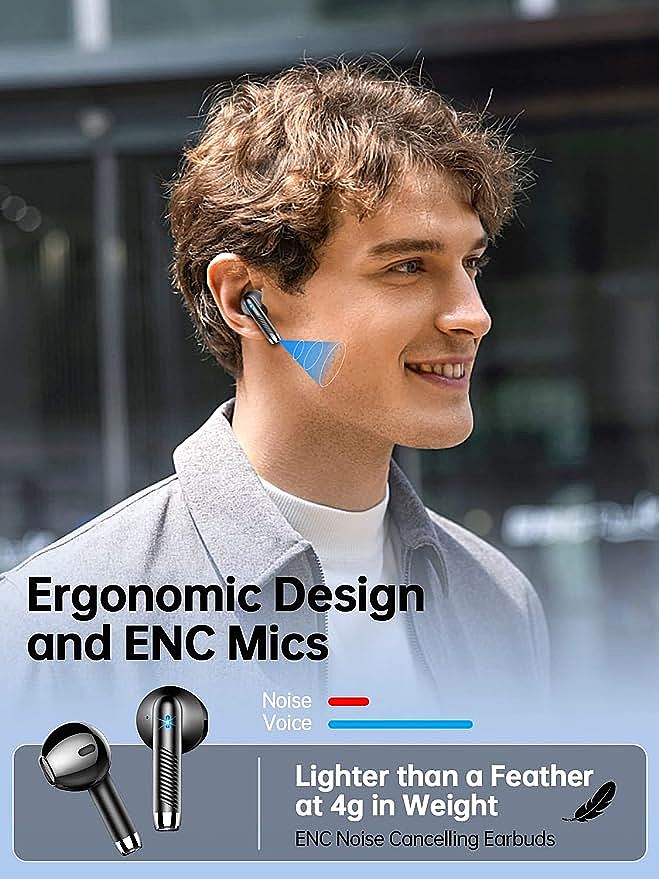
Weight is the spec people dismiss and then feel later. Four-point-three grams per earbud sounds trivial. Spread across a full day of wear, it is not.
The human ear canal is not a flat surface. It is a cartilaginous tube with varying angles and pressure points. An earbud rests against these points, and gravity pulls it downward. At 4.3 grams, the downward force is minimal. At 6 or 7 grams, which is common for earbuds with larger batteries or metal housings, the force increases proportionally and the earbud begins to tug.
During exercise, the problem amplifies. Running creates vertical oscillation. Each footstrike produces a small shock that travels through the skull and reaches the earbuds. A heavier earbud shifts more with each impact, working itself loose from the canal seal. Once the seal breaks, bass response collapses and outside noise floods in. A light earbud stays planted because its inertia is low. The same force that dislodges a 7-gram earbud barely moves a 4.3-gram one.
For prolonged wear, the issue is pressure fatigue. The cartilage in the outer ear is sensitive to sustained pressure. A heavier earbud concentrates its weight on a smaller contact area inside the canal tip. Over several hours, this pressure builds into a dull ache that most people attribute to the wrong cause. They blame the tip material or the earbud shape when the real culprit is mass.
The physics is straightforward. Force equals mass times acceleration. At rest, acceleration is just gravity. During running, acceleration spikes with each step. A 35 percent reduction in mass, from roughly 7 grams to 4.3 grams, means a 35 percent reduction in the force pressing against your ear canal in every scenario. That is the difference between forgetting you are wearing earbuds and constantly adjusting them.
The 6mm Driver and What 16 Ohms Means For Your Phone
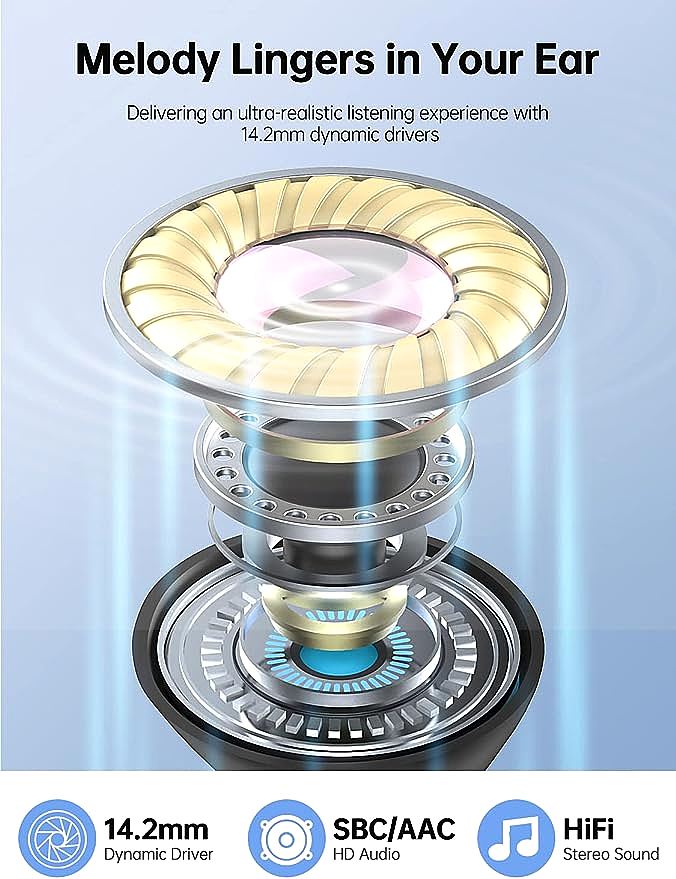
A 6-millimeter dynamic driver is small for a reason. Earbud drivers trade size for efficiency because the acoustic chamber behind them is tiny. A larger driver would demand more power and more air volume than the housing allows.
The dynamic driver works by moving air. A voice coil suspended in a magnetic field receives the audio signal as an electrical current. The current changes direction thousands of times per second, and the magnetic field pushes and pulls the coil. The coil is attached to a diaphragm, and the diaphragm moves air in waves that match the original sound.
At 6mm, the diaphragm surface area is small enough to respond quickly. Quick response means accurate high and mid frequencies. The tradeoff is bass. Bass requires moving more air, and a small diaphragm cannot move as much air as a larger one. This is why budget earbuds often have a V-shaped sound signature with elevated bass boost compensating for the physical limitation. The boost is an electronic fix for a mechanical constraint.
The 16 ohm impedance is where the phone connection matters. Impedance is the resistance the driver presents to the audio signal. Sixteen ohms is low impedance. Low impedance means the driver draws more current from the amplifier. Your phone has a tiny amplifier with limited current output. A low impedance driver is easy for a phone to drive. You get adequate volume and dynamic range without an external amplifier.
Compare this to high-end headphones that often run at 32, 80, or 300 ohms. Those need dedicated amplifiers because a phone cannot push enough current through the higher resistance to reach satisfying volume. The 16 ohm design in earbuds is a deliberate choice to match the output capability of mobile devices.
Passive noise isolation is the acoustic feature that does not require electronics. The silicone or foam tip creates a seal in the ear canal. That seal blocks sound mechanically, the same way earplugs do. A well-fitted tip can block 20 to 25 decibels of external sound. This is different from active noise cancellation, which uses microphones and inverted sound waves to cancel noise. Passive isolation is simpler, cheaper, and does not drain battery. It works better on high-frequency noise like conversation and keyboard clatter than on low-frequency noise like engine rumble. For outdoor runners, passive isolation has an advantage: you can still hear traffic because the seal attenuates rather than eliminates outside sound.
What Real Use Reveals
Running with earbuds exposes weaknesses that specs hide. A Bluetooth 5.3 connection that is stable in your living room can struggle when your body crosses between the earbuds and the phone strapped to your arm. Your torso is mostly water, and water absorbs 2.4 GHz radio energy. The phone antenna ends up behind your body, and the earbuds must receive signal through or around you. Bluetooth 5.3 helps here because the improved connection subrating keeps the link alive through brief interruptions instead of dropping.
Sweat interaction is the other field test. Sweat is salty water. It is more conductive and more corrosive than fresh water. IP7 covers immersion, but sustained sweat exposure during a long run tests the seals differently. Sweat seeps into gaps over time, and the salt deposits it leaves behind can bridge electrical contacts. The nano-coating helps because it causes sweat to bead and run off rather than pooling in crevices. Tap the earbuds against your shirt after a run to shake loose moisture before putting them back in the case.
Call quality is where budget earbuds reveal their limitations most clearly. The microphone in a $30 earbud is a tiny MEMS unit calibrated for proximity. At arm's length, it picks up your voice adequately. In wind, it struggles because wind noise is broadband and the small microphone cannot distinguish your voice from the turbulent air hitting its port. Some earbuds in this class use software to reduce wind noise, but the processing adds latency and can make your voice sound processed. For calls indoors or in calm conditions, the quality is serviceable. For calls on a breezy city sidewalk, you will repeat yourself.
Who These Are For, And Who Will Be Disappointed
No earbud at this price does everything. The honest assessment starts with what is missing.
Active noise cancellation is absent. ANC requires microphones on the outside of the earbud, a processor capable of real-time signal inversion, and a driver that can produce the cancellation signal. That hardware and processing costs money. At $30, the budget goes into the Bluetooth chipset, the battery, and the waterproofing. You get passive isolation instead, which blocks some noise but does not silence a plane cabin or a bus engine. If ANC is non-negotiable for your commute, this tier is not the answer.
Touch controls and wet fingers are a known friction point. Capacitive touch sensors detect the change in capacitance when your finger approaches. Water on your skin or on the earbud surface changes that capacitance reading. A tap registered in dry conditions may not register with wet hands, or worse, a raindrop hitting the surface can trigger a false touch. This is a physics limitation of capacitive sensing, not a design flaw. Physical buttons solve it but add mechanical complexity and cost.
For runners and gym-goers, the combination of IP7, low weight, and a secure fit tip is the core value proposition. The earbuds stay in during movement, survive sweat and rain, and do not fatigue the ear over long sessions. The battery system supports a week of workouts between charges. Bluetooth 5.3 keeps the connection stable through the body-shadow problem that plagues older earbuds.
For budget buyers who want specs they can understand, the appeal is transparency. Bluetooth 5.3 is a verifiable protocol version, not a subjective sound quality claim. IP7 is a standardized test, not a marketing phrase. Forty hours is arithmetic you can check. The These earbuds presents numbers that can be independently verified, which is more than many earbuds in this tier offer.
The boundary is clear. These earbuds serve active users who need durable, lightweight, connected audio at a price that does not punish a lost or damaged pair. They do not serve audiophiles, frequent flyers, or anyone who needs silence more than sound. Knowing where that line falls is the difference between a satisfying purchase and a disappointing one.
Wasart J55 Wireless Earbuds
Related Essays

W23 Earbuds Won't Pair? Fixes & Reset Guide (2026)

Why Won't My Earbuds Pair? Bluetooth Handshakes, Sensors, and a Fix Sequence

Heart Rate Earbuds: How They Measure and Who Needs Them
OnePlus Nord Buds 2 - Affordable ANC Earbuds

Bluetooth Headphone Setup Explained: Pairing, EQ Modes, and TV Audio in 2026

Why Your IPX7 Rating Doesn't Mean What You Think

Erjigo KZ AS16 Pro - Recommended HiFi Music Earbuds


