How Open-Ear Headphones Aim Sound at Your Ear and Cancel It Everywhere Else

ACREO A8 Next Generation Open Ear Headphones
You are sitting at your desk with open-ear headphones on, listening to a podcast at moderate volume. Your colleague two seats away glances over. You can hear their question clearly, which is the point of open-ear design, but they can also hear your podcast, which is not. The sound is leaking sideways from the tiny speakers perched above your ear canals, and no matter how you adjust the fit, the leakage persists. The earbuds are doing exactly what physics demands of a small speaker firing into open air: the sound radiates in every direction.
This leakage problem is not a design flaw. It is a fundamental constraint of projecting sound through air without sealing the ear canal, and solving it requires understanding how sound waves can be steered, reinforced, and cancelled using nothing but timing. The technology is called beamforming, and it applies the same wave interference principles that govern everything from noise cancellation to radar.
How Your Ear Normally Captures Sound
Before examining how open-ear headphones redirect sound, it helps to understand what they are trying to replicate. In natural hearing, sound waves travel through air and enter the pinna, the visible outer ear. The pinna's folds and ridges filter the sound, providing cues about direction. The waves then pass through the concha, the bowl-shaped depression that funnels sound into the ear canal. At the end of the canal, the eardrum vibrates, and those vibrations travel through the middle ear bones to the cochlea, where they become electrical signals for the brain.
This pathway evolved specifically for airborne sound. The ear canal is a resonant tube approximately 2.5 centimeters long that amplifies frequencies between 2 and 5 kilohertz by several decibels. The concha acts as a natural horn, collecting and concentrating sound pressure. Every structure in the outer ear is optimized for capturing and guiding pressure waves through air.
Bone conduction headphones bypass this entire system. They press transducers against the cheekbones or skull, vibrating bone directly to stimulate the cochlea. The eardrum sits idle. The approach has merit for situational awareness because the ear canal remains completely open, but bone is an inefficient conductor of the full audio spectrum. Low-frequency pressure waves that define bass are poorly transmitted through skeletal tissue. High-frequency detail that gives music its texture and spatial character is attenuated. The result sounds adequate for spoken content but lacks the richness that air-conducted sound provides.

Why Open-Air Speakers Leak
A sealed earbud traps air pressure between the driver and the eardrum. The diaphragm pushes forward, pressure builds, and the eardrum responds. Even a 6-millimeter driver can produce satisfying bass in this configuration because the air has nowhere to escape. The system is acoustically sealed.
An open-ear headphone removes the seal. The driver fires into open space, and low-frequency sound waves, which are long and omnidirectional, radiate outward in all directions rather than concentrating at the ear canal entrance. This is the acoustic short circuit: without a contained air volume, the pressure differential that the driver creates dissipates before it can do useful work on the eardrum. The physics is the same reason that a subwoofer in an open room produces less bass than one mounted in a properly sealed enclosure.
The practical consequence is that open-ear headphones need larger drivers to move more air and compensate for the pressure that escapes. A technical analysis of air conduction designs notes that sealed earbuds achieve adequate bass with 6-millimeter drivers, while open-ear designs commonly require 16-millimeter or larger diaphragms to produce comparable low-frequency energy. Larger drivers demand more amplifier power, which creates its own engineering constraints around battery life and thermal management.
Steering Sound With Wave Interference
The solution to the leakage problem lies in controlling where the sound energy goes. A single speaker radiates in all directions. But when multiple speakers emit the same frequency with carefully controlled timing, their waves interact in predictable ways. Where the waves arrive in phase, they add constructively, producing louder sound. Where they arrive out of phase, they cancel through destructive interference, producing silence or near-silence.
This is beamforming, and the mathematics behind it is well established. Acoustic beamsteering research provides the core equation: for an array of speaker elements, each element outputs a signal described as E_n = a_n multiplied by sin(omega times t plus n times Psi), where a_n is the amplitude, omega is the angular frequency, t is time, and Psi is the phase offset for each element. By adjusting Psi, the phase difference between adjacent elements, the direction of maximum constructive interference, the beam, can be steered to any angle without physically moving any speaker.
The steering angle is determined by a simple relationship: sin(theta) equals Psi times lambda divided by two times pi times d, where lambda is the wavelength and d is the spacing between elements. Change the phase offset, and the beam points somewhere new. The principle is identical to phased array radar systems, where antenna elements steer an electromagnetic beam by adjusting the timing of transmitted signals. The waves are different, but the interference mathematics are the same.
A research paper from the University of Technology Sydney on differential beamforming for loudspeaker arrays demonstrates that even small speaker arrays can produce narrow directional patterns. Differential arrays overcome the diffraction limit that normally constrains the directivity of small acoustic sources, which is directly relevant to headphones where the available space for speaker elements is measured in millimeters.

How Directed Audio Reaches Your Ear
In an open-ear headphone, the beamforming target is the concha. The drivers are positioned above or beside the ear canal entrance, angled to fire into the bowl-shaped depression of the outer ear. The ear's natural geometry then does the rest: the concha collects the concentrated sound waves and funnels them into the ear canal, where the eardrum and middle ear respond exactly as they would to any airborne sound.
The result is that sound energy is concentrated at the ear and reduced everywhere else. A technical overview from one manufacturer notes that at 80 percent volume, directed air conduction produces sound that is imperceptible to a person sitting at normal office distance. The waves that would have radiated sideways are cancelled by destructive interference between the phased speaker elements. Only the waves aimed at the concha survive.
This is not a perfect seal. Some sound still escapes, particularly at higher volumes where the cancellation is not complete. But the reduction is substantial enough that the open-ear headphone can be used in shared spaces without the social awkwardness of broadcasting your audio to the room. The comparison with bone conduction on leakage is informative: bone conduction transducers vibrate the headphone chassis as a side effect of their operation, which radiates sound outward. Air conduction with directed beamforming sends energy toward the ear and cancels it elsewhere, which is a fundamentally different approach to the same problem.
Why the Same Word Means Different Things
The term "beamforming" appears in both audio engineering and wireless networking, and the shared vocabulary creates confusion. In WiFi routers, beamforming refers to steering radio-frequency signals between antennas to improve data throughput and range. In headphones, beamforming refers to steering acoustic pressure waves between speakers to control where sound is audible. The mathematical framework is the same: phased elements, constructive and destructive interference, directional energy concentration. The physics medium is entirely different: electromagnetic waves at gigahertz frequencies versus mechanical pressure waves at audio frequencies.
One manufacturer known for bone conduction headphones documents another variant of directed audio using ultrasonic frequencies above 40 kilohertz. At these frequencies, wavelengths are short enough that the beam stays narrow over long distances, up to 50 to 100 meters in open air. When the ultrasonic beam interacts with air, a nonlinear acoustic effect causes the inaudible carrier wave to demodulate, and audible sound appears to emerge from a specific point in space. This parametric approach produces an extremely tight beam but requires significant power and is more suited to commercial directional speaker installations than to battery-powered headphones.
The acoustic beamforming used in open-ear headphones operates at standard audio frequencies and relies on multiple speaker elements with digitally controlled phase relationships. A digital signal processor adjusts the phase and amplitude fed to each element in real time, steering the beam electronically with no moving parts. The approach trades the extreme directionality of ultrasonic methods for lower power consumption and simpler hardware, both critical for a wearable device.

The Size and Power Trade-off
Open-ear headphones face a double constraint that sealed earbuds do not. The drivers must be large enough to compensate for the acoustic short circuit, and the amplifier must be powerful enough to drive them. Research data indicates that open-ear air conduction designs commonly use amplifiers rated at approximately 6 watts to provide sufficient headroom for bass reproduction in an unsealed environment.
Battery capacity becomes the binding constraint. A larger driver and a more powerful amplifier draw more current, which shortens playtime unless the battery is also enlarged, which adds weight, which affects comfort, which is the primary selling point of open-ear design in the first place. The engineering loop closes on itself: every solution to one problem creates or worsens another.
The ACREO A8 open-ear headphones illustrate this balance. They use air conduction with directed audio, large drivers driven by a substantial amplifier, and digital signal processing to manage the beamforming. The design prioritizes sound quality over the maximum situational awareness that bone conduction provides, positioning air conduction as a middle ground between sealed earbuds and bone conduction on the spectrum of openness versus acoustic fidelity.
What the Ear Geometry Adds
The concha is not just a convenient target. It is an acoustic structure that evolved to collect and concentrate sound. When a beamforming array directs sound into the concha, the natural horn shape of the outer ear amplifies certain frequencies, particularly in the 2 to 5 kilohertz range where the ear canal resonance occurs. This means the headphone can operate at lower volume than a flat-radiating speaker would require to achieve the same perceived loudness, because the ear itself contributes gain to the signal.
This anatomical amplification is why concha-targeted designs can achieve usable volume with acceptable battery life despite the inefficiency of open-air sound projection. The headphone does not need to overcome the entire acoustic short circuit through raw driver power alone. It uses the ear's natural geometry as part of the acoustic path, turning a potential weakness of open-ear design into a functional advantage.
The engineering of open-ear headphones is an exercise in using physics to work around physics. Wave interference creates directionality from omnidirectional sources. The ear's anatomy concentrates sound that would otherwise dissipate. Larger drivers and higher power compensate for the missing acoustic seal. Each element addresses a specific limitation imposed by the decision to leave the ear canal open. The result is not a perfect reproduction of sealed-earbud audio, nor does it need to be. It needs to be good enough that the user chooses openness without sacrificing too much fidelity, and that calculation is entirely a matter of what the listener values and what they are willing to trade.
ACREO A8 Next Generation Open Ear Headphones
Related Essays
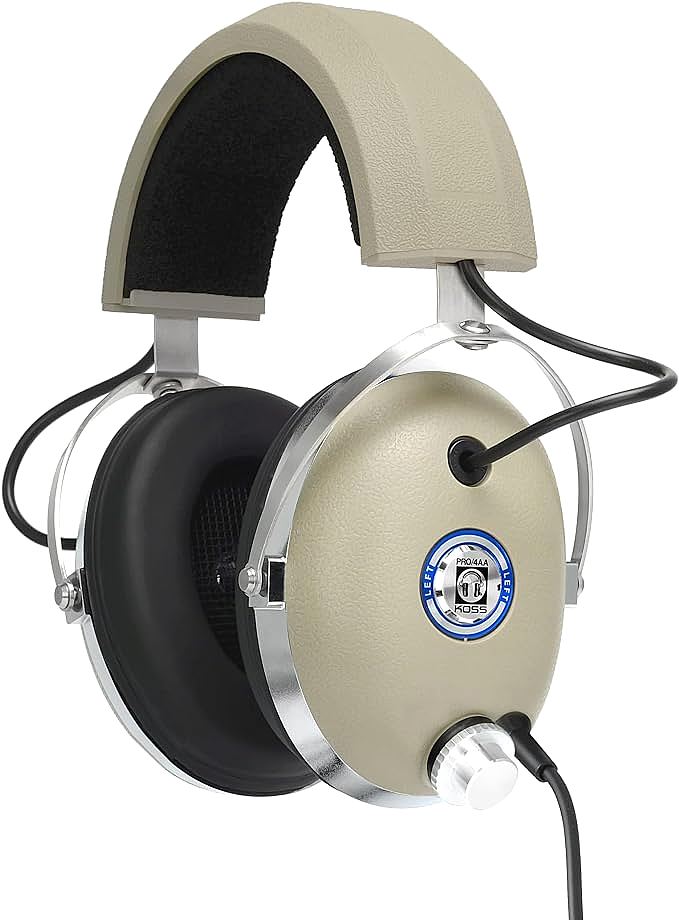
Koss Pro-4AA Giant Killer: Decoding 1970s Audio Legend

The Physics of Fit: Why Ear Hooks Conquer the Runner's Dilemma

The Physics of Fit: Biomechanics and Material Science in Earbud Design

Are Bone Conduction Headphones Safe for Running?
