Battery Volume vs. Miniaturization: The Physics Behind...

Soundbot SB221 HD Wireless Headphones
Your wireless earbuds die halfway through a long flight. Not because the battery degraded, not because you forgot to charge them, but because the laws of thermodynamics do not care about industrial design trends. A lithium-ion cell stores energy proportional to its volume, and when you shrink the container, you shrink the runtime. This is not a limitation of current technology. It is a geometric certainty.
The audio industry's decade-long march toward True Wireless Stereo (TWS) earbuds has produced devices that vanish inside the ear canal. They look clean. They feel light. They also contain batteries ranging from 40mAh to 60mAh, which translates to roughly five to eight hours of playback before silence. The Soundbot SB221, a behind-the-neck supra-aural headphone from 2016, delivers 25 hours on a single charge. The difference is not a significant advancement in chemistry. It is a refusal to shrink.

Energy Density and the Fuel Tank Problem
Lithium-ion battery technology has improved incrementally over the past two decades. Energy density has climbed from approximately 150 Wh/kg in the early 2000s to roughly 250-300 Wh/kg in current commercial cells, according to data published by the U.S. Department of Energy. But these gains are linear, not exponential. A 10% improvement in energy density yields a 10% improvement in runtime, all else being equal.
The real variable is volume. A TWS earbud houses its battery inside a shell that must fit within the concha of the human ear, a cavity measuring roughly 15-20mm in depth. The battery itself is typically a coin-cell or button-cell form factor, constrained to approximately 40-60mAh. A behind-the-neck design, by contrast, distributes its battery across the ear cups and the connecting neckband. Based on a 25-hour runtime at a typical Bluetooth audio draw of 15-20mA, the estimated capacity falls between 300mAh and 500mAh. That is a five-to-eight-fold volumetric advantage.
Think of it this way: a sports car and a cargo truck both burn gasoline. The sports car carries 60 liters and drives 400 kilometers. The cargo truck carries 400 liters and drives 800 kilometers. The truck is not more efficient per liter. It simply carries more fuel. The behind-the-neck headphone is the truck. It does not sip power more frugally than a TWS earbud. It just carries more of it.
Bluetooth 4.0, the protocol many of these devices use, introduced Low Energy (LE) modes for data transmission, but audio streaming still operates over the Classic Bluetooth profile, which draws a relatively constant current regardless of version. The power savings from Bluetooth 5.x over 4.0 for continuous audio are modest, typically 5-15% depending on codec and implementation. The endurance comes from the fuel tank, not the engine.
Biomechanics of Retention: Friction vs. Force
Battery life is one engineering problem. Staying on the head during a 10K run is another. TWS earbuds solve the retention problem through friction. Silicone tips grip the ear canal, and optional wing fins press against the concha's folds. This works under static conditions. Add sweat, and the coefficient of friction drops. Add impact forces from running, and the earbud must resist both gravity and deceleration with nothing but surface grip.
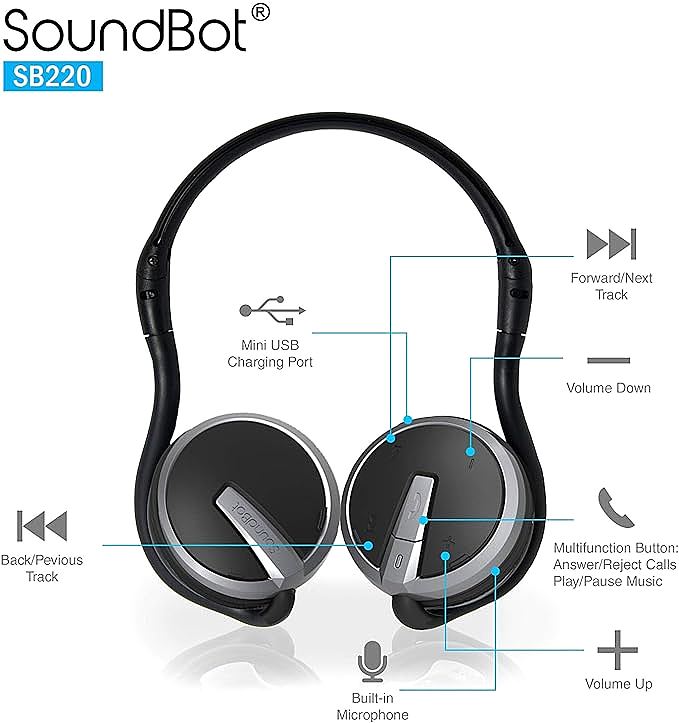
The behind-the-neck design solves retention through a different principle: mechanical clamping force distributed across multiple contact points. The frame loops over the helix (the outer rim of the ear), creating a fulcrum. The neckband then applies lateral compression, pressing the ear cups inward against the sides of the head. This creates what engineers call a "force closure" joint, where friction and normal force combine to resist displacement.
In biomechanical terms, the difference is analogous to holding a book between your palms versus balancing it on a fingertip. The former uses compression and friction across a large area. The latter relies on precise balance and minimal disturbance. During high-impact activity, the multi-point contact system of a behind-the-neck frame distributes G-forces across the skull rather than concentrating them at a single friction-dependent interface.
User feedback from over 5,000 ratings consistently mentions secure fit during exercise. This is not a subjective impression. It is the predictable outcome of a mechanical system that uses structural geometry rather than surface adhesion to resist dislodgement. The trade-off is visibility. A behind-the-neck frame is conspicuous in a way that a TWS earbud is not. You trade aesthetics for physics.
Tactile Certainty and the Ghost Touch Problem
Modern headphones increasingly use capacitive touch surfaces for playback control. Swipe forward to skip a track. Double-tap to pause. The interface is smooth, minimal, and prone to what interaction designers call "ghost touches."
A ghost touch occurs when the capacitive sensor registers input that the user did not intend. Sweat, hair, fabric contact, and even ambient humidity can trigger false activations. During exercise, when the user's hands are occupied and visual confirmation of a touch target is impractical, ghost touches become more than an annoyance. They become a control failure.
The Soundbot SB221 uses five dedicated physical buttons. Each button has tactile resistance, a mechanical detent that produces a perceptible click when pressed. This click serves as haptic confirmation that the input registered, eliminating the need for visual or auditory verification. In the language of human factors engineering, this is called "feedforward" and "feedback" working in concert. The button's resistance tells your finger where it is (feedforward). The click tells your finger what happened (feedback).
There is a reason aircraft cockpits, surgical instruments, and industrial control panels still use physical switches. When the cost of an error is high and the environment is hostile to precision, tactile certainty outperforms elegance. A gym is not a cockpit, but the principle scales. During a set of deadlifts, you do not want to guess whether you paused your music or activated voice assistant. You want a button that clicks.

The Semi-Open Acoustic Compromise
Supra-aural headphones sit on the ear rather than enclosing it. This design choice creates a specific acoustic signature that differs from both in-ear monitors (which seal the canal) and circumaural headphones (which encircle the entire ear).
The foam pads of an on-ear design provide passive noise reduction by creating a physical barrier between the speaker driver and the external environment. This barrier attenuates high-frequency sounds effectively. The short wavelength of high frequencies means they are easily blocked by even modest physical obstacles. Low frequencies, with wavelengths measured in meters, pass through the same barrier with minimal resistance.
The result is a sound signature that emphasizes mid and high frequencies while allowing bass energy to escape through the incomplete seal. For critical listening, this is a limitation. For outdoor exercise, it is a safety feature. The "leakage" that weakens bass response also permits environmental sounds like car horns, bicycle bells, and approaching footsteps to reach the ear.
Active noise cancellation (ANC) systems in sealed headphones attempt to recreate this awareness through "transparency modes" that use external microphones to pipe ambient sound into the audio mix. This works, but it introduces latency. The microphone must capture the sound, the processor must analyze it, and the speaker must reproduce it. Even with low-latency chips, this pipeline adds 5-20 milliseconds of delay. For a car horn approaching at 30 mph, that delay corresponds to approximately 0.7 meters of additional travel distance before the listener perceives the warning. The on-ear design bypasses this pipeline entirely. Sound arrives at the speed of sound, not the speed of processing.
The Geometry of Engineering Priorities
Every product is a stack of trade-offs. The TWS earbud prioritizes portability, discretion, and modern connectivity. The behind-the-neck supra-aural headphone prioritizes runtime, retention, and tactile control. These are not competing answers to the same question. They are answers to different questions.
The physics of energy storage sets a hard boundary on how long a small battery can power a speaker driver. No amount of software optimization or chip efficiency will make a 50mAh cell deliver 25 hours of audio. The geometry of the human ear sets a hard boundary on how much battery mass can be suspended from the concha without causing fatigue. The biomechanics of exercise set a hard boundary on how much force a friction-based retention system can resist before sweat reduces the coefficient of friction below the threshold of stability.
A behind-the-neck frame does not solve these problems through cleverness. It solves them by refusing to accept the constraints that create them. More volume means more battery. Mechanical clamping means more retention force. Physical buttons mean more input certainty. Semi-open acoustics mean more environmental awareness. Each advantage comes from choosing a different set of constraints, not from transcending them.
The engineering lesson here is not that older designs are superior. It is that miniaturization is a choice with measurable costs. When the cost is a dead battery at hour six, the choice becomes visible. When the cost is an earbud falling onto the treadmill belt, the choice becomes expensive. The geometry of a product encodes its priorities. Read the shape, and you will know what the designer valued.
Soundbot SB221 HD Wireless Headphones
Related Essays

Passive Noise Isolation and 38-Hour Battery Life: How Physical Sealing Outperforms Active Circuitry

COMISO E6 Wireless Earbuds: Uninterrupted Sound for Your Active Life

SOL REPUBLIC SOL-HP1400BK Soundtrack Wireless Headphones – Recommended for an Immersive Music Experience

Generic Movement Wireless Bluetooth Headphones – Clear Sound and Stable Fit

MASTER & DYNAMIC MW75 Active Noise-Cancelling (ANC) Wireless Headphones – A Perfect Blend of Luxury and Quality

MASTER & DYNAMIC MW50+ Wireless Bluetooth Headphones - Premium Over-The-Ear Headphones

: HOMBOM Noise Canceling Wireless Headphones - Superior Seismic Sound Quality and Comfort

Xmenha Smallest Earbud – Lightweight and Snug Fit

Xmenha Ear Clips Ear Buds – A Unique Listening Experience
