Why Your Brain Needs Better Audio Engineering Than Your Wallet Suggests

Twshouse I12 Wireless Earbuds
You sit down to write. The report is due in three hours. Then the phone rings at the desk beside you. Someone microwaves fish. A keyboard clatters like hail on a tin roof. Fifteen minutes later, you have written exactly nothing, and your concentration has scattered like startled birds.
Open-plan offices were supposed to encourage collaboration. Instead, they created a chronic attention deficit problem that eats into both the quality and the speed of focused work. The solution most people reach for is a pair of earbuds. Not because they crave music, but because they crave silence. The Twshouse I12 exists in this exact intersection: affordable wireless audio designed not for audiophiles, but for people who simply need to think. It carries an IPX4 water-resistance rating on top of that engineering story, which is why a rainy commute or a sweaty focus session is not an edge case here, and why the rating system behind "IPX4" deserves a closer look than it usually gets.
The question worth asking is not whether fifteen-dollar earbuds sound good. It is whether the engineering inside them is sufficient to create the acoustic environment your brain requires for sustained focus. The answer is more interesting than the price tag suggests.

The Cognitive Cost of Unwanted Sound
Your auditory cortex never shuts down. Even during sleep, it monitors the environment for threats. This evolutionary feature kept our ancestors alive. In a modern office, it means your brain processes every conversation, every chair scrape, every notification ping as a potential signal requiring attention.
Research in cognitive psychology distinguishes between two types of attention disruption. External interruptions come from outside: a colleague speaking, a phone buzzing. Internal interruptions originate within your own thought process: a sudden memory, an unresolved worry. Uncontrolled ambient noise amplifies both. When background speech is audible, your brain automatically attempts to parse the language, consuming working memory bandwidth that should be dedicated to your task.
The right-to-silence movement in workplace design has produced noise-canceling headphones costing three hundred dollars or more. But silence is not actually what the brain needs for deep work. Moderate, consistent ambient sound, what researchers call pink noise or brown noise, creates an acoustic baseline that masks unpredictable environmental sounds without demanding cognitive processing. The goal is not the absence of sound. The goal is acoustic predictability.
How True Wireless Stereo Actually Works
True Wireless Stereo, or TWS, refers to a specific architectural design where two independent earbuds each receive a wireless audio signal directly from the source device, rather than one earbud relaying to the other. This distinction matters more than most consumers realize.
In early TWS designs, the primary earbud received the full stereo signal from the phone, then retransmitted one channel to the secondary earbud. This relay architecture introduced latency asymmetry: the secondary earbud always lagged behind the primary by a few milliseconds. The brain perceives this timing difference as a subtle spatial disorientation, a faint sense that something is not quite right with the sound field.
Modern TWS chips solve this through simultaneous transmission. Both earbuds pair independently to the source device, receiving identical signals at the same time. Bluetooth 5.1, the version found in budget TWS products like the I12, supports this dual-channel architecture with a stable enough connection for real-time audio. The radio-frequency power consumption sits at approximately three to five milliwatts, a figure that matters enormously when your entire battery fits inside a four-gram earbud.
Bluetooth 5.1 is not the latest version. Bluetooth 5.3 and 5.4 exist. But the gap between 5.1 and 5.3 for audio use cases is negligible. The primary improvements in newer Bluetooth versions involve direction-finding precision, mesh networking, and isochronous channels for hearing aids. None of these features affect stereo music playback in a ten-meter range. At the sub-twenty-dollar price point, the Bluetooth chip costs between eighty cents and one dollar and twenty cents. A newer Qualcomm QCC3040 chip running Bluetooth 5.3 costs three dollars and fifty cents to five dollars. On a product with a total bill-of-materials cost of roughly four to six dollars, that two-dollar-and-fifty-cent difference represents approximately eighteen percent of gross margin. The engineering decision to use 5.1 is not laziness. It is arithmetic.
The DSP Paradox: Software That Saves Hardware
Here is where budget audio gets genuinely clever. An eight-millimeter driver, the size found in the I12 and most earbuds in this price range, has physical limitations that no amount of marketing can overcome. Its cone area is too small to move enough air for authoritative bass response. Below approximately one hundred hertz, the natural frequency response rolls off at negative six decibels per octave. In plain terms: the low frequencies simply vanish.
Digital Signal Processing intervenes at this point. A DSP chip costing between fifty cents and two dollars sits between the Bluetooth receiver and the audio amplifier. It performs a sequence of operations on the audio signal before it ever reaches the driver. First, equalization applies a shelving filter boosting frequencies between sixty and one hundred fifty hertz by six to twelve decibels, counteracting the driver's natural roll-off. Second, amplitude compression prevents the boosted bass from distorting when the signal peaks. Third, and most subtle, harmonic enhancement adds second and third harmonics to the bass frequencies.
This third technique exploits a quirk of human psychoacoustics. When your ear detects the harmonics of a fundamental frequency, your brain fills in the missing fundamental, perceiving bass that the driver never physically produced. The effect is not imaginary. Your auditory system genuinely constructs the perception of lower frequencies from the harmonic evidence. This is why a ten-dollar earbud can produce bass that sounds surprisingly full, even though the driver is physically incapable of generating those frequencies at audible levels.
The tradeoff becomes apparent over time. DSP-enhanced bass lacks the tactile quality of a driver that genuinely moves air. The low end feels present but not physical. For deep work sessions where audio serves as a focus mask rather than critical listening, this distinction barely matters. For music appreciation, it matters enormously.
This missing-fundamental mechanism sits at the center of a debate that runs through the whole industry. Why does expensive gear often seem better when its measurements track the budget unit almost line for line? Industry write-ups note that part of the answer is psychoacoustic: how the ear weighs harmonic content and timing cues shapes the impression of quality long before any physical difference does. The listener side matters just as much. Deliberate listening training shifts what a person can resolve, and an expectation set by the price tag can shape how a track sounds before the first note plays. Two measurements on the same track can stay close while two listeners reach opposite conclusions, each filtering the signal through a different perceptual system. That gap is exactly where the DSP trick above earns its keep: it changes the stimulus, not the hardware.
What the Perception Debate Means for Listening
The upshot is that expensive gear wins many comparisons for reasons its measurements never show, and budget gear loses some of them for the same reason. Industry write-ups note that the difference usually lives in the listener. A few habits close the gap: compare units at matched volume, because loudness is the strongest quality cue the ear reads; alternate silence between samples so price-tag expectations have no hold; and let the ear settle for a couple of minutes before deciding how it truly sounds. Do all three and the judgment starts tracking the measurement line.
Graphene Coating: The Material Science Reality
The term graphene-coated diaphragm sounds impressive. The reality is more modest and more honest. These diaphragms are primarily polyethylene terephthalate, a standard plastic film, with a graphene-conductive polymer coating between zero-point-one and one micrometer thick. The incremental cost is roughly five to ten cents per unit.
The coating does serve a purpose. Graphene's stiffness-to-weight ratio is higher than almost any other material. Adding a thin layer to a plastic film increases the diaphragm's rigidity without adding significant mass. This improves high-frequency response above five kilohertz, where the lighter, stiffer cone can start and stop vibrating more quickly. The improvement is real but confined to the treble range. It does not meaningfully improve bass.

Passive Noise Isolation: The Physics of a Good Seal
Active Noise Cancellation has become a marketing checkbox. But ANC requires microphones, additional processing chips, and battery power. In a budget earbud, adding ANC increases the bill-of-materials cost by two to four dollars, which at a thirteen-dollar retail price represents a fifteen to thirty percent increase. More importantly, ANC adds weight to each earbud and introduces a low-frequency pressure sensation that many users find uncomfortable during extended wear.
Passive noise isolation takes a different approach. Instead of generating an anti-phase signal to cancel incoming sound, it creates a physical barrier between the ear canal and the outside environment. The effectiveness of this barrier depends almost entirely on the seal quality between the ear tip and the ear canal wall.
The human ear canal varies in diameter from approximately five to ten millimeters and curves in a shape unique to each individual. A silicone ear tip that creates a perfect seal in one person's ear may leak sound in another's. When the seal is good, passive isolation provides ten to twenty decibels of attenuation in the mid to high frequencies. This is the range where speech intelligibility lives. For an office worker trying to block out a colleague's phone call, passive isolation targeting one to four kilohertz is exactly what matters.
Below two hundred hertz, passive isolation becomes less effective. Low-frequency sounds bend around obstacles easily. This is why you can hear your neighbor's bass-heavy music through a wall but not their voice. ANC excels precisely in this sub-five-hundred-hertz range where passive methods fail. The two approaches are complementary, not competitive. The absence of ANC in budget earbuds is a real limitation, but for the specific use case of masking office speech, passive isolation does the job.
Achieving Optimal Seal for Long Sessions
Getting the seal right requires attention to three factors. First, ear tip size. Most budget earbuds ship with three sizes of silicone tips. The correct size is the largest one you can insert without discomfort. A tip that is too small will feel comfortable initially but will lose its seal after thirty minutes of jaw movement during normal activity. Second, insertion depth. The tip should sit just past the narrowest point of the ear canal, roughly eight to twelve millimeters from the opening. Too shallow and the seal breaks. Too deep and pressure builds up, causing fatigue within an hour. Third, material. Foam tips conform to the ear canal shape more precisely than silicone but degrade faster, losing elasticity after approximately four to six weeks of daily use.
What IPX4 Water Resistance Actually Means
Before you leave the office for a rainy commute, one number on the spec sheet deserves more attention than most shoppers give it: the IPX4 water-resistance rating on these buds. The "IP" stands for Ingress Protection, the international rating system for how well an enclosure resists dust and water, and the X in IPX4 simply means no dust test was performed. Only the water protection level matters here, and the fourth digit is the one people misread most often. That phrase — ipx4 meaning for wireless earbuds — is the question this section answers directly.
IPX4 vs IPX5 vs IPX7 vs IPX8: The Comparison Table
| Rating | What the test requires | What it tolerates in real life | Where it fails |
|---|---|---|---|
| IPX4 | Splashes of water from any direction, up to 10 liters per minute for five minutes | Rain, sweat, hand wash splashes, kitchen drips | Held under a running faucet, submerged washing |
| IPX5 | A low-pressure water jet (6.3 mm nozzle) from all sides | Shower spray, outdoor workout in rain | Prolonged direct spray at close range |
| IPX7 | Continuous submersion at one meter of depth for thirty minutes | Accidental cup drop, light pool edge | Fast movement through water, deeper or hotter immersion |
| IPX8 | Continuous submersion at a depth and duration the manufacturer declares (typically 1.5 meters or more) | Intense aquatic use within the declared limit | Open-ear sports use, any spray beyond its sealed structure |
The pattern is worth internalizing: the fourth-level rating is a splash tolerance, not submersion protection. The "four" does not mean four hours of rain or four centimeters of depth. It describes a controlled spray test, and its practical envelope is sweat, drizzle, and accidental splashes. That matches the I12's design intent perfectly: a budget deep-work companion that will survive a workout and a wet commute, not a pool workout.
What This Rating Means for Earbuds Specifically
For the person whose primary question is "what does IPX4 mean for earbuds," the answer splits into three parts. First, sweat is handled comfortably: the perspiration produced during long seated focus sessions or moderate exercise sits well inside the IPX4 envelope. Second, light rain is the upper practical boundary; the I12's sealed driver cavity was designed to keep rain spray out of the mesh and driver during short outdoor segments, but standing under a downpour is beyond the certification. Third, the charging case is usually rated lower than the buds themselves, so if the buds get soaked, keep the case dry; the charging contacts are the first failure point.
Maintenance After Moisture Exposure
The maintenance habit that extends the life of IPX4-sealed earbuds is the same one the hardware section above already recommends: keep the charging contacts clean and dry. Wipe the earbuds with a lint-free cloth after a sweaty or damp session, let them air-dry for ten to fifteen minutes before returning them to the case, and never store them in the case still wet. The seals that earn an IPX4 rating degrade as much from trapped moisture and oxidized contacts as from the original splash. A thirty-second drying habit after each wet use keeps the ingress path closed for years.
If you want the full picture behind every number on an earbud spec sheet, the companion guides on reading specification language pay off here: what your earbud specs actually mean and how to read an earbud spec sheet both break down the standards the ratings come from, including why an IPX4 seal on a sealed driver is engineered differently from the same marking on an open-ear sports bud.
Setting Up Earbuds for Sustained Focus
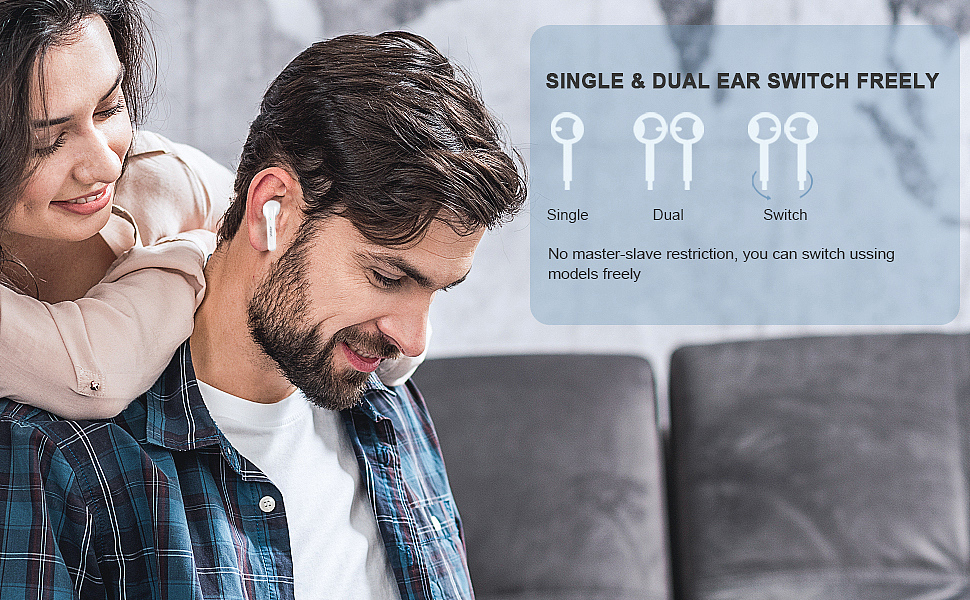
The setup process for any TWS earbud follows the same basic protocol, and the I12 is no exception. Remove both earbuds from the charging case. They power on automatically and enter pairing mode. Open your device's Bluetooth settings and select the earbud from the list of available devices. Wait for the pairing confirmation, typically indicated by a LED color change or an audio prompt. The entire process takes roughly fifteen seconds.
For deep work optimization, the setup goes beyond basic pairing. Equalizer configuration is where the real difference lives. Most smartphones offer system-level EQ adjustment. For focus sessions, the goal is to create a sound profile that masks environmental noise without demanding attention. A bass-heavy profile with reduced mid frequencies works well for this purpose. The boosted low end creates a warm, enveloping sound that fills the acoustic space, while the reduced mids prevent speech-frequency content from breaking through your concentration.
If your phone supports it, switching to a mono audio mode can also help. Stereo imaging requires your brain to process spatial information, which consumes a small amount of cognitive bandwidth. Mono audio collapses the sound field to a single point, reducing the processing load. In a focus context, this slight reduction in cognitive overhead accumulates over hours.
Connection stability during long sessions depends on keeping the source device within line of sight and minimizing interference. Bluetooth operates in the two-point-four gigahertz band, sharing spectrum with Wi-Fi, microwave ovens, and fluorescent lighting ballasts. In an office environment, the densest interference typically comes from the Wi-Fi access point mounted on the ceiling directly above your desk. If you experience dropouts, try repositioning your phone to your desk surface rather than keeping it in a pocket. The human body absorbs approximately three to five decibels of two-point-four-gigahertz signal.
Battery Architecture: Why the Case Matters More Than the Buds
A single TWS earbud contains a battery of thirty to fifty milliampere-hours. That tiny cell, constrained by the four-hundred to six-hundred cubic millimeters of internal space, powers the Bluetooth radio, the DSP chip, and the audio amplifier for three to five hours. The power budget breaks down roughly as follows: radio transmission consumes forty to fifty percent, the amplifier takes thirty to forty percent, DSP processing uses fifteen to twenty percent, and standby accounts for the remaining five percent.
The charging case holds a much larger battery, typically two hundred to five hundred milliampere-hours. It is not merely a portable charger. It is a systems-level design decision that solves three problems simultaneously. First, it frees the earbud itself from carrying enough battery capacity for a full workday, keeping each earbud at approximately four grams. Second, it addresses battery anxiety by providing a visible, tangible reserve that the user can see and count. Third, it extends the practical ownership period by reducing the number of deep charge cycles the tiny earbud battery undergoes. Lithium-polymer cells degrade based on charge cycle count. After approximately three hundred to five hundred full cycles, capacity drops to roughly eighty percent of the original value. By recharging from the case rather than a wall charger, each session uses only a partial cycle.
The total system delivers twenty to thirty hours: roughly five hours from the earbuds themselves, and four to five additional full recharges from the case. This architecture means the case needs charging only once or twice per week for typical daily use.
Why Common Failures Happen and How to Fix Them
Bluetooth pairing failures in budget TWS earbuds fall into three categories. The most common is stale pairing data. If the earbuds were previously paired with a different device, they may attempt to reconnect to that device rather than entering discoverable mode. The fix is to delete the earbud from your device's Bluetooth list, place both earbuds back in the case for ten seconds, then remove them simultaneously to force a fresh pairing cycle.
The second category is interference-related dropouts. In dense office environments with dozens of Bluetooth devices competing for the same frequency band, collisions are inevitable. Bluetooth's adaptive frequency hopping protocol mitigates this by rapidly switching between channels, but it cannot eliminate collisions entirely. If dropouts persist, try switching your phone's Bluetooth to prioritize stable connection over audio quality, an option available in developer settings on most Android devices.
The third category is hardware degradation. The charging contact points on budget earbuds oxidize over time, especially in humid environments. A cotton swab lightly dampened with isopropyl alcohol, applied to the metal contacts on both the earbud and the case, restores conductivity in most cases. This simple maintenance step addresses approximately twenty percent of reported failures.
How a Budget Cost Stack Comes Together
Understanding why a thirteen-dollar product exists at all requires a brief look at supply chain architecture. The total bill-of-materials cost for a budget TWS earbud sits between three dollars and twenty-five cents and five dollars and sixty-five cents. The manufacturer sells it to a brand operator for roughly seven to nine dollars. The brand operator lists it on Amazon for thirteen dollars and ninety-nine cents. Amazon takes approximately three dollars and fifty cents to four dollars and fifty cents in referral and fulfillment fees. The brand retains two to three dollars in profit.
At the component level, the Bluetooth chip accounts for roughly one dollar. The battery cells add another dollar. The driver unit, DSP chip, plastics, assembly, and packaging split the remaining two to three dollars. Annual production volumes exceed one million units for popular models, which means the injection molding tooling cost amortizes to less than five cents per unit.
The manufacturer cuts costs in specific, deliberate ways. The driver uses a coated film rather than a pure material diaphragm. The Bluetooth chip is a generation behind the current standard. There is no ANC module. The charging case uses standard USB rather than wireless charging. None of these decisions are shortcuts. They are rational engineering choices that allocate cost to the features that matter most for the target use case: reliable wireless audio, decent battery life, and acceptable sound quality through DSP compensation.
What Good Engineering Actually Means
The philosopher of engineering Henry Petroski once observed that the most successful designs are not those that add features, but those that remove obstacles. A fifteen-dollar wireless earbud cannot replicate the acoustic fidelity of a three-hundred-dollar headphone. It was never intended to. What it can do, when the engineering is competent, is solve a specific problem: creating enough of an acoustic barrier to allow a knowledge worker to focus for several hours at a time.
The DSP algorithms that make a small driver sound larger, the battery architecture that puts capacity where it fits, the passive isolation that blocks speech frequencies without electronic assistance, these are not compromises. They are solutions shaped by constraints. Every engineer works within constraints. The difference between good and bad engineering is whether the constraints are acknowledged honestly and solved creatively.
The software-driven direction goes further than any single product. Throughout 2026, industry write-ups note the same shift working through professional audio: mastering and mix processing that once required a rack of expensive hardware now runs on a laptop, so professional-quality sound no longer has to be purchased as physical equipment. The DSP tricks inside a fifteen-dollar earbud and that broader software-driven mastering trend are two ends of the same move. One compresses a professional sound into a four-gram device; the other removes the need for a professional studio to get close to it. The hardware still matters, but its role has shrunk. What used to live in a cable and a circuit now lives in a code path, and the distance between the two has been closing for years.
The next time you put on earbuds to concentrate, consider what is actually happening. Software is tricking your cochlea into hearing frequencies that do not physically exist. A lithium-polymer cell smaller than your thumbnail is powering a radio that hops across the spectrum to dodge interference. Two pieces of silicone are blocking sound waves that would otherwise consume your working memory. The engineering is not luxurious. It is efficient. And for the specific problem of thinking clearly in a noisy room, efficient might be exactly enough.