The Physics of Hearing Protection: How NRR 25dB Actually Reduces Workplace Noise

Elgin Ruckus+ Earplug Earbuds
The miter saw bites into oak and the sound hits 110 decibels. Your ears ring. You reach for foam earplugs, compress them, roll them into your canals, and wait for expansion. The scream of the blade drops to a manageable drone. But now you cannot hear your phone, your coworker tapping your shoulder, or the podcast that gets you through a ten-hour shift. You have solved one problem by creating another.
This tension between protection and connection defines modern occupational hearing safety. Workers in factories, on construction sites, and in motorcycle saddles face a daily compromise: block the noise and lose touch with the world, or stay connected and accept gradual damage to their hearing. Understanding how hearing protection actually works -- the physics, the standards, and the limitations -- is the first step toward resolving that compromise intelligently.

The Logarithmic Deception: Why Decibels Defy Intuition
Sound intensity does not add up the way most people assume. A 110 dB table saw is not merely "a bit louder" than a 90 dB lawnmower. The decibel scale is logarithmic, meaning every 10 dB increase represents a tenfold jump in acoustic power. That table saw does not produce 20% more sound energy than the mower. It produces ten times more. At 120 dB, you reach the threshold of pain. At 140 dB -- the peak of a gunshot or a jet engine at close range -- acoustic energy is one hundred times greater than at the 120 dB pain threshold.
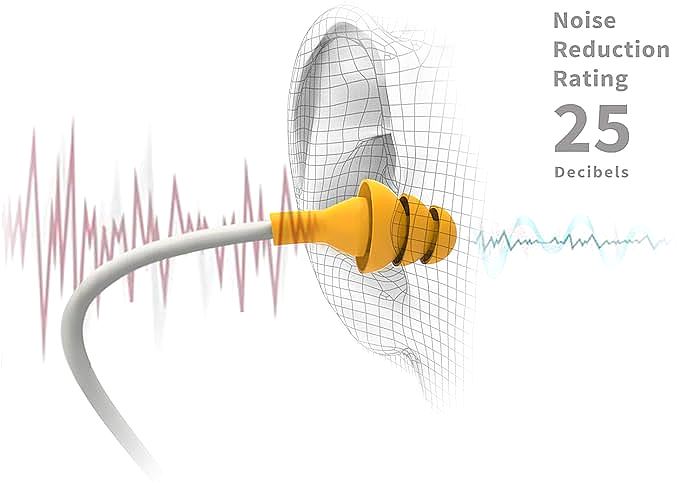
This logarithmic behavior has a direct consequence for hearing protection: even modest-looking reductions in decibels represent enormous decreases in actual sound energy reaching the eardrum. A 10 dB cut eliminates 90% of acoustic power. A 20 dB cut eliminates 99%. And a 25 dB reduction -- the rating found on ANSI-certified earplug earbuds like the Elgin Ruckus+ -- eliminates approximately 99.7% of the sound energy before it reaches the cochlea.
What 25 dB of Attenuation Looks Like in Practice
Consider a CNC machine operator working beside equipment generating 105 dB. Subtract 25 dB through passive isolation and the perceived exposure drops to roughly 80 dB. According to OSHA Standard 1910.95, the permissible exposure limit for an 8-hour workday is 90 dB. At 80 dB, the operator is well within safe limits for an indefinite duration. The same math applies to a woodworker using a circular saw at 100 dB: after 25 dB of reduction, exposure falls to approximately 75 dB, quieter than a vacuum cleaner.
But there is a critical caveat. The NRR number on a package is derived under ideal laboratory conditions using a trained fit protocol. In real-world use, NIOSH recommends applying a derating factor. For formable foam earplugs, NIOSH suggests subtracting 50% of the labeled NRR. For pre-molded or flanged earplugs, the derating is less severe but still significant. A 25 dB NRR might deliver something closer to 17-20 dB of actual attenuation in the field. This is still a substantial reduction -- turning 100 dB into 80-83 dB -- but the gap between laboratory claims and ear-canal reality is something every worker should understand.
Passive Isolation: The Physics of Blocking Sound Without Electronics
There are two fundamentally different approaches to reducing unwanted sound: active noise cancellation and passive noise isolation. They work by entirely different mechanisms and serve different purposes.
Active noise cancellation (ANC) uses microphones to detect incoming sound waves, then generates an inverse waveform through the speaker. When the original wave and the inverse wave meet, they destructively interfere, canceling each other out. This approach excels at low-frequency, consistent sounds -- airplane engine drone, HVAC hum, railway rumble. It struggles with irregular, high-frequency, or impulsive sounds like hammer strikes or the crack of a nail gun.
Passive isolation works by creating a physical barrier between the sound source and the eardrum. No electronics. No phase inversion. Just mass, sealing, and the basic physics of sound wave propagation. When a silicone earplug tip fills the ear canal and creates an airtight seal, sound waves in the air cannot pass through to the tympanic membrane. The energy is reflected and absorbed by the barrier material.
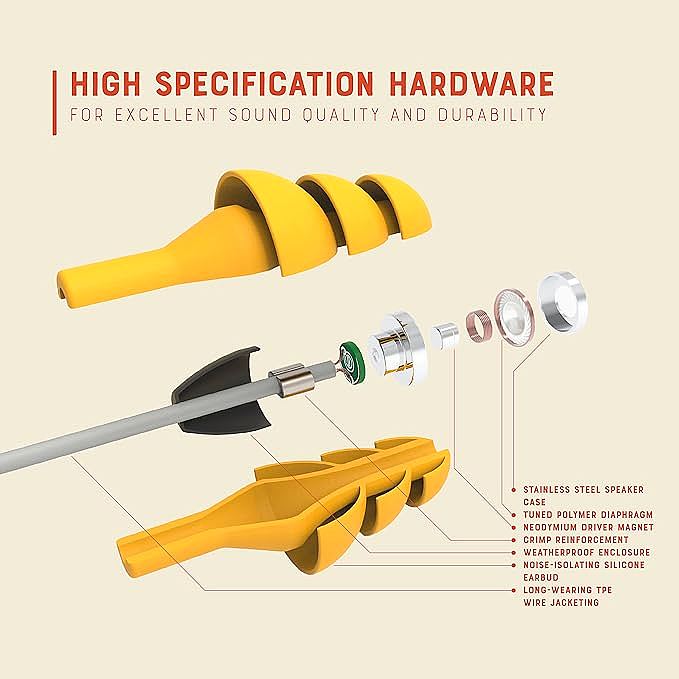
The key variable is the quality of that seal. A perfectly fitted earplug with no gaps can achieve impressive broadband attenuation. Any leak -- even a microscopic channel between the silicone and the ear canal wall -- creates an acoustic shortcut that lets sound bypass the barrier entirely. This is why the material and geometry of earplug tips matter enormously. Medical-grade silicone with a triple-flange design, for instance, conforms to the irregular topography of the ear canal at three distinct points, creating redundant seals. If one seal point leaks, the other two maintain the barrier.
Why Passive Protection Dominates Industrial Settings
OSHA does not recognize active noise cancellation as a substitute for certified hearing protection. The reason is straightforward: ANC depends on battery power, processor function, and microphone accuracy. If any of those systems fail, protection drops to zero without any warning to the wearer. Passive isolation, by contrast, either works or it does not -- and a properly inserted earplug always works. There is no battery to die, no firmware to glitch, no calibration to drift.
This reliability principle extends beyond hearing protection. In safety engineering across domains, passive systems are generally preferred over active ones for life-safety functions. Fire doors do not require electricity to close. Emergency exit signs have battery backup, but the illuminated sign is secondary to the physical door. The same philosophy applies to ear canals: a physical seal is the primary defense, and any electronic feature is a supplement.
The Sealed Ear Canal: Biomechanics of a Proper Fit
The human ear canal is not a uniform cylinder. It is an S-shaped tube approximately 25 millimeters long, with a slight upward curve near the entrance and a narrowing near the tympanic membrane. Its diameter varies between roughly 5 and 10 millimeters along its length, and the shape differs significantly from person to person.
Anthropometric scaling plays a role in earplug design. Engineers use population data to determine the optimal diameter, flare angle, and flange spacing for earplug tips. The goal is to cover the 5th to 95th percentile of ear canal geometries -- approximately 90% of adults without custom molding.
USP Class VI medical-grade silicone is a common choice for extended-wear earplugs. This classification means the material has passed biological reactivity testing and will not cause skin irritation, even after prolonged contact with sweat and body oils.## The Pressure Problem: Comfort Over Long Shifts
The ear canal contains sensitive skin richly supplied with nerve endings. Sustained pressure from a rigid earplug causes ischemia -- restricted blood flow to the tissue -- which manifests as soreness, itching, and eventually inflammation. Triple-flange designs distribute pressure across three contact rings rather than concentrating it at a single point. The silicone material also has a low elastic modulus, meaning it deforms easily under the gentle pressure of the ear canal wall rather than pressing back aggressively.
User feedback consistently identifies comfort as the deciding factor in whether hearing protection gets worn consistently. The NRR rating means nothing if the earplugs end up on a shelf because they hurt after two hours. This is where industrial design and material science intersect with occupational health: the physics of attenuation only matters if the human wearing the device can tolerate it for the duration of their exposure.
OSHA, ANSI, and the Regulatory Framework
In the United States, workplace noise exposure is governed by OSHA Standard 1910.95, which establishes a permissible exposure limit of 90 dB averaged over an 8-hour time-weighted average. The standard also implements an exchange rate of 5 dB: for every 5 dB increase above 90 dB, the allowed exposure time is cut in half. At 100 dB, it drops to 2 hours. At 105 dB, only 1 hour is permitted without hearing protection.
The Noise Reduction Rating itself is an EPA-regulated metric tested under ANSI S3.19-1974 protocol. The testing procedure places earplugs on ten trained human subjects in a laboratory setting, tested at nine frequencies between 125 Hz and 8000 Hz. The NRR is calculated as the mean attenuation minus two standard deviations, ensuring the rating accounts for individual variation in fit technique.
This statistical approach means the NRR represents what approximately 98% of properly trained users can expect to achieve. Everyone gets less protection when fit is imperfect -- which, in a dusty, sweaty, rushed work environment, it often is.## The 3 dB Exchange Rate Controversy
NIOSH, the research arm of U.S. occupational safety, disagrees with OSHA on a fundamental parameter. NIOSH recommends a 3 dB exchange rate rather than 5 dB, aligning with international standards used by the European Union, Canada, and most of the world. Under a 3 dB exchange rate, the allowed exposure time halves for every 3 dB increase -- a much stricter standard. At 100 dB, NIOSH recommends a maximum of 15 minutes of unprotected exposure, while OSHA permits 2 hours.
This discrepancy has real consequences. A worker relying on OSHA limits may believe they are safe when, according to the broader scientific consensus, they are accumulating damaging exposure. Hearing protection rated at NRR 25 dB provides a margin of safety under either standard for most common industrial noise levels, but understanding the difference between the two frameworks helps workers make more informed decisions about their own exposure.
IP65: Engineering Seals for Hostile Environments
Hearing protection that falls apart after a week on a construction site provides no protection at all. Durability in industrial settings is a safety issue, not a convenience feature. The IP rating system, defined by IEC standard 60529, provides a standardized way to describe how well an enclosure resists intrusion from solid objects and liquids.
The first digit, 6, indicates complete protection against dust ingress. This means the enclosure is sealed to the point where no dust particles can enter under test conditions that simulate prolonged exposure to dusty atmospheres. For a woodshop where fine sawdust permeates everything, or a concrete pour where silica dust hangs in the air, this rating ensures the internal electronics and speaker drivers remain functional.
The second digit, 5, indicates protection against low-pressure water jets from any direction. This is not submersion rating -- that would require a 7 or 8. But it covers rain, splashing, and the constant drip of perspiration during physical labor. The distinction matters because water intrusion is the second most common failure mode for personal electronics after cable breakage, and both are addressed by combining IP65 sealing with reinforced cable construction.
Kevlar in a Cable: Materials Science at the Micro Scale
The audio cable is the most mechanically stressed component of any wired earbud. It gets pulled, snagged, twisted, pinched under helmet straps, and yanked from pockets. Standard copper conductors insulated with PVC or TPE fail through metal fatigue -- repeated bending causes microscopic cracks to form at crystal grain boundaries, eventually severing the conductor.
Kevlar, a para-aramid fiber developed by DuPont chemist Stephanie Kwolek in 1965, addresses this failure mode at a fundamental level. Its tensile strength is approximately 3,620 MPa -- roughly five times that of steel on a weight-for-weight basis. When Kevlar strands are woven into the core of an audio cable, they bear the mechanical load while the copper conductors remain relatively unstressed.
This division of labor mirrors reinforced concrete: steel rebar handles tensile loads while concrete handles compressive loads. A Kevlar-reinforced cable follows the same logic -- the composite is more durable than either material could achieve independently.## The Overmolded Jack: Preventing Failure at the Weakest Point
The junction where a cable meets its connector is the single most common failure point on wired earbuds. The thin conductors solder to small terminals inside the plug, and any bending or pulling at this junction stresses those solder joints directly. Overmolding -- injecting multiple layers of polymer around the joint -- creates a graduated transition from flexible cable to rigid plug. The outer layers absorb bending energy before it reaches the solder points.
A triple-molded design takes this further by using three different materials with decreasing stiffness from inside to outside. The innermost layer is a rigid polymer that locks the solder joints in place. The middle layer is a semi-flexible compound that distributes bending forces over a larger area. The outer layer is a durable, grippy material that protects against abrasion and provides strain relief. This graduated approach mirrors the design of multilayer body armor, where different materials handle different types of threats.
The Acoustic Paradox: Silence That Connects
The central engineering challenge of earplug-style earbuds is reconciling two contradictory requirements. The device must block external sound -- that is its safety function. But it must also deliver internal sound -- music, podcasts, phone calls -- through the same sealed chamber.
When the ear canal is sealed by an earplug tip, the small volume of trapped air between the speaker driver and the eardrum acts as a pressure chamber. Speaker driver movement compresses and rarefies this air, and because the volume is small, even modest driver excursion produces significant sound pressure. This is why sealed in-ear designs can achieve impressive volume levels from small, low-power drivers.
The 8mm drivers are engineered for durability and efficiency, not for nuanced frequency reproduction expected from dedicated audio equipment. The sealed, occluded ear canal produces a characteristic bass boost that audiophiles find objectionable -- but for a factory worker listening to podcasts during a shift, this matters little.## Near-Field Voice Capture in a Far-Field Noise Environment
The microphone challenge is the inverse of the speaker challenge. A worker in a 100 dB environment needs to make a phone call. The microphone must isolate their voice from the surrounding cacophony. Noise-canceling microphones address this by exploiting the difference between near-field and far-field sound.
Near-field sound -- the speaker's voice, originating centimeters from the microphone element -- has a pressure gradient that decreases rapidly with distance following the inverse square law. Far-field sound -- the factory machinery, the construction equipment -- arrives at the microphone from multiple directions with relatively uniform intensity. A microphone tuned to prioritize the near-field pressure gradient while rejecting uniform far-field input can extract a voice signal from substantial background noise. This is the same principle used in aviation headsets, where pilots communicate with air traffic control inside cockpit noise levels exceeding 100 dB.
Near-Field Voice Capture in a Far-Field Noise Environment
The microphone challenge is the inverse of the speaker challenge. A worker in a 100 dB environment needs to make a phone call. The microphone must isolate their voice from the surrounding cacophony.
Near-field sound -- the speaker's voice, originating centimeters from the microphone -- has a pressure gradient that decreases rapidly with distance following the inverse square law. A microphone tuned to prioritize near-field pressure gradient while rejecting uniform far-field input can extract a voice signal from substantial background noise. This is the same principle used in aviation headsets, where pilots communicate with air traffic control inside cockpit noise levels exceeding 100 dB.## The Helmet Constraint: A Niche With Distinct Physics
Motorcycle riders face a hearing protection challenge that most other scenarios do not present: the helmet. A full-face helmet creates a partially sealed acoustic chamber around the rider's head. At highway speeds, turbulent air flowing over the helmet surface generates wind noise that can reach 95-100 dB inside the helmet -- enough to cause hearing damage over a long ride.
Earmuff-style hearing protection cannot fit inside a helmet. Most wireless earbuds are too bulky for the tight clearance between ear and helmet liner, and their batteries die on long rides. A low-profile, wired earplug earbud solves both problems simultaneously: the triple-flange tip creates passive isolation inside the ear canal without interfering with the helmet liner, and the wired connection eliminates battery dependency entirely.## When NRR 25 Is Not Enough
Honesty about limitations is as critical as enthusiasm for capabilities. NRR 25 is insufficient for exposure above approximately 115 dB. At that level, even full attenuation brings exposure to 90 dB -- the OSHA limit itself, with no margin. For impulse noise like gunfire, which exceeds 140 dB, NRR 25 earplugs alone do not provide adequate protection. Shooters typically use dual protection -- earplugs plus earmuffs -- achieving combined attenuation of 30-35 dB.## The Unseen Epidemic: Why Hearing Loss Demands Better Engineering
The World Health Organization estimates that 1.1 billion young people worldwide are at risk of hearing loss from unsafe listening practices. NIOSH reports approximately 22 million U.S. workers are exposed to hazardous noise annually. Hearing loss is permanent -- cochlear hair cells do not regenerate in humans. Once damaged, they are gone.
The physics of sound attenuation, the material science of durable construction, and the biomechanics of comfortable fit are not academic exercises. They are the three legs of a stool that, if any one leg is shortened, collapses into preventable harm.
Good hearing protection design is not about achieving perfection in any single dimension. It is about finding the point on the Pareto frontier where small sacrifices in comfort, durability, or attenuation yield the largest improvement in the overall system. A device that blocks 25 dB, survives industrial abuse, and stays comfortable for a full shift is not the result of compromising each goal. It is the result of balancing them at their shared optimum.
Elgin Ruckus+ Earplug Earbuds
Related Essays
Smart PPE: Decoding NRR, OSHA Compliance, and the Physics of Noise Isolation

When Silence Costs More Than Noise: The Engineering Tradeoff Between Hearing...

The Silent Epidemic: How Your Daily Commute Is Quietly...

The Science of Silence: Why Passive Isolation Remains the Gold Standard in a Noise-Polluted World
The Algorithm of Silence: How Active Noise Cancellation Reshapes Our World
The Guardian in the Garden: A Parent's Guide to Kids' Hearing Safety
The Gamer's Guide to Hearing Protection: Why 85dB Is Your Most Important Stat

It's Not the Weight, It's the Balance: The Ergonomics of Power Tools
Shure SE425 PRO Earbuds: Immerse Yourself in Pristine
