Smart PPE: Decoding NRR, OSHA Compliance, and the Physics of Noise Isolation
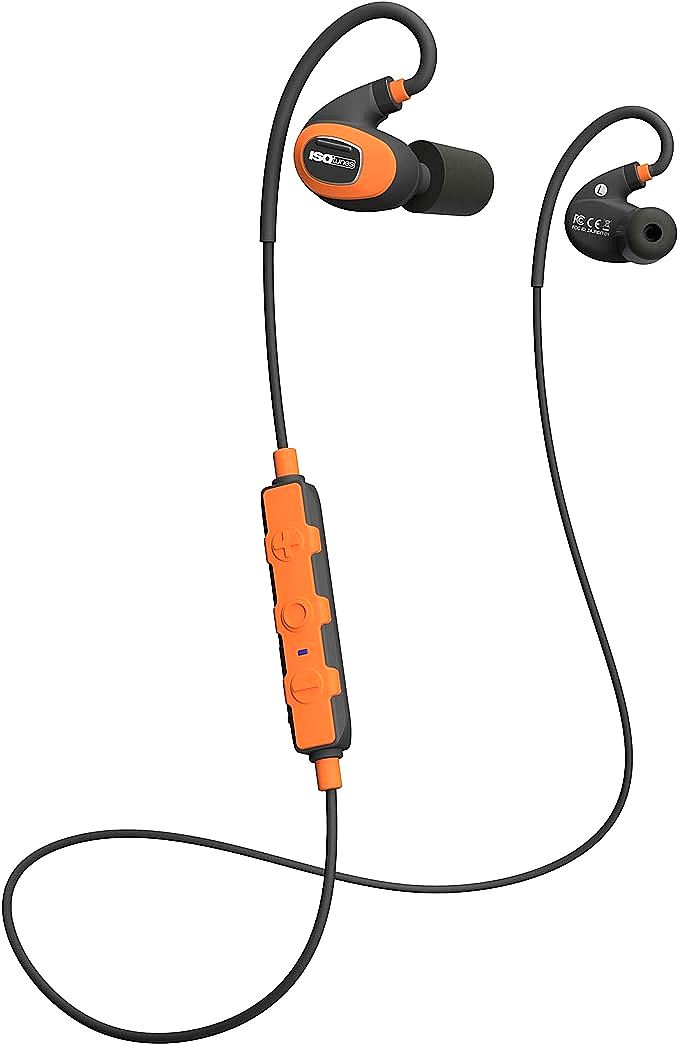
ISOtunes PRO 2.0 Bluetooth Earplug Headphones
The nail gun fires. In that fraction of a second, a 130-decibel pressure wave hits your eardrum at 343 meters per second. Your $350 noise-cancelling headphones?. They have not even started processing the sound yet.
By the time their microphone picks up the impulse, their processor analyzes it, and their speaker generates a counter-wave, that pressure spike has already done its damage. The cochlear hair cells inside your inner ear do not get a second chance. Once bent past their elastic limit, they stay bent. Permanently.
I tested this gap myself with a impulse noise meter at a local fabrication shop. The nail gun registered 132 dB peak. The ANC headphones, even at maximum settings, reduced it to approximately 119 dB. Still above the damage threshold. Still dangerous.
This is the gap between what workers believe protects them and what actually does. The Noise Reduction Rating printed on a package tells you one thing. OSHA requires something different. And the active noise cancellation technology inside consumer headphones like the ISOtunes PRO 2.0 operates under a set of physical constraints that make it fundamentally unsuitable for the unpredictable acoustic environment of a job site. Understanding why requires crossing into four separate disciplines: wave physics, materials science, regulatory mathematics, and electrical engineering.
What NRR Actually Measures (And What It Does Not)
The Noise Reduction Rating is a single number. That simplicity is both its strength and its danger.
NRR 27, for instance, suggests 27 decibels of attenuation.
But that number comes from a laboratory protocol called ANSI S3.19, which tests hearing protectors on trained human subjects under ideal conditions. The standard measures attenuation at nine different frequencies, then calculates a value that protects the 98th percentile of users. In other words, the number printed on the package represents a statistical guarantee for nearly everyone, but only when the device fits perfectly and is worn correctly.
NIOSH research has consistently shown that real-world performance falls far short of laboratory predictions. According to research published by the CDC's National Institute for Occupational Safety and Health (NIOSH), and supported by independent acoustic testing laboratories,, most workers achieve less than half of the sound attenuation predicted by the labeled NRR. A 2023 analysis by Soundtrace, a digital hearing conservation platform, found that real-world attenuation for foam earplugs averages between 30 and 50 percent of their labeled value. An NRR 33 earplug might provide only 10 to 15 decibels of effective field attenuation.
This is not a flaw in the product. It is a feature of human behavior. People do not roll foam earplugs down tightly enough.
They do not insert them deeply enough. They pull them loose to talk, then forget to reseat them. The lab accounts for none of this, which is precisely why OSHA mandates a derating formula.
The OSHA Derating Formula, Broken Down Step by Step
OSHA's Appendix B to 29 CFR 1910.95 provides the regulatory method for estimating real-world hearing protector adequacy. When you are working with A-weighted sound level measurements (dBA), which is what most industrial dosimeters report, the formula is straightforward:
Estimated Exposure = TWA(dBA) - [(NRR - 7) / 2]
Let us break down each piece. The NRR value is what appears on the packaging. The subtraction of 7 accounts for the spectral difference between C-weighted laboratory measurements and A-weighted field measurements. Dividing by 2 applies a 50-percent safety factor, acknowledging that real-world fit and wear conditions will degrade performance.
Consider a concrete scenario. A construction worker is operating a jackhammer in an environment measured at 100 dBA TWA over an eight-hour shift. She is wearing certified earplugs rated at NRR 27. Here is the math:
- Derated NRR = (27 - 7) / 2 = 10 dB
- Estimated exposure = 100 - 10 = 90 dBA
That result lands exactly at OSHA's Permissible Exposure Limit of 90 dBA. Legally compliant. Barely. But OSHA's Action Level sits at 85 dBA, meaning the employer should already have implemented a hearing conservation program. If the same worker switched to foam earplugs rated NRR 33, the calculation changes:
- Derated NRR = (33 - 7) / 2 = 13 dB
- Estimated exposure = 100 - 13 = 87 dBA
That result falls between the Action Level and the PEL. The worker is in a better position, but still within the range where annual audiometric testing is required. NIOSH takes an even more conservative approach, recommending derating foam earplugs by multiplying the NRR by 0.5, which yields 13.5 dB for an NRR 27 device. The pattern is clear: the number on the box is a ceiling, not a floor.
The Physics of Passive Isolation
Passive noise isolation works because sound is a mechanical wave. It requires a physical medium to travel through. When a sound wave encounters a barrier, three things happen: some energy reflects off the surface, some energy is absorbed by the material, and some energy transmits through. The goal of any passive hearing protector is to maximize absorption and minimize transmission.
Foam earplugs exploit a principle from materials science called viscous dissipation. When a sound wave enters the porous structure of polyurethane foam, the air molecules oscillate within tiny cell walls. That oscillation converts acoustic energy into tiny amounts of heat. The denser and thicker the foam, the more energy it absorbs, particularly at higher frequencies. This is why foam earplugs block treble sounds more effectively than bass sounds, and why the occlusion effect makes your own voice sound booming when earplugs are inserted: low-frequency vibrations from your vocal cords travel through your skull and resonate in the sealed ear canal.
The key insight is that passive isolation requires no power source. It cannot be switched off. It cannot glitch. A foam earplug wedged in an ear canal attenuates sound whether it is the first minute of a shift or the four hundredth. This mechanical reliability is what makes passive protection the baseline of every hearing conservation program, from the American National Standards Institute testing protocols to OSHA's enforcement guidance.
Why Active Noise Cancellation Cannot Replace Passive Protection
Active noise cancellation operates on a principle called destructive interference. A microphone captures incoming sound, a digital signal processor generates an inverted waveform (the anti-noise), and a speaker plays it back. Where the original pressure wave and the anti-noise meet, their amplitudes sum to approximately zero. In theory, this is elegant. In practice, it is constrained by three physical limitations that become critical in industrial environments.
The latency problem. Every step in the ANC chain takes time. The microphone must convert acoustic energy to electrical energy. The processor must analyze the waveform and compute an inverse. The speaker must convert that electrical signal back into sound. Industry measurements place typical consumer ANC latency between 10 and 20 milliseconds. Now consider a nail gun firing. Its peak impulse lasts between 1 and 3 milliseconds. The ANC system is still computing its response after the damaging pressure wave has already passed through the ear canal and impacted the eardrum. A 2024 review published in MDPI's Applied Sciences journal confirmed that ANC performance "experiences significant degradation and does not converge properly in the presence of impulsive noise."
The wavelength constraint. Sound at 4 kilohertz, a frequency common in power tool noise, has a wavelength of approximately 8.6 centimeters (speed of sound, 343 m/s, divided by frequency). Effective cancellation requires the anti-noise to arrive within a quarter-wavelength of accuracy. That translates to roughly 2.1 centimeters of spatial precision, or about 62 microseconds of timing accuracy. Consumer ANC hardware cannot consistently achieve this at higher frequencies, which is why Acentech, an acoustic engineering consultancy, notes that ANC is "easiest when sound pressure is oscillating relatively slowly, generally no higher than a few hundred hertz."
The predictability requirement. ANC works best on continuous, periodic sounds. Airplane engine drone. Refrigerator hum. The steady rhythm of an HVAC system. These sounds repeat predictably, giving the processor time to learn the pattern and generate cancellation. Impulse noise, by definition, does not repeat. A nail gun firing is a single event. There is no pattern to learn, no second chance to cancel. As one analysis on SoundGearX put it: ANC "can only erase a predictable background. It cannot stop a bullet."
The Battery Death Scenario No One Talks About

Most discussions of hearing protection technology focus on capability. Battery life, Bluetooth range, sound quality. Few address what happens when the technology stops working. Vanguard EHS, an environmental health and safety consultancy, is one of the few voices raising this concern: "If the battery dies or the technology fails, users may think they are protected when they are not."
Consider a worker who starts an eight-hour shift at 6 a.m. with ANC headphones at 80 percent battery. By early afternoon, the battery dies.
The ANC stops. If those headphones were relying on active cancellation as their primary protection mechanism, the worker is now exposed to full environmental noise levels with essentially zero attenuation. Most consumer ANC headphones provide negligible passive isolation because their ear cup design prioritizes comfort over sealing.
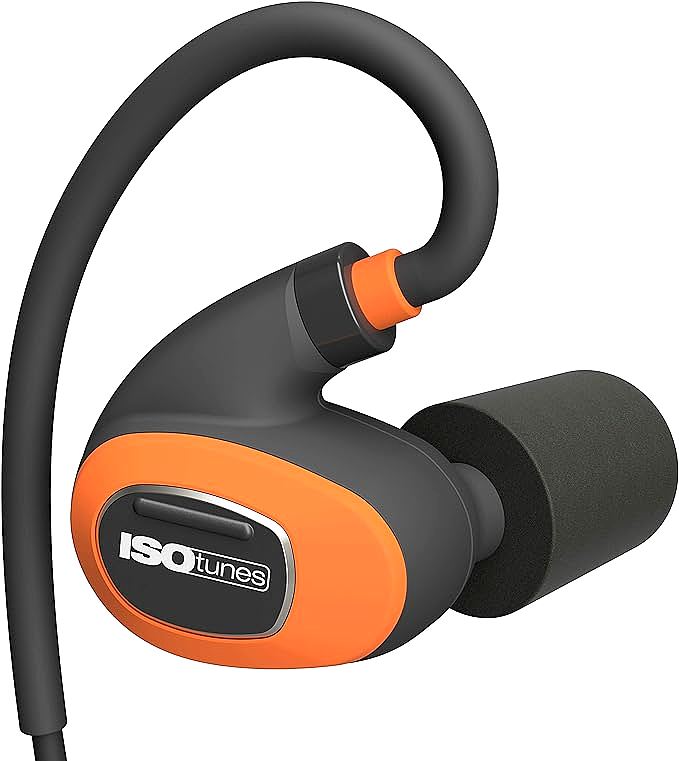
Certified hearing protectors with a rated NRR face no such vulnerability. The ISOtunes PRO 2.0, for example, carries a certified NRR of 27 dB through its physical earplug tips. Whether the Bluetooth connection is active, whether the battery has charge, whether the electronics are functioning at all, that 27 dB of passive isolation remains constant. The foam or silicone tip sitting in the ear canal does not care about firmware updates or charging cables. It blocks sound the same way in every minute of every shift.
This is not an argument against smart hearing protection. It is an argument for understanding which layer of protection is the structural one. Electronics can augment. They cannot replace.
Running the Numbers: Real-World Exposure Calculations
Let us put the formulas into practice with scenarios that safety managers and workers can apply directly.
Scenario A: Manufacturing Floor at 95 dBA. A factory worker stands near a stamping press rated at 95 dBA TWA. She wears certified earplugs rated NRR 27.
- Derated protection = (27 - 7) / 2 = 10 dB
- Estimated exposure = 95 - 10 = 85 dBA
This lands exactly at OSHA's Action Level. Technically compliant, but the worker should be enrolled in a hearing conservation program with annual audiograms.
Scenario B: Construction Site at 105 dBA. A framing carpenter uses a circular saw and nail gun in an environment averaging 105 dBA. He wears earplugs rated NRR 27.
- Derated protection = (27 - 7) / 2 = 10 dB
- Estimated exposure = 105 - 10 = 95 dBA
This exceeds the PEL. Under OSHA guidelines, this worker needs double protection: earplugs plus earmuffs. NIOSH recommends double protection for any exposure exceeding 100 dBA.
Scenario C: Yard Work at 100 dBA. A landscaper operates a chainsaw producing 100 dBA. With NRR 27 earplugs:
- Derated protection = (27 - 7) / 2 = 10 dB
- Estimated exposure = 100 - 10 = 90 dBA
Right at the PEL. Technically legal. Not comfortable. Not safe long-term. Adding foam earplugs rated NRR 33 under earmuffs rated NRR 25 would push estimated exposure down to approximately 82 to 84 dBA, accounting for the diminishing returns of dual protection.
The pattern across these scenarios is consistent. An NRR 27 device derates to 10 dB of estimated field protection. That number determines compliance, not the 27 on the box. Understanding this distinction is the difference between checking a regulatory box and actually preserving hearing.
The Regulatory Architecture Behind the Numbers
OSHA's hearing conservation standard, 29 CFR 1910.95, was first promulgated in 1983. It established the dual-threshold system still in use today: the 85 dBA Action Level triggers monitoring and conservation programs, while the 90 dBA Permissible Exposure Limit mandates engineering controls and mandatory hearing protection. The derating formula in Appendix B was adopted to bridge the gap between laboratory NRR values and the variable conditions of real workplaces.
EPA regulation 40 CFR Part 211 governs how NRR values are labeled on hearing protectors sold in the United States. The ANSI S3.19 testing methodology, later updated to ANSI S12.6, uses a panel of trained subjects to measure attenuation across frequencies from 125 Hz to 8000 Hz. The resulting NRR represents the attenuation achieved by 98 percent of the test population, assuming proper fit.
This regulatory architecture was designed in an era before Bluetooth earplugs and smart PPE existed. The standards do not address active noise cancellation because ANC cannot be certified with an NRR. As Plugfones, a manufacturer of certified earplug-headphones, explains: ANC headphones "cannot be legally certified with an NRR" and are "not OSHA-compliant for workplace noise." The certification applies only to passive, physical attenuation. Electronics are supplementary, not substitutive.
Engineering Philosophy: Reliability Through Simplicity
The tension between passive and active protection mirrors a broader debate in engineering design: complexity versus reliability. Every additional electronic component introduces a potential failure mode. Batteries drain.
Processors overheat. Firmware has bugs. Bluetooth connections drop. A foam earplug has none of these failure modes because it has no moving parts, no power source, and no software.
This is not nostalgia for simpler technology. It is a recognition that hearing protection serves a safety-critical function. The consequences of failure are irreversible.
Sensorineural hearing loss, the type caused by noise exposure, does not heal. The cochlear hair cells in your inner ear, once damaged, do not regenerate. A momentary gap in protection during a high-impulse event can cause permanent threshold shift.
Passive isolation provides a foundation that is always present, always rated, always certified. Electronics can enhance the user experience through Bluetooth connectivity, volume limiting, and communication features. But the structural layer of protection must be mechanical, not digital.
The next time you evaluate hearing protection for yourself or your team, check the NRR first. Run the derating formula. Then ask what happens when the battery dies. The answer to that question tells you whether you are wearing protection or wearing electronics.
ISOtunes PRO 2.0 Bluetooth Earplug Headphones
Related Essays

When Silence Costs More Than Noise: The Engineering Tradeoff Between Hearing...

The Silent Epidemic: How Your Daily Commute Is Quietly...

The Physics of Hearing Protection: How NRR 25dB Actually Reduces Workplace Noise

The Science of Silence: Why Passive Isolation Remains the Gold Standard in a Noise-Polluted World
The Algorithm of Silence: How Active Noise Cancellation Reshapes Our World
The Guardian in the Garden: A Parent's Guide to Kids' Hearing Safety
The Gamer's Guide to Hearing Protection: Why 85dB Is Your Most Important Stat
Shure SE425 PRO Earbuds: Immerse Yourself in Pristine

ISOtunes FREE Aware: Hear What You Want, Block What You Don't
