The Neuroscience of Workout Focus: How Audio Engineering Protects Flow State


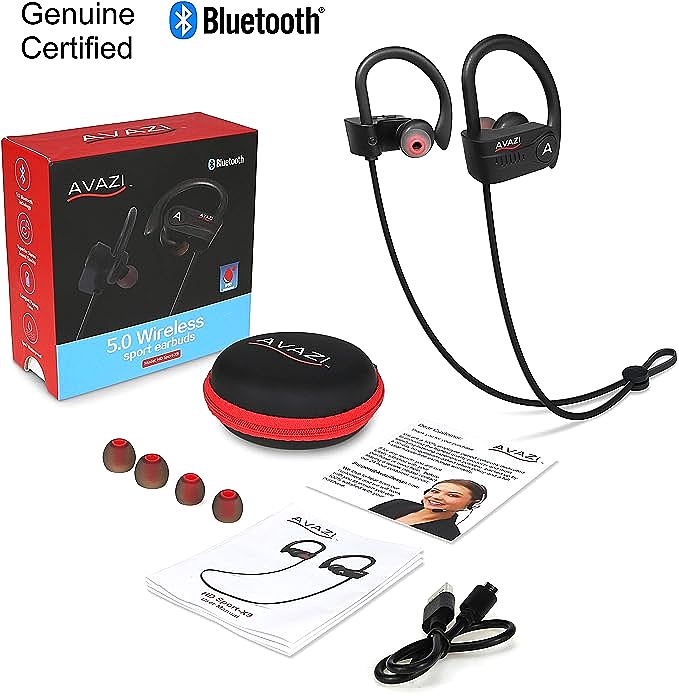
AVAZI HD Sport-X9
There's a moment in every great workout when something shifts. Your breathing finds its rhythm. Your muscles lock into the pattern. The external world fades. For the next forty minutes, nothing exists except the movement and the music driving it forward.
Then an earbud works loose. The spell breaks.
This interruption isn't merely annoying—it's neurologically costly. Research on flow states shows that once you enter that optimal zone of performance, it takes an average of 15-20 minutes to re-enter the same state after an interruption. The engineering challenge behind sports earbuds isn't just about keeping music playing. It's about protecting a fragile neurological state that your brain worked hard to achieve.
The Biomechanics of Distraction Prevention
When an earbud falls out during a workout, the problem isn't user error—it's physics. Understanding the forces at play reveals why some designs succeed while others fail.
During running or high-intensity interval training, your head experiences impact forces up to three times the force of gravity with each footfall. These G-forces transmit through your skeletal structure and act on anything attached to your body. A typical wireless earbud weighs 8-12 grams. Under 3G acceleration, that weight effectively triples to 24-36 grams—enough to overcome the friction holding a smooth plastic surface against moist skin.
Traditional in-ear designs rely on a single anchoring mechanism: the friction fit within the ear canal itself. This creates a precarious situation where one small force vector—turning your head, jumping, looking up—can generate enough torque to break the seal.
Earhook design represents a fundamentally different approach. Instead of fighting physics, it works with your anatomy. The hook leverages the pinna—the cartilaginous outer ear—as a load-bearing anchor point. This transforms the earbud from a cantilevered weight (prone to falling out) into a suspended load (supported by rigid anatomy).
The difference is architectural. Imagine a rock climber leaning against a cliff face versus securing themselves with a well-placed cam in solid rock. One relies on friction alone; the other transforms the body into part of the support structure.
The neurological payoff: When you stop monitoring your earbuds—consciously or subconsciously—your brain frees up cognitive resources for what matters: maintaining proper form, tracking breathing patterns, pushing through that final rep.
The Acoustics of Inner Sanctuary
A commercial gym is a cacophony of competing soundscapes. Iron plates clang at frequencies between 800-2000 Hz. Treadmill motors produce a low-frequency drone around 50-120 Hz. Human voices cut through everything with their distinctive 500-4000 Hz signature. For an athlete attempting to enter a flow state, this sensory assault is a direct threat to performance.
Passive noise isolation operates on elegant physics. The silicone or foam tip forms a mechanical seal within the ear canal, creating a physical barrier that blocks sound transmission. This is acoustic damping in its purest form: sound waves lose energy when passing through dense, flexible materials.
The effectiveness depends on three factors:
Material density determines which frequencies are blocked. High-density memory foam excels at absorbing mid-to-high frequencies (500-8000 Hz)—precisely the range of human speech and equipment noise. Medical-grade silicone offers slightly less isolation but maintains comfort during extended wear, crucial for two-hour training sessions.
Tip geometry affects seal quality. Multi-flange designs (three or more concentric rings) create multiple barrier surfaces, each reflecting and absorbing sound energy. Single-flange tips rely on one sealing surface but often provide more consistent fit across different ear canal shapes.
Insertion depth matters more than most realize. Deeper insertion places the driver closer to the eardrum and creates a longer acoustic path for external sound to traverse. However, deeper insertion also increases pressure sensation and can cause fatigue during extended use.
It's important to distinguish passive isolation from Active Noise Cancellation (ANC). ANC uses microphones and electronic processing to generate "anti-noise" that cancels out low-frequency drones. While effective for airplane engines or HVAC systems, ANC struggles with the irregular, high-frequency noises that dominate gym environments—the sudden crash of a dumbbell, the staccato rhythm of a jump rope, human speech.
For athletic use, passive isolation often provides more relevant protection against the dominant distraction frequencies.
The Material Science of Sweat Resistance
Sweat is an electrolyte solution—water laden with dissolved salts (primarily sodium chloride), trace minerals (potassium, magnesium, calcium), and organic compounds (lactate, urea). From an electronics perspective, it's a corrosive cocktail.
When sweat penetrates an earbud's interior, it creates conductive bridges between components, causing short circuits. As the water evaporates, salt crystals form, physically damaging delicate driver diaphragms and circuit traces. This is why cheap earbuds often die after one rainy run while quality-engineered sports earbuds survive months of daily abuse.
The industry standard for quantifying water resistance is the Ingress Protection (IP) rating system, defined by the International Electrotechnical Commission (IEC) in standard 60529.
IPX7—the rating found on serious sports earbuds—means the device can withstand immersion in up to 1 meter of water for 30 minutes without suffering damage. This isn't marketing hyperbole; it's a tested standard with specific protocols.
The engineering behind IPX7 involves multiple defense layers:
External seals form the first line of defense. Precision-molded gaskets at the earbud shell seams, charging contact ports, and driver housing create continuous barriers. These aren't simple rubber rings—they're engineered compounds that maintain elasticity across temperature ranges from freezing outdoor runs to sauna post-workout sessions.
Internal nano-coatings provide the invisible second layer. Applied through plasma deposition or chemical vapor deposition (CVD), these hydrophobic molecular layers bond directly to circuit boards and components. They exploit the Lotus Effect—a phenomenon observed in nature where microscopic surface structures cause water to bead and roll off rather than spread.
Real-world protection: After an intense 45-minute CrossFit session, an earbud's exterior is saturated with sweat. External seals prevent immediate ingress. Any moisture that penetrates encounters the hydrophobic coating—water beads up, unable to bridge solder joints. Hours later, internal desiccant packs absorb residual humidity, preventing condensation during overnight temperature swings.
The Wireless Stability Equation
You can have perfect fit and complete isolation, but an unstable connection collapses the entire experience. Audio stutters. The link drops mid-set. You're pulled from your zone, forced into the frustrating ritual of re-pairing while your heart rate drops and your momentum dissipates.
Bluetooth 5.1 (the version used in AVAZI HD Sport-X9) serves as the invisible backbone of reliable wireless audio. Released in January 2019 by the Bluetooth Special Interest Group (SIG), this standard introduced several features specifically valuable for athletic use.
Adaptive Frequency Hopping (AFH) has been standard since Bluetooth 1.2, but Bluetooth 5.1 refined the algorithm. AFH monitors the 2.4 GHz spectrum 1,600 times per second, identifying congested channels and avoiding them. In a gym environment, this matters enormously:
Typical commercial gym wireless environment:
- 20-50 active Bluetooth devices
- 5-15 WiFi access points operating on 2.4 GHz
- Microwave ovens generating broad-spectrum interference bursts
- Various wireless peripherals (keyboards, mice, fitness trackers)
AFH continuously maps this RF landscape, routing your audio through clear channels and hopping away from interference before it causes audible disruption.
Enhanced Data Rate (EDR) allows for faster data transmission, which translates to a more stable connection and less likelihood of audio dropouts or stuttering—those annoying little hiccups in your music that can completely disrupt your flow.
Lower power consumption is achieved through optimized connection protocols and more efficient data transfer. The AVAZI HD Sport-X9 boasts up to 12 hours of playback from a 100mAh lithium-polymer battery—though real-world performance varies based on volume levels and usage patterns.
The Latency Paradox: Gaming Meets Athletics
The AVAZI HD Sport-X9 includes a dedicated Gaming Mode, activated by triple-tapping the power button. This mode reduces audio latency to 50ms—a feature that seems oddly specific for a sports-focused product.
But the connection runs deeper than it appears.
Latency, in this context, refers to the delay between when an audio signal is generated and when you actually hear it through your earbuds. Standard Bluetooth headphones typically have a latency of around 200ms or higher. The 50ms latency in Gaming Mode is a significant improvement.
For gamers, lower latency means the gunshot you see on screen synchronizes with the audio you hear—critical for competitive play where reaction time matters.
For athletes, the same principle applies to rhythmic synchronization. Research on music and athletic performance shows that athletes naturally synchronize their movement tempo to musical beats. Runners match their stride cadence to BPM. Cyclists match pedal stroke to rhythm. Weightlifters time their lifts to musical phrases.
When latency is high, this synchronization breaks down. The beat you hear lags behind the movement you're making. The effect is subtle but measurable: performance decreases, perceived exertion increases.
A 50ms latency threshold represents the boundary of human perceptual synchronization—below this threshold, most people cannot consciously detect the delay. This is why gaming mode, ironically, enhances athletic performance: it tightens the audio-motor feedback loop that drives rhythmic movement.
The Battery Longevity Equation
Lithium-polymer batteries power modern wireless earbuds, offering high energy density in flexible, lightweight packages. The AVAZI HD Sport-X9 uses a 100mAh Li-Po cell to deliver up to 12 hours of playback.
But battery chemistry has a hidden variable: charge cycle degradation.
Every rechargeable battery has a finite number of charge cycles before capacity begins to noticeably decline. For Li-Po batteries, this typically ranges from 300-500 full cycles before capacity drops to 80% of original. However, partial cycles (charging from 40% to 80%, for example) cause less stress than full 0%-100% cycles.
Charging practices matter. The manufacturer specifically recommends using a standard 5V/1A charging plug and avoiding fast chargers or car charging. This isn't arbitrary conservatism—it's battery chemistry:
- Fast chargers deliver higher current, which generates more heat during charging. Heat accelerates lithium plating on the anode, permanently reducing capacity.
- Car USB ports often have unstable voltage regulation, especially when the engine is running. Voltage spikes can damage the battery management circuit.
- Computer USB ports provide stable, regulated 5V power—ideal for Li-Po longevity.
The practical takeaway: charging from a computer USB port or a standard 5V/1A wall adapter, rather than a fast charger or car port, extends the functional lifespan of your earbuds' battery.
The Neuroscience of Flow Protection
All these engineering disciplines—biomechanics, acoustics, material science, wireless protocols, battery chemistry—converge on a single neurological outcome: flow state protection.
Psychologist Mihaly Csikszentmihalyi, who pioneered flow research in the 1970s, defined it as optimal experience—complete absorption in an activity where action and awareness merge, self-consciousness dissolves, and performance peaks. Flow requires three core conditions:
Clear goals provide direction. The music itself often serves this function—a driving beat sets cadence targets, a building crescendo signals effort escalation.
Immediate feedback creates the action-awareness loop. You hear every footfall in time with the bass, feel your breath matching the song's rhythm, sense your power output aligned with the music's intensity. Any equipment failure—audio dropout, fit slippage, button malfunction—breaks this feedback loop instantly.
Challenge-skill balance maintains the flow channel. The workout must push your capabilities without overwhelming them. Music modulates this perception—up-tempo tracks make challenging efforts feel more manageable, a phenomenon sports psychologists call "dissociation."
When equipment works reliably, it undergoes a remarkable transformation. It ceases to be an external object you monitor and becomes part of your body's extended system. You don't consciously think about your feet while running—you think about pace, terrain, breathing rhythm. Similarly, trustworthy earbuds become transparent extensions of your will rather than devices requiring management.
This is technology's highest compliment: when it works so well that you stop thinking about it.
The Transparency Achievement
When we examine well-designed sports earbuds, we see a convergence of scientific disciplines, each serving the same neurological end:
Biomechanics provides physical stability through anatomical leverage rather than friction alone. Acoustics carves out a focused auditory space through material density and geometric sealing. Material science builds resilience through multi-layer protection against the corrosive athletic environment. Wireless technology provides an invisible, reliable connection that demands no conscious monitoring. Battery engineering ensures the system remains operational throughout extended use.
The ultimate achievement of all this engineering is profound transparency. Technology doesn't add layers of complexity to your workout; it systematically removes barriers. It becomes an extension of will rather than an object to manage.
In doing so, it allows connection not with a device, but with something more essential: the rhythm of your body, the soul of the music, the pure joy of motion.
The best workout earbuds don't make you think about technology. They make you forget it's there at all—and in that forgetting, you find your flow.
AVAZI HD Sport-X9
Related Essays

bonabest S9 Wireless Earbuds: Seamless Sound & Unmatched Stability

Symphonized PWR Neckband Wireless Headphones - Your Sport and Daily Audio Companion

Jrwaro B25-001 Wireless Earbuds: Immersive Sound & Long-Lasting Battery

AUTREBITS 28CBT Wireless Earbuds: Sound Science for Your Active Life

Occiam K23-2023 Wireless Earbuds: Long-Lasting Battery & Crystal-Clear Calls

lecover C3S Wireless Earbuds: Unleash Your Sound with 150H Playtime and IPX8 Waterproofing
FOYCOY A11 Wireless Earbuds: Dive into a World of Crystal-Clear Sound, Effortlessly

The Engineering of Battery Endurance: Why Some Wireless Earbuds Last Weeks While Others Die in Hours

Why Your Wireless Earbuds Keep Pausing When You Don't Want Them To: The Touch Control Problem Nobody Can Solve